Unit Seven: 40
 Call Kai
 Learn
Learn Practice Test
 Spaced Repetition
 Match
Match Flashcards
 Knowt Play
1/39

There's no tags or description
Looks like no tags are added yet.
Name | Mastery | Learn | Test | Matching | Spaced | Call with Kai |
|---|
No analytics yet
Send a link to your students to track their progress
40 Terms
ALLELES:
Different versions of a gene.
Positioned at the same locus on homologous chromosomes.
Only two alleles per gene.
CRITERIA FOR CHOOSING ORGANISMS TO INVESTIGATE INHERITANCE OF SPECIFIC GENES ALLELES:
Must show discontinuous variation = easy to distinguish characteristic tested.
Must reproduce sexually = can see effect of recombining alleles and get variation in offspring.
Pure breeding (homozygote) = so that genotype of parents is known.
Short life cycle + produces large number of offspring = large, representative sample and enough for stats tests + lots of data in short time.
Convenient to handle = small, cheap to feed and keep.
WHY DO PUNNET SQUARE PROBABILITIES NOT CHANGE?
Random assortment and fertilisation of the same types of alleles each time.
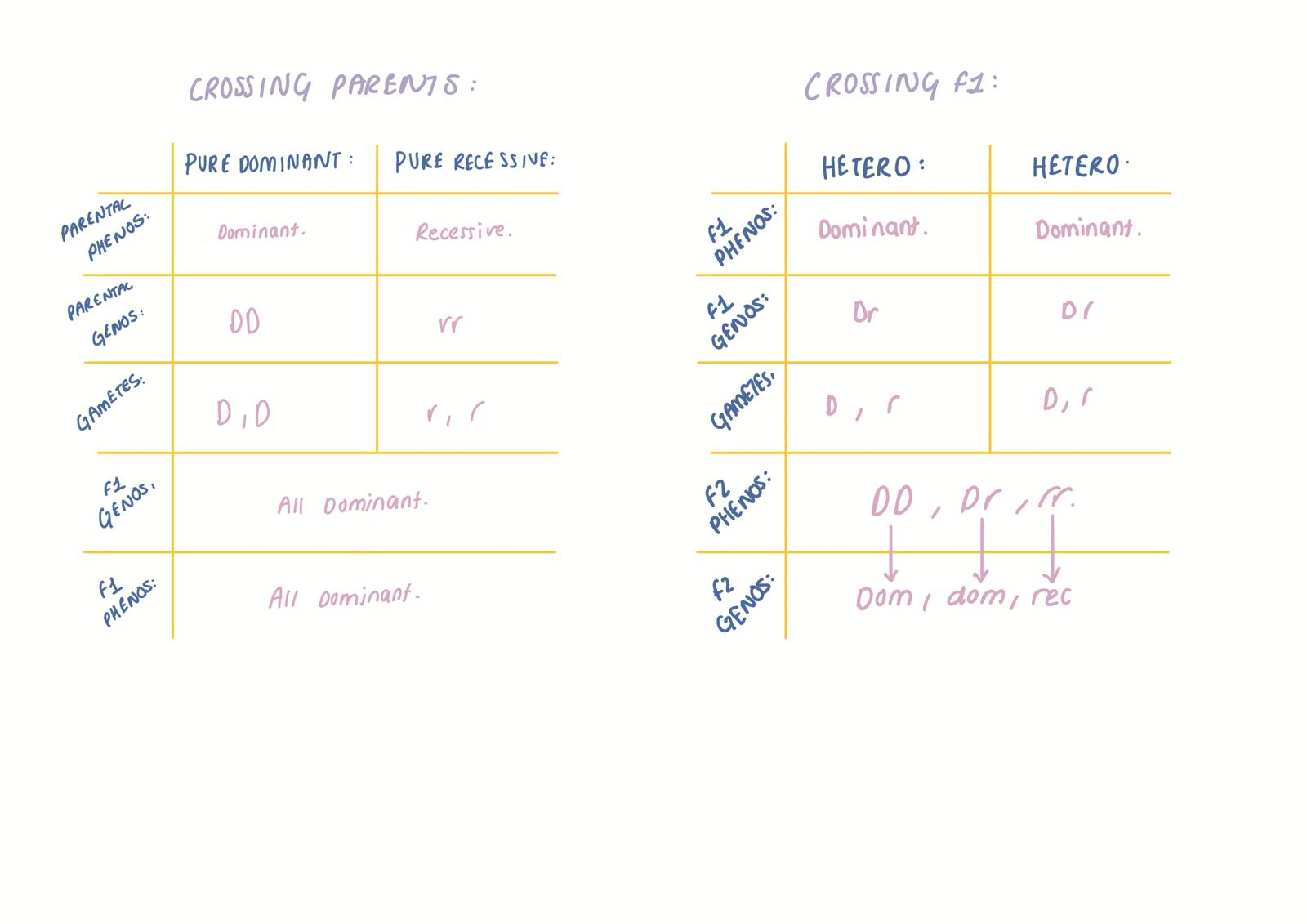
MONOHYBRID CROSS:
Inheritance of one pair of alleles.
F1 (Pure dom x pure rec).
MONOHYBRID CONCLUSION:
Characteristics passed on gen to gen via gametes.
Parents must posses two units of information for each characteristic (alleles).
DRAW A GENERAL PARENT CROSS?
DRAW A GENERAL F1 CROSS?
Must be pure breeding for parents.
WHAT IS A TESTCROSS/BACKCROSS?
Used to determine genotype of an unknown organism.
Cross the unknown with a recessive phenotype (because it will always be homo).
Some homo rec pheno in offspring = heterzygous genotype.
All dom pheno in offspring = homo dom.
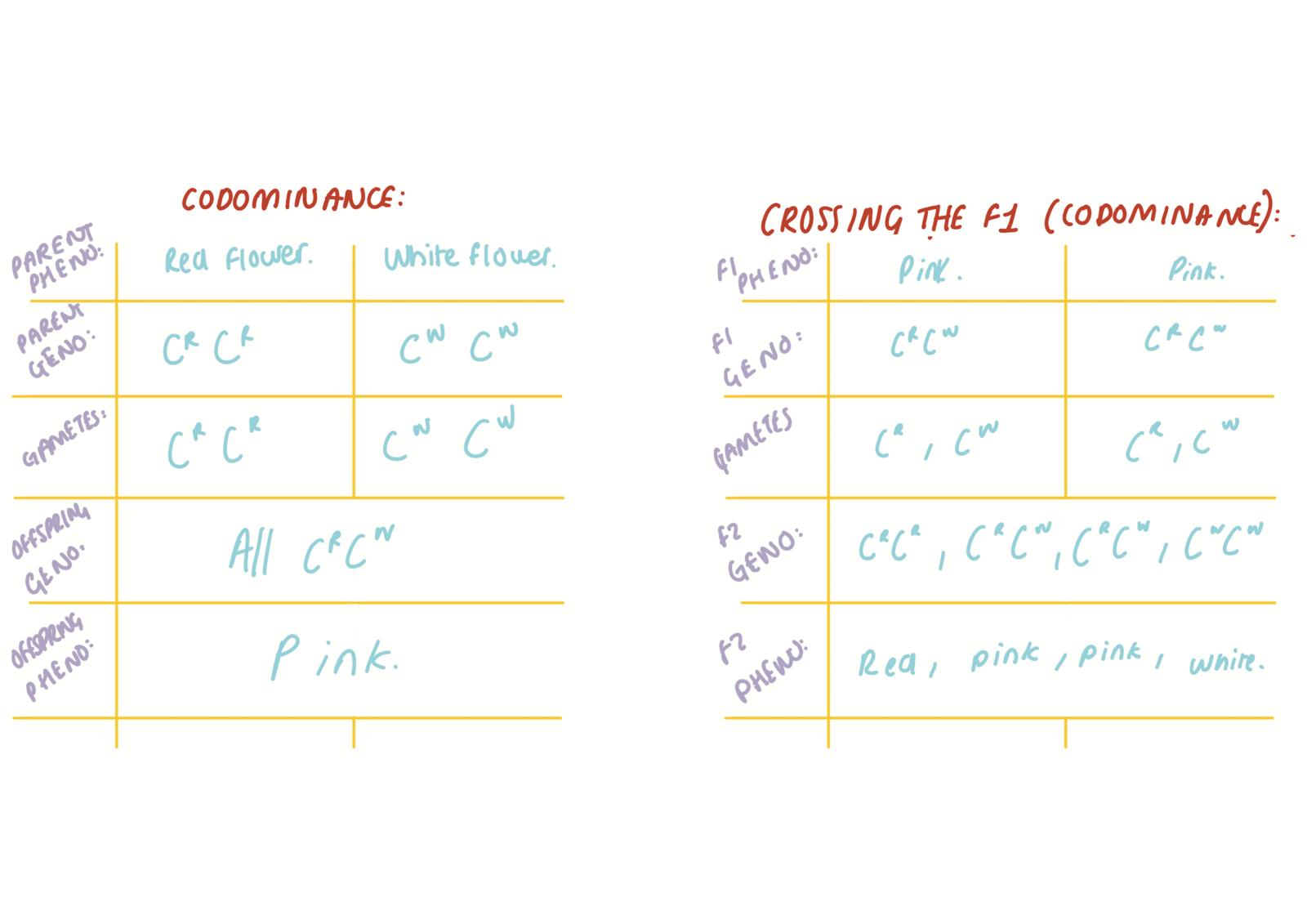
CODOMINANCE:
When a gene has 2 alleles and neither can dominate.
Expressed as a third pheno.
CODOMINANT CROSS WITH RED AND WHITE FLOWERS:
CROSS THE F1 GENERATION AS WELL:
Ratio is 1:2:1.
NAME AND EXPLAIN AN EXAMPLE OF A GENE WITH MULTIPLE ALLELES:
Blood:
A = A antigens, B antibodies, dominant.
B = B antigens, A antibodies, dominant.
O = No antigens, A and B antibodies, recessive.
AB blood = Both antigens, no antibodies, codom.
WHAT IS GENDER DETERMINED BY?
The combination of chromosomes in a zygote (rather than the genes themselves).
22XX (referring to 22 pairs of homologous chromosomes, plus 2X ones).
Ova contains 22 single chromosomes plus 1X.
Sperm contains 22 single chromosomes and 1X/Y.
SEX LINKED GENES AND CHARACTERISTICS:
EVIDENCE FOR NOT ON X CHROMOSOME?
Genes and characteristics that are inherited in different ways in males and females.
Sex-linked diseases caused by recessive alleles on X chromosomes are passed on from carriers.
EVIDENCE NOT: Look for unaffected fathers with affected daughters.
Dominant: all daughters of affected father also affected.
EFFECTS OF SEX LINKED GENES AND CHARACTERISTICS ON MALES:
In males, the two sex chromosomes are non-homologous ::: X and Y differ in size and gene content.
::: Many genes on the X will not have an equivalent allele on the Y.
::: A recessive allele on an X would have a higher chance of being expressed.
Males always inherit their X from mum and pass on the X to daughters.
EVIDENCE FOR AND AGAINST SEX-LINKAGE IN PEDIGREE DIAGRAMS:
Much greater numbers of affected males, and/or no affected females.
Look for when XX with recessive pheno (affected) has son/father with dominant pheno - impossible because if gene is on X, her sons would inherit X with recessive allele from her and be affected/ father with dominant train would pass on X with dom allele to daughter (who would also have dom pheno).
SEX LINKED GENES AND CHARACTERISTICS CROSS:
The female will have a dominant and recessive version.
The male will have neither.
XD Xr y
DIHYBRID INHERITANCE:
Shows how two pairs of unrelated, contrasting characteristics inherited.
Assumed to be on different pairs of chromosomes.
Pure dom breeds crossed.
9:3:3:1.
EPISTATIS:
One gene affects or masks the expression of another.
1:2:3:1.
AUTOSOME:
Non-sex chromosome.
Vary widely in the number of genes they carry.
AUTOSOMAL LINKAGE:
Genes on the same chromosome are said to be linked because they stay together during independent assortment of chromosomes in the first division of meiosis.
::: Their alleles will be passed on to the offspring together ::: fewer types of gametes will form.
Offspring rations closer to monohybrid than dihybrid.
CROSSING OVER:
The closer together the genes on the chromosome, the less likely it is that crossing over will result in these recombinant genotypes.
::: Proportion of recombinants in the offspring can be an indication of the relative positions of the genes on a pair of chromosomes.
A smaller number indicates the genes are closer together.
WHAT IS THE HARDY-WEINBURG PRINCIPLE?
The frequencies of the alleles of a particular gene in a population will stay constant from generation to generation.
If the conditions are met and the allele frequency does not change, then the population is said to be in genetic (HW) equilibrium.
The fact that a population deviates from HWequlibrium shows that species are constantly in a state of evolutionary flux.
And it is possible to see to what extent natural selection and evolutionary changes are taking place by how great these deviations are.
CONDITIONS FOR HARDY WEINBURG?
Large population = Chance events have greater effects on smaller populations.
Random mating = Ensures equal chance of each allele being passed on.
No mutations = It introduces new alleles, changing allele frequencies.
No selection, each genotype must be equally likely to reproduce = Ensures equal chance of each allele being passed on.
No i/emmigration = Adds/removes alleles (known as gene flow).
WHAT IS GENE FLOW?
Adding/removing alleles from a population.
E.g. through i/emmigration.
WHAT DOES SELECTION CHANGE?
WHAT DOES THIS CHANGE CAUSE?
Changes gene pools.
Causing a species to change greatly over time.
SPECIATION:
When an existing species gives rise to two or more new species.
The process whereby one gene pool gives rise to more than one gene pool.
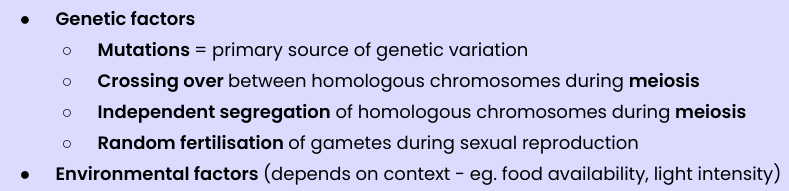
WHY MAY INDIVIDUALS IN A POPULATION OF A SPECIES SHOW A WIDE RANGE OF VARIATION IN PHENOTYPE?
ALLOPATRIC SPECIATION:
Geographical separation.
Reproductive isolation, separating gene pools.
Preventing gene flow.
Random mutations cause genetic variation in each population.
Different selection pressures.
So different advantageous alleles passed on in each population.
Allele frequencies in each population change over many generations.
Eventually, two new species formed that cannot interbreed to produce fertile offspring.
SYMPATRIC SPECIATION:
Mutational isolation.
Reproductive isolation.
Preventing gene flow.
Different selection pressures.
Different advantageous alleles passed on in each population.
Allele frequencies in each population change over many generations.
Eventually, two new species formed that cannot interbreed to produce fertile offspring.
HOW CAN REPRODUCTIVE ISOLATION OCCUR?
Seasonal/Temporal: Two populations reproduce at different times of the year.
Mechanical: Anatomical differences may prevent mating from occurring.
Behavioural: Two populations have different courtship patterns.
Gamete Incompatibility.
GENETIC DRIFT:
Evolution can also occur by genetic drift.
Genetic Drift is when allele frequencies in a population change over generations due to chance.
Bigger effect on smaller populations because the gene pool is small.
This can reduce genetic diversity; some alleles can become fixed and others lost.
May occur due to Founder Effect or genetic bottlenecks.
ABUNDANCE?
The number of individuals of a species in a given area.
ECOSYSTEM:
The environment and all the organisms that live in an area.
Ecosystems are dynamic
NICHE:
How an organism fits into its environment, where it lives and what it does there.
Two species will the same niche will compete.
Governed by adaptations to abiotic and biotic features.
SUCCESSION:
Process of change in the species structure of an ecological community over time.
WHY MAY M-R-C BE UNRELIABLE IN LARGE POPULATIONS?

CARRYING CAPACITY:
The maximum size that a population can remain sustainable in a particular habitat.
Once the carrying capacity is exceeded, the population declines because its environment can no longer support the excess numbers.
PRIMARY SUCCESSION:
Cannabis Helps Old Buddies Sleep. 🍃
Pioneer species colonise.
Pioneer species change abiotic conditions, less hostile.
More suitable for new species, less suitable for old, old outcompteted.
Biodiversity increases.
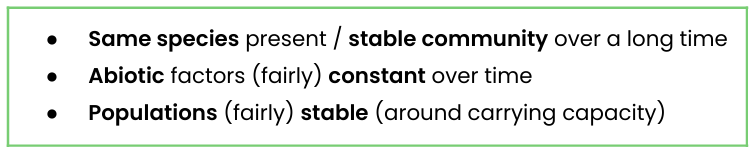
Stable climax community reached.
FEATURES OF A CLIMAX COMMUNITY?
EXPLAIN HOW CONSERVATION OF HABITATS INVOLVES MANAGING SUCCESSION?

DESCRIBE THE CONFLICT BETWEEN HUMAN NEEDS AND CONSERVATION AS WELL AS THE IMPORTANCE OF MANAGING THIS?
