BPrac D - Types of experiments
 Call Kai
 Learn
Learn Practice Test
 Spaced Repetition
 Match
Match Flashcards
 Knowt Play
1/8

There's no tags or description
Looks like no tags are added yet.
Name | Mastery | Learn | Test | Matching | Spaced | Call with Kai |
|---|
No analytics yet
Send a link to your students to track their progress
9 Terms
Describe serial dilution test, describe: Perform a serial dilution by a factor of 10 to prepare about 5 cm^3 of 5 concentrations of glucose
Eg. Perform a serial dilution by a factor of 10 to prepare about 5 cm^3 of 5 concentrations of glucose
Factor of 10 : conc of glucose used for dilution divided by 10 (so you start with 10% , then you continue by using 1% solution to prepare next solution)
Limitation : One solution wrong , everything wrong sigh
Draw serial dilution table
Conc of glucose to be obtained / % | Conc of glucose used for dilution / % | Volume of original stock glucose solution used / cm^3 | Volume of distilled water used / cm^3 |
1 X 10^-1 | 1 | 1 | 9 |
1 | 10 | 1 | 9 |
10 | 10 | 10 | 0 |
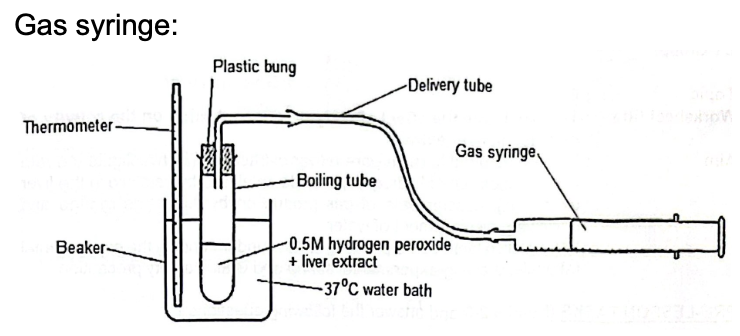
Draw gas syringe
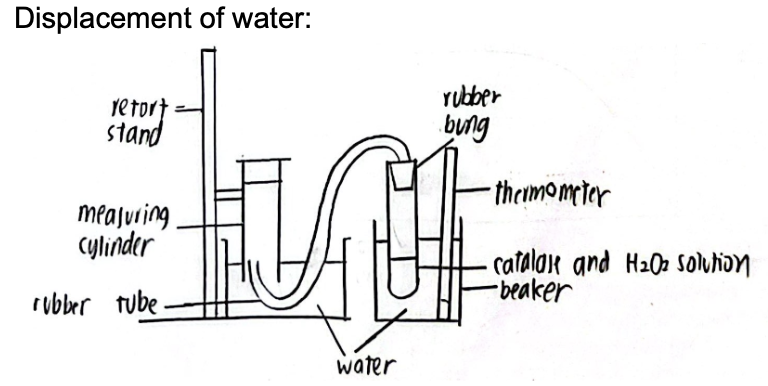
Draw displacement of water
Describe t test
Determine whether there is significant difference between the means of 2 groups
Data are continuous

Comment and EXPLAIN on what these results show.
Stomatal density of sun leaves greater than shade leaves and difference is significant
Difference in mean will occur by chance in less than 0.05
Light is limiting factor in shade
CO2 concentration is limiting factor in sun and not limiting
Higher stomatal density gives a higher rate of uptake of CO2 allowing sun leaves to make use of more available light for photosynthesis
Describe procedure to study transformation
Using:
+pGLO and -pGLO
plasmid DNA
sterile water
nutrient broth
+ goes on LB/amp and LB/amp/ara plate
- goes on LB and LB/amp plate
Label 2 tubes +pGLO plasmid and -pGLO.
Transfer 250l of transformation solution to each tube.
Place tubes in ice and ensure they are fully immersed.
Remove a colony of bacteria from the E. coli master plate with an inoculation loop and transfer the colony to the +pGLO tube.
Twirl the loop between the index finger and the thumb to dislodge the bacteria into the tube.
Using a new inoculation loop, repeat steps 4-5 for the -pGLO tube.
Transfer 8l of plasmid DNA to the +pGLO tube.
Transfer 8l of sterile water to -pGLO plasmid tube.
Control tube to show that without the plasmid -> bacteria cannot be transformed
Mix the contents in the tubes by gently tapping the tubes a few times.
Leave the tubes in ice for 10 minutes.
Heat shock the bacterial cells by transferring the tubes into 42C water bath for exactly 50 seconds. Do not shake the tubes.
Place tubes back into ice for 2 minutes.
Add 250l of LB nutrient broth to each tube and incubate the tubes for 10 minutes at room temperature.
Tap tubes gently to mix contents
Transfer 100l of solution from the +pGLO tube to a LB/amp plate and a LB/amp/ara plate.
Transfer 100l of solution from the -pGLO tube to a LB plate and a LB/amp plate.
Spread the solution over the entire surface of the agar plates using a sterile L-shaped spreader.
Use a clean spreader for each plate.
Seal the plates with parafilm.
Describe what you would observe on the LB and LB/amp plates for the -pGLO tube.
Bacterial lawn on the LB plate but no bacterial colonies on the LB/amp plate
Bacteria in the –pGLO tube have not taken up the plasmid -> do not possess the ampicillin resistance gene -> unable to survive in the presence of ampicillin
Identify the plate(s) acting as control(s) and explain the purpose(s) of the plate(s).
-pGLO LB plate – shows that the bacteria are viable and are able to grow under normal conditions
-pGLO LB/amp plate – shows that non-transformed bacteria are unable to grow in the presence of ampicillin
+pGLO/LB/amp plate – shows that transformed bacteria are able to grow in the presence of ampicillin, but require arabinose as an inducer to express GFP