VTPP 435 - Final Exam
 Call Kai
 Learn
Learn Practice Test
 Spaced Repetition
 Match
Match Flashcards
 Knowt Play
1/41

There's no tags or description
Looks like no tags are added yet.
Name | Mastery | Learn | Test | Matching | Spaced | Call with Kai |
|---|
No analytics yet
Send a link to your students to track their progress
42 Terms
Understand Energy Balance and basics of basal metabolic rate.
Discuss factors of how food intake is controlled, including the role of the arcuate nucleus of the hypothalamus, ghrelin, PYY, leptin, insulin, and cholecystokinin.
Discuss some of the causes of obesity.
what factors influnce basal metabolic rate
thyroid hormone and epinephrine
what is the majority of food energy converted into in the body?
heat
what is the primary regulatory center of food intake?
hypothalamus
what is the arcuate nucleus?
central role in long-term control of energy balance and body weight and short-term control of food intake from meal to meal
what is the main role of NPY for food intake
appetite stimulator
what is the main role of melancortins for food intake
tone down appetite
what is the imput for the NTS
• higher hypothalamic neurons
• digestive tract (Distension, CCK)
Diagram the thermal balance for the body, including heat production (metabolism, exercise, shivering) and heat loss (convection, conduction, radiation, and evaporation).
Identify those mechanisms that shift from heat production to heat loss when environmental temperature exceeds body core temperature.
Diagram the negative feedback control of body core temperature, including the role of the hypothalamic set point.
Contrast the stability of body core with that of skin temperature, including the control and mechanisms of cutaneous blood flow and sweating on skin temperature.
Identify mechanisms for maintaining thermal balance in the following environments: desert (120°F), snow skiing (10°F), falling through ice into a lake (water temp 37°F), and snorkeling in 80°F water.
Apply surface area to volume ratio to thermoregulation.
Understand the function and purpose of brown adipose tissue
what is thermoregulation?
being able to maintain an internal core temp even when the surrounding temp is diffrent
what is the thermostat of the body?
hypothalamus
what receptor is stress sweat
alpha 1
what receptor causes constant tone/ vasoconstriction
Alpha 1
Summarize the functions of the kidneys.
Describe blood flow through the kidney, including the names of key structures from the renal artery to the renal vein, including the glomerular blood vessels, peritubular capillaries, and the vasa recta.
Describe the differences between cortical and juxtamedullary nephrons.
Name the major components of a nephron and identify them on diagram.
Define and describe the 3 major processes that occur in the nephron.
Define and describe excretion.
Describe renal handling of substances with the following properties.
Include how much of the substance will appear in the urine.
Filtration only
Filtration and partial reabsorption
Filtration and complete reabsorption
Filtration and secretion
what are the three main functions of the kidneys
Regulatory (water balance, elecrolyte balance, acid-base balance), Endocrine ( Erythropietin, RAAS, Vit D), and Excretory (waste elimination)
what is the smallest functional unit of the kidney?
the nephron
where does the kidneys get blood from?
the abdominal aorta, 20-22% of output
what is special about the renal blood supply?
portal system (2x capillaries)
what are the vascular components?
Afferent arteriole
Glomerulus (1st Cap, job is filtration)
Efferent arteriole
Peritubular capillaries (cartical)
Vasa recta (jux nefron)
Venule
what are the tubular components?
Tubular components
Bowman's capsule
Proximal tubule (the heavy lifter)
Loop of Henle (active and passive reabsorption)
Descending limb
Ascending limb
Thick and thin portions
Distal tubule/Collecting ducts (This is where we have regulation)
what is glomerular filtration?
nondisciminant filtration of a protien free plasma from the glomerulus into bowman’s capsule
what is tubular reabsorption?
selective movement of filtered substances from the tubular lumen into the peritubular capillaries
what is tubular secretion
selective movement of nonfiltered substances from the peritubular capillaries into the tubular lumen
how much plasma gets filtered per minute
20% so 125mL per min, 180 L per day
how much do we excrete from the kidneys?
1 mL per min, 1.5 L/day
Name the major components of the filtration barrier and the properties of each.
How do these properties affect filtration?
Define glomerular filtration rate (GFR).
Given the capillary and Bowman's capsule hydrostatic and oncotic pressures, calculate the net filtration force at the glomerular capillaries.
Predict the changes in glomerular filtration caused by increases or decreases in any of those pressures.
Compare the composition of filtrate in Bowman's capsule to plasma.
Describe the factors that affect glomerular filtration rate.
Predict the change to GFR with an increase or decrease in any of these factors.
Explain the effect on GFR when afferent or efferent arteriolar resistance is increased.
filtration of blood in the nephron…
is based on size and charge
what part of the nephron is the fenestrated endothelium?
the glomerulus (very very peramble)
what do cells in the fenestrated endothelium have
the glycocalyx
what is the basement membrane compsed of fro the gloerular filtration barrier?
acellular glycoprotiens
where are the podcytes with filtration slits located?
bowman’s capsule
what is the glomerular Filtration Rate dependent on?
Filtration Pressures and Filterability
what are the glomerular filtration pressures?
Glomerular Capillary Blood Pressure (55 mm Hg) - Favors
Plasma-colloid osmotic pressure (30 mm Hg) - opposes
Bowman's capsule hydrostatic pressure (15 mm Hg) - opposes
Net filtration pressure = 55 - 30 - 15 = 10 mm Hg - favors
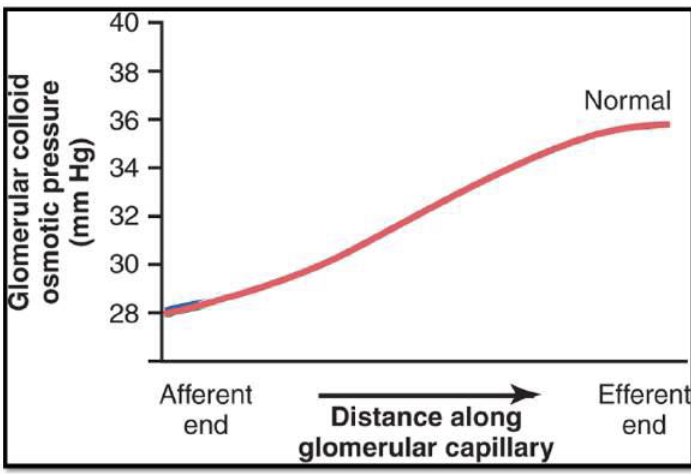
Why does colloid oncotic pressure increase from the afferent end to the efferent end?
you’re losing water
Describe the steps in the Renin-Angiotensin-Aldosterone System (RAAS). Include descriptions of stimuli that trigger the system, the active components of the system, and the end results from activating this system.
Explain what leads to the release of ANP/BNP, their mechanisms of action and the net result.
Explain tubular (transport) maximum and renal threshold and filtered load.
Describe how glucose is handled in the kidney.
Discuss the role of the kidney in regulating blood glucose.
Define osmosis and explain how water reabsorption in the kidney occurs.
Characterize urea handling in the kidney.
what is the majority of the energy used by the kidneys used for?
Na+/K+ ATP on the basolateral membrane
where do we reabsorb the majority of sodium?
the proximal tubule
where ca we regulate sodium reabsoption
the distal and collecting tubules
what would trigger activation of RAAS
a decrease in BP
what is the starting renal threshold
300 mg/100ml
what is the GFR constant?
125 ml/min
what are the reabsopton formulas
Filtered Load – Reabsorbed = Excreted
([plasma]*GFR) – Reabsorbed = Excreted