METHODS IN CONTEXT - SOCIOLOGY
 Call Kai
 Learn
Learn Practice Test
 Spaced Repetition
 Match
Match Flashcards
 Knowt Play
1/21

There's no tags or description
Looks like no tags are added yet.
Name | Mastery | Learn | Test | Matching | Spaced | Call with Kai |
|---|
No analytics yet
Send a link to your students to track their progress
22 Terms
What are the 5 main groups and settings in education?
Pupils
Teachers
Parents
Classrooms
Schools
What are the 3 major differences between studying young people and studying adults?
power and status
ability and understanding
vulnerability
What is the difference between adults and children in terms of "ability and understanding"?
Failing to understamd the research
- may reduce the validity of the research
What is the difference between adults and children's in terms of "vulnerability"?
Eg. If a student has admitted to self harm, the researcher has a duty of care to report this back to the school
Do children/young people tend to have more or less power than adults?
Less
Why does adults having more power make it difficult for younger people?
They may find it difficult to share/express their attitudes - especially if they challenge the adult
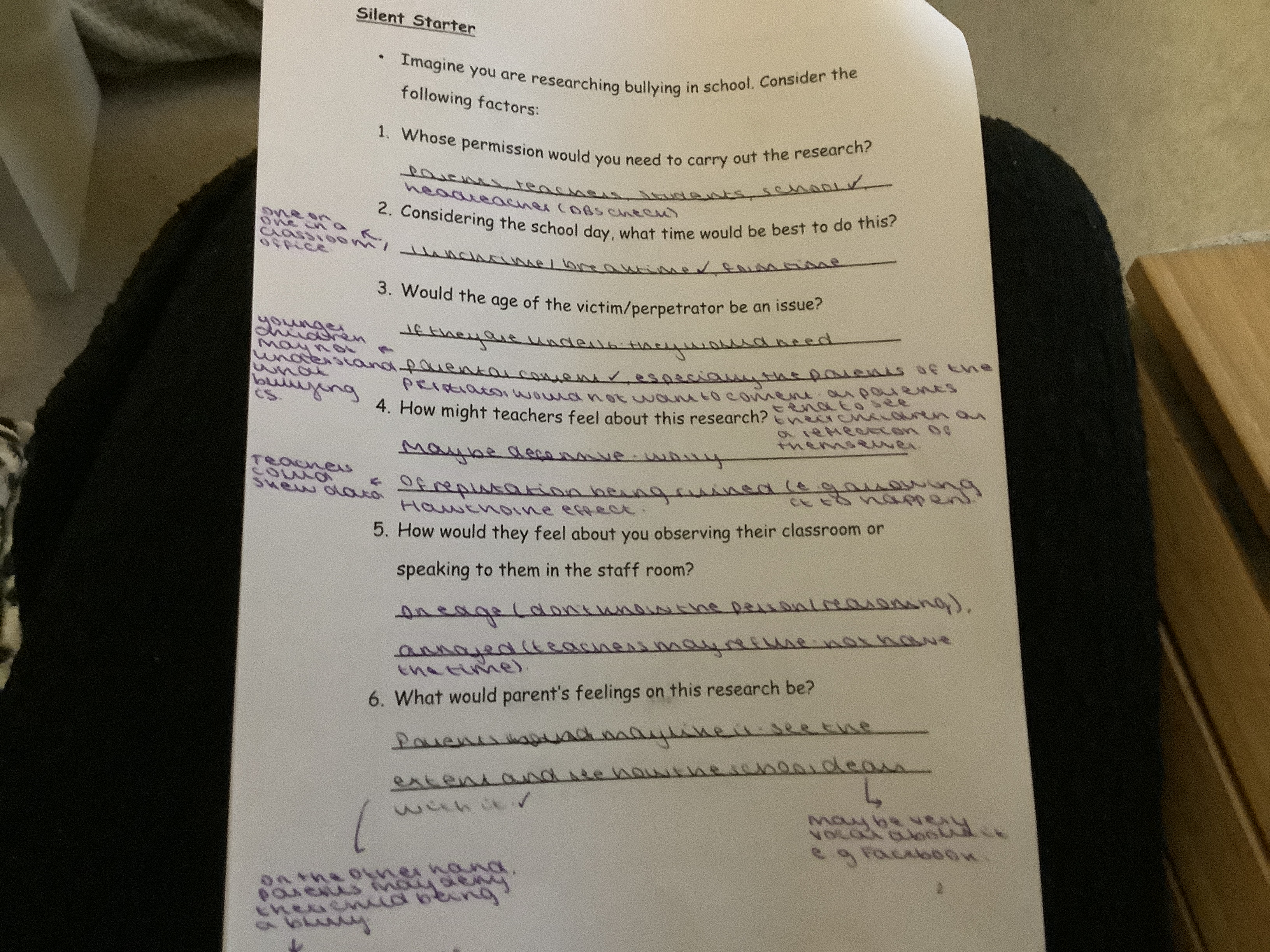
What type of research could you use to research bullying in schools?
unstructured interviews
covert observation
Why do teachers want to influence the views of students in a piece of research?
Make them (and the school) look better, not damage the reputation, don't want to get painted out in a bad light, teachers may want to protect their job
How could this influence the outcomes of the research? (Teachers influencing answers)
Alter data, may make students speak/behave differently, this reduces the validity of the research, don't have the full picture, effects the reliability
How could a researcher tailor their research to small children?
Use pictoral form, make them draw it out, use simple vocab, shorter research (so the child doesn't get stressed), rest breaks, place (familiarity), have toys/colouring, use analogies (so they understand)
Give an example of an analogy where children will understand in terms of bullying?
A group of animals, them leaving one animal out
What does CAGE mean?
Class, age, gender, ethnicity
AO3: Are there any other factors that a researcher needs to consider when researching students? THINK CAGE (in terms of bullying)
More simple lanaguge with younger students, having a female/male interviewer based on group, cultural capital (better understanding of bullying), may be bullied by a male so want a female interviewer, anti school subcultures - younger people may be more understanding
Give an example of considering ethnicities? CAGE
A white researcher wanting to study a group of black students - the students may feel the researcher will never understand their experiences
Are children or adults at more or less risk of being vulnerable?
Children
Give an example of preventing harm to a participant in terms of bullying?
if someone who was less effected may be more open to talking about their experiences
BUT
if someone is experiencing bullying now, they may feel top vulnerable to open up about it
What must young people know/be informed about the research?
must be fully informed about
the nature of the research
informed consent
when/where the research will be published
Why is preventing physical and psychological harm to a child more difficult than an adult?
It can be more difficult to explain to a small child
When researching young people there are many "gatekeepers" who are these?
Parents, teachers, participants, siblings, religious leaders, headteachers, local councils, school boards/governors/trustees
What does "gatekeepers" mean?
People who hold/alter research and information
Give an exmaple of "gatekeepers" in terms of parents? Linking to bullying
A parent may not want to accept or admit their child is bullying another child
as children are a reflection of their parents