C4.1 Populations and Communities
 Call Kai
 Learn
Learn Practice Test
 Spaced Repetition
 Match
Match Flashcards
 Knowt Play
1/48

There's no tags or description
Looks like no tags are added yet.
Name | Mastery | Learn | Test | Matching | Spaced | Call with Kai |
|---|
No analytics yet
Send a link to your students to track their progress
49 Terms
different poopulation
cannot interbreed and produce fertile offspring
What gives rise to different populations?
allopatric speciation
sympatric speciation
allopatric speciation
-eproductive isolation - physical barrier
sympatric speciation
no physical barrier
but
temporal
behavioral
geographical - colony - already have female no need to go to other species colony
Non disjunction
Reproductive isolation
occurs when there is a barrier which prevents individuals from reproducing.
reasoning for sympatric speciation (non disjunction)
Non disjunction in plants - polyploidy (many sets of chromosomes) - allsman
Even same area - ourselves having mutations while making gamete - causing reproductive isolation
Sessile population
Any species that don’t move a lot
How to sample sessile population
Using quadrant sampling- square
Random sampling - equal chance to be chosen from the native environment to eliminate human bias, increasing validity - no human decision
Transect - place at least 10 quadrant horizontally as line - ensure reliability
Reliability
Able to replicate
Consistency
Validity
Accuracy
statistical test cannot
Prove
Shows probability instead
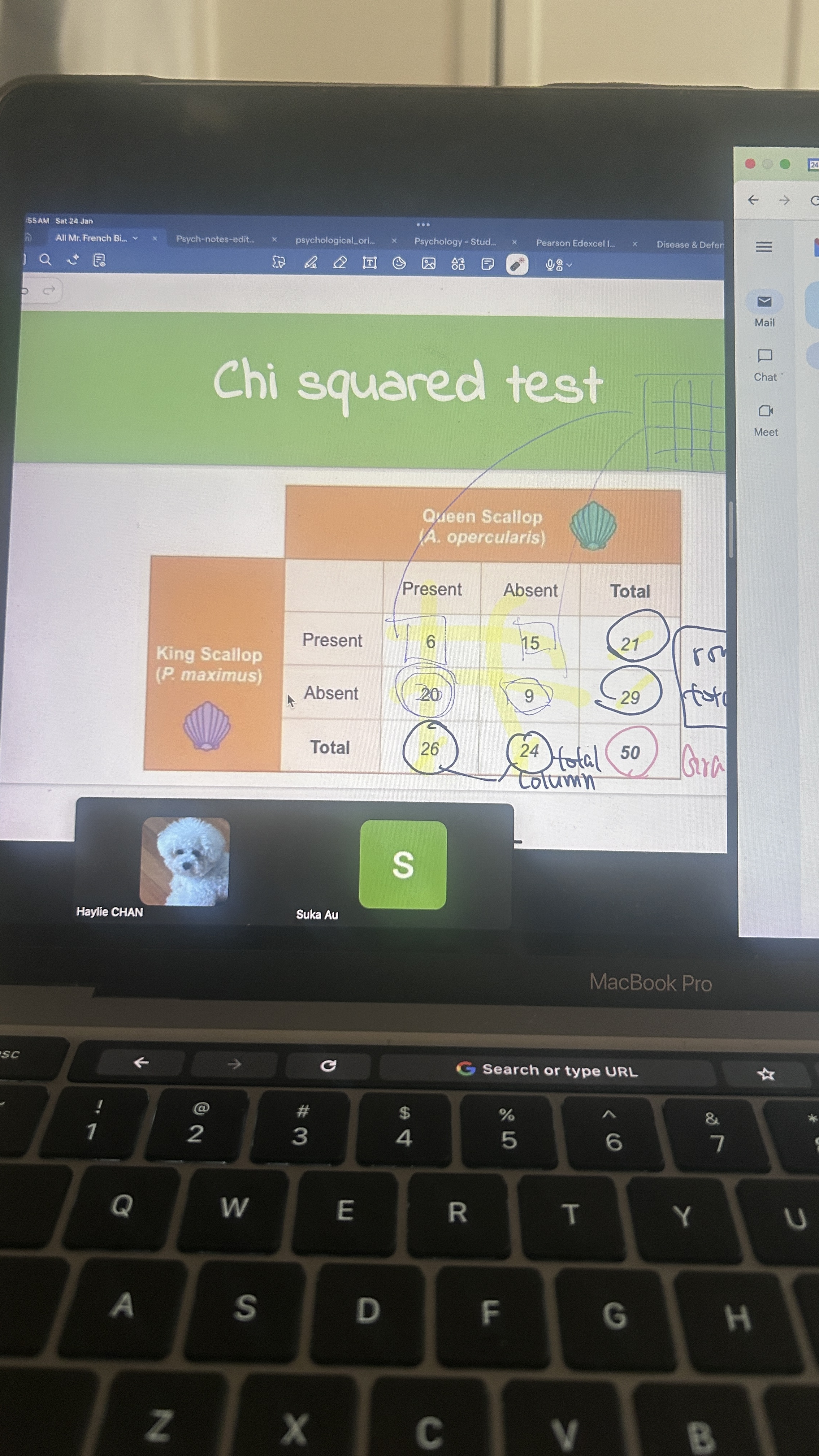
Chi square test process
Hypothesis H0: no relationship H1: correlation (positive negative )
place quadrant using random sampling
Make a table (present absent)
calculate expected frequency (row total x column total/ grand total)
Apply to chi square formula (x2=
find critical value
Find degree of freedom (r total -1) (c total-1)
P value use 0.05
Table of chi square
sampling motile populations
lincoln index
capture-mark-release-recapture
Mx(N/R)
M = Number of individuals initially caught and marked.
N = Number of individuals recaptured
R = Number of marked individuals recaptured
limitations of lincoln index
assume no immigration no emigration.
marks might be lost/fade/be overlooked.
marking may alter behavior
unequal Catchability
small sample size
not suiyable for plants or sessile organisms
how to improve reliability for lincoln index
increase sample size
increase trials
how to improve validity/accuracy for lincoln index
change method - another marking method
change different months to conduct
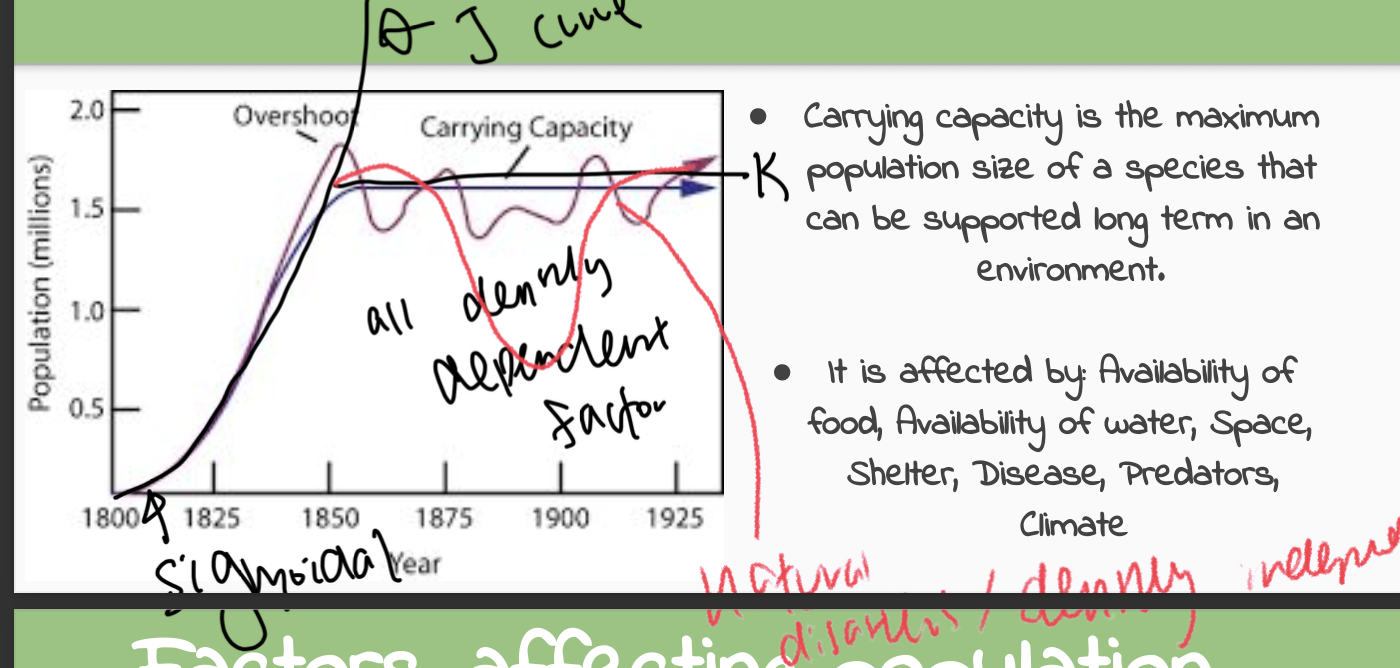
carrying capacity
maximum population size of a species that can be suported long term in an environment
carrying capacity is affected by what factors
availability of food water
space
shelter
disease
predators
climate
carrying capacity graph
factors affecting population growth (2 main catagories)
Density-dependent factors, are any force that affects the size of a population of living things in response to the density of the population.
● Density-independent factor, in ecology, any force that affects the size of a population of living things regardless of the density of the
population.
density dependent factors
panda
predators
resources
nutreint supply
disease
accumulation of waste
density independent factors
paw
phenomena (natural disasters)
abiotic factors eg temperature
weather conditions eg storm
predator prey has a what correlation
4 factors affect the size of population
Natality (N) is the birth rate for a population
Mortality (M) is the death rate for a population Immigration (I) is new individuals entering a population
○ Emigration (E) is individuals leaving a population ● Change in population size = (N + I) - (M + E)
change in population size equation
(N + I) - (M + E)
4 phases in population growth model
lag phase
expotential growth phase
transitional phase
plateau phase
difference between exponential growth and transitional phase
exponential: natality + immigration a lot more than mortality and emigration
transitional: lesser
intrapecific competition
between same species
bc all have same ecological niches
why intraspecific competition increase
density dependent factors
benefits of intraspecific cooperation
group hunting
defense against predators
parenting
interspecific interactions
between different species
herbivory
predation
interspecific competition
mutualism
parasitism
pathogenicity
mutualism explain
type of symbiosis
both benefit
eg bees and plants
cooperation example 1 (mutualism)
Mycorrhizae are formed by a symbiotic relationship between roots of a plant and a fungus.
● Orchids are a family of plants that grow in mineral-poor soil.
The fungi greatly enhance the orchids’ ability to acquire nutrients by increasing surface area for absorption of water and minerals.
The fungus gains as it receives carbohydrates and protection from the plant.
cooperation example 2 (mutualism)
Zooxanthellae algae have a mutualistic relationship with coral polyps.
● The photosynthetic zooxanthellae algae produce nutrients such as glucose used
by the corals, as well as removing wastes and producing oxygen.
● The coral polyps provide protection for the zooxanthellae, as well as providing them with carbon dioxide for photosynthesis.
cooperation example 3 (mutualism)
cooperation example 4 (parasitism)
Parasitism is a form of symbiosis where one species benefits, but
the other species is harmed. Ticks are parasites of many animals such as dogs.
The tick benefits from feeding on the dog’s blood, the dog loses blood, and suffers skin
irritation.
pathogenicity example
occurs when an organism infects another species,
causing a disease.
The disease malaria in humans is caused by the malarial parasite entering the human bloodstream.
invasive species definition
organisms that have been introduced to an
ecosystem, and do not occur there naturally.
cause harm to natural ecosystem
invasive spacies often replace
endemic species (native) by competitive exlcusion
allien species may become an invasive species if
have a better chance of survival than the native species due to:
○ The absence of predators in the new habitat
○ The absence of diseases in the new habitat.
○ Faster rate of reproduction ○ Larger size/ more aggressive
Outcompeting for food and other resources
2 ways to eliminate invasive species
top down
bottom up
invasive species example
Red squirrels are an endemic species in the UK, and grey
●
Grey squirrels are immune to the
●
squirrels are an invasive species. Grey squirrels are outcompeting red squirrels for the following
reasons:
○ Grey squirrels are larger and
stronger.
○ Grey squirrels reproduce
faster.
top down control
Top down factors are pressures applied by a higher trophic level to control the population dynamics of the ecosystem
The top predator either suppresses the abundance of its prey or alters its behaviour to limit its rate of population growth
Top down control results in an oscillating trophic cascade (suppression at one level increases numbers at the next level)
bottom up control
Bottom up factors are pressures that limit the availability of resources to lower trophic levels (e.g. producers)
A lack of resources at lower trophic levels suppresses the abundance of organisms at higher trophic levels i.e. the suppression of the 'bottom’
restricts energy supply to the ‘top'
Human activity can often limit resource availability and hence inadvertently exert bottom up pressure on an ecosystem
con of these two methods (bottom up top down)
affects other species
imbalance of ecosystem
allopathy definition
release of chemicals by one organism which influences the germination, growth, survival or reproduction of another organism.
example of allopathy (black walnut)
Black walnut trees produce and release an allelopathic chemical
called juglone. Juglone inhibits the growth of other plants.
allopathy (penicillim)
The Penicillium fungus secretes the antibiotic chemical penicillin.
● Penicillin inhibits the growth of bacteria near the fungus, reducing
competition for resources.
Penicillin is used as a medicine to inhibit bacterial growth.