ch 2.3 - following Copernicus
 Call Kai
 Learn
Learn Practice Test
 Spaced Repetition
 Match
Match Flashcards
 Knowt Play
1/73

There's no tags or description
Looks like no tags are added yet.
Name | Mastery | Learn | Test | Matching | Spaced | Call with Kai | Chat |
|---|
No analytics yet
Send a link to your students to track their progress
74 Terms
what was Tycho Brahe known for?
accurate and comprehensive astronomical observations
precise systematic measurements of the movements of planets and stars
late 1500s
what did Tycho Brahe observe in 1572?
a “new star” in the constellation Cassiopeia we now know was a supernova!
what did Tycho Brache study?
parallax
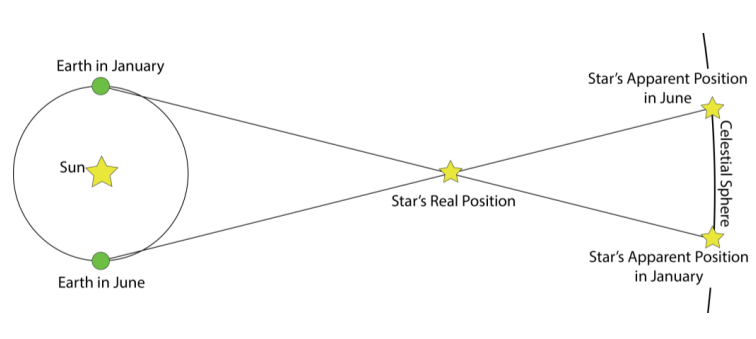
what is parallax?
the apparent shift in an objects’ position due to a change in the observer’s viewpoint
how can you visualize parallax?
by holding your finger out in front of you then closing one eye and then the other. your finger appears to jump side to side against the background
the shift you observe in the apparent placement of your finger is parallax
what does it mean when the closer an object is to the observer?
the larger the parallax
what is parallax crucial for?
measuring distances to nearby stars
how do astronomers observe a star?
from different points in Earth’s orbit (e.g., 6 months apart) and measure the tiny shift in its position against distant stars
trigonometry is then used to calculate its distance
this methods calculates the distance to nearby stars very accurately
relationship between a star’s distance and its parallax angle?
d = 1/p
distance d is measured in parsecs and the parallax angle p is measured in arcseconds
1 arcsecond (1”) = 1/3600° 1 parsec = 3.3 light years = 9.461 x 10¹² km (9.461 trillion km)
what is distance measured in?
parsecs
what is parallax angle p measure in?
arcseconds
how did Tycho Brache attempt to use parallax?
to measure the distances to comets and the 1572 supernova (bright explosion marking the end of a stars life)
what did Tycho Brahe conclude due to the absence of parallax?
correctly conclude that they are far beyond the moon
lack of shift concluded it is far away
Why couldn’t Tycho Brahe detect stellar parallax?
stars are so far away that stellar parallax is too small to observe with the naked eye
How did the lack of stellar parallax affect Tycho Brahe’s view of the universe?
It led him to reject Copernican heliocentrism and propose his own hybrid (geoheliocentric) model.
describe Brahe’s modified Copernican system
Earth is stationary and at the center of the universe
planets revolve around the sun
the moon and sun revolved around the stationary Earth
complex system (goes against Ockham’s Razor)
who was Kepler and what was he known for?
Mathematician assistant to Brahe (used Tycho’s notes after he dies)
Key figure in the 17th century scientific revolution
best known for his laws of planetary motion
~1600
What did Johannes Kepler observe about planetary speed in orbit?
observations led him to hypothesize that the planets move faster in their orbits when closer to the sun than when further away
What major idea did Johannes Kepler reject from Nicolaus Copernicus?
that the planets move in circular and uniform motion (constant speed)
What is Kepler’s First Law of Planetary Motion?
each planets orbit around the sun is elliptical, with the sun at one of the two foci
ellipse = flatten circle
Orbits are ellipses with the Sun at one focus
Planets sweep out equal areas in equal time
what does an eccentricity of 0 mean?
corresponds to no flattening — a perfect circle
what does an eccentricity of 1 mean?
that the circle is squished down all the way to a straight line
What is the shape of planetary orbits?
ellipses
Where is the Sun located in an elliptical orbit?
At one focus (not the center).
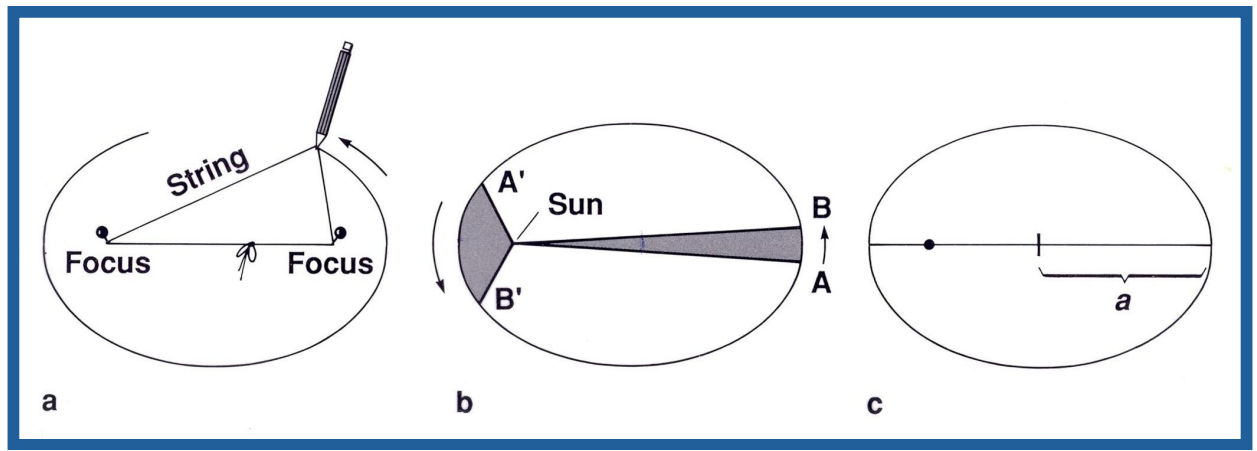
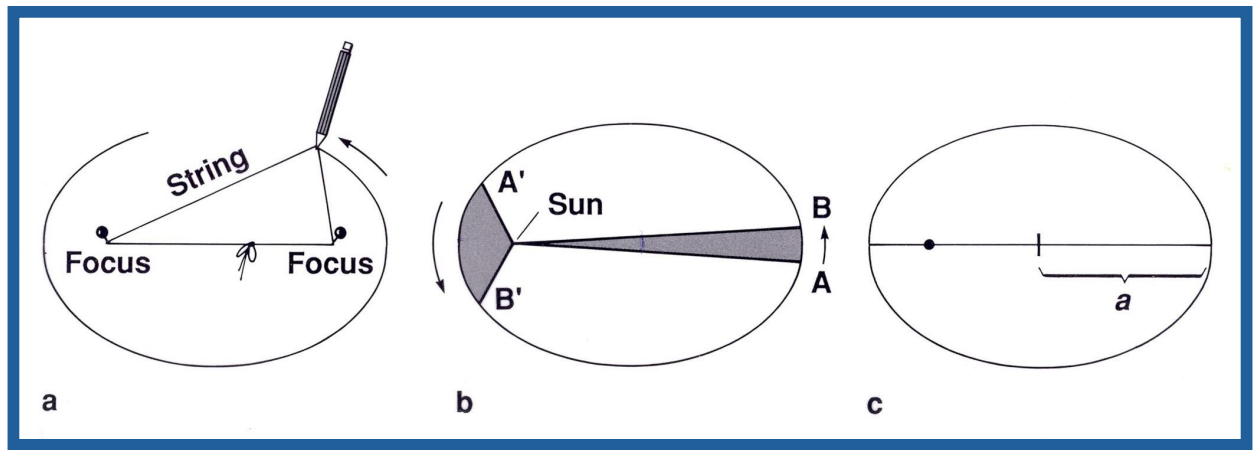
What is the semimajor axis (a)?
Half the longest diameter of an ellipse (defines orbit size).
the size of the orbit is defined by this value.
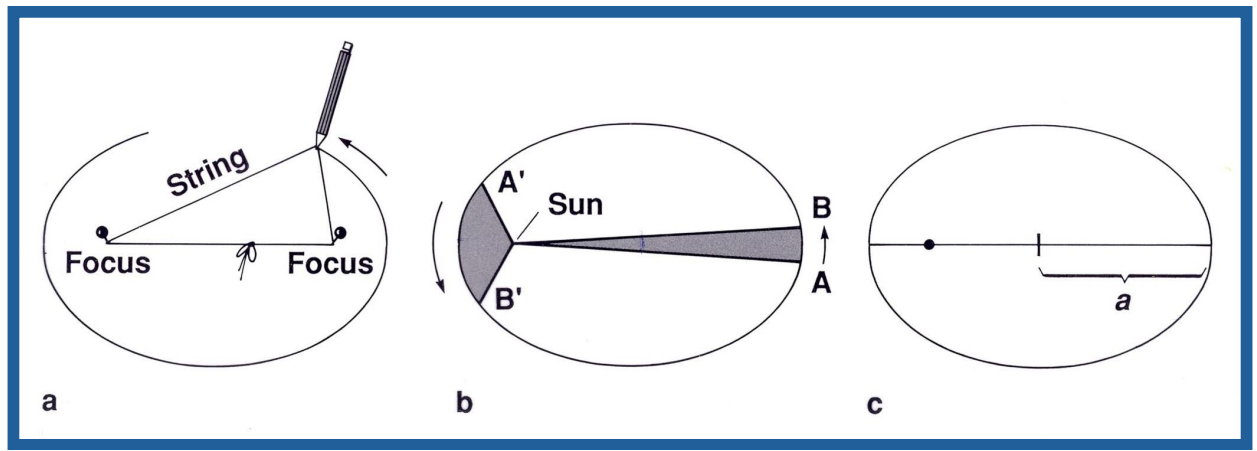
You have two points called foci (plural of focus).
If you loop a string around both foci and pull it tight with a pencil, then trace it…
→ you draw an ellipse.every point on the ellipse has the same total distance to both foci
The shaded wedge shows:
A planet moving from A → B
Sweeping out an area
Big Idea
Orbits are ellipses, not circles
The Sun is at one focus
Planets move faster when closer, slower when farther
The orbit size is described by the semimajor axis (a)
Kepler’s second law of planetary motion
Law of Equal Area
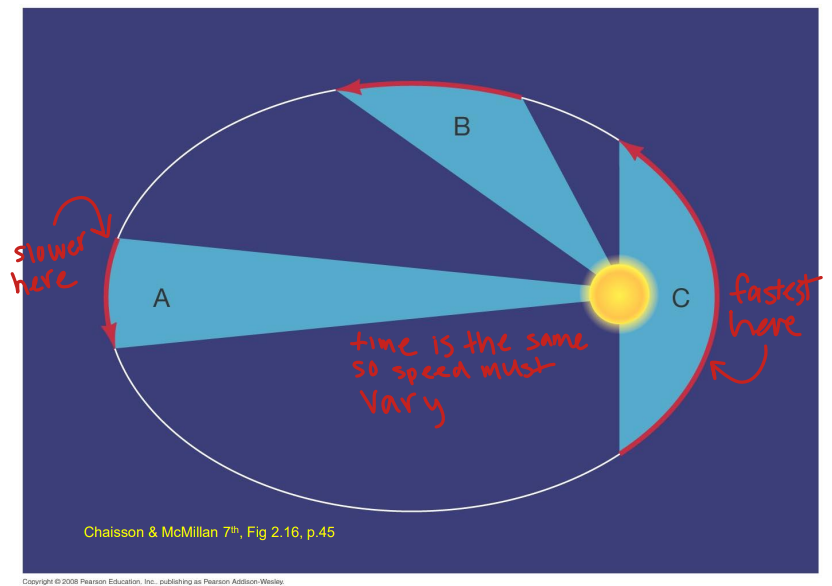
what does Kepler’s second law mean?
each planet orbits the sun so that a line connecting it to the sun sweeps over equal areas in equal time intervals
planets will move faster closer to the sun at perihelion and slower further away at aphelion
perhelion
closest to the sun; faster
aphelion
furthest from the sun; slower
Kepler’s third law of planetary motion
orbital period of planet (in years) is proportional to its distance from the sun in astronomical units (A.U.)
p2=d3
where p = period in years and d = distance in A.U.
the planets “year” P increase more rapidly than does the size of orbit
planets thar are farther from the sun…
take significantly longer to orbit
takes Saturn 30 years to orbit the sun
what has Galileo (1564-1642) been called the father of?
observation astronomy
modern physics
scientific method
modern science
what was Galileo’s discoveries using a telescope?
phases of Venus
What did Galileo Galilei discover orbiting Jupiter? (using a telescope)
Four largests moons orbiting Jupiter: Io, Europa, Ganymede, and Callisto. (referred to as the Galilean Moons)
Why was Galileo Galilei’s discovery of Jupiter’s moons important?
It showed a “miniature Copernican (heliocentric) system,” proving not everything orbits Earth.
What did Galileo Galilei do between January 7 and March 2, 1610?
He made 64 observations/sketches of the positions of Jupiter’s moons.
What are the four largest moons of Jupiter called?
The Galilean moons: Io, Europa, Ganymede, and Callisto.
What did Galileo Galilei observe about planets using a telescope?
Planets appear as circular discs: Earth-like, not points of light.
Why was Galileo Galilei’s observation of planets as discs important?
It showed that planets are Earth-like objects, not distant stars.
What did Galileo Galilei discover about the Moon’s surface using a telescope?
The Moon is not smooth; it has mountains and craters.
What did Galileo Galilei conclude about the Moon compared to earlier beliefs?
The Moon is not a perfect smooth sphere; it is similar to Earth with a rough surface
What did Galileo Galilei do with his observations of the Moon’s surface?
He studied lunar phases and created topographical charts estimating mountain heights.
What did Galileo Galilei observe on the Sun?
Sunspots on the surface of the Sun.
What did sunspots reveal about the Sun’s motion?
The Sun rotates on its axis.
Why were sunspots important in Galileo Galilei’s discoveries?
They showed the Sun is not perfect and has rotational motion.
What is Galileo’s idea of inertia in motion?
An object in motion tends to stay in motion unless acted on by an external force.
How did Galileo Galilei’s ideas contribute to physics?
They helped connect physics and astronomy and led to the development of the law of inertia.
What later law is based on Galileo’s ideas about motion?
Newton's First Law of Motion
who was Newton?
English physicist and mathematician who was culminating figure of scientific revolution of the 17th century
late 1600s
what was Newtons first Law of motion?
body remains in a state of rest or uniform motion unless acted upon by a net external force
force is not needed to keep an object moving but to change course of direction
an object will move forever in a straight line unless some external force (push or pull) changes its speed or direction of motion
the greater the mass the more inertia it has, the greater the force needed to change its state of motion
law of interia

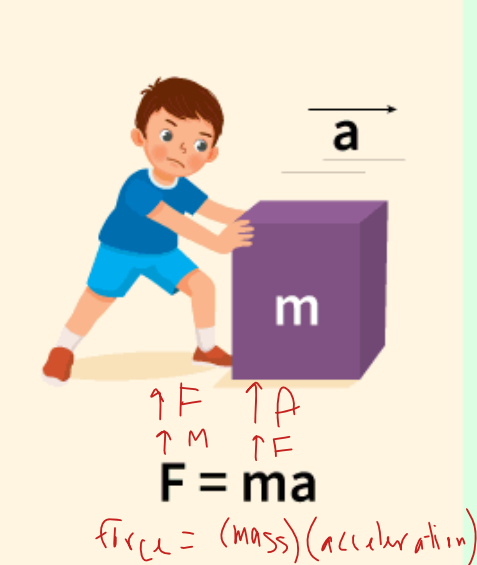
what is Newtons 2nd law of motion
the amount of acceleration of a body is proportional to the acting force and inversely proportional to the mass of the body
F=ma
the greater the force acting on the object or the smaller the mass of the object, the greater the acceleration of the object
law of acceleration
what is Newtons 3rd law of motion
for every action there is an equal but opposite reaction. if an object A exerts a force on object B, then object B will exert an equal but opposite force on object A (swimmer pushes water with hand → action; reaction → water pushes swimmer froward)
Body A exerts a force on Body B then body B necessarily exerts a force on body A that is equal in magnitude but oppositely directed
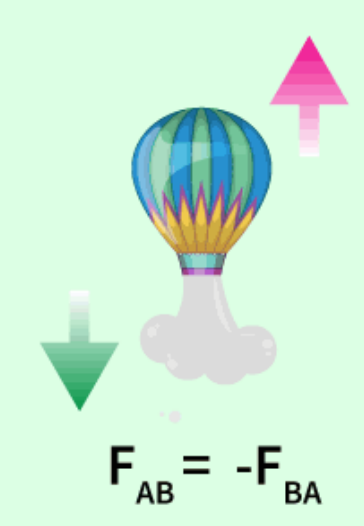
What does Isaac Newton’s 3rd Law say about the forces between Earth and the Sun?
They exert equal and opposite forces on each other.
According to Isaac Newton’s 2nd Law, how does mass affect acceleration?
for the same force, the object with smaller mass accelerates more.
sun has a greater mass than Earth, so Earth must have a greater acceleration
Why do planets orbit the Sun according to Isaac Newton’s reasoning?
Because the Sun’s much larger mass leads to gravitational forces that keep planets in orbit, with Earth accelerating around the Sun
What does Newton’s Law of Universal Gravitation state about how mass affects gravitational force?
Gravitational force is directly proportional to the mass of each object. Increasing mass increases the force
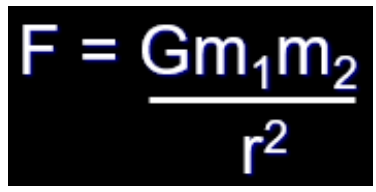
Newton’s Law of Mutual Gravitation
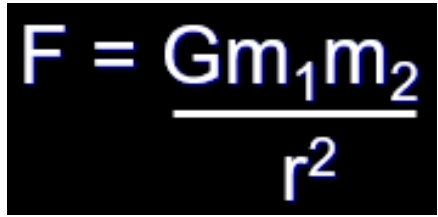
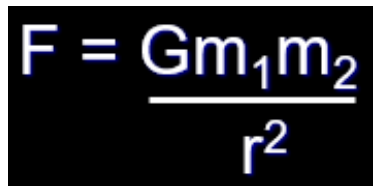
two bodies attract each other with a force that is directly proportional to the mass of each body and inversely proportional to the square of the distance between the bodies
gravitational force continuously pulls each planet toward the sun
more massive → stronger gravitational force
further apart → weaker gravitational force
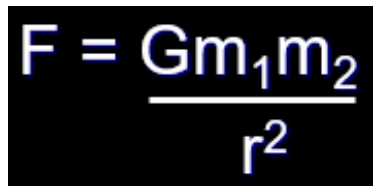
what happens in Newtons Law of Mutual Gravitation if the mass of the one object is doubled?
the force of gravity between them doubled
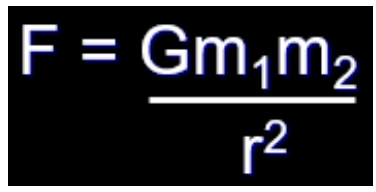
what happens in Newtons Law of Mutual Gravitation if the mass of both objects is doubled
then the force of gravity between them is quadrupled (by a factor of 4)
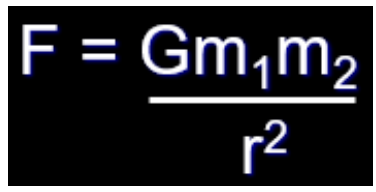
How does distance affect gravitational force in Newton’s Law of Universal (Mutual) Gravitation?
Gravitational force is inversely proportional to the square of the distance between objects.
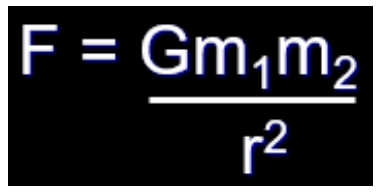
What happens to gravitational force if the distance between two objects is tripled?
The gravitational force decreases by a factor of 9
32=9
decrease gravitational force
how did Newton correct Kepler’s 1st and 3rd law?
by introducing the concept of center of mass
What is the relationship between gravity and inertia in planetary motion?
Planets are pulled inward by gravity but continue moving forward due to inertia, resulting in orbital motion
Why doesn’t the Moon fall straight into the Earth?
The Moon is constantly “falling” toward Earth due to gravity, but its forward inertial motion causes it to orbit instead of crashing.
What is the key idea of Newton’s laws about motion on Earth vs space?
The same laws of motion apply to both Earth and celestial objects; there is no difference between terrestrial and celestial mechanics.
laws of mutual gravitation ad inertia: consequences (if Newton’s laws are true, what does that lead to or explain about the universe)
planets have a tendency to fall towards each other, but offset by the inertial movement of the planet
the moon falls around the Earth rather than towards it
newton’s fundamental law
no difference between motion of Earth and objects observed on the celestial sphere
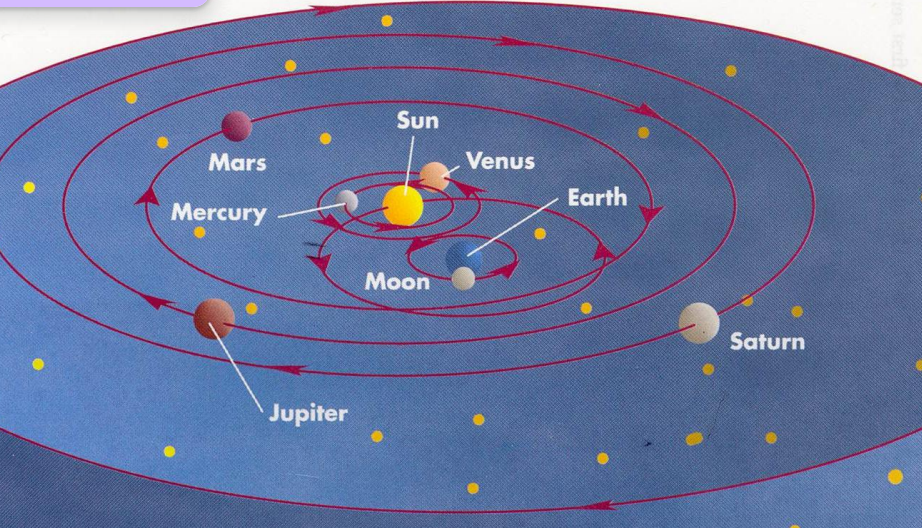
first models of our solar systems were?
geocentric, but couldn’t easily explain retrograde motion
heliocentric model
explains retrograde motion and brightness variations
what did Galileo’s observations support?
heliocentric model and debunked the idea that the heavens were perfect
what did Kepler found?
three empirical laws of planetary motion from observations
what did Newtonian mechanics explain?
Kepler’s observations
gravitational force between two masses is propotional to?
the product of the masses, divide by the square distance between them