15. Body Fluids and Circulation
 Call Kai
 Learn
Learn Practice Test
 Spaced Repetition
 Match
Match Flashcards
 Knowt Play
1/198

Earn XP
Description and Tags
Conceptual chapter so make sure concepts are clear because flashcards can't do that for you probably! Anyway, contains almost every single line from the NCERT chapter. Suitable for revision for IAT, NEST, NEET, etc. Question mode: Flashcards only. Answer mode: Answer with Definition. Recommended study mode: Spaced repetition. Good luck with exams!
Name | Mastery | Learn | Test | Matching | Spaced | Call with Kai | Chat |
|---|
No analytics yet
Send a link to your students to track their progress
199 Terms
What are the two most important functions of the circulatory system?
Supplying oxygen and other substances to living tissue
removal of waste or harmful substances from living tissue
How do simple organisms like sponges and coelenterates do exchange of essential substances to and from living tissue?
They circulate water form their surroundings through their body cavities to facilitate the cells to exchange these substances.
_______ is the most commonly used body fluid by most of the higher organisms including humans for the purpose of exchange of essential substances and waste from living tissue.
Blood is the most commonly used body fluid by most of the higher organisms including humans for the purpose of exchange of essential substances and waste from living tissue.
Blood is a special connective tissue. True or false?
True.
Blood is a special connective tissue consisting of which two parts?
fluid matrix (plasma)
formed elements
What is blood plasma?
Plasma is a straw-coloured viscous fluid made of water, proteins, and minerals. It constitutes nearly 55% of blood.
What is the percentage composition of plasma?
90-92% water
6-8% proteins
small amounts of minerals / organic substances / factors
Which are the major proteins present in blood plasma?
fibrinogen
globulins
albumins
What is the function of fibrinogens in blood plasma?
Fibrinogens are needed for clotting or coagulation of blood.
What is the function of globulins in blood plasma?
Globulins primarly are involved in defense mechanisms of the body.
What is the function of albumins in blood plasma?
Albumins help in osmotic balance.
Which minerals are present in blood plasma? (there are 5 to remember)
sodium ion
calcium ion
magnesium ion
bicarbonate ion
chlorine ion
Plasma without the clotting factors is called _______.
Plasma without the clotting factors is called serum.
What is blood serum?
Plasma without the clotting factors is called serum.
Which sort of factors are present in blood plasma?
Factors for coagulation or clotting of blood are also present in the plasma in an inactive form.
What is the composition of formed elements in blood? (3 things)
erythrocytes
leucocytes
platelets
How many erythrocytes are present on average in a healthy adult male per milimetre cubed of blood?
5-5.5 million RBCs
Which is the most abundant cell in blood?
erythrocytes (RBCs)
Where are RBCs formed in adults?
Red bone marrow
What is the shape of RBCs in most mammals?
devoid of nucleus, biconcave in shape
Why are RBCs red?
They have a red coloured, iron-containing complex protein called haemoglobin
How much haemoglobin is present in a healthy individual per 100ml of blood?
12-16 grams of haemoglobin per 100ml of blood
What is the average lifespan of RBCs?
120 days
What happens to RBCs after their lifespan is up?
They are destroyed in the spleen (graveyard of RBCs)
Why are leucocytes colourless?
Lack of haemoglobin
___________ are nucleated in most mammals.
(erythrocytes / leucocytes)
leucocytes
How many leucocytes are present per millimetre cubed of blood in a healthy individual?
6000-8000
What are the two main categories of leucocytes?
granulocytes
agranulocytes
Which are the three different types of granulocytes?
neutrophils
eosinophils
basophils
Which are the two different types of agranulocytes?
lymphocytes
monocytes
What is the abundance order for the different types of leucocytes? (Also what is the mnemonic device for remembering?)
Neutrophils > lymphocytes > monocytes > eosinophils > basophils
(Never let monkeys eat bananas)
What is the percentage of neutrophils in WBCs?
60-65%
What is the percentage of basophils in WBCs?
0.5-1%
What is the percentage of monocytes in WBCs?
6-8%
Out of the 5 types of leucocytes, which are phagocytic cells?
neutrophils
monocytes
What is the function of basophils?
Basophils secrete histamine, serotonin, heparin etc. and are involved in inflammatory reactions.
What is the percentage of eosinophils in WBCs?
2-3%
What is the function of eosinophils?
They resist infections and are associated with allergic reactions.
What is the percentage of lymphocytes in WBCs?
20-25%
What is the function of lymphocytes?
They are responsible for immune responses of the body.
What are the two major types of lymphocytes?
“B” form
“T” form
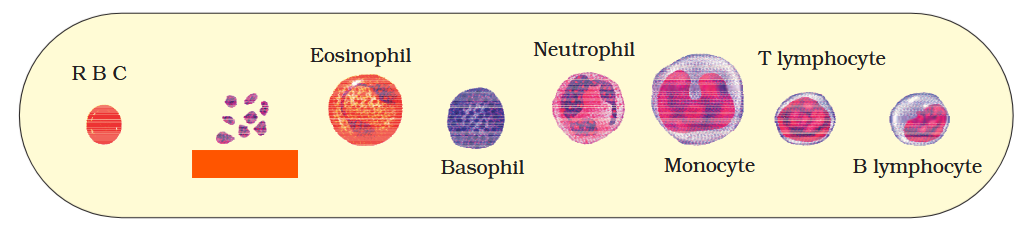
platelets
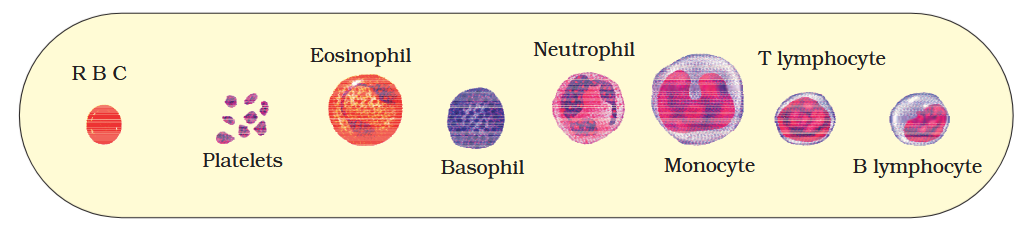
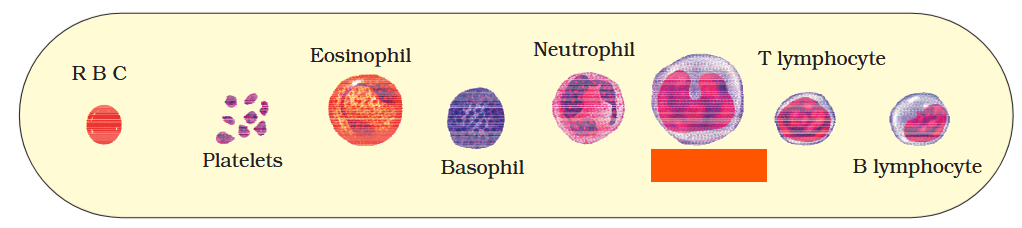
monocyte
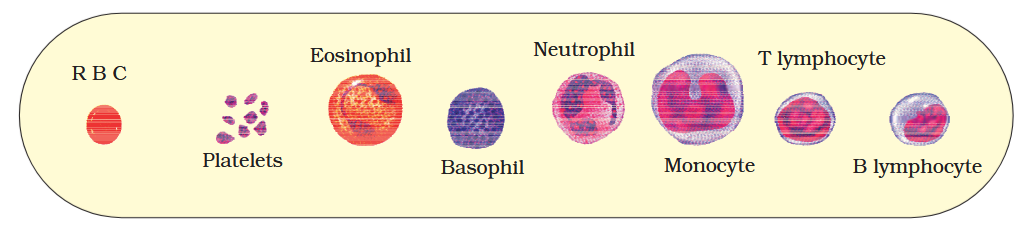
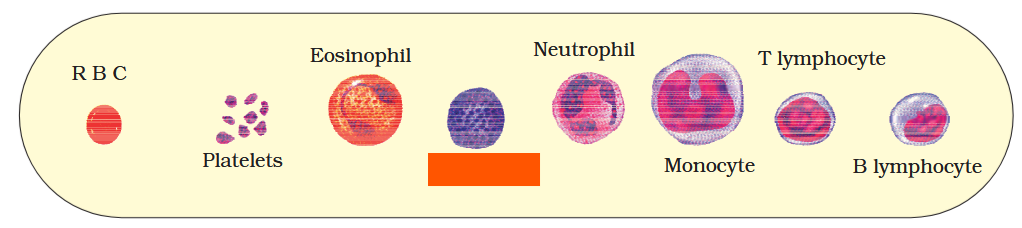
basophil
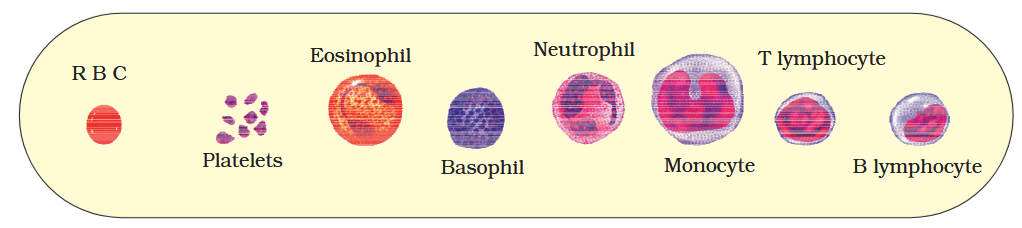
What is another name for platelets?
thrombocytes
thrombocytes are produced from which cells?
megakaryocytes (special cells in the bone marrow)
How many platelets are present per millimetre cubed of blood in a healthy individual?
150,000-350,000
What is the function of platelets?
Platelets can release a variety of substances most of which are involved in the coagulation or clotting of blood.
What is the consequence of reduced platelets in a human body?
A reduction in their number can lead to clotting disorders which will lead to excessive loss of blood from the body.
What are the two main blood groupings used commonly?
ABO grouping
Rh grouping
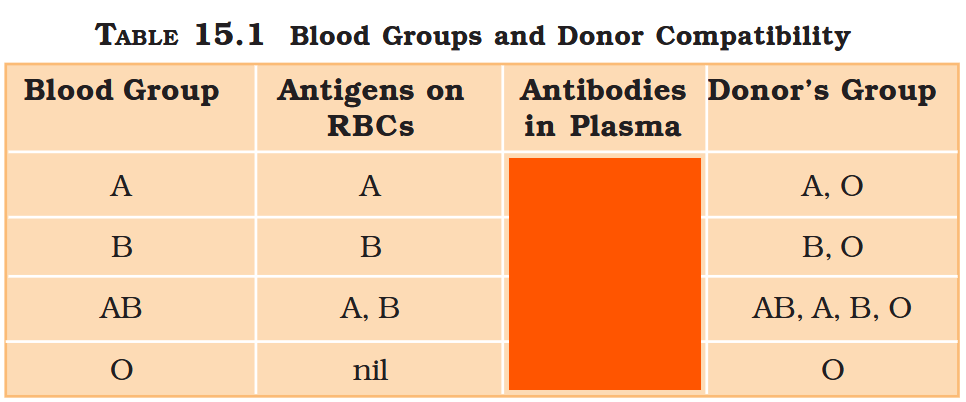
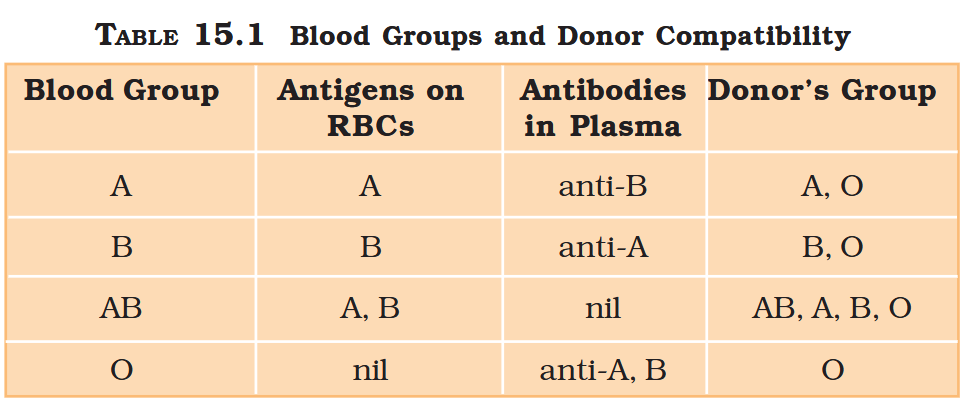
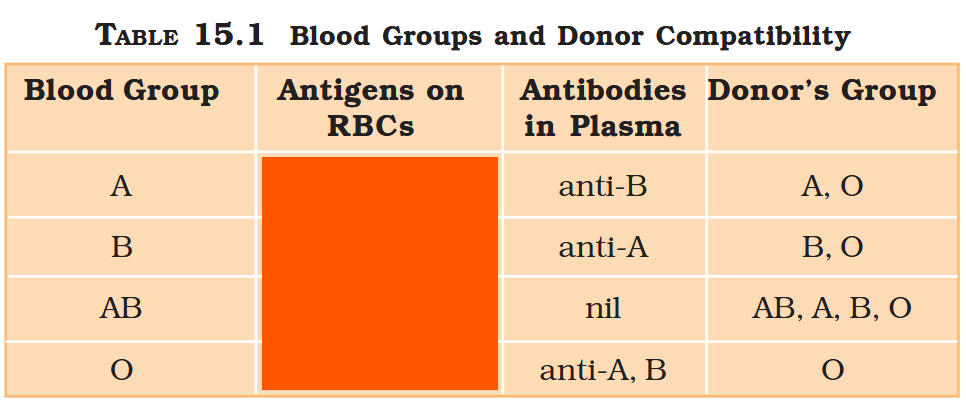
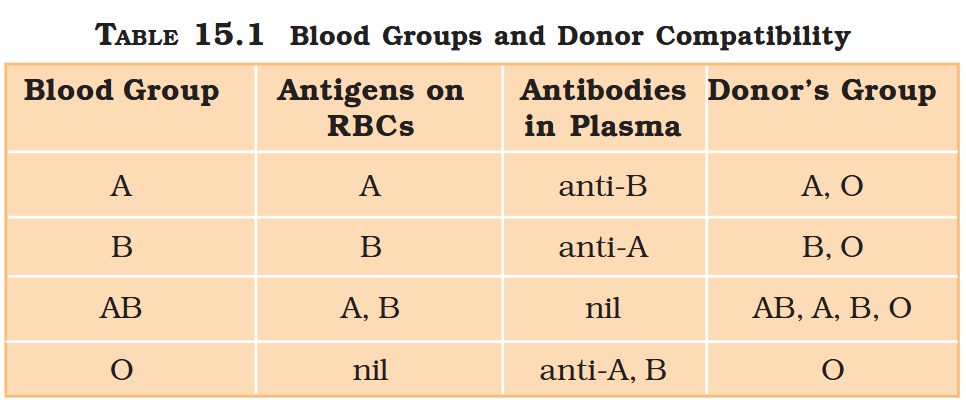
Why must blood of donor and blood of recipient be careful matched in blood transfusions?
the blood of a donor has to be carefully matched with the blood of a recipient before any blood transfusion to avoid severe problems of clumping (destruction of RBC).
What is the basis of ABO blood grouping?
ABO grouping is based on the presence or absence of two surface antigens (chemicals that can induce immune response) on the RBCs namely A and B. Similarly, the plasma of different individuals contain two natural antibodies (proteins produced in response to antigens).
Which ABO blood group is the universal donor?
0
Which ABO blood group is the universal acceptor?
AB
The Rh antigen is present on the surface of RBCs in what percentage of humans?
nearly 80%
What is the difference between Rh positive and Rh negative individuals?
Rh positive individuals have the Rh antigen present on the surface of their RBCs.
Rh negative individuals do not have the Rh antigen.
Under which conditions will an invidual form Rh antibodies?
An Rh-ve person, if exposed to Rh+ve blood, will form specific antibodies against the Rh antigens.
What is erythroblastosis foetalis?
When a woman is pregnant, it’s possible that her baby’s blood type will be incompatible with her own (usually to do with Rh factor). This can cause a condition known as erythroblastosis foetalis, where the mother’s WBCs attack the baby’s RBCs as they would any foreign invaders.
What happens when an Rh-ve mother is pregnant with an Rh+ve foetus? What are the consequences?
Rh antigens of the foetus do not get exposed to the Rh-ve blood of the mother in the first pregnancy as the two bloods are well separated by the placenta. However, during the delivery of the first child, there is a possibility of exposure of the maternal blood to small amounts of the Rh+ve blood from the foetus. In such cases, the mother starts preparing antibodies against Rh antigen in her blood. In case of her subsequent pregnancies, the Rh antibodies from the mother (Rh-ve) can leak into the blood of the foetus (Rh+ve) and destroy the foetal RBCs. This could be fatal to the foetus or could cause severe anaemia and jaundice to the baby.
How can erythroblastosis foetalis be prevented?
This can be avoided by administering anti-Rh antibodies to the mother immediately after the delivery of the first child.
Why does bood exhibit coagulation / clotting property?
It is in response to an injury or trauma. It is a mechanism to prevent excessive loss of blood from the body.
What are the main constituents of clot or coagulam?
a network of fibrins
dead and damaged formed elements of blood (trapped in the fibrins)
How are fibrins formed?
Fibrins are formed by the conversion of inactive fibrinogens in the plasma by the enzyme thrombin.
How are thrombins formed?
Thrombins are formed from an inactive substance present in the plasma called prothrombin. An enzyme complex, thrombokinase, is required for the above reaction.
How is thrombokinase formed?
This complex is formed by a series of linked enzymic reactions (cascade process) involving a number of factors present in the plasma in an inactive state.
An injury or trauma stimulates platelets in the blood to do what?
An injury or a trauma stimulates the platelets in the blood to release clotting factors which activate the mechanism of coagulation.
Thrombokinase is formed by a series of linked enzymic reactions (cascade process) involving a number of factors present in the plasma in an inactive state.
How are these factors activated?
An injury or a trauma stimulates the platelets in the blood to release clotting factors which activate the mechanism of coagulation.
Certain factors released by the tissues at the site of injury also can initiate coagulation.
Which ions play an important role in blood clotting?
calcium ions
How is lymph formed?
As the blood passes through the capillaries in tissues, some water along with many small water soluble substances move out into the spaces between the cells of tissues leaving the larger proteins and most of the formed elements in the blood vessels.
An elaborate network of vessels called the lymphatic system collects the interstitial tissue fluid and drains it back to the major veins. The fluid present in the lymphatic system is called the lymph.
Exchange of nutrients and gases between blood and living cells occurs through which medium?
interstitial fluid, or tissue fluid
Interstitial / tissue fluid has the same mineral distribution as that in plasma.
True or false?
True.
What is lymph?
The fluid present in the lymphatic system is called lymph.
What is the composition of lymph?
water, specialised lymphocytes, nutrients, minerals, hormones, fats
Fats are absorbed through lymph how?
Fats are absorbed through lymph in the lacteals present in the intestinal villi.
Open circulatory system is present in which animal phyla?
arthropoda and mollusca
Closed circulatory system is present in which animal phyla?
annelida and chordata
What is an open circulatory system?
Blood pumped by the heart passes through large vessels into open spaces or body cavities called sinuses.
Which is more advantageous, open or closed circulatory system?
closed

Why is closed circulatory system advantageous over open circulatory system?
Blood pumped by the heart is always circulated through a closed network of blood vessels. This pattern is considered to be more advantageous as the flow of fluid can be more precisely regulated.
In fishes the heart pumps out deoxygenated blood which is oxygenated by the _______.
In fishes the heart pumps out deoxygenated blood which is oxygenated by the gills.
fishes have ________ circulation.
(single / incomplete double / double)
single
reptiles amphibians have _________ circulation.
(single / incomplete double / double)
incomplete double
birds and mammals have _________ circulation.
(single / incomplete double / double)
double
Describe the circulatory system in fishes.
In fishes the heart pumps out deoxygenated blood which is oxygenated by the gills and supplied to the body parts from where deoxygenated blood is returned to the heart (single circulation).
In amphibians and reptiles, the left atrium receives oxygenated blood from which three parts?
gills
lungs
skin
Describe the circulatory system in amphibians and reptiles.
In amphibians and reptiles, the left atrium receives oxygenated blood from the gills/lungs/skin and the right atrium gets the deoxygenated blood from other body parts. However, they get mixed up in the single ventricle which pumps out mixed blood (incomplete double circulation).
What are the three components of the human circulatory system?
heart
blood vessels
blood
Heart in humans is ____________ derived organ.
(ectodermally / mesodermally / endodermally)
mesodermally
Where is the heart situated in humans?
It is situated in the thoracic cavity, in between the two lungs, slightly tilted to the left.
What is the size of a human heart?
about the size of a clenched fist lmao
What is a pericardium?
It is a double walled membranous bag (enclosing pericardial fluid) protecting the heart in humans.
The heart in humans is protected by a double walled membranous bag, __________, enclosing the ____________ fluid.
The heart in humans is protected by a double walled membranous bag, pericardium, enclosing the pericardial fluid.
What are the chambers present in a human heart?
right and left atrium
right and left ventricle
What is an inter-atrial septum?
A thin, muscular wall called the inter-atrial septum separates the right and the left atria in a human heart.
What is an inter-ventricular septum?
A thick-walled, the inter-ventricular septum, separates the left and the right ventricles in humans.
What is an atrio-ventricular septum?
The atrium and the ventricle of the same side are also separated by a thick fibrous tissue called the atrio-ventricular septum.
Where is the tricuspid valve located?
The right atrio-ventricular septum in a human heart.
Where is the bicuspid (mitral) valve located?
The left atrio-ventricular septum in a human heart.