Carboxylic acid derivatives: Intro + phy properties
 Call Kai
 Learn
Learn Practice Test
 Spaced Repetition
 Match
Match Flashcards
 Knowt Play
1/9

There's no tags or description
Looks like no tags are added yet.
Name | Mastery | Learn | Test | Matching | Spaced | Call with Kai |
|---|
No analytics yet
Send a link to your students to track their progress
10 Terms
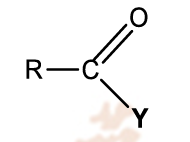
What are carboxylic acid derivatives?
Compounds in which the -OH group in the carboxylic acid is replaced by -Y which can be -F, -Cl, -Br, -I, -OR’, -NH2
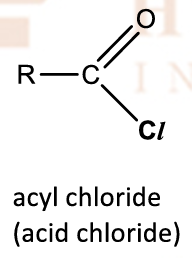
general structure and nomenclature of acyl chloride
replace ‘oic acid’ with ‘oyl chloride’ eg methanoyl chloride
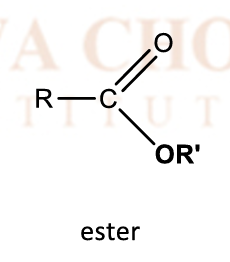
general structure and nomenclature of an ester
first R group attached to oxygen ends with ‘yl’
followed by parent carboxylic acid replacing ‘oic acid’ with ‘oate’
eg phenyl ethanoate
general structure of an amide
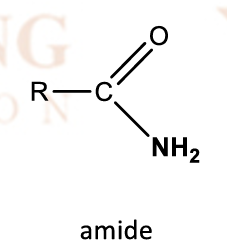
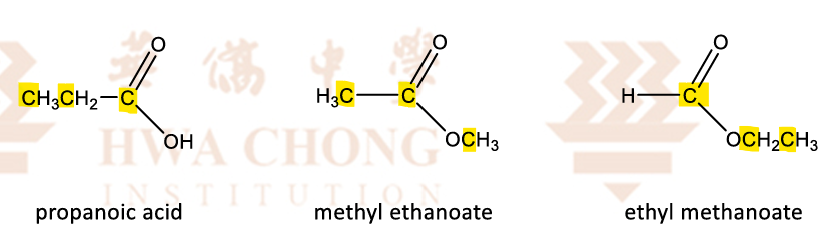
Acyl chlorides and esters have higher/lower boiling points than carboxylic acids. explain.
lower
less energy required to overcome the weaker permanent dipole-permanent dipole interactions as compared to stronger hydrogen bonding between carboxylic acid molecules
(no intermolecular hydrogen bonding as there is no hydrogen directly attached to highly electronegative oxygen)
Solubility of esters
less soluble in water than carboxylic acids, may even be immiscible in water
esters only have on C=O group to accept a H-bond whereas carboxylic acids have both a C=O group to accept a hydrogen bond and a O-H group to donate a hydrogen bond
energy released from weaker hydrogen bonding between ester and water molecules
is less able to /less than energy required to
overcome the pd-pd interactions between ester molecules and hydrogen bonding between water moleculces
rank reactivity of the following carboxylic acid derivatives towards nucleophilic substitution
carboxylic acid
acyl chloride
ester
amide
amide < ester < carboxylic acid < acyl chloride
Why is acyl chloride most reactive in nucleophilic substitution?
electornic effects
halogen substituent withdraws electrons through inductive effect from C=O group
increasing partial positive charge on the carbon group
making it more susceptible to nucleophilic attack
(compared to in carboxylic acids, the lone pairs on OH oxygen delocalise into the carbonyl pi orbital through resonance effect, neutralising the partial positive charge on carbonyl carbon)
leaving group
halides are weaker bases, hence are better leaving groups
Why are amides and esters less reactive towards nucleophilic substitution?
amino group or alkoxy group donates electrons to carbonyl carbon through resonance effect
decreasing the partial positive charge on carbonyl carbon
amides and esters are less readily attacked by nucleophiles
(nitrogen is less EN so donates more)
leaving group
amino group adn alkoxy group are strong bases, hence are have a lower leaving group ability (amino group is a stronger base)
carboxylic acids and esters are ___ isomers if they have the same number of carbons
constitutional isomers