Criminal procedure - investigations
 Call Kai
 Learn
Learn Practice Test
 Spaced Repetition
 Match
Match Flashcards
 Knowt Play
1/19

Earn XP
Description and Tags
going to be tested as multi-choice on exam
Name | Mastery | Learn | Test | Matching | Spaced | Call with Kai | Chat |
|---|
No analytics yet
Send a link to your students to track their progress
20 Terms
What is a criminal justice system:
Method which the state applies the criminal law to it’s citizens
Values in our criminal justice system which compete
Fairness in criminal proceedings -> balancing powers of the state to ensure privacy and dignity
Balance of community safety + reintegration of prisoners
Punishment vs reintegration.
Lawyers role
Public interest -> lawyers have important role in upholding rights in NZBORA [public want a quick outcome for what is obviously 'just']
Trends; in our criminal justice system
Increasingly punitive -> from 70's increasing seriousness and punishment in criminal justice systems. Political issue often they are seeking to outdo each other and being tougher on crime.
Enhanced focus on victims rights -> victims having a say in the process -> apart of this push is bringing in punitive parts.
Increasing managerialism and administrative focus, eg getting people through the system as fast as possible
Types of investigative steps:
Questioning possible witnesses / suspects
Eyewitness identification procedures
Search of addresses
Analysis of phone data (call logs, texts, phone location)
Forensic examination of scene and items seized (samples)
Pathology of deceased (medical experts determining cause of death)
CCTV in vicinity
Covert investigation techniques (undercover policing)/ being under surveillance.
Identification Evidence:
person saying I saw x person on the scene, works when the witness knows the person and their name)
if person does not know the name then they get shown about 8 people who are similar looking including the suspect and they have to pick the person out.
What happens if an eye witness doesn’t know the person they have to identify - risk in justice + ways it goes wrong
Can be the source of a significant miscarriage of justice
Evidence that strangers being identified by a witness from short glances in stressful situations is bad/typically wrong -> but jury places significance on it.
ways it goes wrong;
Investigation + collection -> stress of being asked by police and them say yeah must be him
Bad memory -> some people may be good but science shows that there's large unreliability.
It’s not uncommon for someone to be exonerated by DNA testing after being convicted by faulty eye witness identification (examples R v Edmonds) (Fukofuka v R))
Evidence Act 2006 s 4 (Visual identification evidence) -definiton
assertion by a person, based wholly or partly on what that person saw, to the effect that a defendant was present at or near a place where an act constituting direct or circumstantial evidence of the commission of an offence was done at, or about the time the act was done.
s 45 Evidence act 2006 Admissibility (use in proceedings against someone) of identification evidence
(1) if formal procedure is followed in obtaining VIE of a person alleged to have committed an offence or there was a goods reason not for following a formal procedure. Evidence = admissible in criminal proceeding. UNLESS D proves on balance of probabilities evidence is unreliable.
2) if proper formal procedure is not followed with no good reason not to evidence = inadmissible. UNLESS the prosecution proves beyond reasonable doubt that the circumstances in which the identification was made have produced a reliable identification.
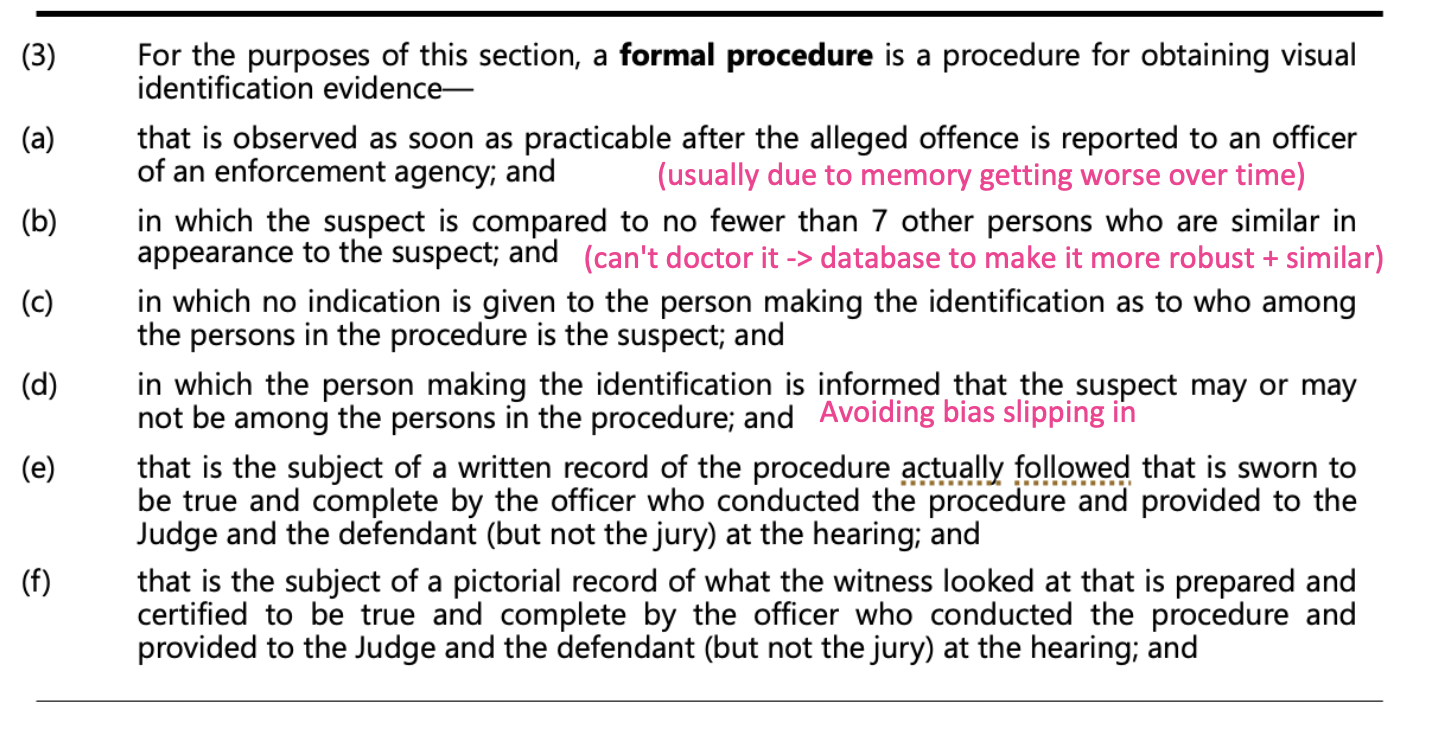
Formal procedure for obtaining visual identification evidence = (under s 45(3) a-f)
a) should be done ASAP after the offence is reported to police
b) suspect must be compared to no fewer than 7 other people who are similar in appearance.
c) no indication should be given to person making the identification on who is the suspect.
d) identifier should be informed the suspect may or may not be among the persons in the procedure.
e) a written record of the procedure actually followed, that is sworn to be true and complete by the officer who conducted the procedure and provided to the Judge and defendant (not jury) at the hearing.
f) pictorial record of what the witness looked at is prepared and certified to be true and complete by the officer who conducted the procedure and provided to Judge and defendant at hearing.
Good reasons not to follow formal procedure (VIE) s 45(4) (a)-(f)
a) refusal of the suspect to take part in the procedure (refusing to take part in parade, not permit photos or videos where agency doesn’t already have a photo showing true likeness)
b) singular appearance of the suspect (that can’t be disguised so that the person is similar in appearance to those with whom the person is to be compared) e.g. face tattoo
c) substantial change in the appearance of suspect after the alleged offence occurred and before it was practical to hold formal procedure
d) no officer involved in investigation or prosecution could reasonably anticipate that identification would be an issue at the trial. (e.g. being caught on scene)
e) an identification of a person alleged to have commited an offence has been made to an officer of a enforcement agency soon after the offence occurred and in the course of that officers initial investigation
f) identification of a person alleged to have committed an offence has been made to an officer of an enforcement agency after a chance meeting between the person who made the identification and the person alleged to have committed the offence.
Aims of the rules around admissibility
reduce the risk of wrongly convicting people.
Aim to make sure that the evidence is accurate
Judicial direction on Visual identification evidence s 126
1) In a criminal proceeding tried with a jury in which the
case against the defendant depends wholly or substantially on the correctness of 1 or more visual or voice identifications of the defendant or any other person, the Judge must warn the jury of the special need for caution before finding the defendant guilty in reliance on the correctness of any such identification.
(2) The warning need not be in any particular words but must
(a) warn the jury that a mistaken identification can result in a
serious miscarriage of justice; and
(b) alert the jury to the possibility that a mistaken witness may be convincing; and
(c) where there is more than 1 identification witness, refer to the possibility that all of them may be mistake
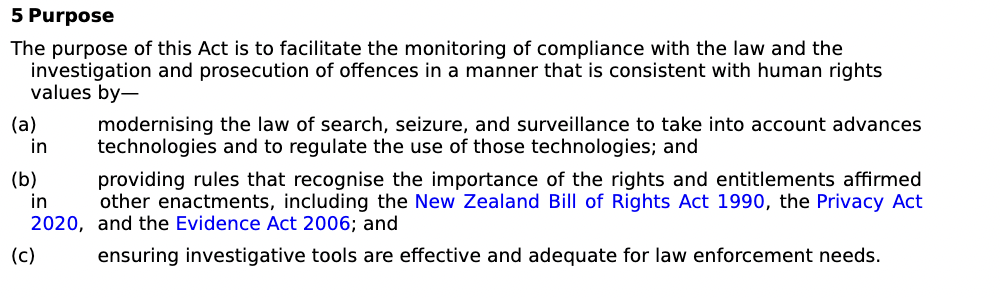
Search and seizure; Search and surveillance Act 2012; purpose s 5
monitoring of compliance with law and the investigation and prosecution of offences in manner that is consistent with HR values
see photo
NZBORA 1990 s 21 unreasonable search and seizure (Search and seizure)
right to be secure against unreasonable search or seizure (person, property or correspondence or otherwise)
search not defined in NZBORA and SSA.
Police have same rights as ordinary citizens - at some point investigatory conduct carried out by police = search.
current test for whether it’s a search
expands on Entick v Carrington
Hamed v R; if the police activity invades a reasonable expectation of privacy.
An expectation of privacy will be reasonable if:
first, the person complaining of the breach of s 21 did subjectively have such an expectation at the time of the police activity and, secondly, that expectation was one that society is prepared to recognise as reasonable
Statutory powers of search
Warrant preference rule;
can apply
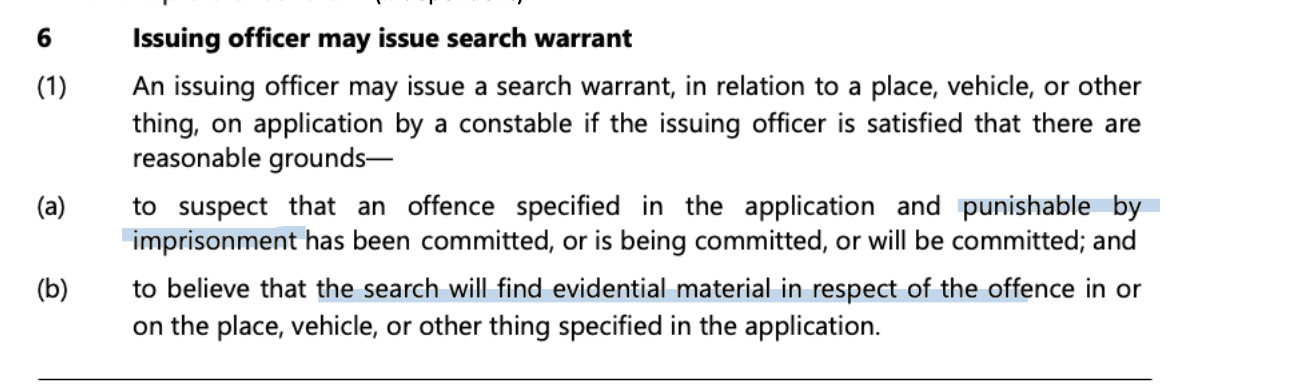
warrant may be issued if issuing officer is satisfied that there a reasonable grounds
to suspect (mere speculation or concern is not enough must be possible or likely) that an offence punishable by imprisonment (committed, being committed or will be committed) AND
believe (higher standard, objective credible basis) that the search will find evidential material in respect of the offence
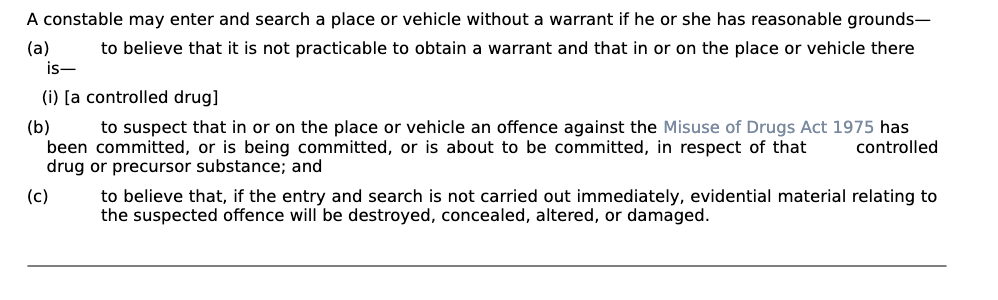
warrantless search s 20 Warrantless search of places and vehicles in relation to some Misuse of Drugs Act 1975
offences
not practicable to obtain a warrant where there is a controlled drug
offence against Misuse of drugs act is committed, (future, past, now) and
If entry and search is not carried out immediately evidential material relating to the suspected offence will be destroyed etc.
Other examples of warrantless search power
Consent (but must be advised able to refuse)
• Pursuant to lawful arrest (difficult issues arise around searching contents of phone found on person,
unless Police have “reasonable grounds to believe evidential material will be located on it”.
• Items in plain view when exercising otherwise lawful power.
• To prevent offence or respond to risk of life
• Arms and drug offences when certain conditions present
search and seizure other info - penalty for breach and phones
Penalty for breach? Possible exclusion of evidence.
• Requirement to report to Police Commissioner when warrantless power exercised.
• Law Commission recommendation In relation to phones -> need to have clearer guidelines.