Day 1
 Call Kai
 Learn
Learn Practice Test
 Spaced Repetition
 Match
Match Flashcards
 Knowt Play
1/14

There's no tags or description
Looks like no tags are added yet.
Name | Mastery | Learn | Test | Matching | Spaced | Call with Kai |
|---|
No analytics yet
Send a link to your students to track their progress
15 Terms
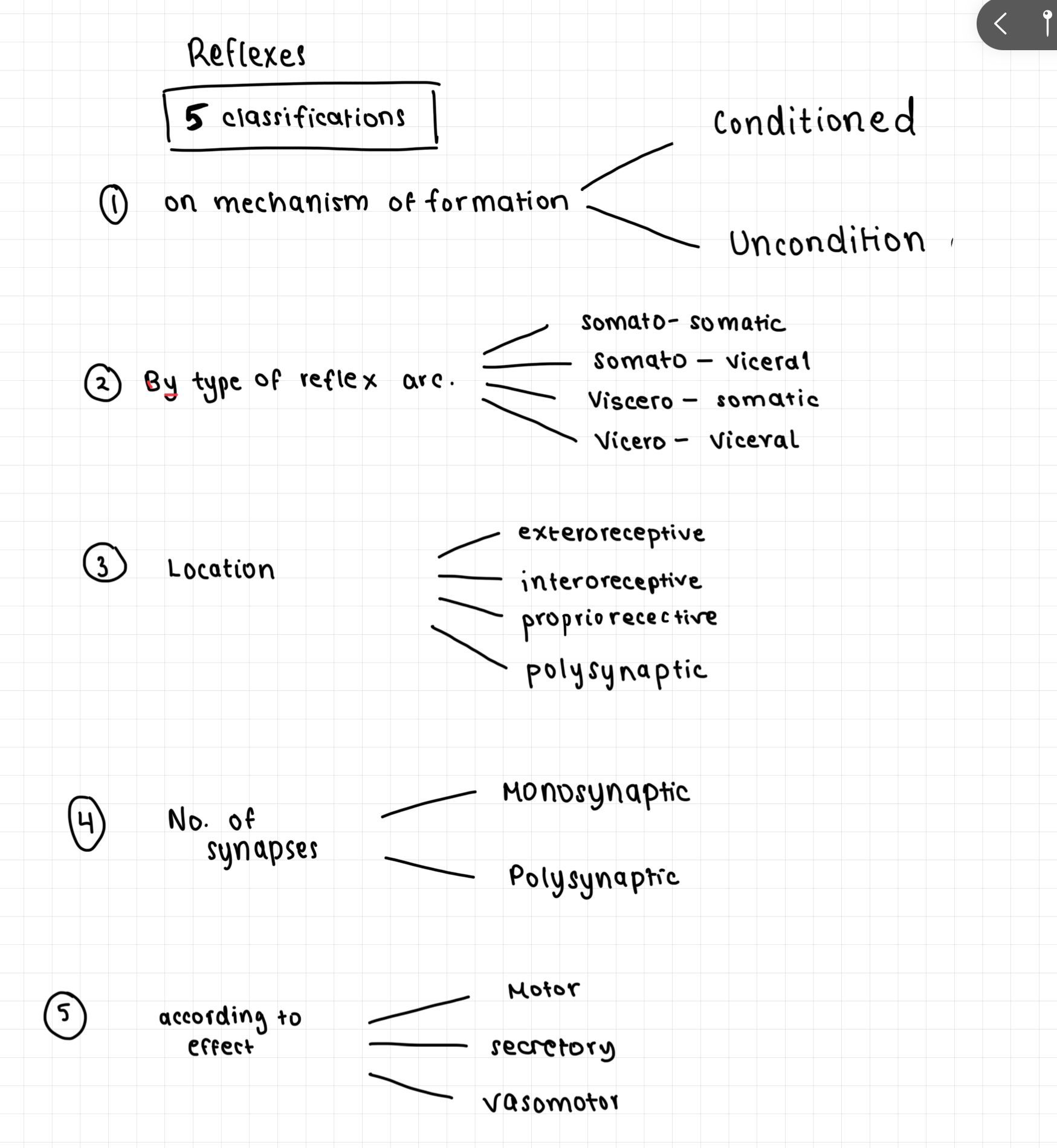
Example of unconditioned reflex
Patellar (knee-jerk) reflex
Example of conditioned reflex
Pavlov’s salivary reflex
Unconditioned reflexes are ______ , inherited responses that do not require prior learning. They possess a ________ ______ ___ and are triggered by an _______ stimulus.
In contrast, conditioned reflexes are acquired during life through learning and experience. They are ________, ________, and depend on the formation of new neural connections in the cerebral cortex. They are _________, individual, and depend on the formation of ___ ________ _____________ in the ________ ______. Conditioned reflexes arise when a neutral stimulus is repeatedly associated with a stimulus that naturally evokes a response.
innate, temporary reflex arc, adequate
Temporary, individual, new neural connections, cerebral cortex,
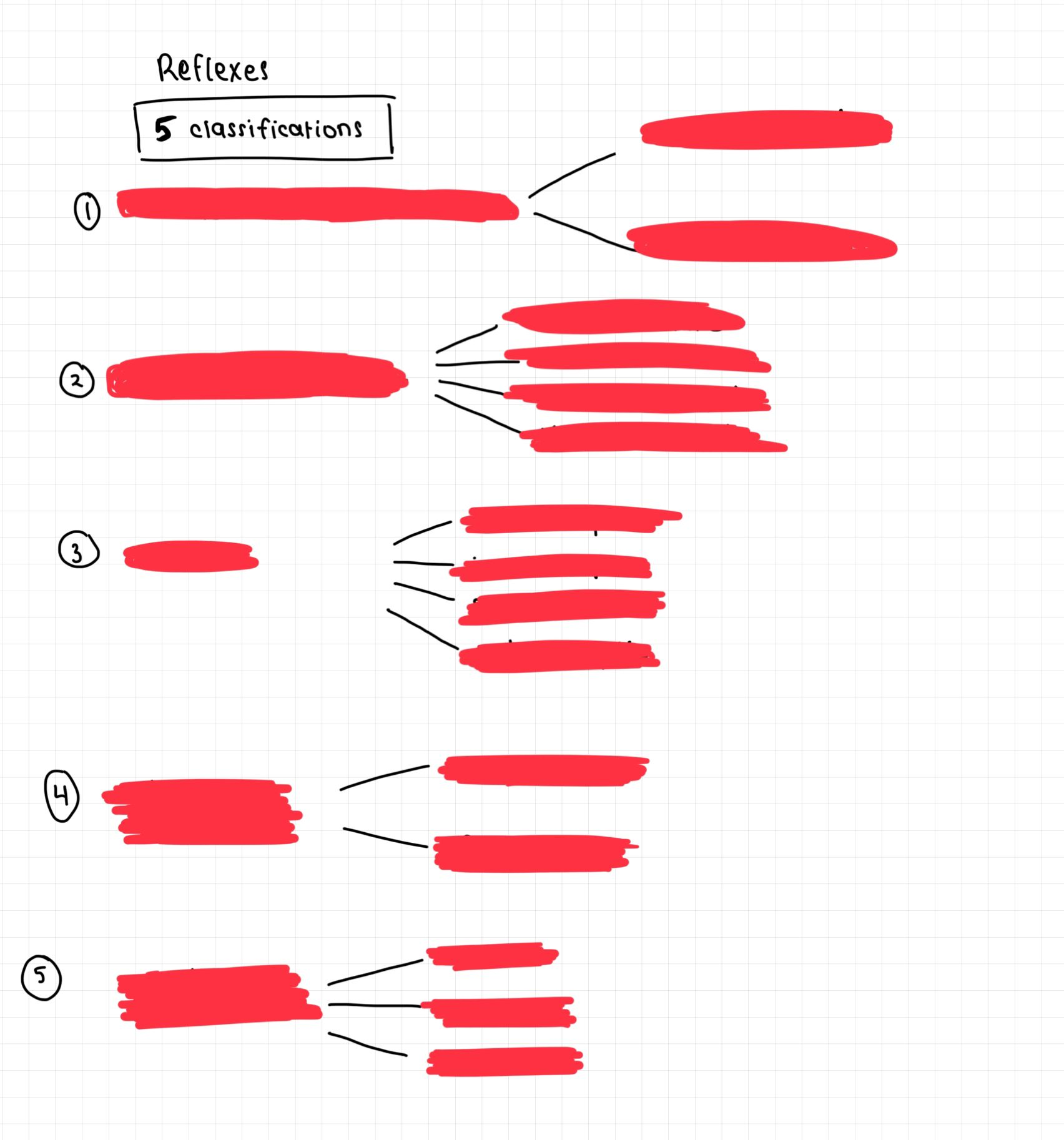
4 ways reflexes are categorized depending on reflex arc
Somato-somatic
Somato-viceral
Vicero-somatic
Vicero-viceral
Somato-somatic reflex
Origin/arise from :
Affect :
Example :
Somato-somatic reflex
Origin/arise from :
Affect :
Example :
Exteroceptors, skeletal muscles, plantar reflex
Somato-visceral reflex
Origin/arise from :
Affect :
Example :
Exteroceptors, smooth muscles + glands, oculocardiac reflex
Vicero-somatic reflex
Origin/arise from :
Affect :
Example :
interoceptors, skeletal muscles, abdominal wall rigidity
Vicero-visceral reflex
Origin/arise from :
Affect :
Example :
interceptors, smooth muscles and glands, pressor reflex.
According to receptor location, reflexes can be classified as ______________, _______________ or _________________ (give their locations)
exteroceptive - inner ear
interoceptive - internal organs
proprioceptive - muscular joints
Classification according to number of synapses
Monosynaptic
Polysynaptic —> involving one or more interneurons
3 reflexes according to effect:
Motor
Secretory
Vasomotor
A nerve centre is a collection of ____________ within the CNS where information is __________, _________, and _____________. Nerve centres are rich in __________ _________ and are responsible for controlling specific physiological functions.
Examples include the :
Respiratory and cardiovascular centres -
Vasomotor centre -
Defecation centre -
Sensory centre -
Motor centre -
Visual centre -
Auditory centre -
A nerve centre is a collection of interneurons within the CNS where information is received, processed, and integrated. Nerve centres are rich in chemical synapses and are responsible for controlling specific physiological functions.
Examples include the :
Respiratory and cardiovascular centres - medulla oblongata and pons
Vasomotor centre - medulla
Defecation centre - lumbosacral spinal cord
Sensory centre - parietal cortex
Motor centre - frontal lobe
Visual centre - occipital lobe and midbrain
Auditory centre - temporal lobe and midbrain.