Animal associations: Introduction
 Call Kai
 Learn
Learn Practice Test
 Spaced Repetition
 Match
Match Flashcards
 Knowt Play
1/34

There's no tags or description
Looks like no tags are added yet.
Name | Mastery | Learn | Test | Matching | Spaced | Call with Kai |
|---|
No analytics yet
Send a link to your students to track their progress
35 Terms
what do intraspecific interactions include? (homogenetic assocations)
herd/flock associations, parental care, pairing, colonial life
what doe interspecific interactions include? (heterogenetic associations)
commensalism, mutualism, predation, parasitism
what are the challenges that every animal faces
How to obtain nourishment
• How to shelter from the elements
• How to find a mate and reproduce
• How to disperse to reduce competition for food, shelter
and mates
what is the 1879 definition of symbiosis
the living together of unlike organisms
what are herd and flock associations
a social grouping of animals of the same species including flock, herd, school, and swarm
what are the advantages of herd/flock associations
Safety in numbers – individual level lower predation and
parasitism (ectoparasites like biting flies/mosquitoes)
• Aerodynamics- Conserves their energy- each bird flies
slightly above the bird in front of him, resulting in a reduction of
wind resistance.
• Communication and coordination within the group
• Protection while foraging
• Efficient foraging
• Finding a mate
• Raising families
what are the disadvantages of herd/flock associations
Visibility to predators
• Usually leads to predators targeting old and young
• Competition for food and mates
• Infectious disease (parasites and pathogens)
what is parental care
parental behaviour that arose and/or is maintained for the purpose of increasing offspring fitness
what is the trade off that comes with parental care
the greater the amount of care, the fewer the number of offspring
monoecious (hermaphrodite)
an
organism having both the male and
female reproductive organs in the same
individual (common in invertebrate
animals)
dioecious
an organism having the
male and female reproductive organs in
separate individuals
• Monogamous: an individual
having only one mate at a time
• Polygamous: an individual
having more than one mate at a
time.
colonies
a group of animals of one kind living closely together or forming a physically connected structure
advantages of colonies
1. Safety in numbers
2. Communication and
coordination within the group
3. Efficient foraging
4. Mating
5. Raising families
disadvantages of colonies
1. Visibility
2. Competition
3. Hierarchy within colony members
what are the different types of predation in simple terms
true predation, grazing/micropredator, parasites and parasitoids
amensalism
one species is harmed or inhibited while the other species remains relatively unaffected (it neither benefits nor is harmed)
competition
both species get less than they would if they were alone
neutralism
where two species coexist in the same environment but have no measurable effect on each other
commensalism
a relationship between two species in which one species benefits and the other is not affected eg cleaning, protection, transport
phoresy
hitching a lift on another organism
give two examples of phoresy
sexton beetle and mites, spinner dolphin and remora fish, The remora hitch a ride of their
hosts
• Spinner dolphins in particular
breach explosively in order to get
rid of their passengers
mutualism
a relationship between two species in which both benefit from the association
example of mutualism
Cleaner and client fish:
•Cleaners gain food (+) in the form of ectoparasites, bacteria and necrotic tissue
from the body or surface of the ‘client’ fish
•Clients are protected from infection (+)
•Cleaner fish often hold territories with ‘cleaning stations’ that their clients visit – and
visit more often when they have parasites.
mutualism in coral and algae
a relationship where one resource is traded for another, • The algae (zooxanthellae) get inorganic nutrients from the corals
• The corals get sugars (by-products of photosynthesis) from the algae.
• When a coral 'bleaches' it is actually kicking out the zooxanthellae
that live in it, so all you see is the coral's skeleton, which is white
mutualism in anemones and clownfish
a relationship where one service is traded for another, Anemones provide clown fish with protection from predators
(which cannot tolerate the stings of the anemone's
tentacles) and the fish defend the anemones against
butterfish which eat anemones
mutualism, oxpecker and antelope
Antelope is groomed-ectoparasites removed
Oxpecker gets food (e.g. ticks) from the antelope
mutualism, humans and farming
Humans benefit from agriculture by having a reliable food
source
• Crop and livestock species are cultivated and protected by
humans for their benefit, at the expense of wild species
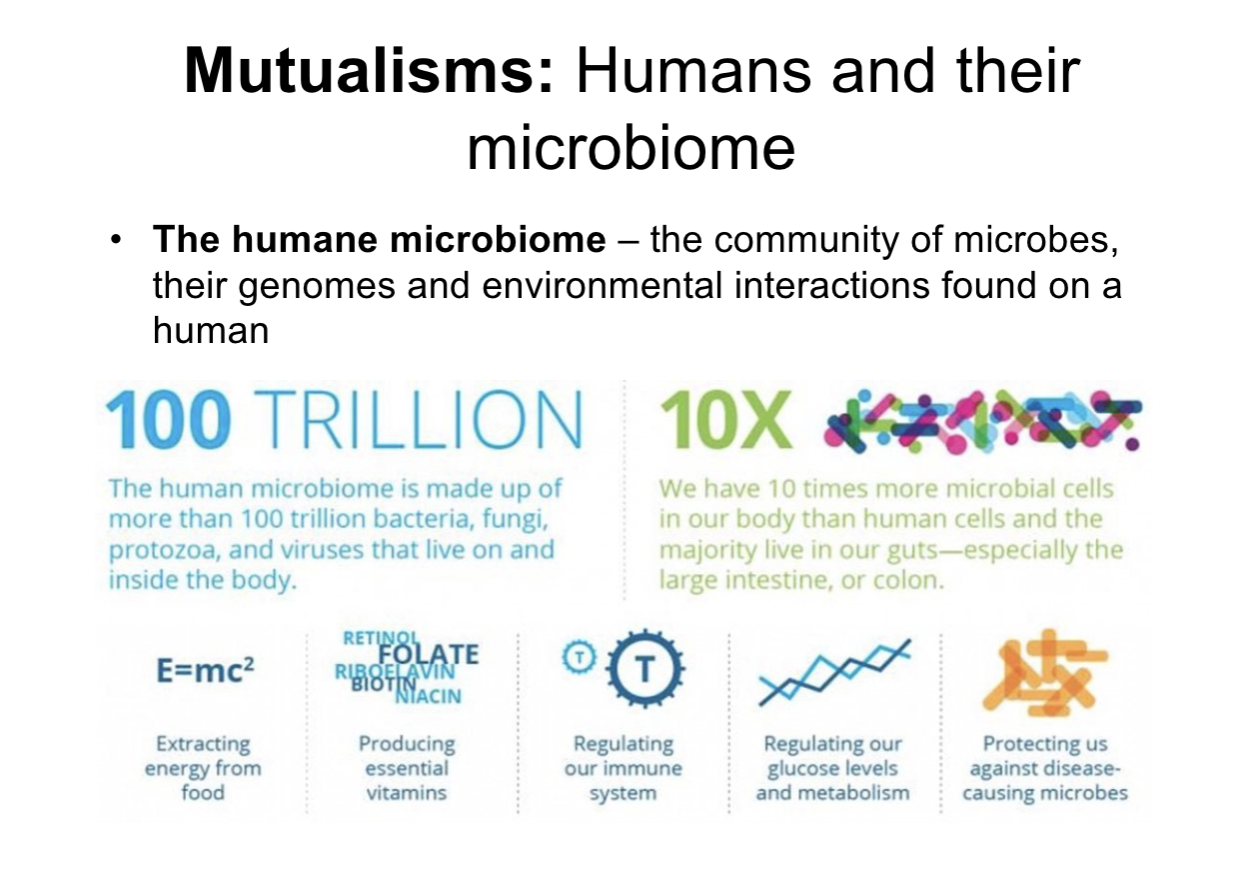
mutualism, human and their microbiome
The human
microbiome –
the community of
microbes, their
genomes and
environmental
interactions
found on a
human
numbers and functions of human microbiome
parasitism
relationship between two species in which one species benefits at the expense of the other
ectoparasites
live on the body surface of the host
endoparasites
live inside the host’s
body may be intercellular (inhabiting spaces
in the host’s body) or intracellular
(inhabiting cells in the host’s body)
e.g. Botfly larvae in a horse
’s stomach
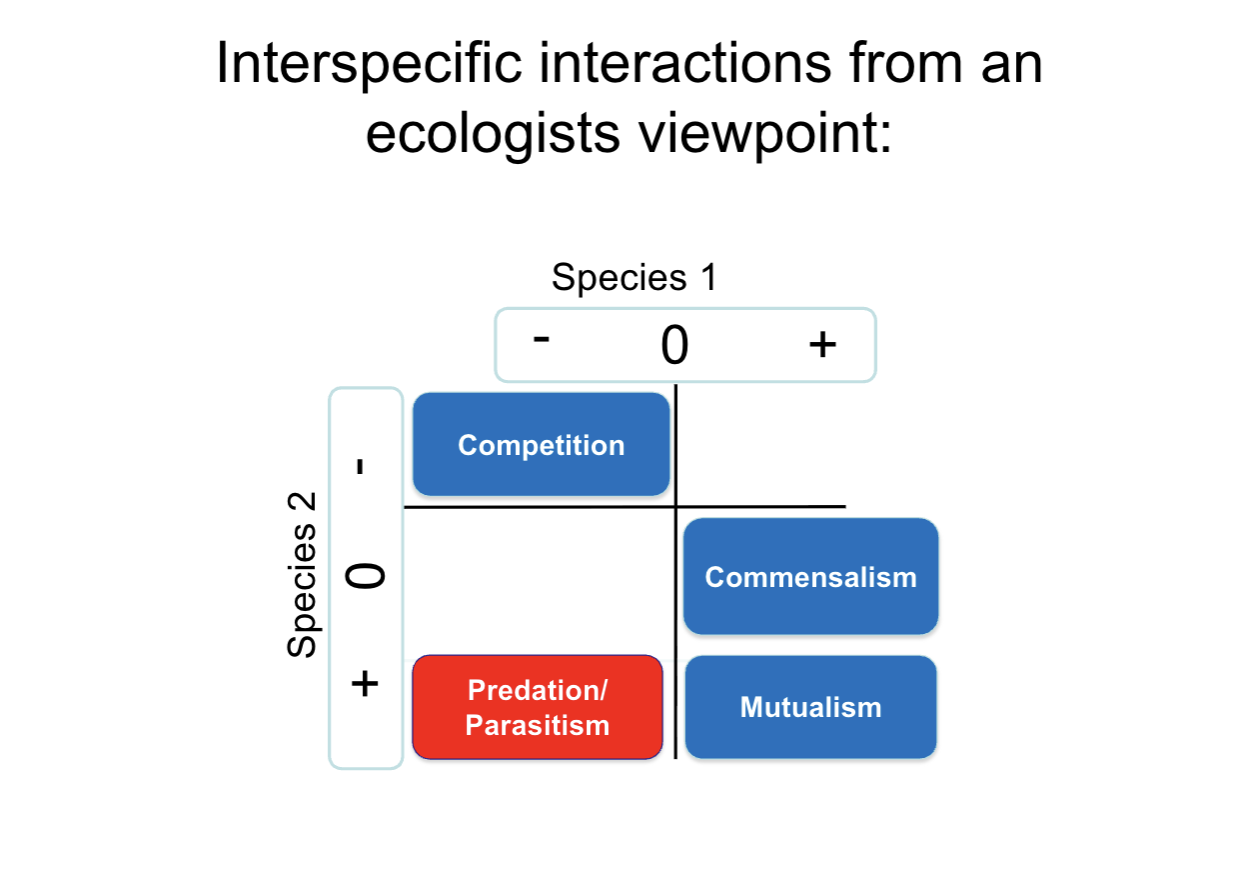
interspecific interactions from an ecologists viewpoint
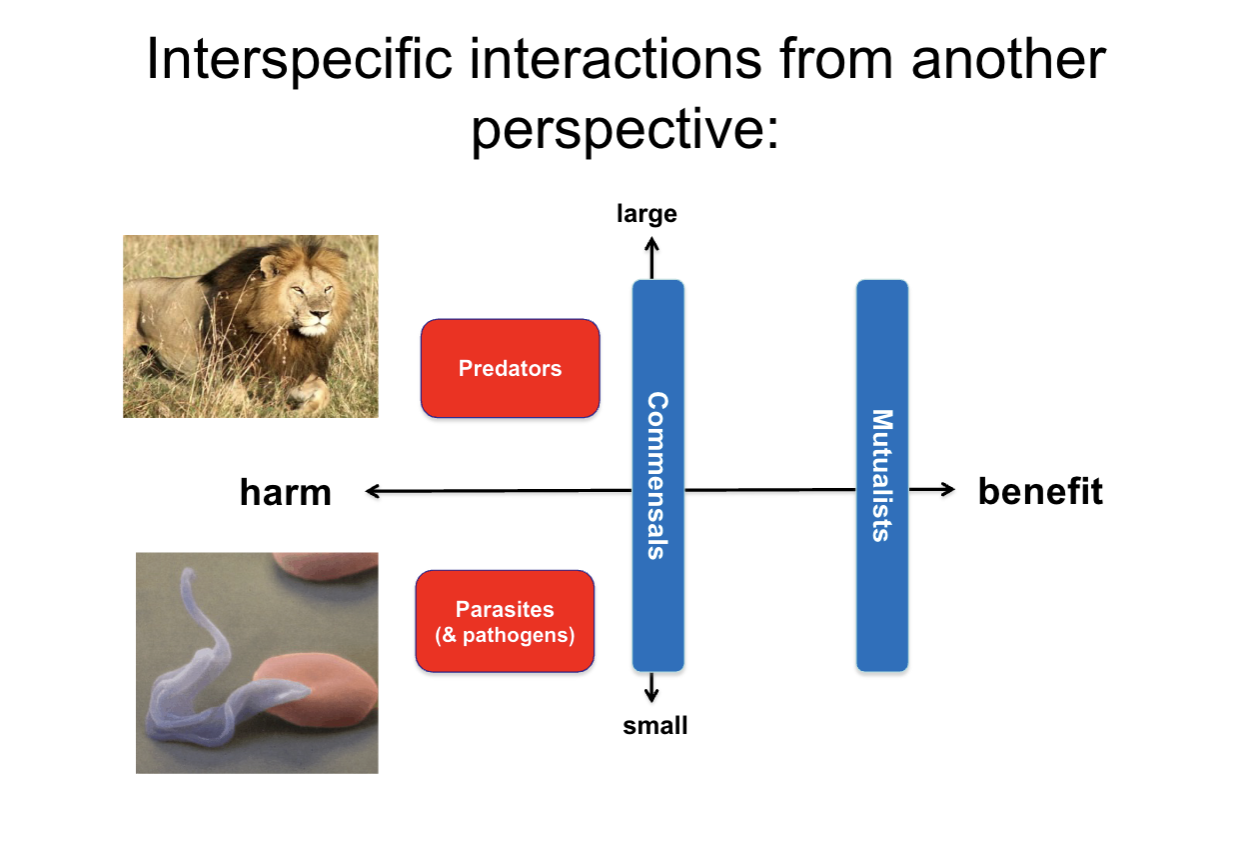
interspecific interactions from another perspective