Forces
 Call Kai
 Learn
Learn Practice Test
 Spaced Repetition
 Match
Match Flashcards
 Knowt Play
1/47

There's no tags or description
Looks like no tags are added yet.
Name | Mastery | Learn | Test | Matching | Spaced | Call with Kai |
|---|
No analytics yet
Send a link to your students to track their progress
48 Terms
Speed
a scalar quantity defining how fast an object moves, measured as the rate of change in distance.
Distance
a scalar quantity of far something travels.
Displacement
How far something travels in a given direction.
Acceleration
The rate of change in velocity.
Scalar
A quantity with magnitude.
Vector
A quantity with magnitude and direction.
Velocity
How fast something travels in a given direction.
label the displacement graph
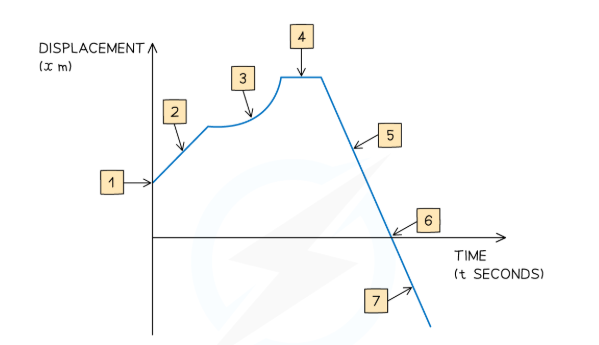
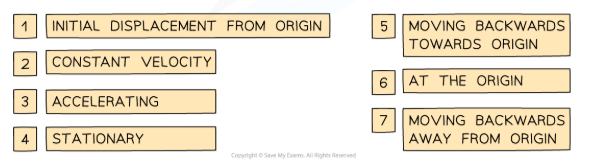
in a displacement time graph, what does positive gradient represent
moving forwards
in a displacement time graph, what does negative gradient represent
moving backwards
in a displacement time graph, what does straight line represent
constant velocity
in a displacement time graph, what does curved line represent
accelerating or decelerating
in a displacement time graph, what does horizontal line represent
stationary
in a displacement time graph, what does line touching x axis represent
object back at origin
label the velocity time graph
A= Constant acceleration
B= Constant velocity
C= Constant deceleration
D= Stationary
What does SUVAT stand for
Displacement, Initial velocity, Final velocity, Acceleration, Time
displacement unit
m
initial velocity unit
m/s or ms^-1
final velocity
m/s or ms^-1
acceleration unit
m/s² or ms^-2
time unit
s
SUVAT Equations
v= u+ at
s= ut+ ½ at²
s= ½ (u+v) t
v² = u² + 2as
The gradient of a displacement - time graph is what
velocity
The gradient of a velocity-time graph is what
Acceleration
The area under a velocity-time graph is what
displacement
how to use two light gates
Set up the ramp with two light gates (attached to a computer) at the bottom
Measure the length of the card using a ruler
Release the trolley from rest at the top of the ramp.
As the trolley passes through light gate 1 and 2, times t1 and t2 are recorded, on the data logger, as the card blocks the light beam.
The time for the trolley to pass between the light gates is also recorded.
using one light gate
Set up the ramp (attached to 2 masks) with one light gate (attached to a computer) at any point
Measure the length of each mask using a ruler, ideally, these should be the same length.
Release the trolley from rest at the top of the ramp.
As the trolley passes the light gate, the computer records the time t1 that the first card blocks the light beam and the time t2 that the second card blocks the light beam.
how to find the acceleration of the trolley without light gates and a datalogger
Draw two lines across a tilted board, one near the top and one near the bottom.
Measure the distance between both lines.
Hold the trolley so it is lined up with the first line.
Let go, and simultaneously start the stopwatch. Stop the stopwatch just as the front of the trolley meets the bottom line.
use s = ut+ ½ at²
What is drag?
the frictional force that opposes the movement of an object through a gas or a liquid. eg - air resistance
resultant force
the combined effect of multiple forces acting on the same object.
how is the resultant force calculated
subtracting opposite forces from one another.
If the resultant force is 0 N we say the forces are balanced.
If the resultant force is greater than 0N, the object will accelerate in the direction with a larger magnitude
What is a free-body diagram?
A diagram showing all the forces acting on a single object, represented by arrows pointing in the direction of each force.
What are the common forces shown in free-body diagrams?
Weight (W): Force due to gravity, points down
Normal force (N): Contact force perpendicular to a surface
Friction (f): Opposes motion along a surface
Tension (T): Force along a string, rope, or cable
Applied force (F): Any push or pull applied to the object
What is terminal velocity?
the constant speed an object reaches when the drag force balances the accelerating force (no further acceleration).
what is the normal reaction force
between two surfaces that are touching each other, it acts perpendicular to the two surfaces (at 90 degrees)
what is state friction
the force that stops one surface beginning to move against another surface. The coefficient of static friction is a measure of the amount of friction involved:
what is dynamic friction
the force that resists movement of an object that is already moving which is needed to keep the object moving at a constant velocity.
what method can we use to measure the coefficient of static friction
Measure and record the mass of a block with a hook attached to it. Calculate its weight.
Place the block on the bench and attach a newton meter.
Gently pull the block using the newton meter and record the force when the block just begins to move.
Repeat steps 1-3 five more times and then calculate the mean value.
Calculate μ using the values from steps 1 and 4.
Repeat the method for different surfaces.
Conservation of Momentum law
In a closed system, the total momentum before an event is equal to the total momentum after the event.
whats the relationship between Momentum and Resultant Force
When a resultant force acts on an object, it’s momentum changes.
The rate at which this momentum changes is equal to the resultant force.
newtons 1st law
An object at rest remains at rest, or if in motion, remains in motion at a constant velocity unless acted on by a net external force
newtons 2nd law
states that the net force acting on an object is directly proportional to its acceleration and directly proportional to the object's mass
newtons 3rd law
states that for every action (force) in nature, there is an equal and opposite reaction.
what is inertia
the natural tendency of an object to resist changes in its state of motion,
what is an accelerometer and what its primary function?
a tiny sensor that measures acceleration. It detects changes in speed and direction and converts that motion into electrical signals.
What are the 3 axes of rotation in 3D space, and what movements do they describe? (linear)
X: Side to side
Y: Front to back
Z: Up and down
How many accelerometers are required to measure motion in three planes (3D)?
Three accelerometers are required, positioned at right angles to one another.
Why are motion equations necessary for devices like smartphones and fitness trackers?
Because accelerometers gather raw data on force/movement, then is calculated using motion equations to determine distance, speed, or specific activities.