Lecture 18 - Life course epidemiology
 Call Kai
 Learn
Learn Practice Test
 Spaced Repetition
 Match
Match Flashcards
 Knowt Play
1/29

There's no tags or description
Looks like no tags are added yet.
Name | Mastery | Learn | Test | Matching | Spaced | Call with Kai |
|---|
No analytics yet
Send a link to your students to track their progress
30 Terms
What is the aim of life course epidemiology?
Aim to integrate and extend the 3 main theories of disease aetiology
Foetal/developmental origins of adult disease
Adult lifestyle
Social causation theories
The initial focus of life course epidemiology was what?
Initial focus: early life factors -> clinical disease end-points
1980s:
Primary focus on ‘conventional’ adult lifestyle models of chronic disease since 1950s but growing dissatisfaction with them
Poor predictors of individual risk
Why is life course epidemiology relevant to new policies?
Evidence for the life course approach is strong
What happens in early life affects health and wellbeing later in life
Successful policies in response to an ageing population are likely those which take a whole life course approach
Why is time important in a life course approach?
Encourages consideration of different exposures in the context of:
Timing
Duration
Temporal ordering
Aims to provide aetiological insights into lifelong processes which influence ageing and health
Also gathers evidence on the type, timing and targeting of the most effective interventions to promote health
How is a theoretical life course framework constructed?
More than just the collection of exposure data across life
Requires diagrammatical ordering of variables across life with temporal ordering of exposure variables and their inter-relationships explicitly shown
Used for hypothesis generation and testing, enables researchers to outline a priori not only hypothesised associations of factors earlier in life with later outcomes but also possible underlying social and biological pathways
How is a theoretical life course framework turned into testable hypothesis?
Need to breakdown theoretical frameworks into smaller testable parts
Modelling the whole life course pathway would be too complicated
Life course models were originally used to test the influence of the timing and duration of exposure across life on later disease risk
Critical and sensitive period models
Accumulation of risk models
Models are not mutually exclusive and may operate simultaneously
What is a critical period model? Give an example.
The only time period during which an exposure (A) has an effect
E.g. thalidomide in utero and limb abnormalities
What is a sensitive period model? Give an example.
A time period during which an exposure (B) has a greater effect than outside this period
E.g. smoking before 1st pregnancy and breast cancer risk
What do accumulation of risk models aim to model?
Exposures or insults gradually accumulate across life through episodes of illness and injury
Accumulation of risk models aim to model this
What is ‘Accumulation of independent risks’?
Accumulation of exposure to different, uncorrelated risk factors (A, B and C) causes long term damage and increases disease risk
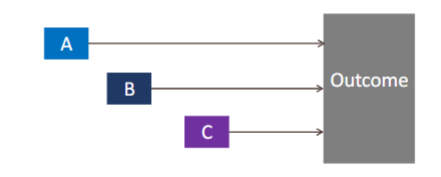
What is an example of ‘accumulation of independent risks’?
Being burgled
Death of child
Job loss
All increase risk of depression

What is ‘Accumulation of clustered risks’?
Accumulation of exposures to different risk factors (A, B and C) which are clustered as each are associated with another risk factor (D) which causes long term damage and increases disease risk
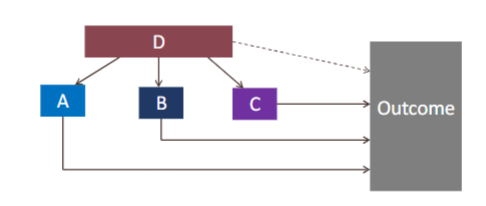
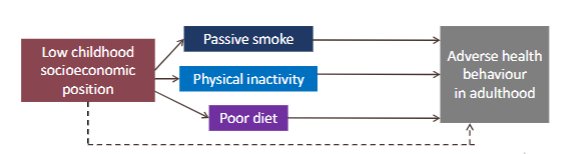
What is an example of ‘accumulation of clustered risks’?
Low childhood socioeconomic position
Passive smoke
Physical inactivity
Poor diet
All increase risk of adverse health behaviour in adulthood
What are the two types of ‘chain of risk’ models?
Additive effect models
Trigger effect models
What are ‘Additive effect’ models?
Type of ‘Chain of risk’ model.
Each exposure (A,B) not only increase the risk of subsequent exposure (B,C) but also has an independent effect on disease risk (irrespective of later exposure)

What is an example of ‘additive effects’?
Smoking
Poor lung function
Sedentary behaviour
All increase risk of cardiovascular disease

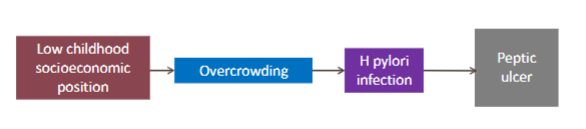
What are ‘Trigger effect’ models?
Type of ‘Chain of risk’ model.
Earlier exposures (A and B) influence the risk of subsequent exposures but have no effect on disease risk without the final exposure (C)
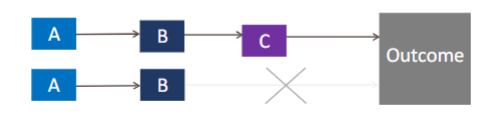
What is an example of ‘trigger effect’?
Low childhood socioeconomic position
Overcrowding in home
H pylori infection
Peptic ulcer development
What are the limitations of life course models?
Focus on lifetime exposures rather than the responses
Not all outcomes are ‘hard’ disease end-points
Original examples consider exposures at different time points when quite often we’re investigating exposure to the same risk factor over time
Don’t accurately represent the complex and dynamic interplay of developmental, risk factor and age-related trajectories across life
What is the ideal study which could be used to test a life course hypothesis?
Assessment of outcomes
At different life stages
Baseline measures ascertained prior to onset of major age-related decline
With repeat measures over time
Data on potential risk factors
From birth (or earlier) onwards
With repeat measurements over time (to facilitate study of different life course models)
That are potentially modifiable
Which types of studies are used for life course research?
National and regional birth cohorts
Historical cohorts
Adult cohorts with retrospective data on childhood
Natural experiments
Long-term follow-up of randomized controlled trials (RCTs)
What are national and regional birth cohorts?
National and regional birth cohorts
Data collected prospectively across life from birth
What are historical cohorts?
Historical cohorts
Some data ascertained earlier in life and study participants then retraced later in life
What are adult cohorts with retrospective data on childhood?
Adult cohorts with retrospective data on childhood
Repeat measures in adulthood and recalled data on childhood
What are the benefits of using multiple ‘life course’ studies?
No one study has data on all measures of interest at all relevant life stages
Facilitates study of cohort differences
Are associations generalizable or cohort specific
May impact on associations observed and relative public health importance of different risk factors
Important differences in environment across time
and between countries
How has life course epidemiology impacted understanding of factors across life relating to chronic pain later in life?
Serious illness before 25 has been associated with increased risk of chronic widespread pain at age 68y
What associations were found during studies of childhood factors and back pain?
Persistent back-pain
Taller childhood height (in women), abdominal pain in adolescence, poor care in childhood, poorer maternal health
Back-pain in early adulthood only
Taller childhood height (in women)
Mid-adulthood onset of back-pain
Abdominal pain in adolescence