macroeconomics - aggregate demand and supply
 Call Kai
 Learn
Learn Practice Test
 Spaced Repetition
 Match
Match Flashcards
 Knowt Play
1/41

There's no tags or description
Looks like no tags are added yet.
Name | Mastery | Learn | Test | Matching | Spaced | Call with Kai |
|---|
No analytics yet
Send a link to your students to track their progress
42 Terms
aggregate demand definition
total demand for a nation's goods and services from domestic households, firms, the government and foreigners.
also known as the total quantity of goods and services that all buyers in an economy want to buy at different possible price level, ceteris paribus
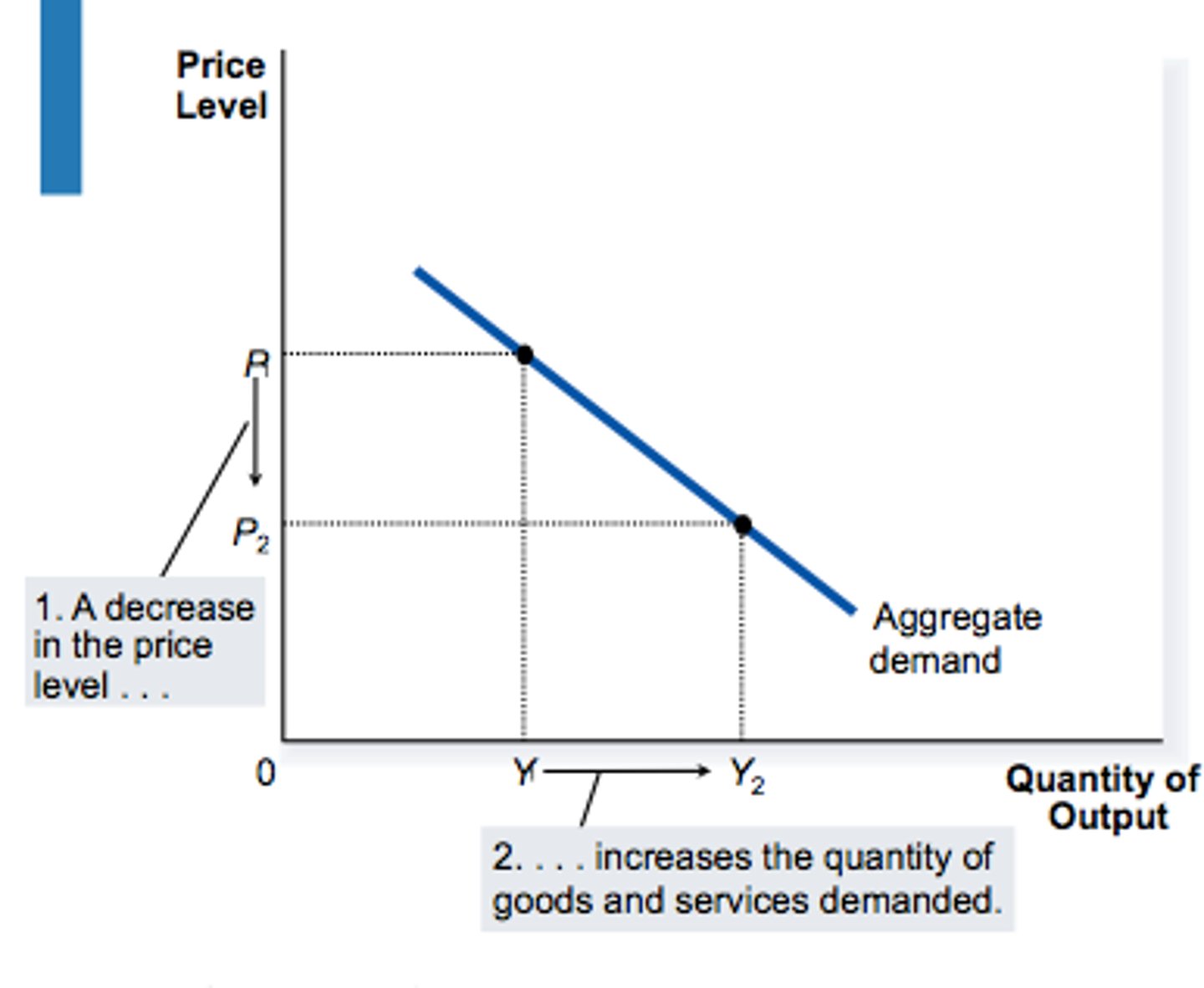
AD curve
aggregate demand formula
C + I + G + (X-M)
C = demand of consumers
I = demands of firms
G = demand of government
X = demand of foreigners for exports
M = demand of domestic buyers for imports
3 reasons for aggregate demand being downward sloping
1. the wealth effect
2. the interest rate effect
3. the net export effect
what is the wealth effect
changes in price level affect the real value of people's wealth (NOT income)
what is wealth
it is equity
assets - liabilities
economic theory - the wealth effect
as the prices go up, liabilities increase, but assets stay the same, which reduces wealth
OR
1. PL increase
2. households' liabilities increase
3. households' wealth decreases
4. households' consumption decreases
5. since consumption (C) is a component of real GDP; real GDP decreases
what is the interest rate effect
changes in price level have impact on rates of interest which in turn affect aggregate demand
interest rate is
the cost of borrowing money
economic theory - interest rate effect
1. PL increases
2. Interest rates increase
3. HHs: more savings and less borrowing --> less consumption
4. Since consumption (C) is a component of RGDP, RGDP decreases
what is the net export effect
also known as international trade effect
--as the price level in a particular country falls, ceteris paribus, goods and services produced in that country become more attractive to foreign customers
--likewise, domestic consumers find imports less attractive as they now appear relatively more expensive, so the net expenditure on exports rises as price level falls
economic theory - net export effect
1. PL increases
2. Imports increase
3. Net exports decrease
4. Since net exports (X-M) are a component of RGDP, RGDP decreases
what does right shift of AD mean?
it means that aggregate demand increases: for ay particular price level, a larger amount of real GDP is demanded
what does left shift of AD mean?
it means that aggregate demand decreases: for any particular price level, a smaller amount of real GDP is demanded
what causes shifts of aggregate demand?
changes in components of AD
AD = C + I + G + Xn
1. changes in consumer spending (C)
2. changes in investment spending (I)
3. changes in government spending (G)
4. changes in foreigners' spending (Xn)
6 changes in consumer spending
1. a change in wealth
--value of household's assets minus liabilities
2. a change in expectation about future incomes and prices
3. a change in interest rates (returns on saving more)
4. a change in personal income taxes (due to fiscal policy)
5. a change in level of household indebtedness
6. a change in the attitudes towards spending
explain a change in interest rates
returns on saving more
if interest rates are higher, households will prefer to save more and consume less.
At lower interest rates, consumption is higher and saving is less
explain a change in level of household indebtedness
at high debt levels, households must allocate more income to paying off debt, therefore consumption falls
explain a change in the attitudes towards spending
consumer confidence
explain a change in personal income taxes (due to fiscal policy)
A tax cut boosts disposable income, allowing for higher spending, while a tax increase reduces it
what is fiscal policy
the use of government spending and taxation to influence a nation's economy, particularly to manage economic growth, inflation, and unemployment
level of taxation and government spending
2 changes in investment spending
1. interest rates
2. expectations of firms (business confidence)
explain change interest rates in terms of investment spending
at lower interest rates, firms borrow more money and buy more new capital equipment.
if interest rates are higher, firms will invest less
explain change in expectation of firms (business confidence) (4 things)
1. a change (improvement) in technology
2. a change in business taxes (due to fiscal policy)
3. legal/institutional changes
4. a change in expectations about future sales
if firms are confident about future business opportunities ____
if expectations are poor ____
they make higher investment
firms will invest less
2 changes in government spending
1. fiscal policy
2. government debt/political priorities
explain changes in fiscal policy
lower taxes increase the AD
higher taxes decrease the AD
explain changes in government debt/political priorities
more debt may mean more government spending in the short-run, so taxes have to be raised and government spending must fall if there is too much government debt
what does short run mean in macroeconomics
this is the period of time during which the nominal pries of resources, particularly the price of labor (wages), don't change in response to changes in price level.
we can think of resource prices as being constant
what does long run mean in macroeconomics
this is the period of time in which the nominal prices of all resources, including the price of labor change, so as to reflect fully any change in price level.
5 reasons for uncahnging wages
1. labor contracts fix wage rates for certain periods of time, perhaps a year, or 2, or more
2. minimum wage legislation fixes the lowest legally permissible wage
3. workers and labor unions resist wage cuts
4. wage cuts have negative impacts on worker morale, causing firms to avoid them
5. ideas of fairness may dictate the level of wages
aggregate supply definition
this is the total quantity of goods and services produced in an economy at different price levels, ceteris paribus
short run aggregate supply (SRAS)
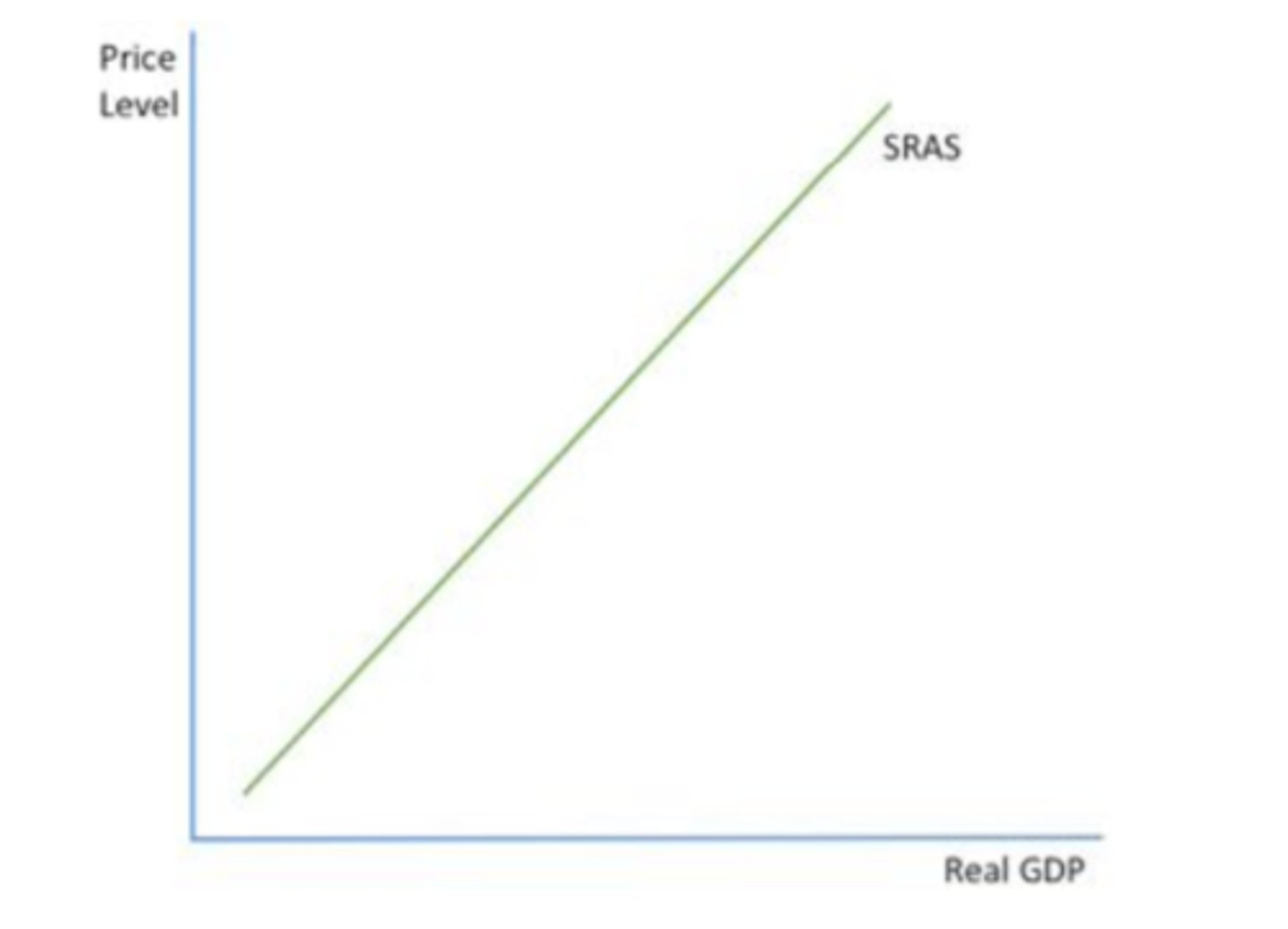
this shows the relationship between the price level and the quantity of real GDP produced by firms when resource prices (particularly wages) do not change.
SRAS curve
reason for SRAS being upward sloping
profitability
5 changes in SRAS (shifts in the SRAS curve)
1. changes in wages
2. changes in non-labor resource prices
3. changes in business taxes
4. changes in subsidies offered to business
5. supply shocks
explain changes in wages SRAS
if they increase, SRAS shifts left
explain changes in non-labor resource prices SRAS
if resource prices increase, SRAS shifts left
explain changes in business taxes SRAS
lower taxes for businesses or lower taxes for consumers - boosts AS, shifts right
explain changes in subsidies offered to business SRAS
a) an industry that holds a large share of national econ's capacity - to boost AS
b) an energy provider -- energy prices decrease, AS shifts right
explain supply shocks SRAS
natural or hand-made disasters that delay/destroy production in the short run, especially climate change.
shift in SRAS