UNIT 2 Autonomic Nervous System pharm
 Call Kai
 Learn
Learn Practice Test
 Spaced Repetition
 Match
Match Flashcards
 Knowt Play
1/62

There's no tags or description
Looks like no tags are added yet.
Name | Mastery | Learn | Test | Matching | Spaced | Call with Kai |
|---|
No analytics yet
Send a link to your students to track their progress
63 Terms
Nervous System
Functions to control and coordinate activity of all systems in the body
Controls and coordinates all activities in the body.
Involuntary and voluntary control
Voluntary Control
(You choose to do it)
Things you can control on purpose.
Walking
Talking
Writing
Raising your hand
Easy memory tip: … = "I decide."
actions you control.
Involuntary Control
(Happens automatically)
Things your body does without you thinking about it.
Heartbeating
Breathing
Digestion
Blinking
Easy memory tip: … = "Body does it automatically."
actions your body controls automatically.
Two Subdivisions of the Nervous System
1. Central Nervous System (CNS)
2. Peripheral Nervous System(PNS)
1. Central Nervous System (CNS) 🧠
Made of:
Brain
Spinal cord
What does it do?
The … is the control center .
Item:
Receives information from the body
Interprets (understands) the information
Sends instructions back to the body
Example:
You touch a hot stove.
Skin feels heat 🔥
Message goes to the brain/spinal cord
Brain says "That's hot!"
Brain sends message to move your hand away
Easy memory:
👉 CNS = Control Center
2. Peripheral Nervous System (PNS) 🔌
Made of all the nerves outside the brain and spinal cord.
The PNS is like the telephone wires connecting the body to the CNS.
What does it do?
Carries messages:
To the CNS
From the CNS
Easy memory:
👉 … = Pathway of Nerves
afferent nerves- sensory impulses toward CNS
efferent nerves-motor impulses away from CNS
cranial nerves-12 pr.
spinal nerves-31 pr.
Afferent Nerves
2. Peripheral Nervous System(PNS)
Sensory Nerves 👀👂👃
These carry messages TO the CNS .
What are they carrying?
Things you:
See
Hear
Feel
Smell
Taste
Example:
You touch ice 🧊
Message travels:
Hand → CNS
Easy memory:
👉 … = Arrives at CNS
2. Peripheral Nervous System(PNS)
Efferent Nerves
Motor Nerves 💪
These carry messages AWAY from the CNS .
Example:
Brain tells your arm to move.
Message travels:
CNS → Arm muscle
Easy memory:
👉 … = Exits CNS
Cranial Nerves
12 pairs
Come directly from the brain
They help with:
Vision 👀
Hearing 👂
Smell 👃
Taste 👅
Facial movements 😊
Easy memory:
👉 … = Comes from the Cranium (brain/skull)
Spinal Nerves
2. Peripheral Nervous System(PNS)
31 pairs
Come from the spinal cord
They send messages between the spinal cord and the rest of the body.
Examples:
Arms
Legs
Chest
Back
Easy memory:
👉 … = Connect body to spinal cord
Two Subdivisions of the Nervous System
side by side
Term | Easy Meaning |
|---|---|
CNS | Brain + spinal cord (control center) |
PNS | All nerves outside CNS |
Afferent | Sensory messages TO CNS |
Efferent | Motor messages AWAY from CNS |
Cranial nerves | 12 pairs from brain |
Spinal nerves | 31 pairs from spinal cord |
Afferent = Arrives at CNS 🚶➡🧠
Efferent = Exits CNS 🧠➡💪
Somatic Nervous System (SNS) 💪
Think of the …. as the part of the nervous system that lets you move your body on purpose .
What does it do?
It controls your skeletal muscles (the muscles attached to your bones).
Examples:
Walking 🚶
Running 🏃
Writing ✍
Smiling 😊
Raising your hand 🙋
These are all movements you choose to make .
1. Somatic Nervous System
"Nerves branch from cranial and spinal motor nerves"
This means:
The nerves that control movement come from:
Cranial nerves (from the brain)
Spinal nerves (from the spinal cord)
These nerves carry messages to your muscles.
Example:
You decide to wave your hand.
Brain makes the decision 🧠
Motor nerves carry the message 📩
Hand muscles receive the message 💪
Your hand waves 👋
1. Somatic Nervous System
"Innervate skeletal muscle"
Innervate = supply nerves to
Skeletal muscle = muscles attached to bones
So this phrase means:
👉 The somatic nervous system sends nerves to skeletal muscles so they can move.
Example:
Arm muscles
Leg muscles
Finger muscles
All are controlled by the somatic nervous system.
"Voluntary control by cerebral cortex" Voluntary
Means you control it on purpose .
Cerebral cortex
The outer part of the brain that helps you:
Think
Learn
Make decisions
Control movement
Example:
You decide to pick up a pencil.
Cerebral cortex says, "Pick up the pencil." 🧠
Message travels through nerves 📩
Hand muscles move ✏
Somatic Nervous System / PNS
…..
Controls voluntary (intentional) movements of skeletal muscles.
Pathway:
🧠 Brain (cerebral cortex)
➡ Motor nerves
➡ Skeletal muscles
➡ Movement
Examples:
Walking
Writing
Kicking a ball
Raising your hand
Easy Memory Trick
… = Skeletal muscles = Stuff you choose to do
👉 … = "I move it." 💪🧠
PNS
Autonomic Nervous System (ANS) - Visceral
Think of the ANS as the body's autopilot system .
It controls things that happen without you thinking about them .
Examples:
Heartbeating ❤
Digestion 🍔
Breathing 😮💨
Sweating 💦
Saliva production 😋
Easy memory:
👉 Autonomic = Automatic
"Visceral"
Visceral means internal organs .
Examples:
Heart ❤
Stomach 🍔
Intestines
Lungs 🫁
Bladder
Autonomic Nervous System (ANS) - Visceral/ PNS
"Branches of cranial and spinal motor nerves innervate cardiac and smooth muscle of internal organs and glands"
Innervate = supply nerves to
The ANS sends nerves to:
Cardiac Muscle ❤
Heart muscle
Smooth Muscle 🫁🍔
Muscles found in organs such as:
Stomach
Intestines
Blood vessels
Bladder
Glands 💧
Make and release substances:
Salivary glands
Sweat glands
What's happening?
The ANS sends messages to these organs so they can work properly.
Autonomic Nervous System (ANS) - Visceral/ PNS
"Involuntary Control"
happens automatically
You do NOT have to think:
❌ "Beat heart now."
❌ "Digest lunch now."
❌ "Make saliva now."
Your body does it automatically.
"Regulated by hypothalamus and medulla oblongata"
These are brain areas that help control automatic body functions.
Hypothalamus
Acts like the body's thermostat 🌡
Helps control:
Body temperature
Hunger
Thirst
Sleep
Medulla Oblongata
Controls life-sustaining functions ❤
Helps control:
Heart rate
Breathing
Blood pressure
Autonomic Nervous System (ANS) - Visceral
Authorhythmicity
contraction without any stimulus"
Means an organ can create its own rhythm.
Example:
❤ Heart
The heart can beat on its own without someone telling it to beat every time.
Easy memory:
👉 Auto = self
👉 Rhythmicity = rhythm
… = self-made rhythm
Autonomic Nervous System (ANS) - Visceral
"Regulates the rate at which these organs work by increasing or decreasing their activity → homeostasis"
The ANS can:
⬆ Speed things up
OR
⬇ Slow things down
Example:
Running 🏃
ANS:
Increases heart rate ❤⬆
Increases breathing 🫁⬆
Sleeping 😴
ANS:
Slow heart rate ❤⬇
Slow breathing 🫁⬇
Why?
To keep the body balanced.
Autonomic Nervous System (ANS) - Visceral
PNS
side by side
Term | Easy Meaning |
|---|---|
ANS | Automatic nervous system |
Visceral | Internal organs |
Innervate | Supply nerves to |
Cardiac muscle | Heart muscle |
Smooth muscle | Muscles in organs |
Involuntary | Automatic, no thinking |
Hypothalamus | Controls temperature, hunger, thirst |
Medulla oblongata | Controls heart rate and breathing |
Autorhythmicity | Organ creates its own rhythm |
Homeostasis | Keeping the body balanced |
Autonomic Nervous System = "My body does it automatically." ❤🫁🍔
Autonomic Nervous System (ANS)
1. Ganglia = Relay Stations 🚉
What are ganglia?
Ganglia are groups of nerve cell connections where messages stop briefly before continuing.
Simple idea:
Think of a ganglion as a bus station .
🧠 Spinal Cord → 🚉 Ganglion → ❤ Organ
The message stops at the ganglion and then continues to the organ.
Easy memory:
👉 Ganglia = Relay stations
Autonomic Nervous System - continued
2. Preganglionic Nerve vs Postganglionic Nerve
Preganglionic nerve
First Neuron 🚶 What does it do?
Carries the message from the spinal cord to the ganglion .
Path:
🧠/Spinal Cord → Preganglionic Nerve → 🚉 Ganglion
Easy memory:
👉 Pre = Before the ganglion
3. Postganglionic Nerve = Second Neuron 🚶 What does it do?
Carries the message from the ganglion to the organ or gland .
Path:
🚉 Ganglion → Postganglionic Nerve → ❤ Organ
👉 Post = After the ganglion
Autonomic Nervous System
path
Whole Path Together Example: Heart Rate Control ❤
Brain/spinal cord sends message 🧠
Preganglionic nerve carries it 🚶
Message reaches ganglion 🚉
Postganglionic nerve carries it 🚶
Heart receives message ❤
Heart speeds up or slows down
4. Neurotransmitters (NTs)
Autonomic Nervous System
Chemical Messengers 💌
What are they?
Special chemicals that carry messages from one nerve cell to the next.
Without neurotransmitters, the message would stop.
Think of them as:
💌 "Text messages" between nerve cells
What do neurotransmitters do?
They:
Carry the message
Attach to receptors
Cause an action
Example:
Brain wants heart to beat faster ❤
Neurotransmitter is released 💌
It attaches to recipients on the heart 🔑
Heart responds ❤⬆
Receivers = Locks 🔒 Receptors
They are special places on organs that receive neurotransmitters.
Easy way to remember:
🔑 Neurotransmitter = Key
🔒 Receiver = Lock
When the key fits the lock, an action happens.
Autonomic Nervous System - continued
meaning
Made up of ganglia-collections of synapses (impulse travels from one neuron to the next) between preganglionic and postganglionic nerves
Preganglionic nerve- emerges from spinal cord
Postganglionic nerve- travels from ganglion to internal organ or gland
Neurotransmitters (NT)- keep impulse going, chemical substance, stimulates internal organ or gland to produce a change/action by binding to receptors
Autonomic Nervous System - continued
side by side
Term | Easy Meaning |
|---|---|
Ganglia | Relay stations where messages stop |
Preganglionic nerve | Carries message from spinal cord to ganglion |
Postganglionic nerve | Carries message from ganglion to organ |
Neurotransmitter (NT) | Chemical messenger |
Receptor | Receives the neurotransmitter |
Organ response | Action happens (heart beats, gland secretes, etc.) |
PRE = Before ganglion
🧠 → Preganglionic → 🚉
POST = After ganglion
🚉 → Postganglionic → ❤
NT = Chemical messenger 💌
Receiver = Lock 🔒
NT + Receiver = Action! ⚡❤🫁🍔
1. Sympathetic Nervous System
ANS
"Fight, Fright, or Flight" 🏃💨
This system turns the body ON during stress, danger, excitement, or emergencies.
What's happening?
❤ Heart rate increases
🫁 Breathing increases
👀 Pupils get bigger
🍔 Digestion slows down
💪 More blood goes to muscles
Example:
You see a big dog running toward you.
Your sympathetic nervous system says:
⚡ "Emergency! Get ready to run!"
Your heart beats faster and your muscles get ready for action.
Your heart beats faster and your muscles get ready for action.
Adrenergic
This means it mainly uses the neurotransmitter norepinephrine (and epinephrine) .
You don't need to memorize much right now—just remember:
👉 Sympathetic = Adrenergic
2. Parasympathetic Nervous System
ANS
"Rest and Digest" 😌🍔
This system calms the body down and helps it conserve energy.
What's happening?
❤ Heart rate slows
🫁 Breathing slows
🍔 Digestion increases
😴 Body relaxes
💧 More saliva is produced
Example:
You just finished eating dinner and are relaxing on the couch.
The parasympathetic nervous system says:
✅ "Everything is safe. Time to relax and digest food."
Cholinergic
This means it mainly uses the neurotransmitter acetylcholine .
👉 … = Cholinergic
Most Organs Receive Both Nerves
Subdivisions of the ANS
Most organs have:
A sympathetic nerve
A parasympathetic nerve
These work like a gas pedal and a brake pedal in a car.
Heart Example ❤
Sympathetic
⬆ Speeds heart rate up
Parasympathetic
⬇ Slows heart rate down
The body chooses which one is needed.
Exception: Blood Vessels 🩸
Most blood vessels receive only sympathetic nerves , not both divisions.
This is an important exception to remember.
Sympathetic Nervous System
fight, fright, flight
adrenergic
Parasympathetic Nervous System
rest and digest
cholinergic
Sympathetic vs Parasympathetic
Sympathetic | Parasympathetic |
|---|---|
Fight, fright, flight | Rest and digest |
Emergency mode | Relax mode |
Speeds heart up ❤⬆ | Slows heart down ❤⬇ |
Digestion decreases 🍔⬇ | Digestion increases 🍔⬆ |
Adrenergic | Cholinergic |
Sympathetic = Stress
"Fight or Flight"
🏃💨❤⬆👀⬆
Parasympathetic = Peace
"Rest and Digest"
😌🍔❤⬇
Sympathetic = Speeds things up ⚡
Parasympathetic = Slows things down and helps digestion 🌿🍔
Adrenergic System
Sympathetic Nervous System
"Fight, Flight, Fright" ⚡🏃
Think of the … System as your body's emergency mode .
When you're stressed, scared, excited, sick, or in danger, this system turns on to help you respond quickly.
What does it do?
It prepares your body to:
🏃 Run away (flight)
🥊 Fight
😨 React to fear (fright)
Example:
A car suddenly swerves toward you.
Your body instantly:
❤ Heart beats faster
🫁 Breathing increases
👀 Pupils get bigger
💪 Muscles get more blood and energy
This is the adrenergic system at work.
"Regulates activity of internal organs and glands during stressful situations"
Adrenergic System
This means the adrenergic system controls organs during stress.
Main organs affected:
❤ Heart
🧠 Brain
🫁 Lungs
It makes them work harder and faster.
"Large amount of energy exerted physically and mentally" What does this mean?
Your body uses lots of energy when stressed.
Physically:
🏃 Running
🥊 Fighting
🚴 Exercising
Mentally:
😰 Anxiety
📚 Taking an exam
🚨 Emergency situations
The body burns extra energy to stay alert and ready.
"Whole body will be stimulated"
Adrenergic System:
This is very important!
The adrenergic system affects many organs at the same time .
Not just one body part.
Example:
When scared:
❤ Heart speeds up
🫁 Lungs work harder
👀 Eyes widen
🍔 Digestion slows
Everything happens together.
"Daily stresses, illness, anxiety, crisis"
The adrenergic system doesn't only turn on during emergencies.
It can also be activated by:
📚 Exams
😰 Anxiety
🤒 Illness
🚨 Crisis
🏃 Exercise
"Gandlia are far from the effector organ"
Adrenergic System
Sympathetic Nervous System
Effector organ
= the organ that does the work
Examples:
❤ Heart
🫁 Lungs
🍔 Stomach
Simple idea:
In the sympathetic nervous system, the ganglia (relay stations) are usually closer to the spinal cord and farther from the organ.
Think:
🧠 → 🚉 Ganglion → ➖➖➖➖➖ → ❤ Organ
Long postganglionic nerve.
You mainly need to remember:
👉 …. ganglia are far from the organ.
"Adrenal medulla releases epinephrine and some norepinephrine"
Adrenergic System
Adrenal medulla
Part of the adrenal glands that sit on top of the kidneys.
Think of it as an emergency hormone factory .
What does it release?
⚡ Epinephrine (adrenaline)
⚡ Norepinephrine
These chemicals travel through the blood.
What do they do?
They help create sympathetic responses:
❤ Heart beats faster
🫁 Breathing increases
💪 More energy available
👀 Pupils dilate
"Endocrine function" Endocrine
= hormones released into the bloodstream
Unlike nerves, hormones travel through the blood to reach organs.
Think:
🏭 Adrenal medulla
⬇
⚡ Epinephrine released
⬇
🩸 Bloodstream
⬇
❤🫁💪 Organs respond
Adrenergic System
Sympathetic Nervous System
Term | Easy Meaning |
|---|---|
Adrenergic System | Fight, flight, fright system |
Purpose | Helps body handle stress |
Affects | Heart, lungs, brain, muscles |
Whole body stimulated | Many organs respond together |
Epinephrine | Adrenaline |
Norepinephrine | Sympathetic neurotransmitter |
Adrenal medulla | Releases adrenaline |
Endocrine | Hormones travel through blood |
Adrenergic = Adrenaline ⚡
Stress → Adrenal medulla → Epinephrine → Fight or Flight
😨 ➡ ⚡ ➡ ❤⬆ 🫁⬆ 💪⬆
Adrenergic System = Emergency Mode 🚨🏃💨
Adrenergic System: “Fight, Flight, Fright”
Sympathetic Nervous System
regulates activity of internal organs and glands during physical and mental stressful situations (heart, brain, lungs)
large amt of energy exerted physically and mentally
WHOLE body will be stimulated, not just a part; one neuron acts on many
daily stresses, illness, anxiety, crisis
ganglia are far from effector organ
adrenal medulla releases epinephrine and some norepinephrine that travel to receptor sites and produce sympathetic responses (endocrine function)
Neurotransmission of Sympathetic Nervous System
ACh = At the Ganglion/ cholinergic
NT released at ganglia from presynaptic nerve endings (both systems)
NE = Nerve Ending to Organ/ adrenergic
NT released at postganglionic nerve endings
synthesized from dopamine
released by adrenal medulla and neurons
EPI = Emergency Adrenaline/ adrenergic
acts on adrenergic receptors
produced by adrenal medulla
Dopamine (DA)
sympathetic and CNS neurotransmitter
precursor to NE
stimulates many receptors (alpha, beta, dopaminergic); different actions based on dose given
DA → NE → EPI
Dopamine → Norepinephrine → Epinephrine ✅
This pathway is one of the most important things to remember for sympathetic nervous system questions.
The One Chart to Memorize 📝
Neurotransmission of Sympathetic Nervous System
Sympathetic Nervous System
🧠
⬇
ACh (at ganglion)
🚉 Ganglion
⬇
NE (at organ)
❤🫁💪
Hormone Pathway
🏭 Adrenal Medulla
⬇
Epinephrine (Adrenaline)
⬇
🩸 Bloodstream
⬇
❤🫁💪 Fight-or-Flight Response
Neurotransmitter | Easy Job | Where It Works |
|---|---|---|
ACh | Carries message to ganglion | Preganglionic nerve |
NE | Main fight-or-flight chemical | Postganglionic nerve |
EPI | Adrenaline; boosts body response | Adrenal medulla → blood |
DA | Precursor to NE | CNS & sympathetic system |
Sympathetic Pathway
🧠/Spinal Cord
⬇
Preganglionic nerve
⬇ releases Acetylcholine (ACh)
🚉 Ganglion
⬇
Postganglionic nerve
⬇ releases Norepinephrine (NE)
❤🫁💪 Organ
Acetylcholine (ACh) vs Norepinephrine
Acetylcholine (ACh)
First Messenger 📩 What does it do?
ACh carries the message from the preganglionic nerve to the ganglion .
Important:
Both the sympathetic and parasympathetic systems use ACh at the ganglion.
Easy memory:
👉 ACh = At the ganglion
Norepinephrine (NE) = Main Sympathetic Messenger ⚡ What does it do?
After the message reaches the ganglion:
The postganglionic nerve releases norepinephrine
NE then goes to the organ and creates the fight-or-flight response .
Effects:
❤ Heart rate increases
🫁 Breathing increases
👀 Pupils dilate
🍔 Digestion slows
Easy memory:
👉 NE = Nervous system's Emergency chemical
NE Comes from Dopamine
Your body makes NE like this:
Dopamine
⬇
Norepinephrine
Easy memory:
👉 DA → NE
(Dopamine becomes Norepinephrine)
Epinephrine (EPI)
Neurotransmission of Sympathetic Nervous System
…. = Adrenaline ⚡⚡ What is it?
Epinephrine is also called adrenaline .
Where is it made?
🏭 Adrenal medulla (part of the adrenal gland)
What does it do?
Travels through the blood and helps create the fight-or-flight response.
Effects:
❤ Faster heart rate
🫁 Faster breathing
💪 More energy
👀 Larger pupils
Easy memory:
👉 EPI = Emergency Power Increase
4. Dopamine (DA) 🧠
What is it?
A neurotransmitter found in:
🧠Central Nervous System (CNS)
⚡ Sympathetic Nervous System
Important Job
Dopamine is the precursor to norepinephrine.
Precursor means:
"Comes before"
Easy pathway:
Dopamine
⬇
Norepinephrine
⬇
Epinephrine
Easy memory:
👉 DA → NE → EPI
Dopamine Can Affect Different Receptors
Neurotransmission of Sympathetic Nervous System
Dopamine can stimulate:
Alpha receptors
Beta receptors
Dopamine receptors
Why is this important?
Different doses of dopamine can cause different effects.
Think of dopamine as a multitool 🛠 that can do different jobs depending on how much is present.
Sympathetic Nervous System: Step-by-Step
Example:
You see a bear 🐻 and get scared.
Your body needs to activate the fight-or-flight response .
Step 1: Brain/Spinal Cord Detects Stress 🧠
Your brain realizes:
⚠ "Danger! We need to react!"
The message starts in the brain/spinal cord.
Step 2: Preganglionic Nerve Carries the Message
The message travels down the preganglionic nerve .
Think of this as the first messenger .
Step 3: Acetylcholine (ACh) Is Released 📩
When the message reaches the ganglion (relay station) :
The preganglionic nerve releases Acetylcholine (ACh) .
Why?
Because ACh helps pass the message to the next neuron.
Think: 🧠 → ACh → 🚉 Ganglion
Step 4: Postganglionic Nerve Receives the Message
The second neuron (postganglionic nerve) receives the message.
Now it must deliver the message to the organ.
Step 5: Norepinephrine (NE) Is Released ⚡
The postganglionic nerve releases Norepinephrine (NE) onto the target organ.
Why?
NE tells the organ: ⚡ "Emergency mode!"
For example: ❤ Heart beats faster, 🫁 Lungs work harder
👀 Pupils get bigger
Think: 🚉 Ganglion → NE → ❤ Organ
Neurotransmission of Sympathetic Nervous System
summary
Imagine you're walking in the woods and seeing a bear:
🧠 Brain senses danger.
🚶 Preganglionic nerve carries message.
📩 ACh released at ganglion.
🚶 Postganglionic nerve carries message.
⚡ NE released at organs.
❤ Heart speeds up, 🫁 breathing increases.
🏭 Adrenal medulla releases epinephrine into blood.
⚡ Whole body goes into fight-or-flight mode.
What You Really Need to Memorize Nerve Pathway
Brain → Preganglionic Nerve → ACh → Ganglion → Postganglionic Nerve → NE → Organ
Hormone Pathway
Adrenal Medulla → Epinephrine → Bloodstream → Organs
Chemical-Making Pathway
Dopamine → Norepinephrine → Epinephrine
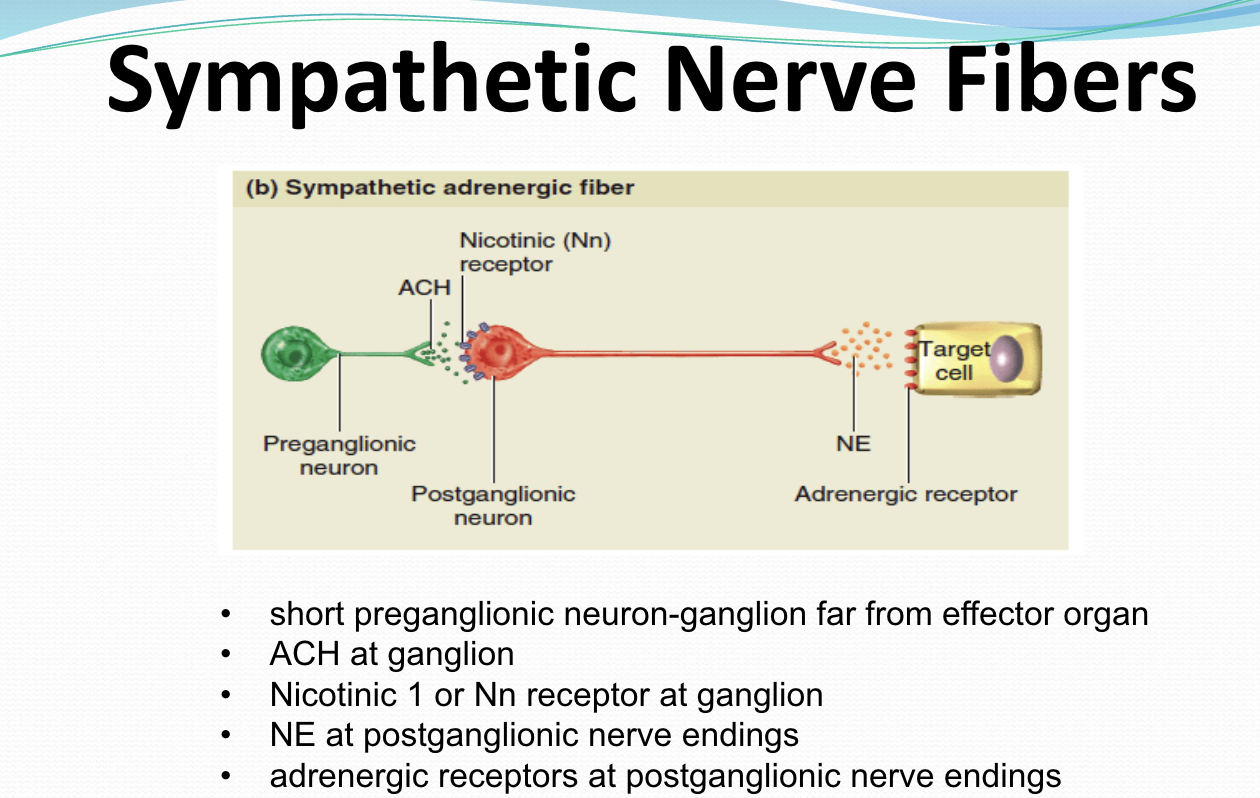
Sympathetic Nerve Fibers
steps
Sympathetic = ACh → NE
Neuron 1 → Ganglion
ACh Releases
Binds Nicotinic (Nn) receptor
Neuron 2 → Organ
Releases NE
Binds Adrenergic receptor
Formula
Brain
⬇
Preganglionic neuron
(ACh)
⬇
Nicotinic (Nn) receptor in ganglion
⬇
Postganglionic neuron
(NE)
⬇
Adrenergic receptor on organ
⬇
Fight-or-flight response
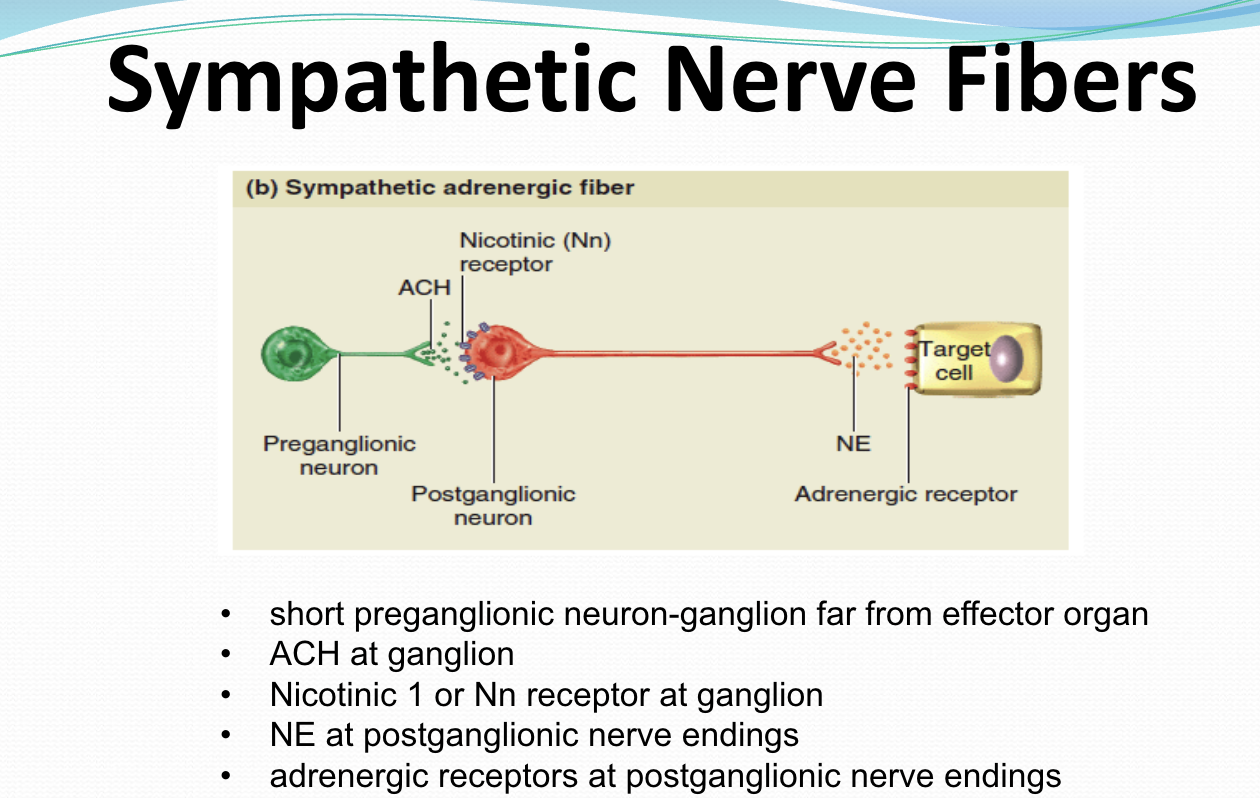
Why is the first neuron short?
The ganglion sits close to the spinal cord.
SW:
Short preganglionic neuron
Long postganglionic neuron
This is a hallmark of the sympathetic nervous system .
Quick Quiz
What neurotransmitter is released at the ganglion?
ACh
What receptor is at the ganglion?
Nicotinic (Nn)
What neurotransmitter is released at the target organ?
NE
What receptor is on the target organ?
Adrenergic receptor
Shortcut for exams:
🟢 ACh → Nicotinic (Nn) → NE → Adrenergic
That's the entire pathway shown in the picture. 🎯
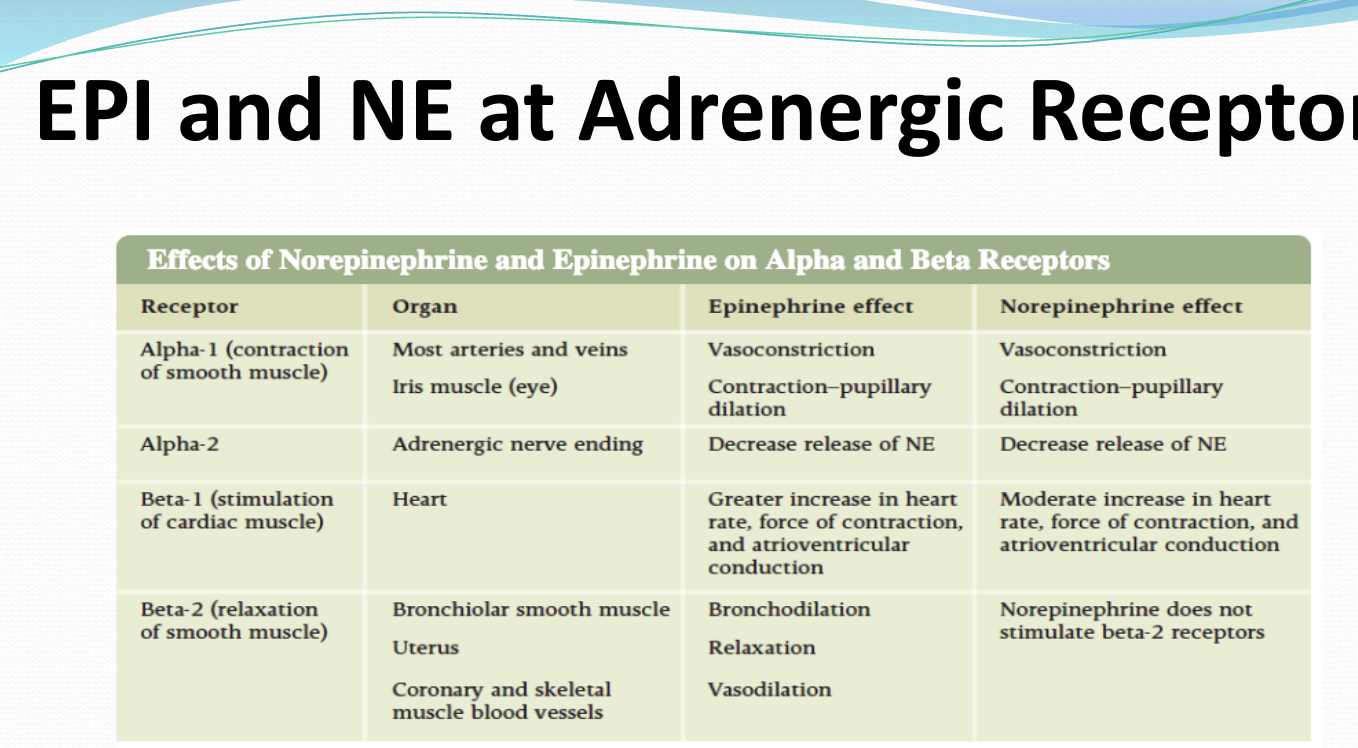
Sympathetic/Adrenergic Receptors
Receptor | Main Effect |
|---|---|
α1 (Alpha 1) | SQUEEZE |
α2 (Alpha 2) | STOP |
β1 (Beta 1) | HEART 1 ❤ |
β2 (Beta 2) | LUNGS 2 🫁 |
When NE (norepinephrine) or EPI (epinephrine) is released, it attaches to different receptors.
1. Alpha 1 = SQUEEZE
Sympathetic/Adrenergic Receptors
📍 Found on:
Blood vessels
Eyes
Smooth muscle
What's happening?
The muscles contract (squeeze) .
Results:
✅ Blood vessels constrict (get narrower)
✅ Blood pressure goes UP
✅ Pupils dilate (mydriasis)
Memory Trick
Alpha 1 = 1 word = SQUEEZE
Think:
👉 "Alpha 1 squeezes blood vessels."
α1 = Constrict = ↑ BP
2. Alpha 2 = STOP
Sympathetic/Adrenergic Receptors
📍 Found on nerve endings
What's happening?
Alpha 2 acts like a brake pedal.
It tells the body:
🛑 "Stop releasing so much norepinephrine."
Results:
✅ Less NE released
✅ Blood vessels relax
✅ Blood pressure decreases
Memory Trick
Alpha 2 = Auto Shutoff
Think:
A thermostat shuts itself off when things get too hot.
Alpha 2 does the same thing.
It says:
"Enough NE already!"
α2 = STOP = ↓ NE = ↓ BP
3. Beta 1 = HEART ❤
Sympathetic/Adrenergic Receptors
📍 Found mainly on the heart
What's happening?
It makes the heart work harder.
Results:
✅ Heart beats faster
✅ Heart beats stronger
✅ Electrical conduction increases
Memory Trick Beta 1 = 1 Heart ❤
One heart → Beta 1
β1 = Heart goes FAST and STRONG
Easy Phrase
Beta 1 = Beat 1 Heart
4. Beta 2 = LUNGS 🫁
Sympathetic/Adrenergic Receptors
🫁
📍 Found in:
Lungs
Uterus
Skeletal muscle blood vessels
What's happening?
Causes relaxation.
Results:
✅ Bronchodilation (airways open)
✅ Blood vessels relax
✅ Uterus relaxes
Memory Trick Beta 2 = 2 Lungs 🫁🫁
You have 2 lungs.
Think:
β2 opens the airways.
Beta 2 = Breathe
Sympathetic/Adrenergic Receptors
side by side
Receptor | Think | Effect |
|---|---|---|
α1 | SQUEEZE | ↑ BP, pupil dilation |
α2 | STOP | ↓ NE, ↓ BP |
β1 | HEART ❤ | ↑ HR, ↑ contraction |
β2 | LUNGS 🫁 | Bronchodilation, relaxation |
α1 = Constrict α2 = Stop β1 = 1 Heart ❤ β2 = 2 Lungs 🫁🫁
A bear is chasing you 🐻
α1
Blood vessels squeeze
➡ BP goes up
β1
Heart beats faster and stronger
➡ More blood to muscles
β2
Lungs open wider
➡ More oxygen
α2
After things calm down
➡ Tells body to stop releasing extra NE
EPI and NE at Adrenergic Receptors
chart
Effects from Sympathetic Stimulation
side by side
Body Part | What Happens? | Why? |
|---|---|---|
Adrenal gland | Releases epinephrine (adrenaline) | Boosts fight-or-flight |
Arteries | Mostly constrict | Raises BP |
Heart | Beats faster and stronger | Pumps more blood |
Intestines | Slow down | Digestion isn't important during danger |
Eyes | Pupils dilate | See better |
Lungs | Airways open wider | Get more oxygen |
Bladder | Relaxes | Holds urine |
Urinary sphincter | Contracts | Prevents urination |
Effects from Sympathetic Stimulation
adrenal Medulla vs Arteries
1. Adrenal Medulla What's happening?
Releases:
✅ Epinephrine (Adrenaline)
Think:
🚨 Danger → Adrenaline rush
This helps prepare the whole body for action.
2. Arteries What's happening?
Blood vessels constrict (squeeze).
Think:
🩸 Pipe gets smaller
➡Blood pressure increases
Why?
To send blood where it's needed most.
Exception:
Blood vessels going to:
Heart ❤
Skeletal muscles 💪
actually get wider (dilate) so they receive more blood.
Effects from Sympathetic Stimulation
Heart vs Intestines
3. Heart ❤ What's happening?
The heart:
✅ Beats faster
✅ Beats stronger ✅ Conducts electrical signals faster
Think:
🏃 Running from a bear
Your heart needs to pump lots of blood quickly.
Memory Trick
Sympathetic = Speed Up the Heart
4. Intestines 🍔 What's happening?
Digestive activity decreases.
✅ Less movement
✅ Less secretion
Think:
If a bear is chasing you, your body says:
"Forget digesting lunch right now!"
Digestion slows down.
Eyes vs Lungs vs Urinary Bladder
5. Eyes 👀 What's happening?
Pupils dilate (get bigger).
Mydriasis = pupil dilation
Think:
👀 Bigger pupils = more light enters
➡ Better vision during danger
6. Lungs 🫁 What's happening?
Bronchodilation
Bronchi = airways
Dilation = open wider
Think: Airways get bigger
➡ More oxygen enters
➡ More oxygen to muscles
7. Urinary Bladder What's happening?
Bladder relaxes.
Think:
🫙 Relaxed bladder can hold more urine.
Your body doesn't want you stopping to pee during an emergency.
8. Urinary Sphincter What's happening?
Contracts (closes).
Think: 🚪 Door closes ➡ Urine stays in
Sympathetic Nervous System Turns On
❤ Heart beats faster
🫁 Lungs open wider
👀 Pupils get bigger
💪 More blood goes to muscles
🍔 Digestion slows
🚽 Bladder holds urine
⚡ Adrenaline is released
Everything is focused on:
SURVIVE AND RUN
Fight or Flight =
❤ Fast heart
🫁 Open lungs
👀 Big pupils
🍔 Stop digestion
🚽 Hold urine
⚡ Release adrenaline