Chemistry 2 Unit 8 Flashcards
 Call Kai
 Learn
Learn Practice Test
 Spaced Repetition
 Match
Match Flashcards
 Knowt Play
1/94

There's no tags or description
Looks like no tags are added yet.
Name | Mastery | Learn | Test | Matching | Spaced | Call with Kai |
|---|
No analytics yet
Send a link to your students to track their progress
95 Terms
What happens at the particle level when a solution is formed?
The solute particles become evenly distributed among the solvent particles.
What are aqueous solutions?
Water samples containing dissolved substances.
What is a solvent?
The dissolving medium.
What is a solute?
The dissolved particles.
What is a solution?
A homogeneous mixture of particles in a dissolving medium.
True or False: After NaCl dissolves in water, it settles to the bottom.
False
Can solute particles be both ionic or molecular?
Yes
Can solute particles be easily filtered with filter paper?
No
Do ionic compounds and polar molecules readily dissolve in water?
Yes
Do nonpolar molecules readily dissolve in water?
No
What happens when sodium chloride is placed in water?
Water molecules attract and separate the Na⁺ and Cl⁻ ions, dissolving the substance
What is solvation?
When solute ions become surrounded by solvent molecules.
If enough solvent is present, what eventually happens to the solid?
It completely dissolves.
Why are some ionic compounds insoluble?
Because of the strength of their ionic bonds.
What does “like dissolves like” mean?
Polar solvents dissolve ionic and polar solutes, while nonpolar solvents dissolve nonpolar solutes.
True or False: Molecular compounds separate into ions in water.
False
What is dissociation?
The separation of cations and anions in solution.
Give an example dissociation equation.
(Any equation that matches this format)AxBy → xA+ + yB-⁻
What does concentration measure?
The amount of solute dissolved in a solution.
What is the most important unit of concentration in chemistry?
Molarity
True or False: Molarity is used to measure most commercial products.
False
Can percent concentration be measured using mass or volume?
Both
What is the formula for molarity?
𝑀=moles of solute/liters of a solution
What is the formula for percent concentration?
Concentration = (amount of solute ÷ amount of solution) × 100 [1]
What two values must be known for solution stoichiometry?
Volume and molarity.
What are the three steps in concentration-to-mass stoichiometry?
Multiply molarity by liters. 2. Use mole ratio. 3. Convert moles to grams.
How do you make a solution less concentrated?
Add solvent.
What happens to molarity when the volume of a solution is doubled?
The molarity is halved.
What is the dilution equation?
M_1V_1=M_2V_2
The unit for volume in a solution has to be _____
Liters (it just has to be the same between V1 and V2, there is no specific volume.)
What three factors affect the rate of dissolving?
Agitation, temperature, and particle size.
Why do finely ground particles dissolve faster?
They expose more surface area for colliding solvent particles
What is solubility?
The amount of substance that dissolves in a given quantity of solvent at a constant temperature in mass.
What is a saturated solution?
A solution holding the maximum amount of solute possible at a given temperature.
What are miscible liquids?
Liquids that are soluble in each other.
How does increasing temperature affect the solubility of solids?
It usually increases solubility.
True or False: All ionic solids are soluble in water.
False
How does increasing temperature affect the solubility of gases?
It decreases solubility.
How does a solution become supersaturated?
By cooling a saturated solution carefully so excess solute stays dissolved.(example making fudge)
What property do acids have with metals?
They react with metals to produce H₂ gas.
What do acids taste like?
Sour
What do bases taste like?
Bitter
What do bases feel like?
Slippery
Both bases and acids _______
conduct electricity and change the color of an indicator
What is an electrolyte?
A substance that conducts electricity in solution.
What are the products of acid-base reactions?
Salt and water.
What are Arrhenius acids?
Compounds that produce H⁺ ions in solution.
True or False: All Arrhenius acids behave exactly the same way.
False
What is a monoprotic acid?
An acid that releases 1 H⁺ ion.
What is a diprotic acid?
An acid that releases 2 H⁺ ions.
What is a triprotic acid?
An acid that releases 3 H⁺ ions.
What are Arrhenius bases?
Compounds that produce OH⁻ ions in solution.
Do Group 1 and 2 metals react with water or acid to create Arrhenius bases?
Water
Write an equation showing an Arrhenius base forming.
M+OH- → M⁺ + OH⁻
What is the Brønsted-Lowry definition of acids and bases?
Acids are H⁺ donors and bases are H⁺ acceptors.
Are Brønsted-Lowry reactions reversible?
Yes
Where are conjugate acids and bases found in a reaction?
On the product side/right side of arrows.
What forms when a base gains a hydrogen ion?
A conjugate acid.
What do conjugate bases accept from conjugate acids?
Hydrogen ions.
True or False: Amphoteric substances can act as both acids and bases.
True
What type of reaction occurs when acids and bases react?
Double replacement
Give an example of a neutralization reaction.
HF + NaOH → NaF + H₂O ( Any example that follows AB+CD—> AD+CB)
Does water gain or lose H⁺ to become hydronium?
Gain
Does water gain or lose H⁺ to become hydroxide?
Lose
What is the self-ionization of water?
An equilibrium between water molecules and ions that spontaneously disscociate from water.
Write the self-ionization equation of water.
H2O+H2O—>←H3O++OH-
What do square brackets [ ] mean in chemistry?
Aqueous concentration.
Can dissolving substances shift the self-ionization equilibrium of water?
Yes
In aqueous solutions hydrogen ions ____ to make H+
combine
In neutral what is the relationship between OH- and H+
They both are equal
What ion concentration is equal in neutral solutions?
[H⁺] = [OH⁻]
What is the ion-product constant for water?
H+ X OH- = 1.0 X 10⁻¹⁴
In pure water, how do the concentrations of H⁺ and OH⁻ compare?
They are equal.
Which type (acid or base) of solution has more H⁺ ions?
Acidic
Which type of solution (acid or base) has more OH⁻ ions?
Basic
What is the formula for pH?
pH=-log[H+]
What is the formula for pOH?
pOH=-log[OH-]
What pH is basic?
pH > 7
What pH is neutral?
pH = 7
What pH is acidic?
pH < 7
True or False: The pOH of a neutral solution is 7.0.
True
What is the relationship between pH and pOH?
pH+pOH=14
What type of acids completely ionize in water?
Strong acids
What type of acids ionize only slightly in water?
Weak acids
How are ionization equations different for strong and weak acids?
Strong acids use one-way arrows; weak acids use equilibrium arrows.
What do strong bases do in water?
Dissociate completely.
True or False: A concentrated acid is the same as a strong acid.
False
Can Ka and Kb be calculated for strong or weak acids and bases?
Weak
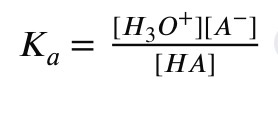
What is the general form of Ka?
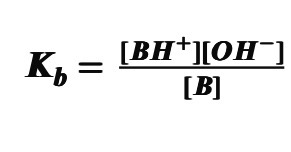
What is the general form of Kb?
Why can’t Ka for strong acids be calculated?
Because strong acids do not establish an equilibrium.
Why is water left out of Ka and Kb expressions?
Because it is a pure substance.
True or False: The stronger an acid is, the larger its Ka value.
True
What two variables are needed to calculate Ka?
The ionization concentration and the H⁺ concentration (or pH).
What is the ratio of Kb?
The concentration of conjugate acid times hydroxide concentration divided by the concentration of the conjugate base.