Chemistry Paper 2 Mistakes
 Call Kai
 Learn
Learn Practice Test
 Spaced Repetition
 Match
Match Flashcards
 Knowt Play
1/96

There's no tags or description
Looks like no tags are added yet.
Name | Mastery | Learn | Test | Matching | Spaced | Call with Kai | Chat |
|---|
No analytics yet
Send a link to your students to track their progress
97 Terms
Can alcohols be used as fuels?
Explain your answer.
Yes — burning alcohols is a v/ exothermic reaction
During cracking, hydrocarbons are often passed over a substance so that they break apart.
What is the general name for this type of substance?
Hot catalyst
Describe the types of cracking.
Catalytic cracking — passing hydrocarbons over a hot catalyst
Steam cracking — mixing hydrocarbons w/ steam + heating to v/ high temp → thermal decomposition occurs
Name the gas produced when ethanol reacts with sodium.
Hydrogen
Describe all the reactions of alcohols.
air — alcohol + oxygen → carbon dioxide + water
water — dissolves to form neutral solution
sodium — alcohol + sodium → hydrogen + salt
oxidising agents — produces carboxylic acids
True or false? Ethene can be manufactured by the dehydration of ethanol.
True
Describe the reaction of fermentation.
glucose → ethanol + carbon dioxide
aqueous solution of ethanol produced
conditions:
35°C
yeast enzyme catalyst
anaerobic conditions
Describe the combustion of hydrocarbons.
hydrocarbons + oxygen → carbon dioxide + water
hydrogen + oxygen → water
carbon + oxygen → carbon dioxide
Hydrogen and oxygen are oxidised
Releases energy
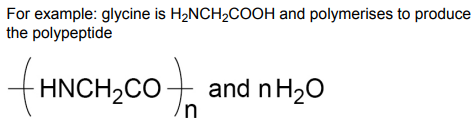
What is the name of this amino acid? H₂NCH₂COOH
Glycine
What do amino acids have?
Two functional groups in same molecule
Describe how amino acids react.
Condensation polymerisation — produces polypeptides
Diff. amino acids can be combined in same chain — produces proteins
Ethanol reacts with oxygen to give ethanoic acid.
Give the name of the other product that is formed.
Water
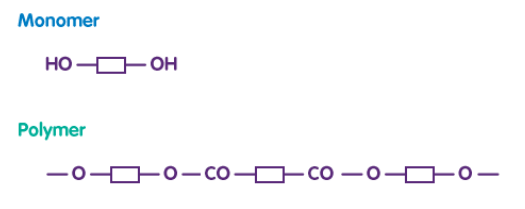
Look at the diagram.
Identify the monomer.
Dialcohol
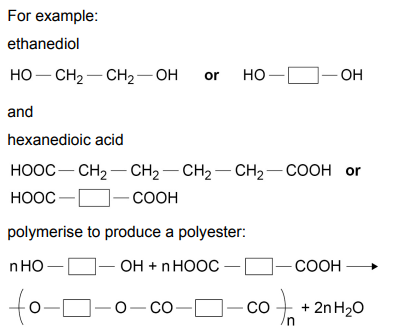
Describe condensation polymerisation.
Two diff. monomers w/ same functional groups on each monomer
Small molecules (e.g. water) often lost (condensation reactions)
______________ + ____________ ______ → polyester + _________
ethanediol
hexaneoic acid
water
How many types of monomers are there in addition polymerisation?
1
What can alkenes be used to do in addition polymerisation?
Form polymers — e.g. poly(ethene) and poly(propene)
Describe what happens in addition polymerisation reactions.
Many small molecules (monomers) join together to form v/ large molecules (polymers)
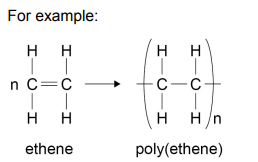
In addition polymers, why does the repeating unit have the same atoms as the monomer?
No other molecule is formed in the reaction.
What happens during thermal decomposition? [2 marks]
Large molecules are broken down into smaller molecules by heat.
![<p><span style="background-color: transparent;">The diagram shows a reaction which takes place in an oil refinery.</span></p><p><span style="background-color: transparent;">Compounds Y and Z are both useful substances.</span></p><p><span style="background-color: transparent;">Compound Y is unsaturated. Compound Z is saturated.</span></p><p><span style="background-color: transparent;"><strong>a) </strong></span><span><strong><mark data-color="yellow" style="background-color: yellow; color: inherit;">Suggest</mark> </strong></span><span style="background-color: transparent;"><strong>one use for compound Y. [1 mark]</strong></span></p><p><span><strong>b) <mark data-color="yellow" style="background-color: yellow; color: inherit;">Suggest</mark></strong></span><span style="background-color: transparent;"><strong> one use for compound Z. [1 mark]</strong></span></p>](https://assets.knowt.com/user-attachments/9d29c0b6-f305-4937-bf76-95cee33d9377.png)
The diagram shows a reaction which takes place in an oil refinery.
Compounds Y and Z are both useful substances.
Compound Y is unsaturated. Compound Z is saturated.
a) Suggest one use for compound Y. [1 mark]
b) Suggest one use for compound Z. [1 mark]
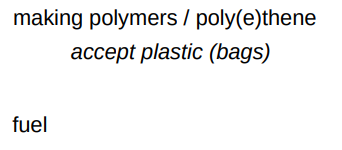
a) Making polymers
b) Fuel
The hydrocarbon C16H34 was heated strongly in the absence of air.
This is one of the reactions which took place:
C16H34 C6H14 + C6H12 + 2C2H4
This type of reaction is carried out because there is a greater demand for the products than for the original hydrocarbon.
Suggest two reasons for this. [2 marks]
Smaller molecules are more reactive (flammable) — useful as fuels
Produces unsaturated compounds (alkenes)

![<p><span style="background-color: transparent;">Small molecules of substances called monomers can be joined together in polymerisation — ethene → poly(ethene).</span></p><p><span style="background-color: transparent;"><strong><mark data-color="yellow" style="background-color: yellow; color: inherit;">Complete</mark> the equation to show the formation of the polymer from the monomer propene. [1 mark]</strong></span></p>](https://assets.knowt.com/user-attachments/d40012cf-4637-4fee-90ae-2132242f3959.png)
Small molecules of substances called monomers can be joined together in polymerisation — ethene → poly(ethene).
Complete the equation to show the formation of the polymer from the monomer propene. [1 mark]
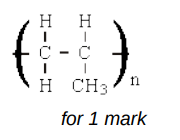
bonds beyond rounded brackets
no double bond
‘n’ on outside
![<p><span style="background-color: transparent;">The equation shows the cracking of a hydrocarbon compound into two different compounds, A and B.</span></p><p><span style="background-color: transparent;"><strong>Why is compound A useful in industry? [1 mark]</strong></span></p>](https://assets.knowt.com/user-attachments/bd494152-e8e1-4450-b1cd-22806ff8ab34.png)
The equation shows the cracking of a hydrocarbon compound into two different compounds, A and B.
Why is compound A useful in industry? [1 mark]
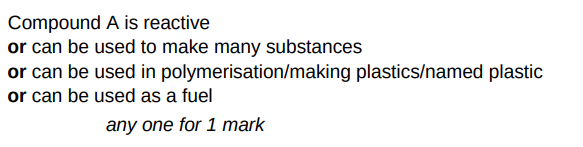
Compound A is reactive.
Fibreglass is a composite material consisting of glass fibres and what other material?
Plastic
Describe how different types of glass are made.
Soda lime glass — heating mixture of sand, sodium carbonate + limestone
Borosilicate glass — heating mixture of sand and boron trioxide
melts at higher temps than soda lime
Describe how clay ceramics like pottery and bricks are made.
Shaping wet clay
Heating in furnace
The properties of polymers depend on what ______________ they are made from and the ______________ under which they are made.
For example, ______ __________ (LD) and _______ __________ (HD) ______________ are produced from __________.
monomers
conditions
low density
high density
poly(ethene)
ethene
Describe the differences between low density and high density poly(ethene).
LD — weaker forces of attraction (chains further apart) → low melting point + soft
low density — less particles per unit volume
HD — higher forces of attraction (chains closer) → higher melting point
high density — more particles per unit volume
Describe the properties of thermosoftening polymers.
Individual, tangled polymer chains
easily separated + melted by heat
weak intermolecular forces b/ chains
chains easy to separate at lower temps
less energy needed to break chains
Describe the properties of thermosetting polymers.
Polymer chains w/ crosslinks
Don’t melt when heated
Describe what composites are.
Matrix/binder surrounding + binding fibres of fragments of other material (reinforcement)
Give and describe the properties of four types of composites.
Carbon fibre reinforced polymer — carbon fibres + polymer resin
hard + v/ brittle
strong, stiff + lightweight
Fibreglass — glass fibres + polymer resin
hard + v/ brittle
strong, stiff + lightweight
Reinforced concrete — steel + concrete
can be broken using machinery
Chipboard — wood chips + resin glue
strong in all directions

When hydrogen peroxide is added to manganese dioxide, the hydrogen peroxide decomposes into water and oxygen. The chemical equation for this reaction is shown below.
What is the catalyst in this reaction?
Manganese dioxide
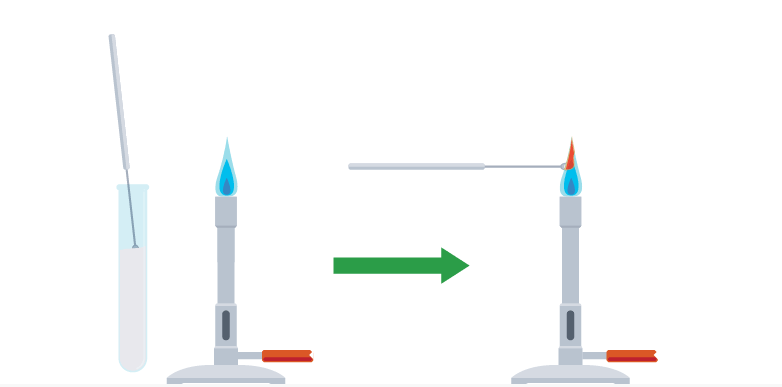
Describe how to do a flame test.
Pass nicrome wire through flame to sterilise it
Dip it into metal ion solution + run through flame again
produces coloured flame
List all the positive metal ions used in the flame tests and their positive results.
Lithium (Li+) - crimson
Sodium (Na+) - yellow
Potassium (K+) - lilac
Calcium (Ca2+) - orange-red
Copper (Cu2+) - green
If a sample contains a mixture of metal ions, a flame test may be inconclusive. Why?
Metal ion that is in highest conc. may mask others
How do you perform the positive metal hydroxides tests?
Add sodium hydroxide to metal ion solution
Precipitate produced
List all of the positive metal ions used in the sodium hydroxides tests and the coloured precipitate they produce.
Aluminum (Al3+) - white (dissolves in excess NaOH)
Magnesium (Mg2+) - white
Calcium (Ca2+) - white
Copper (Cu2+) - blue
Iron (Fe2+) - green
Iron (Fe3+) - brown
What is the half equation for the production of copper hydroxide?
Cu2+ + 2OH- → Cu(OH)2
What is the half equation for the production of aluminium hydroxide?
Al3+ + 3OH- → Al(OH)3
What is the half equation for the production of magnesium hydroxide?
Mg2+ + 2OH- → Mg(OH)2
What is the half equation for the production of calcium hydroxide?
Ca2+ + 2OH- → Ca(OH)2
What is the half equation for the production of iron (II) hydroxide?
Fe2+ + 2OH- → Fe(OH)2
What is the half equation for the production of iron (III) hydroxide?
Fe3+ + 3OH- → Fe(OH)3
When you add excess NaOH to an ____________ ion solution, the precipitate formed ___________.
aluminium
dissolves
How do you perform the halides tests for negative metal ions?
Add dilute nitric acid + silver nitrate
precipitate produced
Why can’t hydrochloric acid be used for the halide ion tests?
Contains chlorine
Would react + produce precipitate
List the negative halide ions and the colour of the precipitate produced for the halide ion tests.
Bromine (Br-) - cream
Chlorine (Cl-) - white
Iodine (I-) - yellow
How do you perform the test for sulfate ions?
Add hydrochloric acid + barium chloride
White precipitate
Carbonates react with ________ _____ to form _______ _______ gas.
dilute acids
carbon dioxide
What are 2 examples of instrumental methods?
Gas chromatography
Flame emission spectroscopy
Why are instrumental methods better than chemical tests? (4)
They are:
sensitive
quantitative
accurate
rapid
How do you perform flame emission spectroscopy?
Sample put into flame and light given out passed through spectroscope
Output is line spectrum — can be analysed to identify metal ions in solution + measure their concentrations
Concrete is a composite material made from gravel and what other material?
Cement
Algae first produced gas X about 2.7 billion years ago. Soon after that, gas X started appearing in the atmosphere. What is gas X and explain why?
Oxygen
Algae performs photosynthesis → releases oxygen gas
What is meant by the term precipitation reaction?
Solid product formed during reaction b/ solutions
During waste water treatment, sedimentation produces effluent and... what?
Sewage sludge
Describe what needs to be removed from different types of waste water.
Sewage + agricultural waste water — organic matter + harmful microbes
Industrial waste water — organic matter + harmful chemicals
What does sewage treatment include?
Screening + grit removal
Sedimentation → produces sewage sludge + effluent
Anaerobic digestion of sewage sludge
Aerobic biological treatment of effluent
Describe how quality water is produced.
Water passed through mesh screen → removes larger bits
Chemicals added (makes solids + microbes clump → forms sediment + sink)
Anaerobic digestion of sewage sludge
Water sterilised w/ chlorine (kills microbes)
Explain the differences in relative ease when obtaining potable water from different sources.
Cheaper + easier to get potable water f/ groundwater + wastewater than saltwater
saltwater is plentiful → good for countries w/ little fresh water
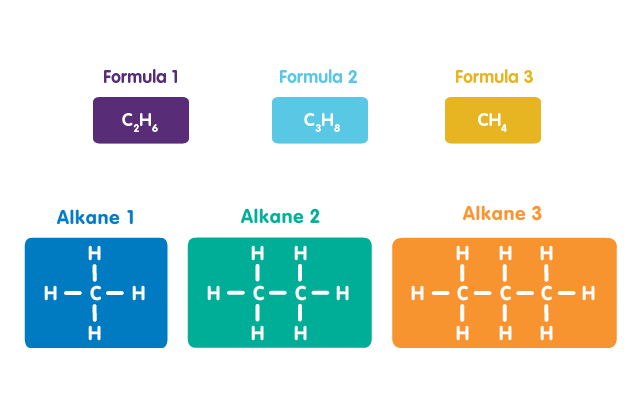
The line between the C and H represents a _______ bond.
covalent
Potable water can be produced through various processes.
For example, water can be passed through ______ beds to remove any solids.
mesh
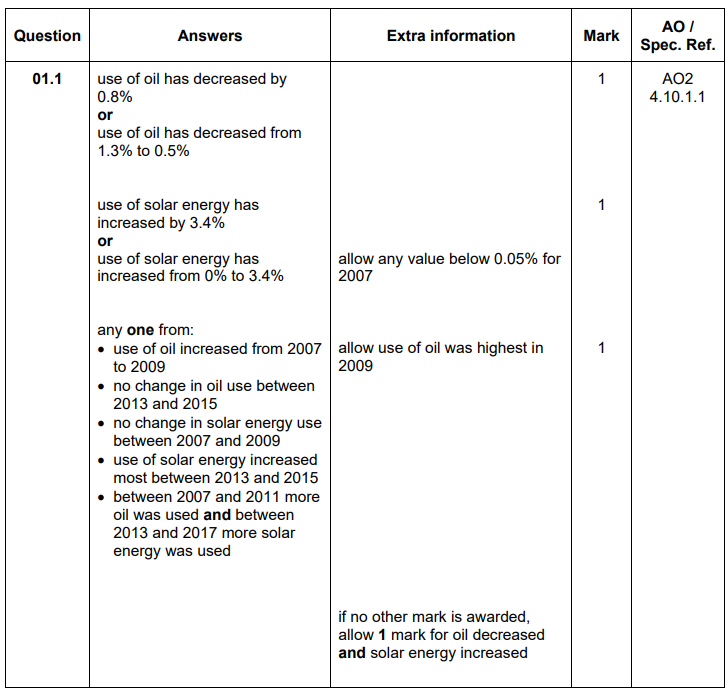
![<p>Figure 1 shows the percentage of electricity generated in the UK between 2007 and 2017 using:</p><ul><li><p>oil</p></li><li><p>solar energy</p></li></ul><p><strong><mark data-color="yellow" style="background-color: yellow; color: inherit;">Describe</mark> the changes in the percentage of electricity generated in the UK between 2007 and 2017 using:</strong></p><ul><li><p><strong>oil</strong></p></li><li><p><strong>solar energy</strong></p></li></ul><p><strong><mark data-color="yellow" style="background-color: yellow; color: inherit;">Use</mark> data from Figure 1 in your answer. [3 marks]</strong></p>](https://assets.knowt.com/user-attachments/d353e88f-5169-402f-84df-b370ff048c7d.png)
Figure 1 shows the percentage of electricity generated in the UK between 2007 and 2017 using:
oil
solar energy
Describe the changes in the percentage of electricity generated in the UK between 2007 and 2017 using:
oil
solar energy
Use data from Figure 1 in your answer. [3 marks]
Use of oil decreased by 0.8%
Use of solar energy increased by 3.4%
Use of oil increased f/ 2007 → 2009
Oil contains carbon and some sulfur.
When oil is burned, the products of combustion may be released into the atmosphere.
Explain the environmental effects of releasing these products of combustion into the atmosphere. [6 marks]
Combustion of carbon dioxide:
carbon dioxide
greenhouse gas → increase in surface temps → global warming
climate change
carbon particulates
global dimming + respiratory issues in humans
carbon monoxide (incomplete combustion)
almost undetectable + toxic
combustion of sulfur:
sulfur dioxide
acid rain → damages buildings + statues
damages trees + aquatic life
respiratory problems in humans
Suggest one reason why using solar energy is a more sustainable way of generating electricity than burning oil. [1 mark]
Solar is renewable

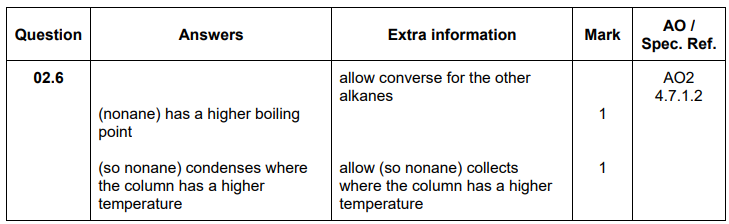
![<p>The alkane with nine carbon atoms in a molecule is called nonane.</p><p>Nonane will condense lower in a fractionating column during fractional distillation than the other alkanes in Table 1. </p><p><strong><mark data-color="yellow" style="background-color: yellow; color: inherit;">Explain</mark> why. [2 marks]</strong></p><p>You should refer to the temperature gradient in the fractionating column.</p>](https://assets.knowt.com/user-attachments/a21508a2-cd42-45e9-affe-2ff15813834e.png)
The alkane with nine carbon atoms in a molecule is called nonane.
Nonane will condense lower in a fractionating column during fractional distillation than the other alkanes in Table 1.
Explain why. [2 marks]
You should refer to the temperature gradient in the fractionating column.
Nonane has higher boiling point
condensed where column has higher temp
A food colouring contains a dye.
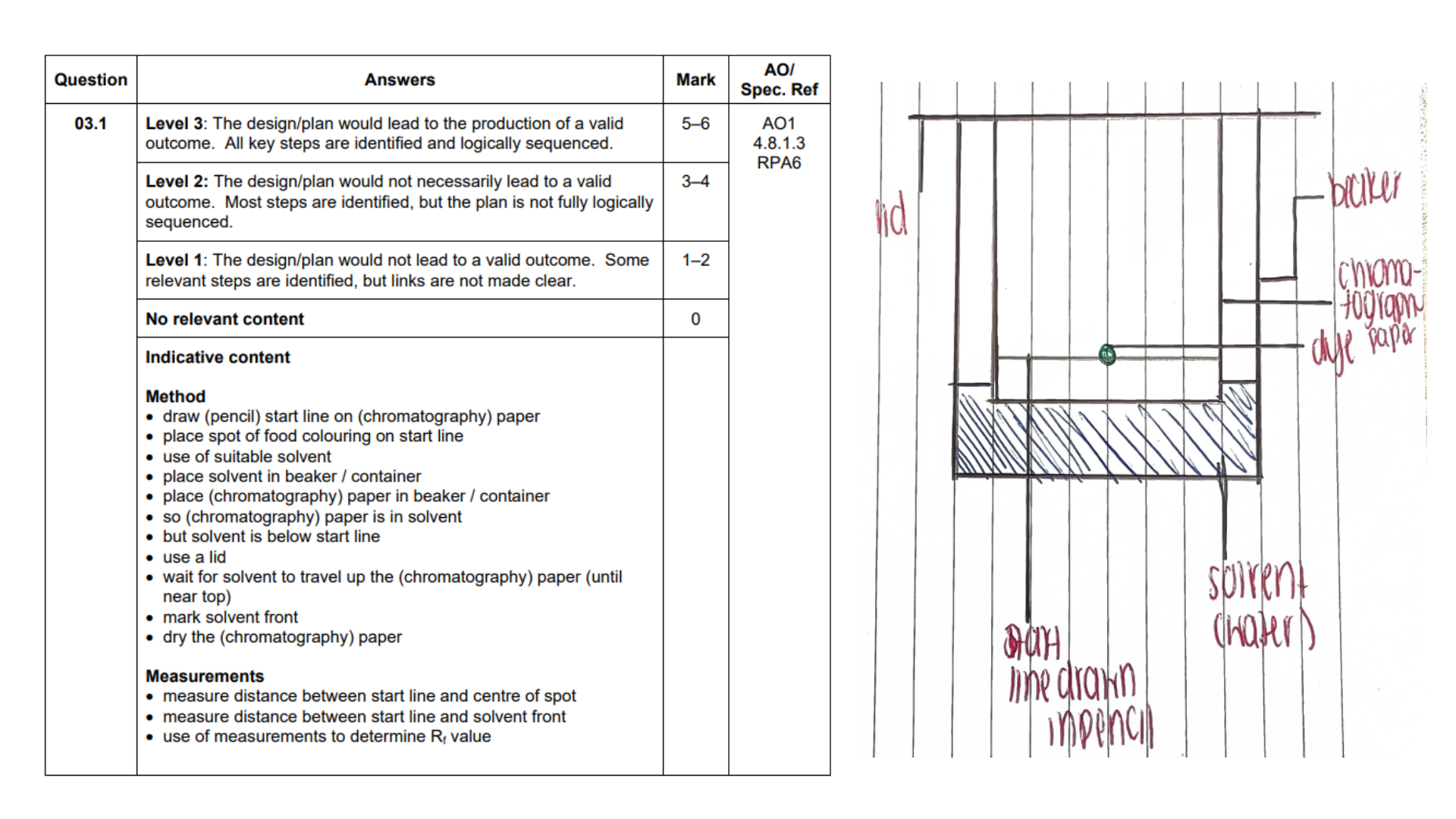
Plan an investigation to determine the Rf value for the dye in this food colouring. [6 marks]
Rf= distance moved by substance / distance moved by solvent
Your plan should include the use of:
a beaker
a solvent
chromatography paper
Set up apparatus
Wait for solvent to travel up paper until it is near top
Mark solvent front
Dry paper
Measure distance b/ start line + centre of spot using ruler
Measure distance b/ start line + solvent front using ruler
Use measurements to calculate Rf value
Two students investigated a dye in a food colouring using paper chromatography.
Each student did the investigation differently.
The Rf values they determined for the same dye were different.
How did the students’ investigations differ? [1 mark]
Different length of paper used
Different period of time used
Different size of beaker used
Different solvent used
Different solvent used
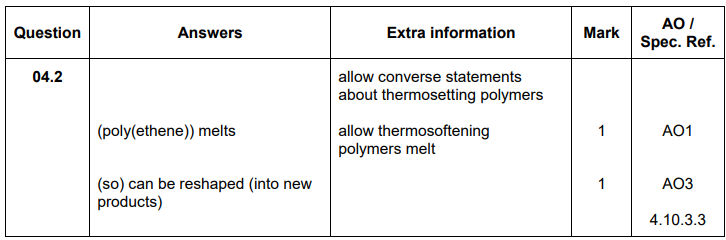
Poly(ethene) is a thermosoftening polymer.
Suggest why poly(ethene) is easier to recycle than thermosetting polymers. [2 marks]
Poly(ethene) melts
can be reshaped into new products
Ethene produces different forms of poly(ethene).
How can different forms of poly(ethene) be produced from ethene? [1 mark]
Diff reaction conditions

![<p>Two different forms of poly(ethene) are:</p><ul><li><p>high density poly(ethene) (HDPE)</p></li><li><p>low density poly(ethene) (LDPE)</p></li></ul><p>Figure 4 represents part of the structures of HDPE and LDPE.</p><p><strong><mark data-color="yellow" style="background-color: yellow; color: inherit;">Explain why</mark> HDPE has a higher density than LDPE. [2 marks]</strong></p>](https://assets.knowt.com/user-attachments/c03fcb64-24fa-4c91-ad74-d34d7ec4d1a4.png)
Two different forms of poly(ethene) are:
high density poly(ethene) (HDPE)
low density poly(ethene) (LDPE)
Figure 4 represents part of the structures of HDPE and LDPE.
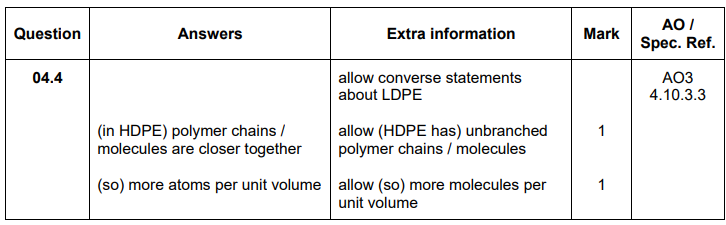
Explain why HDPE has a higher density than LDPE. [2 marks]
Polymer chains closer together
more atoms per unit volume
![<p>Figure 5 shows three monomers, A, B and C. </p><p>Monomer A can react with monomer B and with monomer C to produce polyesters.</p><p><strong><mark data-color="yellow" style="background-color: yellow; color: inherit;">Complete</mark> Table 2 to show the formula of the small molecule produced when:</strong></p><ul><li><p><strong>monomer A reacts with monomer B</strong></p></li><li><p><strong>monomer A reacts with monomer C</strong></p></li></ul><p><strong>[1 mark]</strong></p><table style="min-width: 50px;"><colgroup><col style="min-width: 25px;"><col style="min-width: 25px;"></colgroup><tbody><tr><td colspan="1" rowspan="1" style="border-width: 1pt; border-style: solid; border-color: rgb(0, 0, 0); vertical-align: top; padding: 5pt; overflow: hidden; overflow-wrap: break-word;"><p><span style="background-color: transparent;"><strong>Reacting monomers</strong></span></p></td><td colspan="1" rowspan="1" style="border-width: 1pt; border-style: solid; border-color: rgb(0, 0, 0); vertical-align: top; padding: 5pt; overflow: hidden; overflow-wrap: break-word;"><p><span style="background-color: transparent;"><strong>Formula of small molecule produced</strong></span></p></td></tr><tr><td colspan="1" rowspan="1" style="border-width: 1pt; border-style: solid; border-color: rgb(0, 0, 0); vertical-align: top; padding: 5pt; overflow: hidden; overflow-wrap: break-word;"><p><span style="background-color: transparent;">A and B</span></p></td><td colspan="1" rowspan="1" style="border-width: 1pt; border-style: solid; border-color: rgb(0, 0, 0); vertical-align: top; padding: 5pt; overflow: hidden; overflow-wrap: break-word;"><p><span style="background-color: transparent;">1</span></p></td></tr><tr><td colspan="1" rowspan="1" style="border-width: 1pt; border-style: solid; border-color: rgb(0, 0, 0); vertical-align: top; padding: 5pt; overflow: hidden; overflow-wrap: break-word;"><p><span style="background-color: transparent;">A and C</span></p></td><td colspan="1" rowspan="1" style="border-width: 1pt; border-style: solid; border-color: rgb(0, 0, 0); vertical-align: top; padding: 5pt; overflow: hidden; overflow-wrap: break-word;"><p><span style="background-color: transparent;">2</span></p></td></tr></tbody></table><p></p>](https://assets.knowt.com/user-attachments/281d9a7a-fae4-49b0-aba2-b755ec2fabf0.png)
Figure 5 shows three monomers, A, B and C.
Monomer A can react with monomer B and with monomer C to produce polyesters.
Complete Table 2 to show the formula of the small molecule produced when:
monomer A reacts with monomer B
monomer A reacts with monomer C
[1 mark]
Reacting monomers | Formula of small molecule produced |
A and B | 1 |
A and C | 2 |
H₂O
HCl

Some fertilisers are described as NPK fertilisers because they contain three elements needed for healthy plant growth.
Which two compounds each contain two of these elements? [2 marks]
Ammonium nitrate
Ammonium phosphate
Calcium chloride
Calcium phosphate
Potassium chloride
Potassium nitrate
Ammonium phosphate
Potassium nitrate

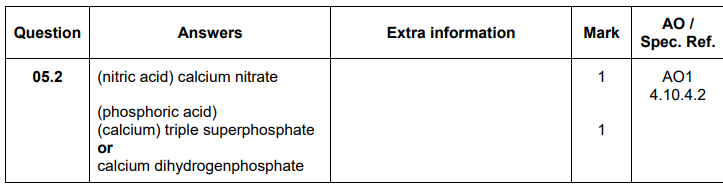
Rocks containing calcium phosphate are treated with acid to produce soluble salts that can be used as fertilisers.
Name the soluble salts produced when calcium phosphate reacts with:
nitric acid
phosphoric acid
[2 marks]
Calcium nitrate
Triple superphosphate
Ammonium sulfate is a compound in fertilisers.
Ammonium sulfate can be made using an industrial process or in the laboratory.
In the industrial process, the following steps are used:
React streams of ammonia solution and sulfuric acid together.
Evaporate the water by passing the solution down a warm column.
Collect dry crystals continuously at the bottom of the column.
In the laboratory, the following steps are used:
React ammonia solution and sulfuric acid in a conical flask.
Evaporate water from the solution until crystals start to form.
Leave to cool and crystallise further.
Separate the crystals using filtration.
Dry the crystals between pieces of filter paper.
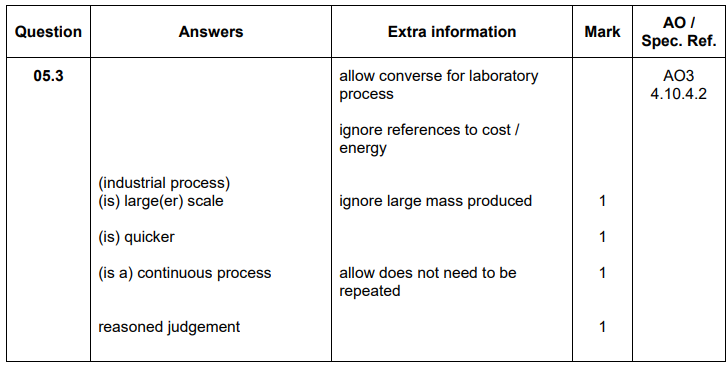
Evaluate the two methods for producing a large mass of ammonium sulfate. [4 marks]
Industrial process is:
quicker
larger scale – uses more ammonia solution + sulfuric acid
a continuous process – dry crystals collected continuously
I think that industrial process is faster + better for producing large mass of ammonium sulfate
Potash alum is a chemical compound.
The formula of potash alum is KAl(SO₄)₂
Give a test to identify the Group 1 metal ion in potash alum. [2 marks]
You should include the result of the test.
Flame test
Lilac flame

Copper can be obtained by:
processing copper ores
recycling scrap copper
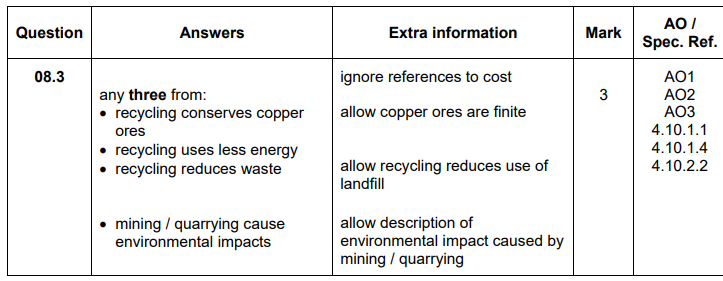
Suggest three reasons why recycling scrap copper is a more sustainable way of obtaining copper than processing copper ores. [3 marks]
Recycling:
conserves copper ores
uses less energy
reduces waste
Copper is extracted from low-grade ores by phytomining.
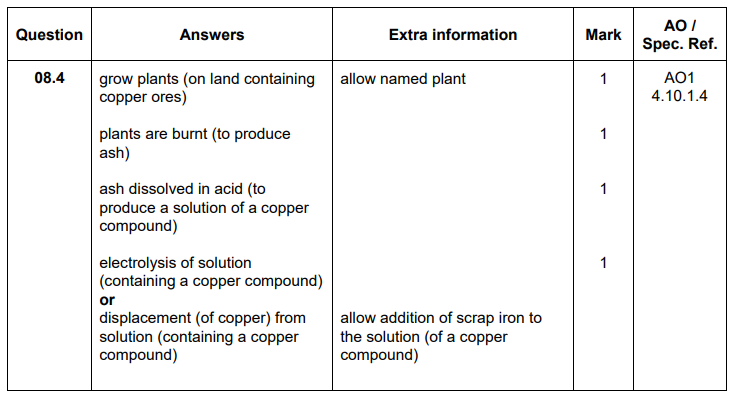
Describe how copper is extracted from low-grade ores by phytomining. [4 marks]
Grow plants
Burn plants → produces ash
Ash dissolved in acid → produces solution of copper compound
Electrolysis of solution
Copper is extracted from low-grade ores by phytomining.
Phytomining has not been widely used to extract copper.
Suggest two reasons why. [2 marks]
Land not available
Phytomining takes a long time
![<p>A student investigated how a change in concentration affects the rate of the reaction between zinc powder and sulfuric acid. </p><p>The equation for the reaction is: <span style="color: green;"><strong>Zn(s) + H₂SO₄(aq) → ZnSO₄(aq) + H₂(g) </strong></span></p><p>This is the method used:</p><ul><li><p>Pour 50 cm3 of sulfuric acid of concentration 0.05 mol/dm3 into a conical flask.</p></li><li><p>Add 0.2 g of zinc powder to the conical flask.</p></li><li><p>Put the stopper in the conical flask.</p></li><li><p>Measure the volume of gas collected every 30 seconds for 5 minutes.</p></li><li><p>Repeat steps 1 to 4 with sulfuric acid of concentration 0.10 mol/dm³</p></li></ul><p>Figure 8 shows the apparatus used.</p><p>The student made an error in setting up the apparatus in Figure 8. </p><p><strong>What error did the student make? [1 mark]</strong></p>](https://assets.knowt.com/user-attachments/531278bf-b8ae-40a2-ad14-eac51ba92874.png)
A student investigated how a change in concentration affects the rate of the reaction between zinc powder and sulfuric acid.
The equation for the reaction is: Zn(s) + H₂SO₄(aq) → ZnSO₄(aq) + H₂(g)
This is the method used:
Pour 50 cm3 of sulfuric acid of concentration 0.05 mol/dm3 into a conical flask.
Add 0.2 g of zinc powder to the conical flask.
Put the stopper in the conical flask.
Measure the volume of gas collected every 30 seconds for 5 minutes.
Repeat steps 1 to 4 with sulfuric acid of concentration 0.10 mol/dm³
Figure 8 shows the apparatus used.
The student made an error in setting up the apparatus in Figure 8.
What error did the student make? [1 mark]
Delivery tube in sulfuric acid

Ethanol can be produced from ethene and steam.
The equation for the reaction is: C₂H₄(g) + H₂O(g) ⇌ C₂H₅OH(g)
The forward reaction is exothermic.
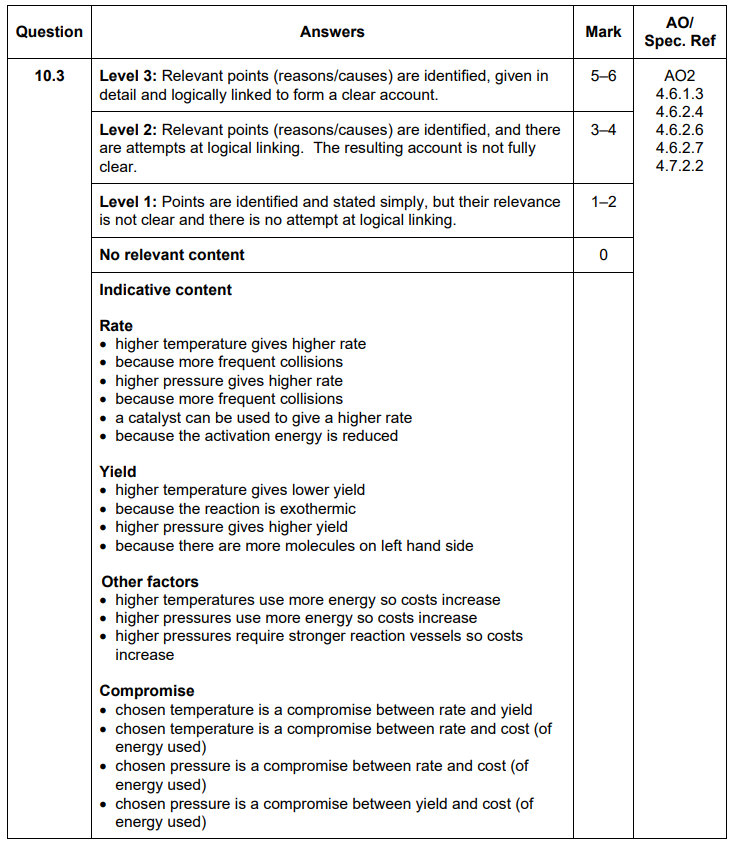
Explain how the conditions for this reaction should be chosen to produce ethanol as economically as possible. [6 marks]
Higher temp = higher rate
more frequent collisions
Higher pressure = higher rate
more frequent collisions
Catalyst used for higher rate
reduced activation energy
Higher temp = lower yield
exothermic reaction
Higher pressure = higher yield
more molecules on left
Higher temps + pressure use more energy → increased costs
Chosen temp is compromise b/ rate and yield
Describe what humans use the Earth’s resources to do.
Provide:
warmth
shelter
food
transport
Natural resources (supplemented by agriculture) provide:
food
timber
clothing
fuels
Finite resources (from Earth, oceans + atmosphere) processed → provides energy + materials
Describe what is meant by sustainable development.
Development that meets needs of current generations without compromising ability of future generations to meet their own needs
State some examples of natural products that are supplemented or replaced by agricultural and synthetic products.
Fertilisers – natural manure → synthetic fertilisers (e.g. ammonium nitrate – produced using ammonia f/ Haber process)
Rubber – natural rubber (f/ tree sap) → synthetic polymers (e.g. poly(butadiene) for tyres + washers)
Textiles:
wool → synthetic fibres – acrylic or poly(propene)
cotton → polyester
silk → nylon
Wood – used in construction → PVC or composites (e.g. MDF)
Linseed oil – used in paints → acrylic resin
Describe what potable water is.
Safe to drink
low levels of dissolved salts + microbes
NOT pure water — contains dissolved substances
Describe how most potable water is produced.
Rain → water w/ low levels of dissolved substances (fresh water)
collects in ground, lakes + rivers
Pass water through filter beds → remove diff sizes of insoluble solids
Sterilise — kills microbes
w/ chlorine, ozone, or UV light
Describe how and why desalination is done.
Limited supplies of fresh water → desalination of salty water/sea water
done by distillation or reverse osmosis → require large amounts of energy
What is bioleaching?
Using bacteria to produce leachate solutions (contain metal compounds)
How can copper be obtained from solutions of copper compounds?
Displacement using scrap iron
Electrolysis