Art History (final exam)
 Call Kai
 Learn
Learn Practice Test
 Spaced Repetition
 Match
Match Flashcards
 Knowt Play
1/26

Earn XP
Description and Tags
Name | Mastery | Learn | Test | Matching | Spaced | Call with Kai |
|---|
No analytics yet
Send a link to your students to track their progress
27 Terms
What is Realism?
Realism:
A 19th-century movement to rid art of inherited academic traditions
Not a “style” but a commitment to accuracy, honesty and impartial objectification of the real world
Based on direct observations of the real world
An intellectually and socially conscious movement concerned with the lived experience of the working classes
A reaction to industrialization, overcrowding, social unrest, and violence that plagued the streets of Paris during and after the Industrial Revolution
A reaction against the emotional excess of Romanticism
Rejected aristocratic and mythological subjects in favour of real, contemporary experience
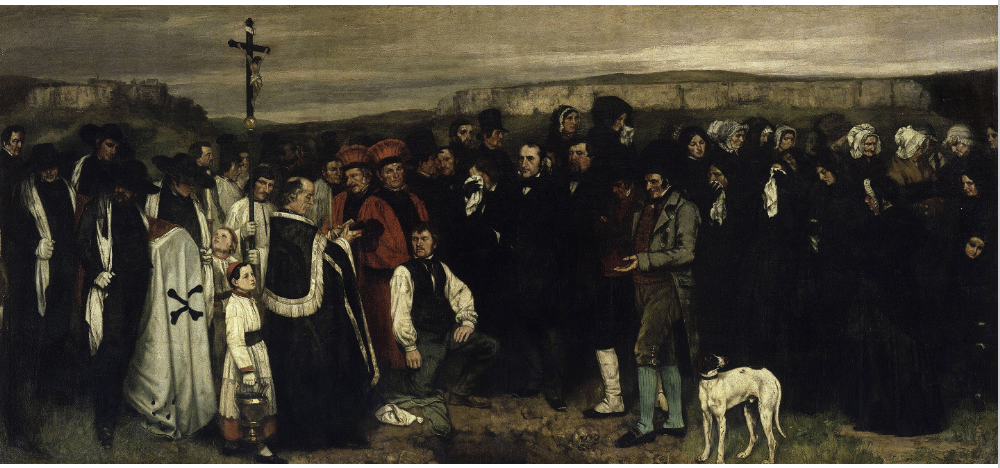
Gustave Courbet, A Burial at Ornans, 1849
Scene of Gustave Courbet’s hometown of Ornans
Depicts an unidealized portrayal of ordinary rural life
Courbet treats an ordinary provincial funeral with the scale and seriousness usually reserved for historical or religious subjects
Ordinary rural people are given visual importance and presence, similar to high-status subjects, unconventional at the time.
Highly controversial as it challenged academic painting traditions and what was considered worthy subject matter, by focusing on real, contemporary life
Corbet uses “live models” (in this case, it's his family), including his uncle on the far left
Includes French revolutionaries (noticeable by their clothing, centre right)
The grave digger is depicted cleanly and with dignity despite having just dug a grave—a physically demanding, dirty task.
This dignified portrayal of a low-status labourer was unconventional for the time, and reflects Courbet's broader commitment to elevating working-class subjects
Insisted on painting only what he could directly observe — "I cannot paint an angel because I have never seen one."
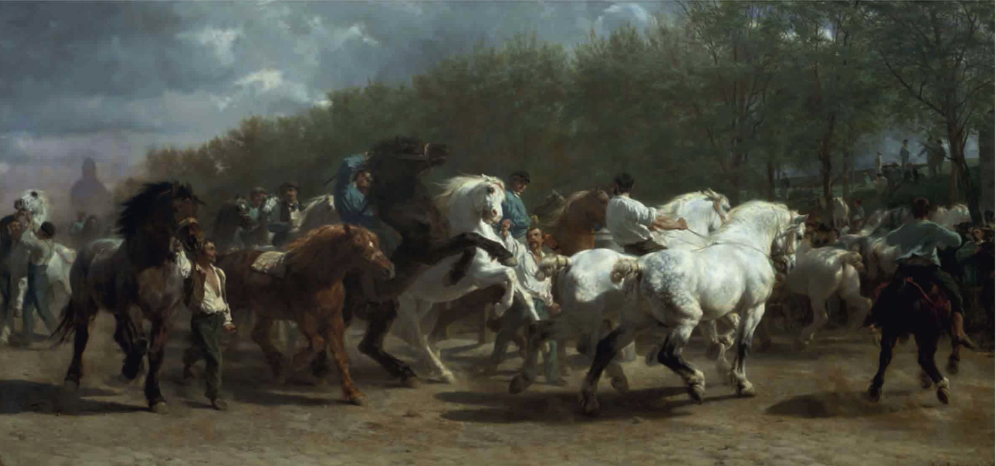
Rosa Bonheur, The Horse Fair, 1852
Bonheur comes from a socialist background, like Courbet — both elevated working-class subjects
Women were traditionally trained only by a father or brother; Bonheur's family actively encouraged her, which was highly unusual at the time
Female artists were prohibited from life drawing classes.
Bonheur refused both traditional feminine subject matter (flowers, domestic scenes) and the male-dominated classical tradition. For her, choosing animals was a negotiation with what was available to her.
Submitted to the Paris Salon of 1853, Bonheur, similar to Courbet, painted this scene at the same scale and seriousness usually reserved for historical or religious subjects, as a deliberate claim about where animal paintings belonged in the academic hierarchy.
She spent a year and a half sketching at the horse market while dressed as a man, as women were not permitted and required an official police permit to wear mens pants.
Bonheur visited slaughterhouses to dissect animals and study their anatomy firsthand — applying the same rigour a history painter would bring to figure drawing.
Percherons are workhorses, which can be read as a reference to the working class, and the muscle of the Parisian economy, consistent with Bonheur’s socialist background and with Realism's investment in labour as subject matter.
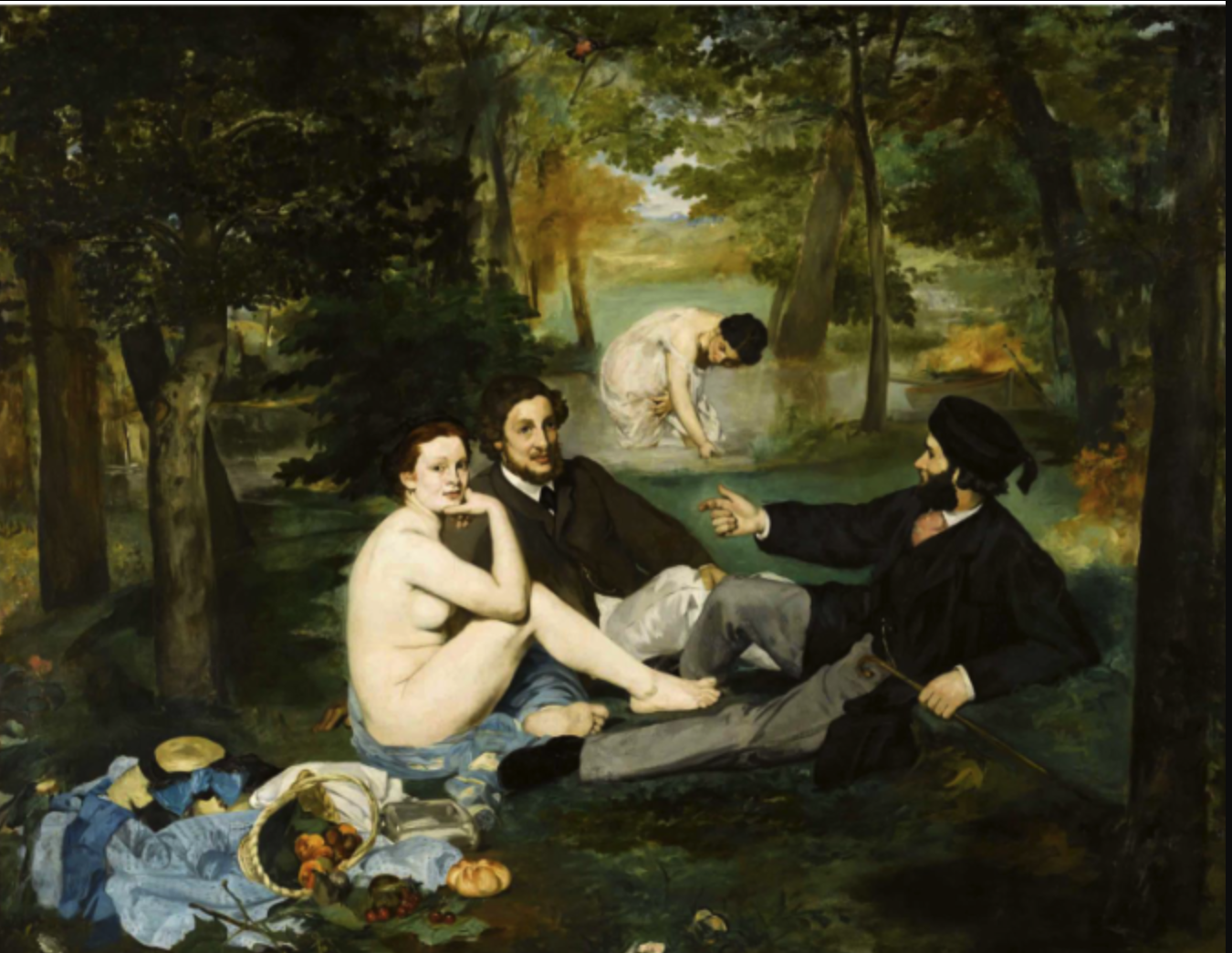
Édouard Manet, Le Déjeuner sur l’Herbe ‘Luncheon on the Grass’, 1863
Le Bain (The Bath); rejected by the official Salon and shown at the Salon des Refusés in 1863, where it caused a storm of controversy — both for its subject matter and its technique.
The subject matter references Titian's Pastoral Concert
The scandal wasn't nudity itself. The problem was the context: a nude woman with no mythological cover, seated among men in recognizable contemporary Parisian dress.
Because she and the male figures were recognizable as real people — not gods, nymphs, or allegories — the scene felt immediate and uncomfortable rather than safely distanced.
The nude woman in the foreground, Victorine, also posed for Olympia.
She looks directly out at the viewer with a nonchalant, unapologetic gaze—this was a deliberate break with convention; the rare female nude who met the viewer's eye was expected to look reserved, not direct.
The three foreground figures are disconnected and alienated from each other as well as from the viewer, who is positioned as an uninvited observer — a voyeur.
The woman appears naked rather than nude — her discarded clothing and hat are visible in the foreground, and she wears a ribbon in her hair, marking her as a modern Parisian woman who has taken her clothes off, not a mythological figure born naturally unclothed.
Her figure is rendered flatly, with almost no contrast from light to dark. Rather than the smooth tonal gradations used to give classical nudes their sense of volume, she looks nearly outlined in dark grays — more cutout than body.
Critics described the paint handling as unfinished and underdeveloped. Manet's loose, visible brushwork throughout the grass and landscape was a flagrant rejection of traditional salon painting standards
The spatial construction is deliberately broken: the background figure is too large for her position in the middle ground, and her gesture appears to reach down toward the thumb of the foreground man, collapsing the illusion of depth.
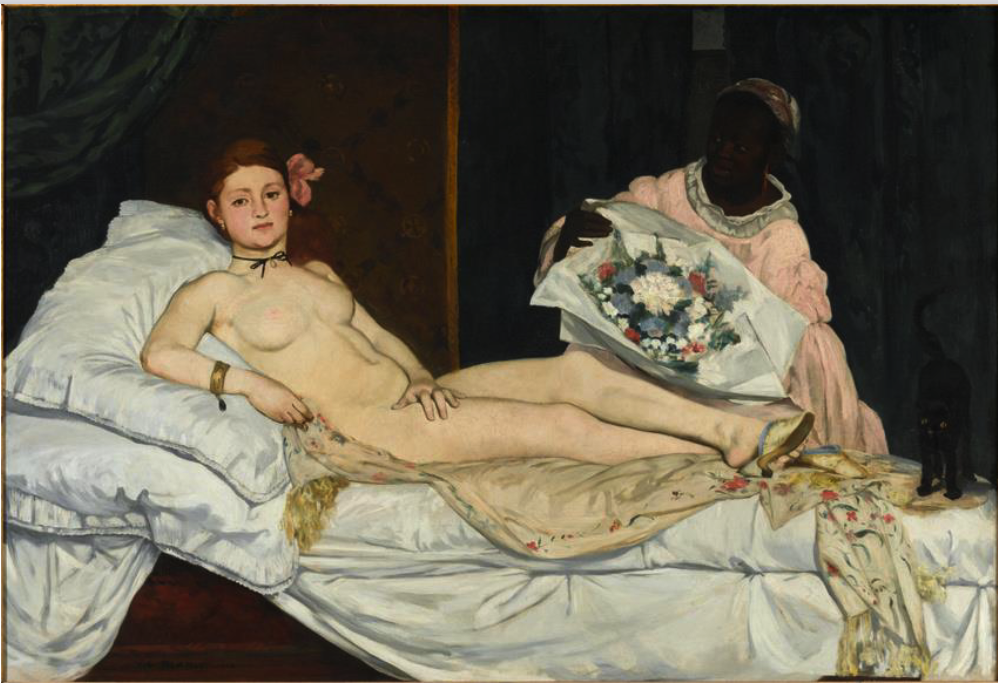
Édouard Manet, Olympia, 1863
Manet’s Olympia depicts a nude white woman (Olympia) lying on a bed being attended to by her black maid (Laure)
The figure of Olympia was modelled after Victorine Meurent
Olympia scandalized the Salon public in 1865 with her confrontational gaze.
“Olympia” was a recognized name for a socially ambitious prostitute. Manet puns on the way French prostitutes often borrowed names of classical goddesses, collapsing the distance between Venus and her contemporary equivalent.
A deliberate provocation against Titian's Venus of Urbino, where Venus is seamlessly contoured, and set in an atmospheric imaginary world, Olympia is flat, harshly lit, and unmistakably situated in contemporary Paris.
Olympia’s eyes confront the viewer directly; her expression can be read as cold, defiant and in control
The left hand of Titian’s Venus is curled and appears to entice, whereas Olympia’s left hand appears to block the viewer's gaze, which can be interpreted as a symbol of her role as a prostitute, granting access to her body in return for payment.
The viewer is denied the voyeuristic access Venus extends.
The dog in Titian’s Venus of Urbino represents fidelity and loyalty; it is replaced here by a black cat, with its arched back and tail upright, a sign of nocturnal promiscuity, sensuality, and independence.
Chatte is also slang for female genitalia
Laure, the Black woman presenting the flowers, serves as a stark contrast to Olympia's whiteness — a pairing Manet uses to embody the uncertainty and social complexity of modern Paris.
The intentionally flat, two-dimensional surface dissolves classical illusionism.
Critic Clement Greenberg would later identify this frankness about the painted surface as the defining feature of the first truly modernist works.
Often called the first modern artwork, it refuses disengaged viewing. The assumed client hovers just outside the frame. As viewers, we are customers.
Complicates bourgeois morality by forcing acknowledgment: the same men criticizing the painting were the ones creating the demand for it.
What is French Impressionism?
The term ‘Impressionism’ was coined by critic Louis Leroy, who, after seeing Claude Monet’s Impression, Sunrise, called the works unfinished or mere "impressions".
En plein air - artists moved out of the studio, painting on-site to capture instantaneous, candid scenes
The invention of tin tubes allowed artists to take their oil paints outdoors (en plein air) without the paint drying or requiring complex, studio-based preparation.
Emphasis on the shifting effects of sunlight and colour, often using broken, unblended dabs of paint to convey movement and life.
Focus on everyday life, including urban Parisian cafes, suburban leisure, landscapes, and railway stations.
Loose, quick, and visible strokes that emphasize the "impression" rather than fine detail.
The rise of photography influenced painters to abandon the need to record reality perfectly and encouraged them to focus on capturing a specific, transient "moment in time," as well as adopting spontaneous, unconventional compositions.
Also heavily influenced by ukiyo-e woodblock prints, a phenomenon known as Japonisme (term for objects + images that characterized European ideas about Japan).
Impressionists rejected the strict standards of the official Parisian Salon
Eventually making the Paris Salon irrelevant by 1881
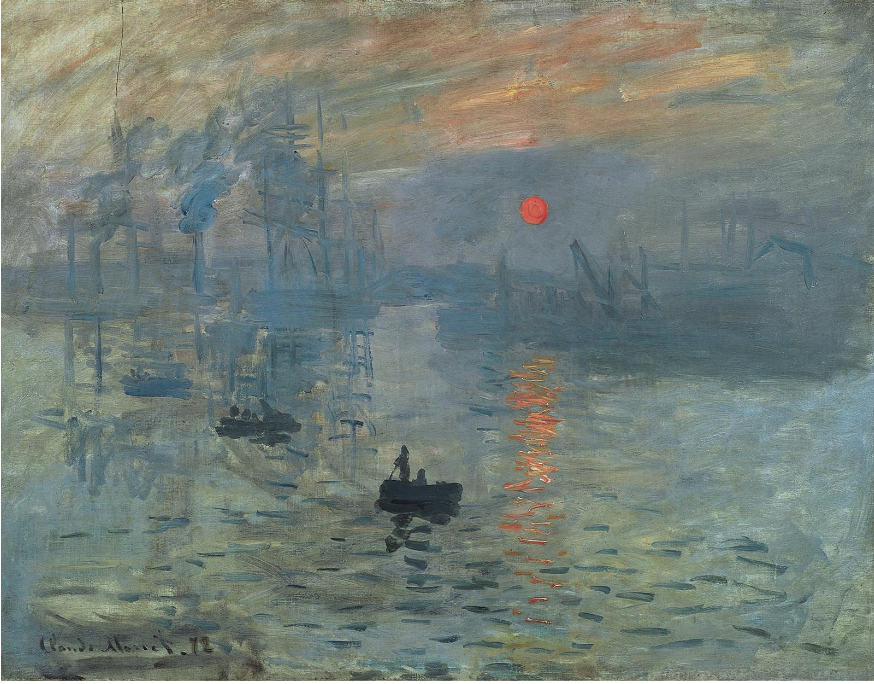
Claude Monet, Impression, Sunrise, 1872
Depicts Le Havre, Monet's hometown and a major port in France, in the early 1870s at sunrise.
Foreground and background share the same muted palette, dissolving into one another across the canvas
Painted en plein air, outdoors, capturing light quickly with rapid, loose brushstrokes of pink, red, and blue.
Portable paint tubes made this possible.
Industrial elements — smokestacks, steamships alongside traditional fishing boats — reflect the changing world of 19th-century French industry and commerce
Japan had been largely isolated from foreign contact for over two centuries under the Sakoku policy, with only a limited Dutch trading post in Nagasaki
The Perry Expedition, 1853, the US military arrived in Tokyo Bay with four black gunships — the Japanese called them “the black ships” and pressured Japan to open to trade; treaty of Kanagawa was signed in 1854
Japanese goods began to flood into Europe, and Japonisme — a fascination with Japanese art and aesthetics — spread widely among French artists and intellectuals
Monet eventually collected 231 Japanese woodblock prints; Hiroshige and Hokusai influenced his treatment of atmosphere, asymmetric composition, and the flattening of pictorial space
The flow of Japanese goods into France in this period reflects the same expanding global trade networks visible in Le Havre's smokestacks
What is Postimpressionism?
Not an obvious continuation of impressionism -
Not a unified style; artists became interested in exploring space, time, perspective and colour in art, to understand their own interiority.
The term comes from Roger Fry, a historian who retroactively identified these artists as postimpressionists, as they would have been aware of what they were doing, but the category itself came later.
Conscious, more structured approach to subject matter
Wanted to create something more concrete
Impressionism was too light and feathery, and not rigorous enough
Not a cohesive, unified movement, but rather a collection of individual artists
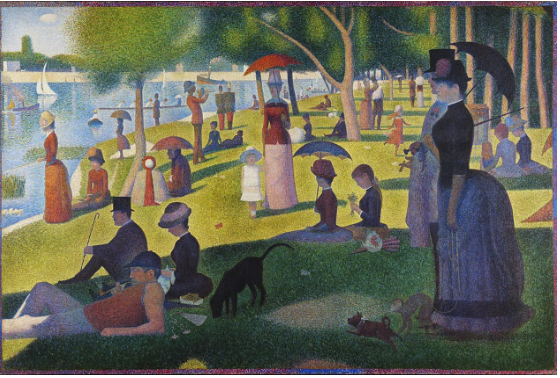
George Seurat, Sunday Morning on the Island of La Grande Jatte, 1884
Depicts a large-scale scene of Parisian leisure on the Seine
a subject rooted in modernity
Figures appear frozen and static, a deliberate departure from Impressionism's spontaneity
Seurat was motivated to use science to correct Impressionism as he considered it “intellectually shallow or pretty.”
Chromatic optical mixing: colours are placed side by side in small dabs rather than blended on the palette — the eye fuses them at a distance. A blue dot next to a red dot reads as purple.
Only 11 colours in 3 values were used across the entire canvas
Composition is highly focused on precision and accuracy
Considered Neo-Impressionism
Reflects the avant-garde shift toward a brighter palette
Pointilism or Divisionism (The application of dabs of colour (short strokes, dashes, or dots) in a uniform, systematic manner).
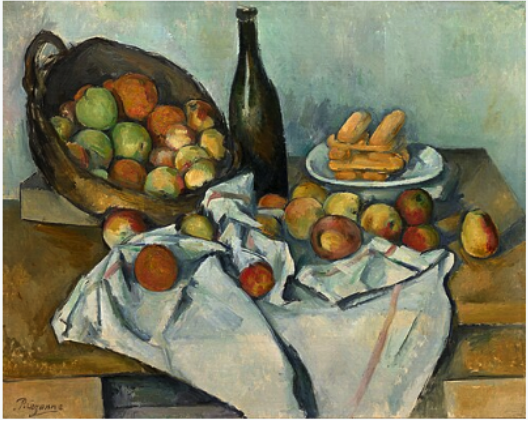
Paul Cézanne, The Basket of Apples, 1893
Cezanne takes Impressionism to a conceptual direction (away from optical recording toward structural logic).
Intentionally distorted, the objects are painted in physically impossible ways; the bottle appears warped and multi-silhouetted, giving the illusion that it's vibrating or shaking on the table.
To the public at the time, these appeared as mistakes and poor skills
Simplified into solid, stable forms, prioritizing the pictorial logic of the painting itself over the literal view from the eye.
Cézanne believed we don’t see the world in a linear perspective; human perception is not fixed. We see the world from shifting, multiple viewpoints — and the canvas should reflect that.
Impressionists chased a fleeting moment; Cézanne wanted to make Impressionism into something solid. He felt it was too formless, too atmospheric, and lacking intellectual control.
Focused on the underlying structure, form and volume of objects (such as apples, jugs, or landscapes).
Would break objects into underlying geometric volumes, reconstruct them on the canvas, and use colour to model form — warmer colours appear closer, while cooler tones appear further away
Shift from: What does it look like? → How is it constructed?
For Cézanne, a painting is not a visual recording — it is its own structured thing, built from form, colour, and composition independent of the artist's eye. He worked slowly: long looking, then painting, then looking again.
Often called the father of modern form. His insistence on geometric reconstruction and pictorial structure directly opened the door to Cubism (Picasso, Braque) and abstraction more broadly.
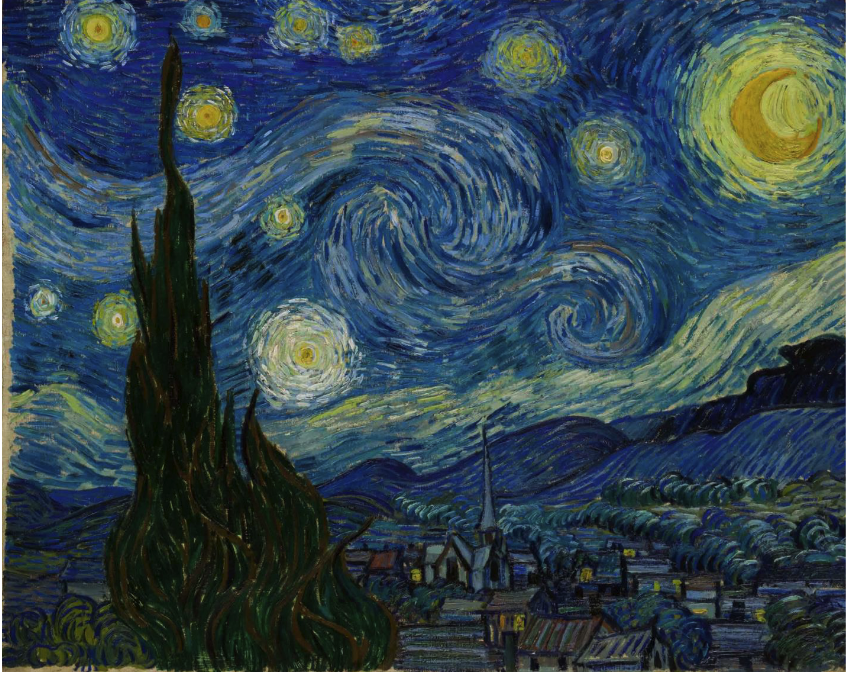
Vincent van Gogh, The Starry Night, 1889
Gogh’s goals were to liberate colour from its rational and mimetic associations – freeing it to build his own archive of references (e.g., yellow = joy) his intense brushstrokes (impasto- suggests what he’s feeling), like colour, can transmit emotion and state of mind, arguably more than his colour decisions at the time. ,
Gough saw a cypress tree through his window at the mental institution in Saint-Remy during his self-imposed sectioning, and how they appear like flames,
an organic kind of power that makes it appear almost not of this world.
Heavenly bodies in the sky also relay a similar kind of strangeness
“burn like gas lamps in an uneven sky.”
the star that appears to vibrate in a white-ish yellow (near the cypress tree) is said to represent the planet Venus (our old friend, the Roman goddess of love) – and it is not too much of a reach to understand why Venus may have been worth singling out for the artist because it is this desire for connection, this desire for love, that he constantly sought throughout his life – something he never claimed to have found on earth, but was always in the distance.
His expressive colours and expressive brushwork result in this kind of abstraction in this work, a distillation of feelings he was experiencing at this moment and on this site.
Distortion of reality in order to shape how he feels in his emotional state at that time
Impasto and brushstrokes done with force and vigour, Gogh’s goals were to liberate colour from its rational and mimetic associations – freeing it to build his own archive of references (e.g., yellow = joy).
His intense brushstrokes, like colour, can transmit emotion and state of mind, arguably more than his colour decisions at the time,
also reflects the various mental states and crises he was experiencing in his 30s.
Gough saw a cypress tree through his window at the mental institution in Saint-Remy during his self-imposed sectioning, and how they appear like flames,
an organic kind of power that makes them appear almost not of this world.
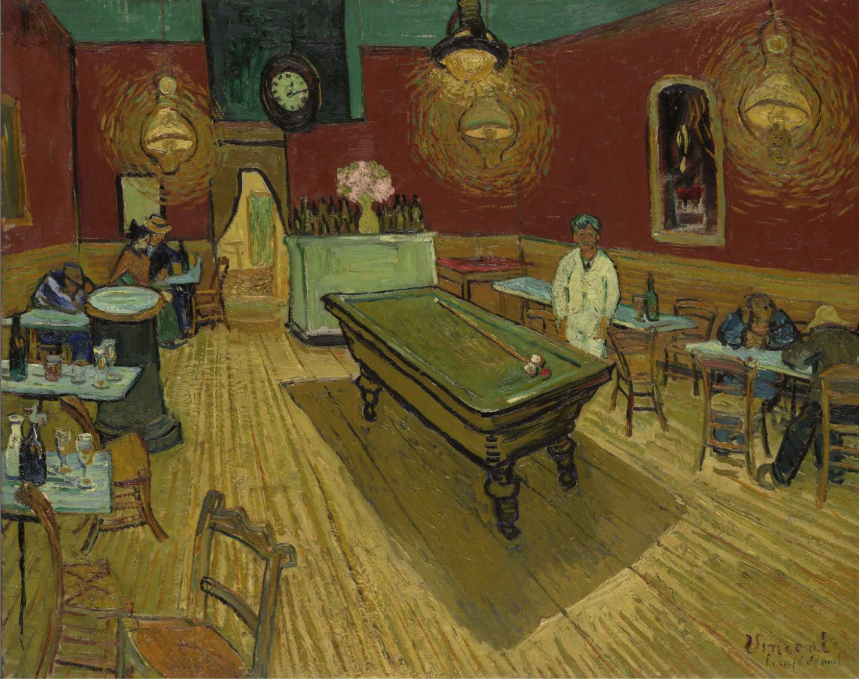
Vincent Van Gough, The Night Cafe, 1889
Painted in Arles
Use of clashing colours, yellow, red, green
Radiate stylized auras-
Distorting and messing with perspective lines
Roughly outlined figures
The figures are alienated - sick from modernity and industrialization
Personal expression was still a novel thing
Concept of alienation
Showcasing modernity-affecting him and society at the time
van Gogh sought to make what he deemed ‘simple’ and ‘unsophisticated’ art – in other words, art that could be enjoyed by everyone regardless of academic familiarity and institutional access.
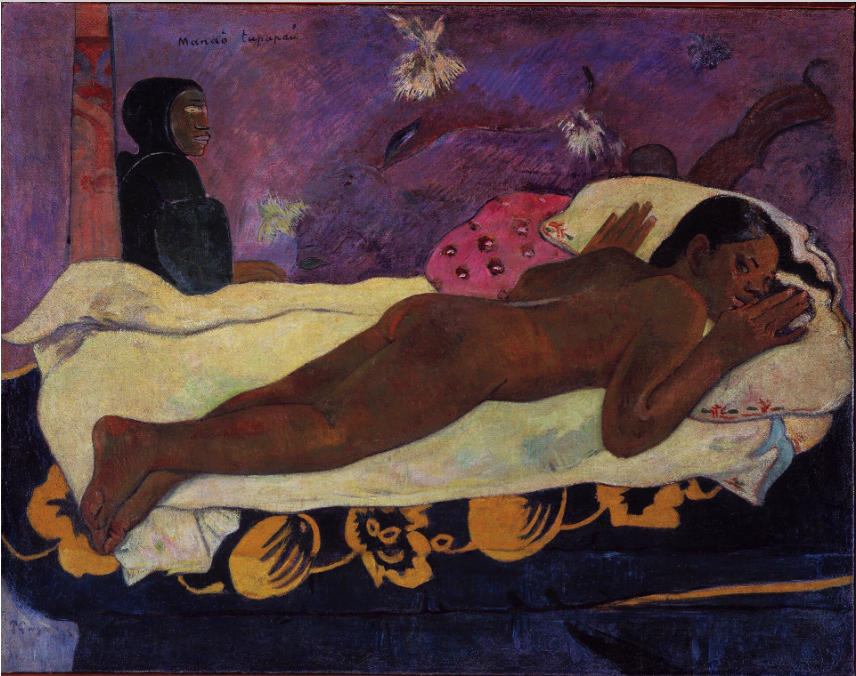
Paul Gaugin, The Spirit of the Dead Watching, 1892
Gaugin worked as a stockbroker before turning to painting full-time, not formally trained as an artist.
Felt traditional European painting had become too imitative and lacked depth
Left Europe to explore other cultures, and also wanted to become the new leader of the Parisian avant-garde
Father of Modern Primitivism is not an essentialist category but a relational one — the term only exists in contrast to "civilized." The two concepts constitute each other. In the West, it is applied negatively.
Primitivism is the Western fascination with less industrially developed cultures and the romantic notion that non-Western peoples might be more genuinely spiritual or closer to God than their European counterparts????
Gauguin projects fantasies of origin, nature, and liberated instinct onto the cultures he encounters.
Fixated on people living in Oceania, particularly Tahiti, and then the Marquesas
Gaugin was fascinated with the colonial pavilions at the 1889 Exposition Universelle, which gave him the idea to move to an exotic, preindustrial locale and escape his money troubles.
He set sail for Tahiti in 1891.
Central figure in the development of modern primitivism, also set the stage for movements such as Fauvism and Expressionism.
Once he arrived in Tahiti, Gauguin found that the place he envisioned did not exist: the island was already dealing with the impacts of colonialism and modernity, and native customs seemed headed toward extinction. In his art, he tried to reimagine a lost paradise.
Gauguin considered this the most significant painting from his first stay in Tahiti.
The subject is Teha'amana, Gauguin's 13-year-old wife, depicted lying face-down on a bed, appearing frightened
The tupapau — the spirit of the dead, appears as an older woman in a black cloak.
On the wall behind the bed are feathery white forms, the artist described as phosphorescent lights, representing the spirits' interest in the living
The tupapau figure replaces the maid (Olympia's attendant) with a Tahitian spirit of the dead, substituting a symbol of Parisian modernity with a figure from Polynesian folklore.
Brought a photograph of Olympia with him to Tahiti
Inversion of the reclining nude tradition: her prone, face-down position departs from every other reclining nude convention — Titian, Manet — in posture, gaze, and power dynamics.
Gauguin assumed the role not only of an artist but of a much older man in a position to take advantage of his subject
For Gauguin, colour is symbolic and decorative: flattened, non-naturalistic, used to convey mood or meaning independent of observed reality.
In his journals Noa Noa, Gauguin wrote about Tahitian life in terms that projected European fantasies of primitive sexuality onto the people he encountered.
Now read as a primary document of colonial racism — the "primitive" he describes says more about European desires than about Tahitian reality.
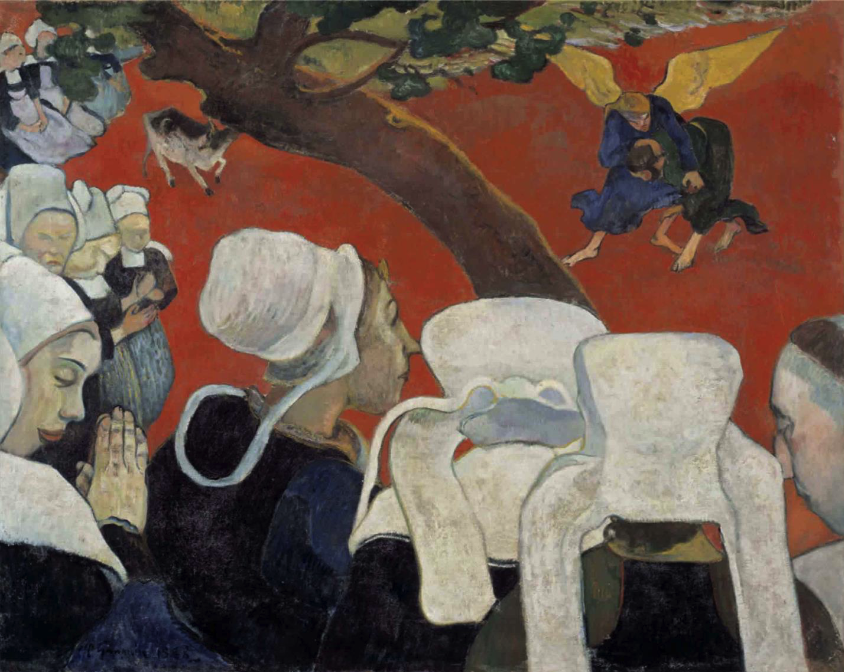
Paul Gaugin, Vision after the Sermon, 1888
Gauguin used the term Synthetism to describe paintings like Vision After the Sermon, in which he aimed to synthesize the outward appearance of a subject, the artist's emotional response to it, and the aesthetic considerations of line, form, and colour.
(outward appearance, artist’s emotions, and pure aesthetic lines/colours)
Painted in Pont-Aven, Brittany
Depicts the biblical story of Jacob wrestling a mysterious angel indirectly, shown through the vision of a group of Breton women who have just heard a sermon on the subject
The composition is divided by a large diagonal tree trunk, separating the Breton women in the foreground from the wrestling figures in the background.
The tree is an apple tree, which carries its own symbolic weight — in the Bible, a symbol of knowledge and man's fall, but here depicted full and lush, suggesting the possibility of redemption.
Gauguin found inspiration in Japanese woodblock prints by Hiroshige and Hokusai, developing the idea of non-naturalistic landscapes and applying large areas of flat colour. The diagonal tree is the most direct visual reference to this influence. It eliminates traditional perspective, creating a clear boundary between reality and the imagined or spiritual world.
The brown trunk, black garments, white hats, and red field are painted with minimal colour shading — Gauguin moves away from naturalism toward a more abstract, symbolic manner of painting
Breton women are shown in traditional ceremonial dress (the distinctive white coifs/caps).
Gauguin viewed this regional costume as marking these women as closer to a pre-modern, folk religiosity, which connects to his primitivist interests even within Europe.
The use of colour red is both structural and symbolic; it organizes the composition while giving emotional and spiritual weight to the scene.
The vivid vermilion red of the ground symbolizes the biblical River Jabbok and signals that this landscape exists only in the imagination, not in observed reality.
Red conveys energy, tension, and drama. Gauguin uses it to heighten the psychological and emotional impact of the vision, making the spiritual encounter feel immediate and vivid.
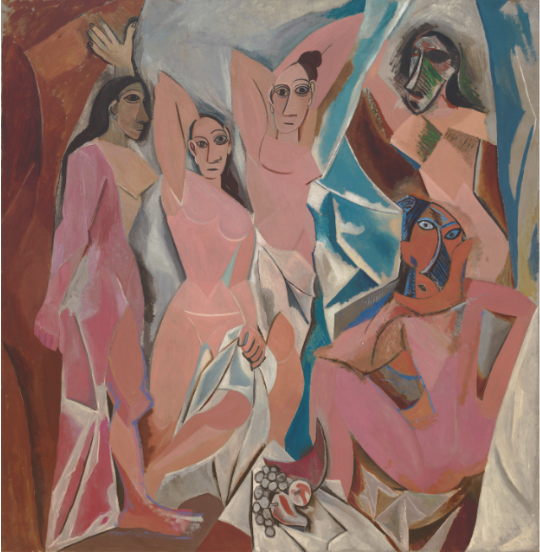
Pablo Picasso, Les Demoiselles d'Avignon, 1907
Jacques Doucet, a Parisian fashion designer, purchased the painting directly from Picasso in February 1924.
In 1937, MoMA purchased it
Picasso produced extensive preparatory studies over the course of the painting's development.
Originally titled The Brothel of Avignon
Nicknamed The Philosophical Brothel
Originally included male figures, originally planned with a sailor and a medical student among the figures, which would have made the scene more explicitly narrative.
Picasso removed these figures, shifting the focus entirely to the women.
The five figures are prostitutes from the Carrer d'Avinyó brothel district in Barcelona
Inspired by Cézanne and Matisse (also responding competitively to Matisse's Le Bonheur de vivre)
Left figures: influenced by ancient Iberian sculpture
Right figures: influenced by African masks — most closely associated with Fang Ngil masks from Gabon
Picasso denied African influence publicly
No vanishing point — perspective is completely abandoned, nowhere for the eye to move beyond the women
Figures surrounded by curtains — staged, theatrical, places viewer in position of voyeur or customer
Jagged, angular forms throughout — deliberate discomfort, figures appear fragmented and disunified in space
The crouching figure at lower right is the most contorted — face visible frontally while body faces away, an impossible position
Called it his "first canvas of exorcism" — referring to the psychological act of giving fear physical form, not a statement about Western painting broadly
Originally more naturalistic; became increasingly confrontational as African mask influence entered the composition
The painting maps two traumatic memories for Picasso: a visit to a brothel in Barcelona and a visit to the ethnographic museum (Trocadéro)
All five women look directly at the viewer — the painting is about looking and the trauma of looking
Apotropaic function: the mask-faced women on the right threaten and ward off the viewer rather than invite them
Analogous to Medusa's head — a personal threat of petrification, not a traditional narrative
The viewer is positioned as voyeur or customer — the act of looking is implicated and made uncomfortable
Disrupts the traditional safe, passive viewing of the female nude
No conventional beauty or invitation — the women are confrontational, not idealized
Picasso's legacy: changing the conditions under which the viewer looks at anything
The women's nudity is openly sexualized while simultaneously degrading them — their presentation to the male viewer positions that viewer as voyeur or potential customer, making the act of looking itself implicated and uncomfortable.
What is Dada?
Dada did not emerge from a single movement but was strongly influenced by earlier avant-garde developments, especially: futurism, cubism, and expressionism.
Dada pushed beyond these movements by abandoning structure altogether. Where earlier avant-garde art still sought meaning or progress,
Rejects meaning itself, using chaos as both a method and a message.
Informal movement intertwined with WWI
Dada- is a nonsensical term
A nihilist movement = an anti-aesthetic
Inability to be coherent
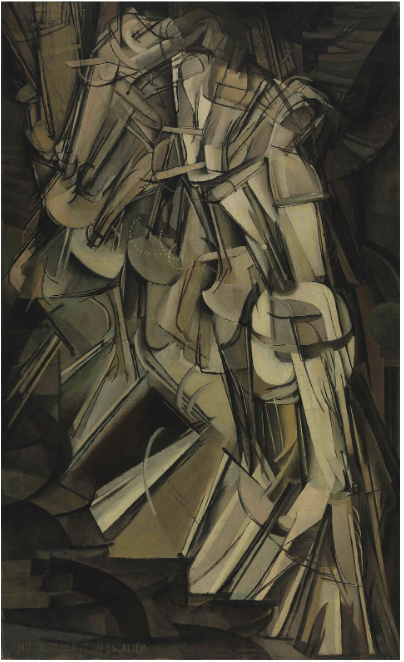
Marcel Duchamp, Nude Descending Staircase No.2, 1912
First exhibition of modern art in North America - The Armoury Show
Monochromatic - cubist colours
Nude portrait of a body in motion, descending a staircase
Shattered mechanical Atomiton
Mirrors 20th-century industrial society
Shattered the way we view objects in nature
It is no longer acceptable to show things as they are
Until this art - art was understood as autonomous, separate from social life and institutions in itself
Rejected from the salon - Duchamp decides he's no longer preoccupied with seeing
Becomes a dadaist
Zurich, switzerland - central place of dadaism
Dadaist blamed the bourgeoisie for issues???
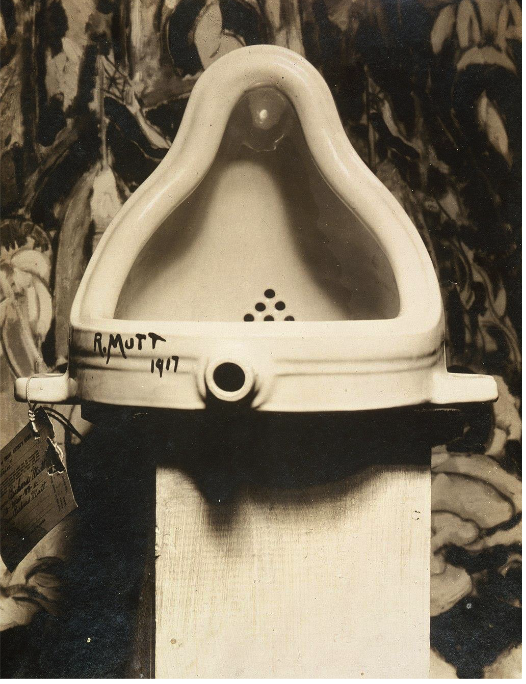
Marcel Duchamp, Fountain, 1917, readymade porcelain
1917, porcelain urinal, readymade
Submitted to the Society of Independent Artists exhibition in New York
Purchased from a plumbing supply store called J. L. Mott Iron Works — Duchamp brought it to his studio, turned it 90 degrees, and signed it R. Mutt (pseudonym)
R. Mutt" is a play on words: "Mott" from the store name
Duchamp submitted under a pseudonym so the board would have to judge the object on its own terms, without his reputation behind it
Duchamp was a founding member of the Society of Independent Artists, whose stated principle was that any work submitted by an artist who paid the fee would be accepted
The board rejected it anyway, hiding it behind a partition
Grounds for rejection: immoral and indecent, plagiarism, "a plain piece of plumbing."
Duchamp resigned from the board in protest
Object and the Concept:
A readymade: an unmodified commercial object selected and recontextualized by the artist
Duchamp's argument: He took an ordinary article of life, placed it so that its useful significance disappeared under the new title and point of view, and created a new thought for that object
The act of selection and recontextualization is the artistic act, not making, not craft
Duchamp separates craftsmanship from art entirely. Does art have to be made by the hand of the artist?
Ontological: What is art?
Epistemological: how do we know it?
Institutional: who gets to decide?
Kant
When you experience art, you're not thinking about its use, its price, or what it can do for you — you just experience it
called this disinterested pleasure — appreciation with no practical interest attached
For Kant, the absence of utility is what separates art from everything else
Duchamp
He picks a urinal — an object with an extremely specific, bodily function
He removes it from its context, puts it on a pedestal, titles it, and calls it art
By changing the context, he drains the object of its function — what's left?
The question Duchamp forces
If art is defined by the absence of utility, then any object can become art the moment an artist strips away its utility through recontextualization
So what actually makes something art — the object? The artist's decision? The institution that displays it?
Legacy
Shifts art from a visual/retinal practice to a philosophical/conceptual one
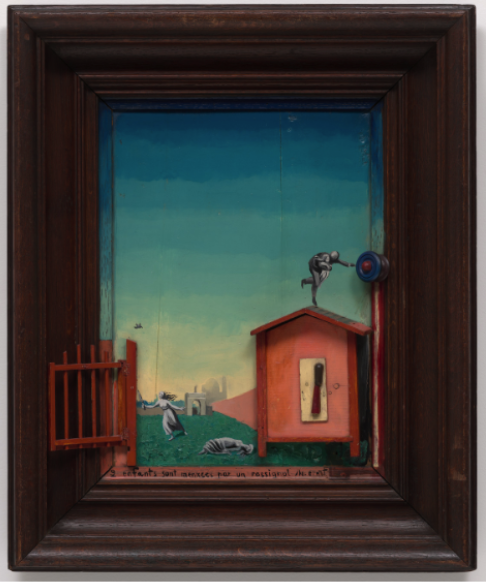
Max Ernst, Two Children Menaced by a Nightingale, 1924
Inspiration for the title came from a fever dream Ernst had during a measles-induced fever he experienced as a child, which caused him to hallucinate images in the wood grain of a panel near his bed.
The title is painted onto the wooden frame below the painting.
Assemblage centred around an oil painting created with impasto (the process or technique of laying on paint or pigment thickly so that it stands out from a surface) and figures painted in grisaille (a method of painting in gray monochrome, typically to imitate sculpture)
The elements that make it an assemblage extend into real space.
(the hinged wooden gate, a small home/shed, an actual knob fastened to the interior of the frame —appearing like a kind of doorbell and toy-like object (interest in the child)
Beyond the assemblage elements, the painting is traditionally structured.
Dominated by a blue sky, appearing like different hues of blue, but also structured according to linear perspective and atmospheric perspective
In terms of subject matter, a panicked female figure on the left dashes away, brandishing a large, phallic knife
It's unclear whether the woman is running away from something or toward something, but her distress is palpable, and much is left out of this painting to tell us exactly what is happening or why it is happening
Another female figure swoons on the ground, possibly dead, her body unreadable and amorphous
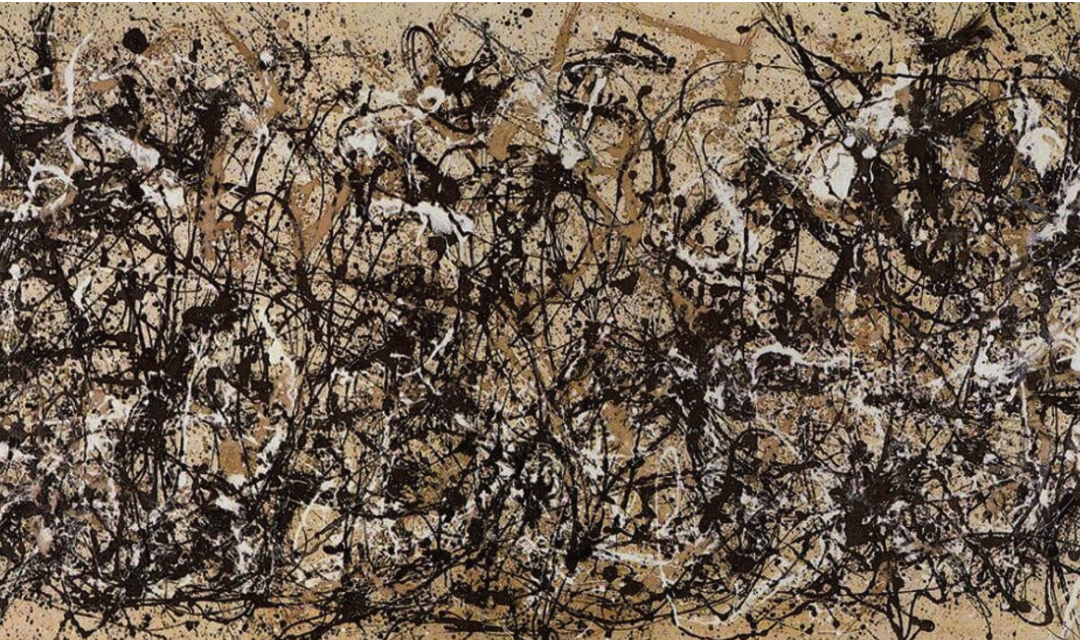
Jackson Pollock, Autumn Rhythm (Number 30), 1950, enamel and oil on canvas
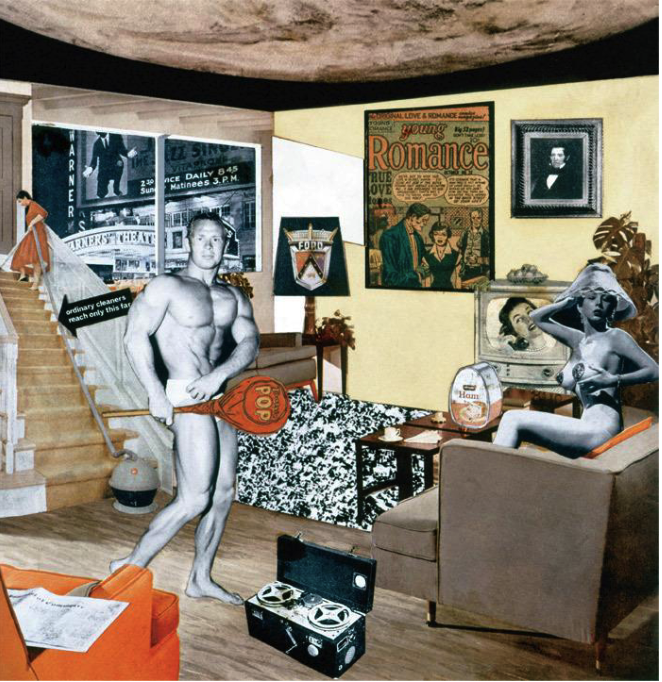
Richard Hamilton, Just What is it That Makes Today’s Homes So Different, So Appealing?, 1956, collage on paper
one of the first pop artists
Collage
Pop psychological parody of post-war imagery
Uncanny domesticity
Using the language of advertising (the vacuum in the lower left)
Phalic references - the tootsie roll ‘penis’
Long vacuum
Womens breasts directed to the tootsie roll
Delirious crossing of sexual, technological, and __? aesthetic
Spliced in order to create a new kind of image
Picassos collage was avante garde- but this is a collage of advertisements
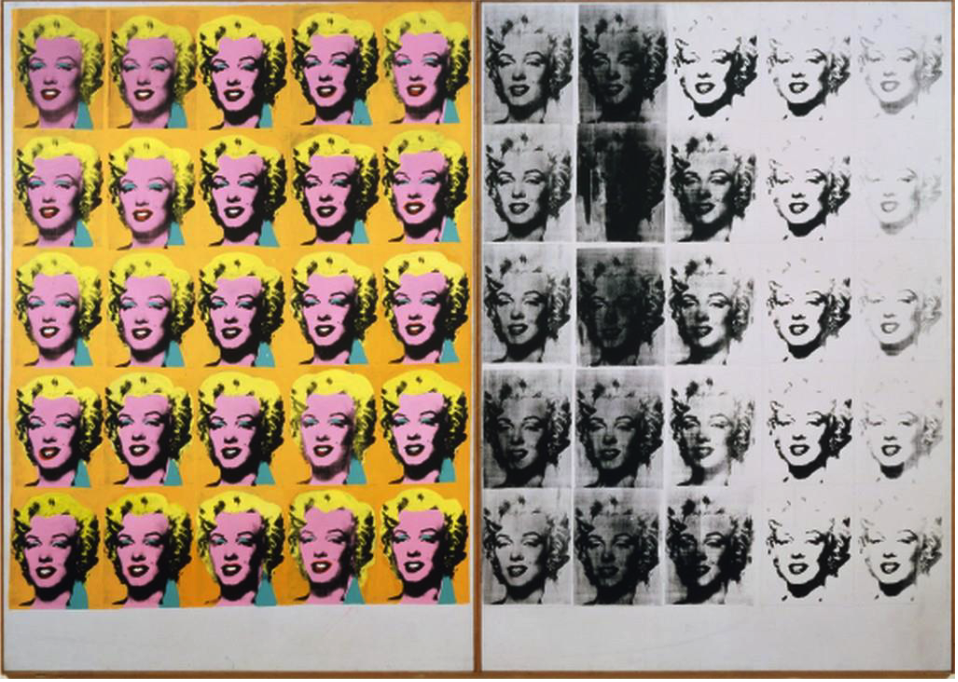
Andy Warhol, Marilyn Diptych, 1962, Silkscreen ink and acrylic paint on two canvases
Like Duchamp’s ‘readymade’, Warhol used a found photo of Marilyn, silkscreened 50 times
Acrylic paint used- a commentary on consumer culture - acrylic paint is ‘plastic paint.’
Warhol uses acrylic, which was originally for advertising - bright, bold flat colours
The repetition of her ‘icon’ like face reflects her branding/iconicness - she's everywhere in mainstream media/culture
Advertising is also about repetition
She becomes an object for mass production and consumerism
Her face becomes like a mask - flattened, objectified
Marilyn committed suicide as Warhol began this art - might be expressed in the right side being black and fading away
Simulack???? - copy without an original
Obsessive fixation with things that become lost - melancholia
Fetish of commodity
Reality of suffering underneath -tragedy of Monroe is relayed through the semulac
Apathy -
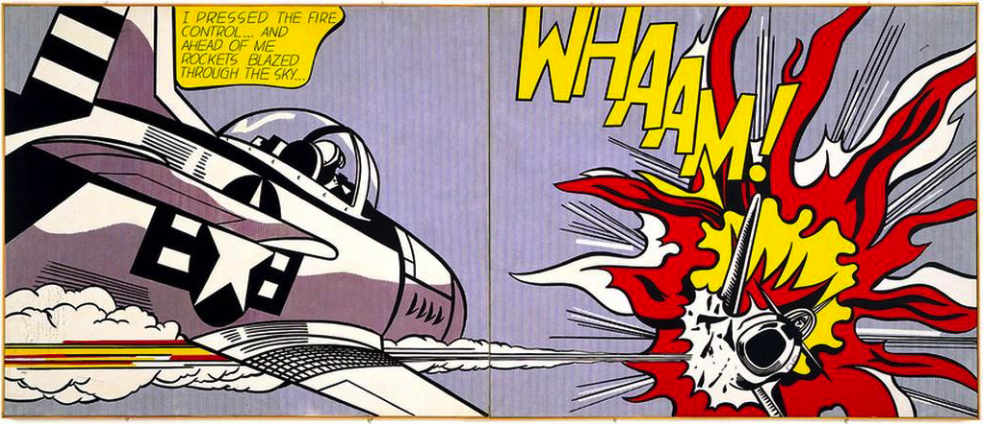
Roy Lichtenstein, Whaam!, 1963, oil and acrylic on canvas
Critiques considered him banal and said he would plagiarize
Sketches the comic-uses a projector to enlarge-
Looks mechanical and industrialized
Blurs the line between handcrafted and mechanical reproductions
Hand-made “ready-made”
Borrowing the aesthetic of comic strips
Copied from a wartime comic strip
Ben-Day dots technique - originally a printing process for newspapers to print colour
Dots convey the mechanical process
Life is now mediated in terms of imagery because of mass consumer technology
Argued he was recomposing, not reproducing
Challenging us by offending aesthetic taste
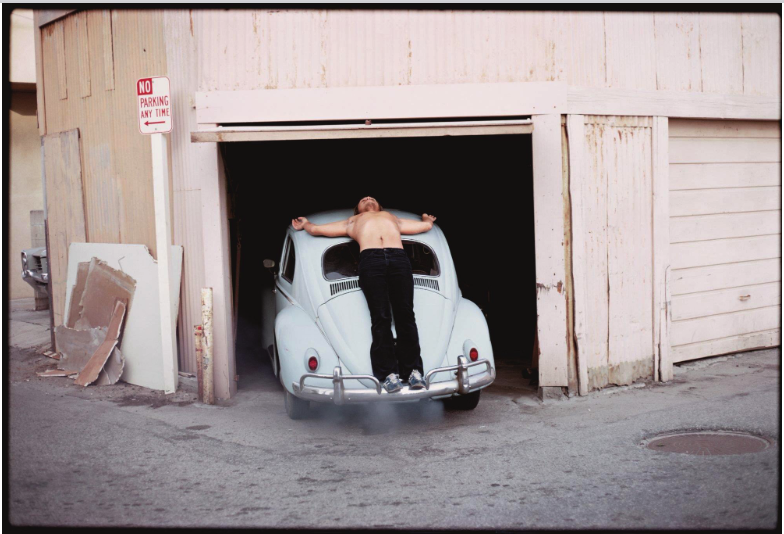
Chris Burden, Trans-fixed, 1974, performance, Venice CA
Fixity: to cause someone to be struck with horror
Body art
Burden is nailed through his hands to the back of a Volkswagen Beetle
The driver (burdens attorney lol) revs the engine for two minutes while he screams
Ritualistic aspect
Trans-fixing the audience also literally fixed to the car - using trans-mission?
Relics - the nails left over from being nailed to the car
Pushes performance art to an extreme, pushing ethical limits
At what point do we take action- the same time as the Vietnam War - at what point is it enough?
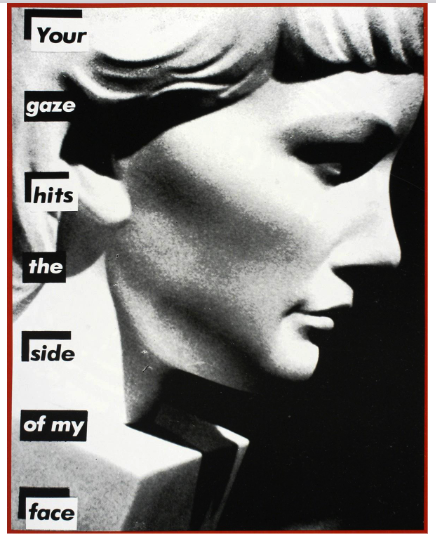
Barbara Kruger, Untitled (Your Gaze Hits the Side of My Face), photograph and type on paper, 1981
Style of photo montage based on appropriation
Advertising and media prey on human psychology
Socially conscious
Cropped colleges, with text
Your Gaze hits the side of my face
Tradition of ‘unknown label’ used as Kruger is a female artist
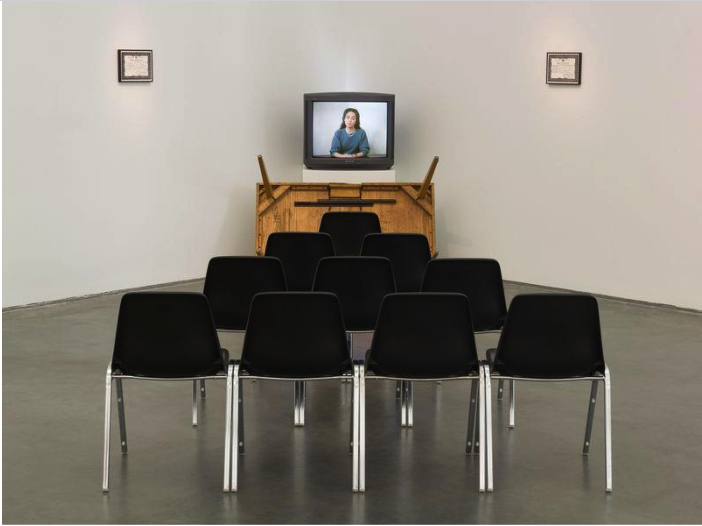
Adrian Piper, Cornered, 1988, video installation (monitor, chairs, table, birth certificate), dimensions variable
Conceptual artist and analytic philosopher — both practices are central to her work, not separate
PhD in philosophy from Harvard (1981), supervised by John Rawls; also studied Kant and Hegel at the University of Heidelberg
First tenured African American woman professor in the field of philosophy
Piper is a trained Kantian philosopher
Cornered
Video installation: single monitor wedged into a corner behind an overturned table, with chairs for viewers arranged in front
Flanking the monitor on either side are two birth certificates — one identifying Piper's father as white, the other as black
The overturned table functions as a barrier — Piper is physically distanced from the viewer but makes direct eye contact through the screen
The architecture of the corner is deliberate — Piper is literally and figuratively cornered, and so is the viewer
Piper begins the 16-minute monologue by stating, "I'm black," then quietly and methodically argues that statistically, the white viewers watching are also likely to have black ancestors
Her tone is calm and measured — the rationality of the delivery is part of the provocation
Piper diagnoses racism as a kind of perceptual disease, a distortion in how people see and categorize others
The work destabilizes fixed racial categories by showing they are constructed, inconsistent, and statistically incoherent
The Argument
Uses logical, philosophical argumentation to expose the irrationality of racism
If racial categories are so important, why do so many white people have undisclosed black ancestry? The categories are socially constructed, not biological fact
Piper's own light skin and ambiguous racial identity is central — it confounds stereotypes and serves as the basis for her deconstructive analysis, calling into question not only her racial identity but the viewer's as well
Ends with a direct challenge to the viewer: "So how do you propose we solve it? What are you going to do?"
She uses rationality as a tool to expose pseudo-rationality
Racism presents itself as rational (categories, classifications, order) but is actually irrational when examined logically
Piper treats the viewer as a rational agent capable of being reasoned with — the work demands intellectual engagement, not just emotional reaction
Analyzes cultural biases and their impact on the individual, specifically for women of colour
Using documentary, testimonial, and personal experience as artistic material
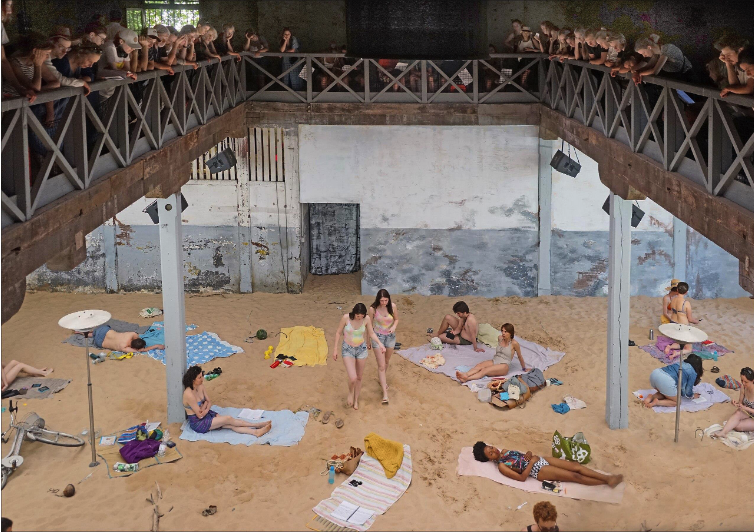
Lina Lapelyte and Vaiva Grainyté, Sun and Sea (Marina), 2019, opera installation
An opera installation performance about climate change
Viewers watch from a gallery balcony, looking down onto the performance
Bienalle- Biennale art gallery exhibition
“The sea is full of algae.” ????
Suspended in time at the edge of climate catastrophe -
Coming together on this work - absence/destruction of art categories - product of the capitalist world we live in, there is too much
Slow violence of change
Audience would freely come and go, as well as talk and take photos/videos - it was expected
Occupies multiple spaces in time simultaneously
Contemporary means to occur and exist at the same time (disjuncted times)
Emphasis on social space-