30. Benign and malignant tumors of the paranasal sinuses, principles of treatment.
 Call Kai
 Learn
Learn Practice Test
 Spaced Repetition
 Match
Match Flashcards
 Knowt Play
1/16

There's no tags or description
Looks like no tags are added yet.
Name | Mastery | Learn | Test | Matching | Spaced | Call with Kai |
|---|
No analytics yet
Send a link to your students to track their progress
17 Terms
What are the benign tumours of the paranasal sinuses
They’re rare
papillomas/ inverted papillomas
osteomas
ossifying fibromas
gliomas
haemangiomas
What are inverted papillomas
locally aggressive tumour
can transform into SCC
What are the clinical signs of inverted papilloma
Often asymptomatic until they have reached an advanced stage → non-specific symptoms:
Nasal airway obstruction, epistaxis, bloody rhinorrhea
Fetid nasal odor, recurrent bouts of sinusitis, headache, facial pain
Swelling of the buccal soft tissues, swelling at the medial canthus of the eye
Infraorbital nerve involvement → hypoesthesia or numbness of cheek
Orbital infiltration → diplopia, proptosis, eye swelling
How do you diagnose inverted papilloma
history
inspection, palpation
endoscopy- polyp like lesion
biopsy with histological examination
CT
What is the treatment of inverted papillomas
surgical removal
describe osteomas
benign bone tumour
in sinuses- commonly occurs as isolated mass in ethmoid and frontal sinus
what are the clinical signs of osteomas
asymptomatic
until treached an advanced stage → non specific symptoms
How do you diagnose osteomas
detected incidentally on skull x ray after head trauma
history, inspection, palpation
endoscopy
biopsy with histological examination + CT
What is the treatment of osteomas
surgical removal if symptomatic
no need for therapeutic intervention if asymptomatic
Describe malignant tumours of paranasal sinuses
more common than benign
mainly in maxillary sinuses
then ethmoid cells, frontal sinus, sphenoid sinus
What are the malignant tumours of the paranasal isnuses
Tumors of epithelial origin:
SCC, adenocarcinoma, adenoid cystic carcinoma
Tumors of mesenchymal origin:
osteosarcomas, chondrosarcomas
Tumors of lymphoid origin:
lymphomas
Metastasis form:
kidney, lung, breast, testis, thyroid gland
What are the symptoms of malignant tumours
often asymptomatic
advance stage → non specific symptoms
How do you diagnose malignant tumorus of the sinus
history, inspection, palpation
endoscopy
biopsy with histological exam + aspiration cytology of neck metastasis
imaging
CT, MRI of skull, neck US, CXR, bone scintigraphy ± PER scans
lab
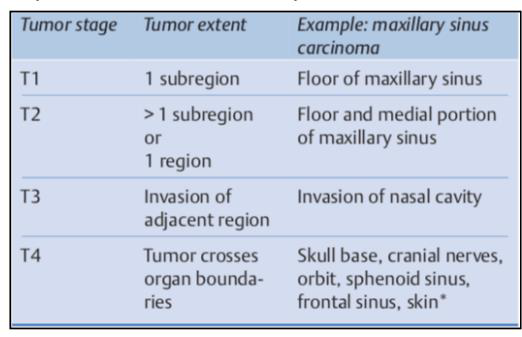
What is thte TNM staging
only done for carcinomas of maxillary sinus and athmoidal cells
What is the treatment of malignant tumours
individualised to histology and extent of malignant tumour
treatment of choice can consist of preoperative chemotherapy, surgery, postoperative radiation
What is the surgical treatment of malignant tumours
partial maxilla, or frontal bone resection
total maxillectomy
radical maxillectomy + orbital exenteration
removal of entire globe and its surrounding structures