Trauma and Stressor Related Disorders
 Call Kai
 Learn
Learn Practice Test
 Spaced Repetition
 Match
Match Flashcards
 Knowt Play
1/59

There's no tags or description
Looks like no tags are added yet.
Name | Mastery | Learn | Test | Matching | Spaced | Call with Kai |
|---|
No analytics yet
Send a link to your students to track their progress
60 Terms
What is the primary characteristic of trauma and stressor-related disorders?
Emotional and behavioral difficulties resulting from exposure to traumatic or stressful events.
what is the pathophysiology of trauma-related disorders?
Structural/functional changes in the amygdala and hippocampus, dysfunction in neuroendocrine axis, abnormal amount/function of neurotransmitters
What can include "experiences" of acute stress disorder and PTSD?
first-hand victim, witness, learning the events happened to family or a close friend, and or repeated firsthand exposure
How is a "traumatic event" defined?
Threatened death, witnessing actual death, serious injury, or sexual violation
What are the most common causes of acute distress disorder?
motor vehicle accidents, witnessnessing a mass shooting, and assault/rape
What are the risk factors for acute distress disorder?
pre-existing psychiatric disorder, female gender, trauma severity, history of prior trauma, neuroticism, and avoidant coping
What are the five main symptom categories for Acute Stress Disorder and PTSD?
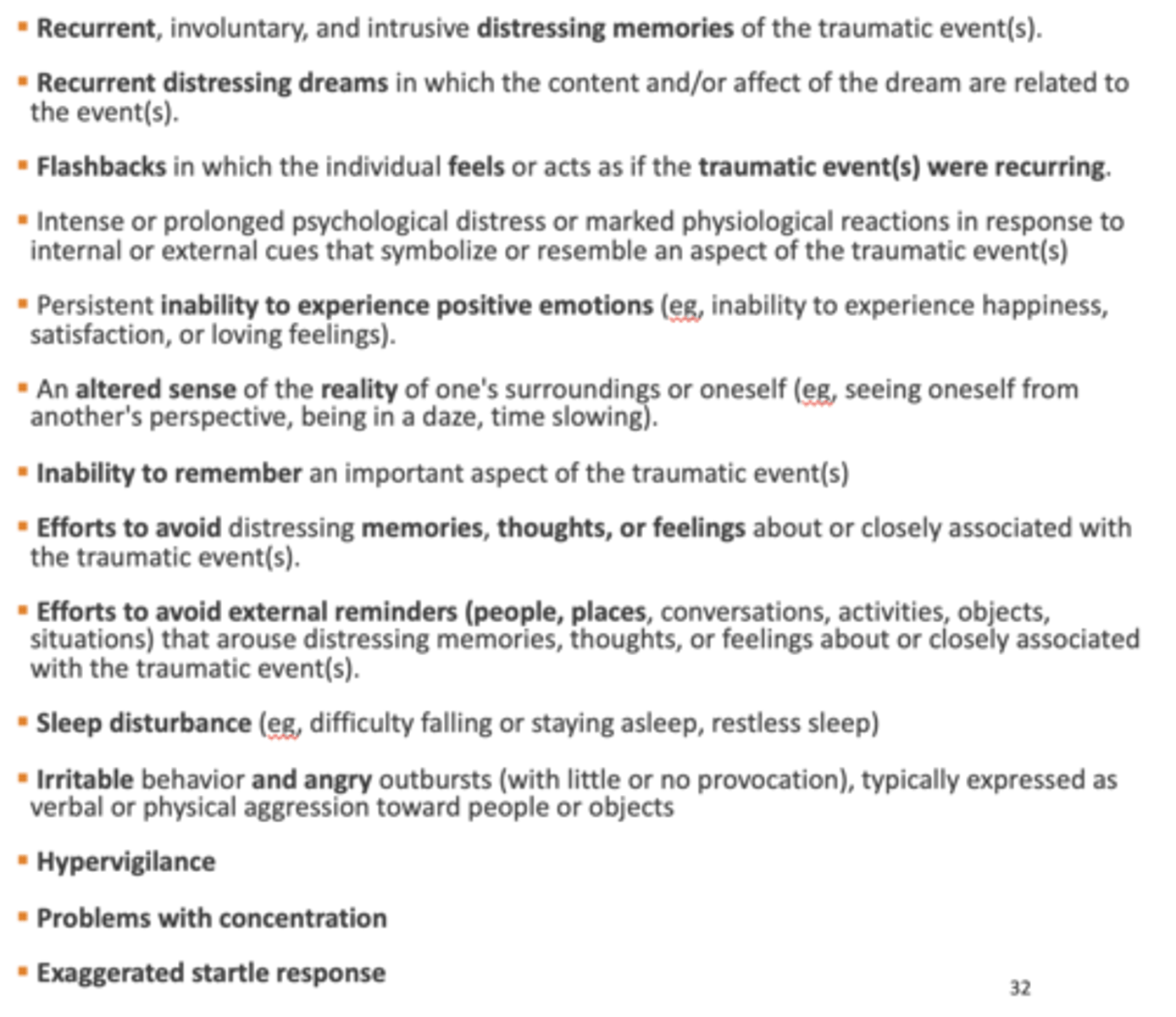
Intrusion, Avoidance, Arousal, Negative mood and cognition, and Dissociative symptoms.
What is the presentation of intrusion symptoms?
recurrent memories/dreams, flashbacks, intense response to internal/external stimuli that resembles the event
What is the presentation of avoidance symptoms?
Effort made to avoid distressing internal/psychologic reminders (substance use) or external reminders (isolation and disruption of routine)
How may arousal symptoms present?
Insomnia, irritability/anger, hypervigilance, difficulty concentrating, exaggerated startle response, self-destructive behavior (PTSD only)
How are 'Negative Mood' symptoms characterized in Acute Stress Disorder?
An inability to experience positive emotions (happiness, satisfaction, love) with frequent anxiety, stress, apathy, fear, guilt, or shame.
How does negative mood symptoms in Acute Stress Disorder differ from PTSD?
Negative mood symptoms are more severe in PTSD than in acute stress disorder
What are common 'Dissociative' symptoms in Acute Stress Disorder?
Altered sense of reality and/or an inability to remember deails of the event
How might children manifest symptoms of Acute Stress Disorder differently than adults?
Through separation anxiety, excessive need for attention, repetitive play involving trauma themes, and frightening dreams without recognizable content.
What is the diagnostic criteria for acute stress disorder?
at least 9 total symptoms from any category that appear in the first month after experiencing a traumatic event lasting between 3 days and 1 month
What is the first-line treatment for Acute Stress Disorder?
Trauma-focused cognitive behavioral therapy (CBT).
What components are typically included in trauma-focused CBT?
1) Patient Education
2) Cognitive Restructuring (EMDR)
3) Exposure
Why are SSRIs and SNRIs generally not used for Acute Stress Disorder?
Because the disorder is defined by its short duration; often resolving within 30 days
When might medication be used in the treatment of Acute Stress Disorder?
Used to target specific, severe symptoms like panic or sleep disturbance.
What are the prevalence factors of Posttraumatic Stress Disorder (PTSD)?
Females, Native American, Refugee, Military, Survivors of rape/combat/genocide
What symptom is not part of a PTSD diagnosis but are added as a "specifier"?
Dissociative symptoms
How does negative cognition and mood symptoms present in PTSD?
- Inability to remember an important aspect of the vent
- persistent negative beliefs about oneself
- blame of self/others
- guilt/shame
- inability to feel positive emotions
- diminished interest and detachment
What are the diagnostic criteria for PTSD in individuals older than 6 years?
- 1 intrusion symptom
- 1 avoidance symptom
- 2 arousal symptoms
- 2 negative alterations in cognition and mood symptoms
How do PTSD diagnostic criteria for children 6 years and younger differ from adults?
- 1 intrusion symptom
- 2 arousal symptoms
- 1 avoidance symptom OR negative alterations in cognition and mood.
What is the minimum duration of symptoms required for a PTSD diagnosis for both children and adults?
Persistent, chronic symptoms for more than 1 month
What is the 'with dissociative symptoms' specifier for PTSD?
PTSD criteria is met with accompanied depersonalization or derealization not attributable to substances or medical conditions.
What is the 'with delayed expression' specifier for PTSD?
full diagnostic criteria is not met until more than 6 months after the traumatic event.
What are the complications of PTSD?
suicidal thoughts/attempts, deaths from suicide, social impairment, reduced quality of life, and physical health problems
What is the first-line psychotherapy for PTSD?
Cognitive Behavioral Therapy (CBT) with Eye Movement Desensitization and Reprocessing (EMDR)
What is the most common approach and goal of EMDR?
Guided eye movements may be used to reprocess memories so they become less disturbing
What treatment is recommended if relief is not achieved with CBT alone?
1) SSRIs: Sertraline and Paroxetine
2) SNRI: Venlafaxine
* Either is continued for at least 6 months to 1 year to prevent relapse or recurrence *
Which medication is specifically used for PTSD-related nightmares and sleep disturbances?
Prazosin
Which medication is specifically used for PTSD-related insomnia?
Trazodone
Which treatments should be avoided in PTSD?
Cannabis (no improvement shown) and Benzodiazepines (dependence)
What is the primary characteristic of Adjustment Disorder?
Maladaptive emotional or behavioral symptoms that develop in response to an identifiable, non-life-threatening stressor.
What are types of stressors that can onset adjustment disorder?
job loss, breakups/divorce, death of a loved one, illness, hostile environments, finance/education issues
What depressive symptoms are present in Adjustment Disorder?
Low mood, Tearfulness, and Hopelessness
What anxiety symptoms are present in Adjustment Disorder?
Nervousness, Worry, and Jitteriness
What physical symptoms may be present with Adjustment Disorder but not needed for diagnosis?
Headaches, body aches, tension, stomach pain/nausea
What is the timeframe for the development and resolution of symptoms in Adjustment Disorder?
Develop within 3 months of the identifiable stressor and resolve within 6 months of the stressor resolution
What are the diagnostic requirements for Adjustment Disorder regarding functional impairment?
Distress must be out of proportion to the severity of the stressor and/or cause significant impairment in social, occupational, or other areas of functioning.
What are the specifiers for adjustment disorder?
Can be diagnosed with depression, anxiety, conduct disturbance, or distinguished as chronic if persists over >6 months with a prolonged stressor
What family-related factors can predispose children to adjustment disorders?
Family unity disruptions, disappointment in relationships, and death of a parent
What is the treatment of choice for adjustment disorders?
Psychotherapy, such as counseling or CBT
When is pharmacotherapy indicated for adjustment disorders?
It is not generally used, but may be considered if specific symptoms are severe (SSRIs)
Define bereavement.
The situation or period of time after someone who is close dies.
Define grief.
The natural response to bereavement, including thoughts, feelings, behaviors, and physiologic reactions.
Define mourning.
The process of adapting to a loss and integrating grief.
What are the five stages of grief?
denial, anger, bargaining, depression, acceptance
What is the typical duration for normal grief in adults versus children/adolescents?
Less than 12 months in adults and less than 6 months in children or adolescents
What is the standard treatment for normal grief?
Time, reassurance, support from family and friends, and counseling.
What is Prolonged Grief Disorder?
A form of grief that is unusually protracted, intense, and disabling, characterized by maladaptive thoughts, dysfunctional behaviors, and dysregulated emotions that impede adaptation.
What are primary risk factors for prolonged grief disorder?
Co-exisitng major depression or bipolar disorder, death of child (high suicide risk), deaths of violent nature, and pre-existing psychiatric disorders
What is the presentation of prolonged grief disorder?
Significant daily symptoms of emotional disturbance that impairs function and exceeds their expected norms
How might young children display distress following a loss?
Through play, behavioral changes, developmental regression, separation anxiety, and disturbances in sleep, eating, or digestion.
What are the general symptoms of prolonged grief disorder?
Intense yearning or longing for the deceased and/or preoccupation with memories of the deceased
* one or both must be present *
Which accompanying symptoms may be present in prolonged grief disorder?
Identity disruption, significant disbelief about death, avoidance of reminders, intense pain, difficulty engaging, numbness, loneliness, hopelessness
* at least 3 must be present *
What is the duration requirement for prolonged grief disorder?
Death must have occurred at least 12 months prior (or 6 months for kids) with symptoms nearly every day for at least 1 month
What are some adverse consequences associated with Prolonged Grief Disorder?
Suicidal ideation and substance use
What is the first-line treatment for Prolonged Grief Disorder?
Targeted prolonged grief therapy focusing on loss and restoration