Coasts: Physical Processes
 Call Kai
 Learn
Learn Practice Test
 Spaced Repetition
 Match
Match Flashcards
 Knowt Play
1/43

There's no tags or description
Looks like no tags are added yet.
Name | Mastery | Learn | Test | Matching | Spaced | Call with Kai |
|---|
No analytics yet
Send a link to your students to track their progress
44 Terms
What are the 4 types of marine processes?
- Wave action
- Deposition
- Transportation
- Erosion
Wave Action
- Waves erode, transport and deposit materials.
- Waves are formed when wind blows over the sea surface, and are set in motion by friction between the wind and water.
What do the strength of waves depend on?
The strength of waves depends on the strength of the wind, and the length of time and distance over which the wind has been blowing (the fetch).
Swash and Backwash
- Swash: carries material up the beach at an angle to the coast
- Backwash: drags the sediment back to the sea
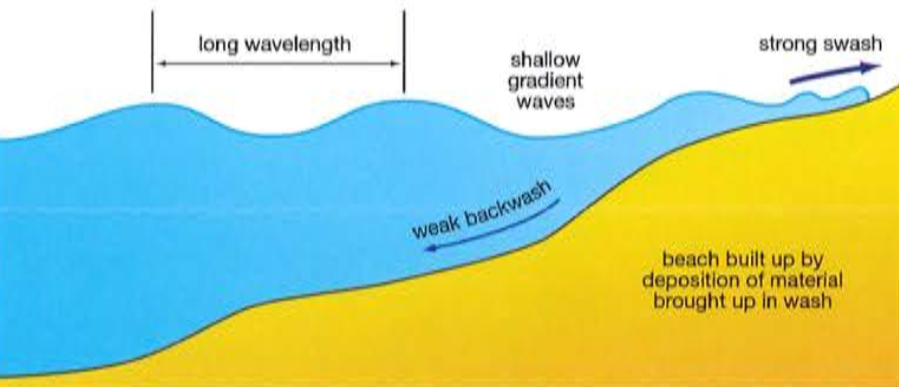
Constructive Waves
- long wavelength and shallow gradient waves
- swash > backwash
- large amount of material moves onto the beach
- help to build up the beach
Diagram of Constructive Waves
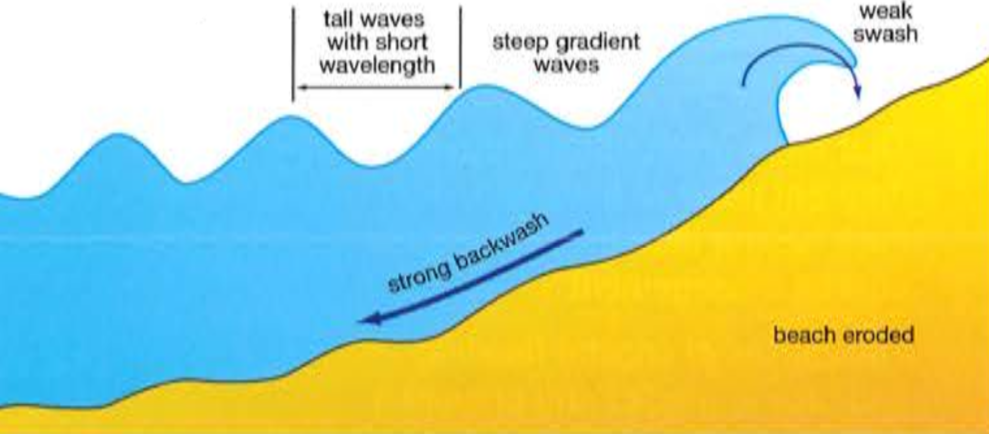
Destructive Waves
- backwash > swash
- cause erosion of beach
- short wavelengths and steep gradient waves.
Diagram of Destructive Waves
Deposition
- constructive waves
- strong swash causes material to be moved up beach and deposited (left) there
Transportation
- movement of materials formed by attrition with destructive waves
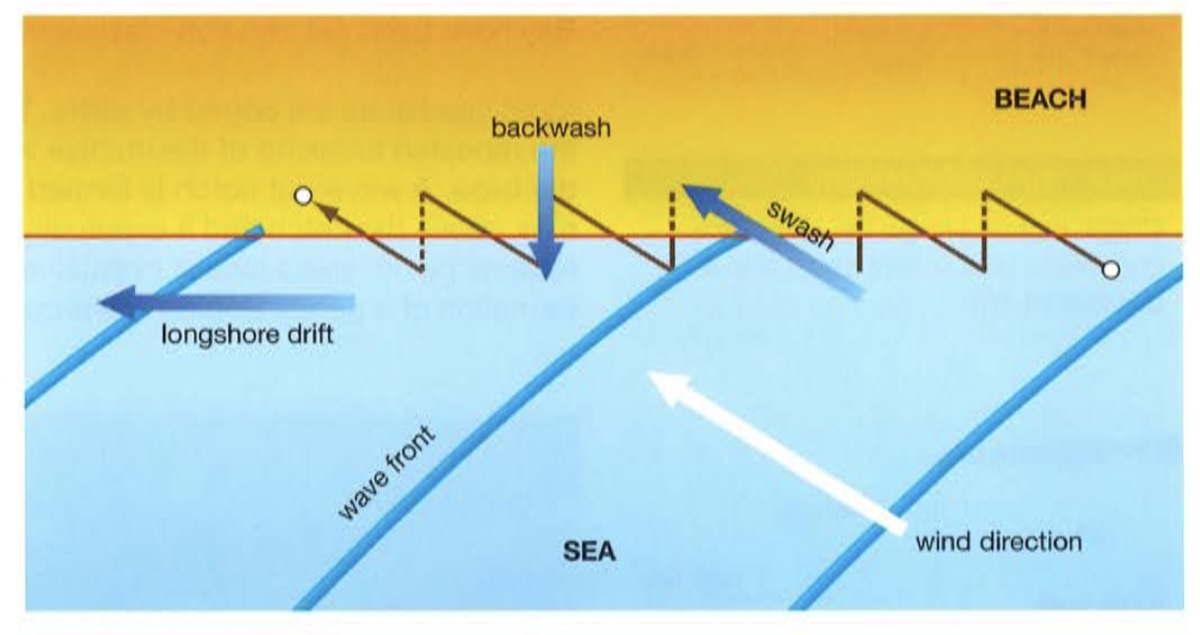
- longshore drift
How does longshore drift work?
- transportation of sediments along the coastline in a zig zag pattern
- swash carries material up beach at angle to coast in direction of prevailing wind
- backswash carries it back down at right angles to the coast
Diagram of Longshore Drift
Erosion
- destructive waves
- hydraulic action, abrasion, corrosion, or attrition.
Hydraulic Action
- force of the waves hitting the cliffs and forcing pockets of air into cracks and crevices
- rocks break overtime
Abrasion
- waves pick up stones and hurl them at cliffs
- wear cliff away like sandpaper
Corrosion (solution)
dissolving of soluble material from rocks by slightly acidic sea water.
Attrition
- material becomes rounded and smaller over time as it collides with other material
What is weathering?
- breakdown of rocks in-situ
- mechanical, biological, and chemical
Mechanical Weathering
- physical breakdown of rock by environmental factors
- Freeze thaw weathering: Water seeps into cracks in the rock, freezes, expands, and wedges apart the rock. With repeated freeze/thaw cycles, the rock breaks into pieces.
- Exfoliation/ Onion Skin Weathering: Rock surface heats up and expands, then cools and contracts, forming cracks on the outer of the rock, until the surface of the rock breaks off.
What is biological weathering?
weakening and breakdown of rock by plants, animals and microbes.
What is chemical weathering?
Rocks, such as chalk, limestone, and marble, gradually dissolve and weather due to slightly acidic rainwater (because CO₂ from the air is dissolved into it).
What is mass movement?
- removal of cliff-face material under the influence of gravity
- There are 2 types: sliding and slumping
Slide
- movement of material all together until hitting the bottom of a slope.
Slip
weak, saturated rocks like clay
large area of land moves downslope in one piece, leaving a curved surface behind
What factors affect the coastline and its landforms?
- Geology
- Vegetation
- People
- Sea-level Changes
How does geology affect coastal environments?
- Hard rock: more resistant, harder to erode, headlands, high and steep cliff shape, bare and rugged cliff face, boulders and rocks at foot of cliff
- Soft rock: easily eroded, bays, lower and less steep shape, smoother cliff face, few rocks, sand and mud on foot of cliff
How does vegetation affect coastal environments?
- To survive, vegetation must cope with particular conditions, such as high levels of salt in both the air and soil.
- protect and preserve coastal landforms
How do people affect coastal environments?
- Economic Development: tourism, land for agriculture and industry, fishing (construction of ports and harbours), energy business
- Coastal Management: sea walls, groynes
How do sea-level changes affect coastal environments?
- Climate change and global warming cause melting of glaciers and ice sheets, thus rising sea levels, threatening low-lying coastal areas.
- Rising sea levels produce submergent coastlines, with rias and fjords
- Falling sea levels produce emergent coastlines, with raised beaches, cliffs with caves, arches
How are headlands and bays formed?
- They form on discordant coasts (bands of soft and hard rock at right angles to the sea) by destructive waves
- Bays form when soft rock erodes more quickly so the coastline recedes more quickly.
- Hard rock erodes more slowly resulting in the formation of a protusion of rock called a headland.
What stages does it take for a cliff to become a stump?
Cliff → Cave → Arch → Stack → Stump
How are wave-cut notches formed?
- Destructive waves erode the base of the cliff by hydraulic action, due to repeated breaking.
- The cliff is undercut at the base.
- Softer rock can erode more quickly than harder rock, leading to the formation of a wave cut notch.
How does a wave-cut platform form?
- Formation of a Wave-Cut Notch
- Undercutting weakens the rock above the notch and it eventually collapses.
- This means that the cliff face retreats but its steep face is maintained, leading to the formation of a gently sloping wave-cut platform at the base.
How is a cave formed?
- Cave forms along a headland, which begins to be eroded (hydraulic action and abrasion) by wave action, especially where there are lines of weakness.
- The repetition of this process leads to this line of weakness widening, creating a cave.
How are arches formed?
- Arches form at headlands, where waves erode the base of the cliff either side of it, and forms a cave on each side.
- As the erosion continues, caves become wider until the water breaks through the other side, forming an arch.
- As further undercutting takes place, the arch becomes wider and more developed.
How are stacks and stumps formed?
- Continued erosion by destructive waves widens the arch, weakening the roof which eventually collapses, forming a stack.
- Further wave action erodes base of stack and causes it to collapse over time into a stump.
What are the depositional landforms?
- Beaches
- Spits
- Salt Marshes
- Tombolos
- Cuspate Forelands
- Bar
How are beaches formed?
- Constructive waves (what are they?) have a strong swash, carrying material from eroded coasts (sand and shingle) up the beach where it is deposited because the backwash is weaker.
How are spits formed?
- Spits are created by sediment moving along a coastline by longshore drift in the direction of the prevailing wind.
- The material is deposited and extends the beach through constructive waves.
- The coastline changes direction but deposition continues.
- The build up of these materials over a long period of time results in the formation of a spit.
How are salt marshes formed?
Salt marshes form at the river estuary, when a spit causes the river to drop its sediment mainly on the landward side of the spit.
How are tombolos formed?
Tombolos are spits that have continued to grow seawards until they reach and join an island.
How are cuspate forelands formed?
- Cuspate forelands are triangular-shaped spits, developing as a result of longshore drift occurring from two different directions.
- The head-on collision of the two drifts leads to the deposition of sediment and the formation of the foreland.
How is a bar formed?
- A bar is where two headlands are joined and built across when a spit develops into a bay.
- It forms when there is a gently sloping beach and no sizeable river entering the bay.
How are lagoons formed?
- This is where a small body of water on the landward side is trapped behind a bar or tombolo.