bio p2
 Call Kai
 Learn
Learn Practice Test
 Spaced Repetition
 Match
Match Flashcards
 Knowt Play
1/68

There's no tags or description
Looks like no tags are added yet.
Name | Mastery | Learn | Test | Matching | Spaced | Call with Kai |
|---|
No analytics yet
Send a link to your students to track their progress
69 Terms
effect of calcium
calcium ions to make calcium pectate to {hold cells together / increase cell wall stability / form middle lamella}
effect of magnesium
magnesium ions to make chlorophyll so {photosynthesis can occur / light energy can be absorbed / glucose can be made} - to produce ATP
effect of nitrates
nitrates are needed to make famino acids / proteins
/ polypeptides / DNA / RNA / nucleic acid}
simililarities and differences of schlyrenchyma and xylem tissue (3)
Similarity (1)
both contain (cellulose / pits / dead cells / secondary walls)
both (are hollow / do not contain cytoplasm)
Difference (1)
• sclerenchyma contain end walls whereas xylem do not
how golgi apperatus modifies proteins + secretes them to other places in the organism
A description that makes reference to two of the following:
modification of protein (1)
enzyme(s) packaged into (secretory) vesicles (1)
enzyme(s) leave cell by exocytosis (1)
vesicle) fuses with cell surface membrane to release them
outside of the cell (1)
function of plasmodesmata (2)
communication between /
connects (connected) cells (1)therefore signalling substances pass through {symplast / cytoplasm} / cytoplasmic streaming / transport of suitable named molecules e.g. minerals, water, glucose, amino acids, proteins, RNA (1)
how structures of cellulose and microfibrils increase strength (3)
An explanation that includes the following points:
because there are hydrogen bonds between (adjacent) cellulose molecules (1)
{layers / sheets} of microfibrils
(1)which have microfibrils at different angles (therefore it increases the strength) (1)
conditions needed for bacterial growth
oxygen for (aerobic) respiration (1) • glucose for respiration / amino acids for protein synthesis (1) • optimum temperature for (faster) {enzyme / metabolic} reaction (1) • optimum pH for (faster) {enzyme / metabolic} reaction (1) | ||||
nucleolus function
produce ribosomal subunits
structure of starch relating to its function
{polymer of / contains} glucose because (glucose) is anenergy source (1) • {branched / 1,6 bonds} therefore can be rapidly hydrolysed(to release glucose/energy) (1) • compact so more {glucose/energy} can be stored / compactso high energy density} (1) • insoluble therefore does not affect osmosis (1) | ||||
Explain how the arrangement of cellulose molecules and secondary thickening in xylem vessels contributes to the physical properties of the cell wall.
(4)
cellulose molecules can be organised into microfibrils. (1)
RocketRevise
(due to layers of) {cellulose / microfibrils} arranged in {different directions / a mesh} (1)
{hydrogen bonds in cellulose molecules / hydrogen bonds in ACCEPT lignin microfibrils / layers (of microfibrils) / lignin / secondary thickening / pectate} add (strength / support / stability) (1)
arrangement contributes to {rigidity / flexibility}
(of vessel)
• {(cellulose) microfibrils / mesh) held together by {pectin / pectate) (1)
ACCEPT cellulose microfibrils can't slide over each other
• lignin makes (outside of xylem vessels / cell wall)
impermeable (to water) (1)
ACCEPT lignin makes {cell walls / xylem}
waterproof
• the structure of lignin described (1)
tissue definition
• group of (similar) cells working together to perform a (specific) function (1) | |||
why sustainable
• (because) calabash fruits are renewable / more can be grown / will not run out / available to future generations (1) • biodegradable / can be broken down by decomposers (1) • carbon neutral (1) | |||
similarities and differences of xylem and phloem
Similarities:
both (fibres) contain cellulose (in the cell wall) (1)
both have tubular structures (1)
both do not contain a nucleus (1)
Differences (max 3):
phloem (sieve tubes) have {sieve plates / (perforated) end walls) whereas xylem (vessels) have no {end walls / sieve plates) (1)
phloem (sieve tubes) {contain cytoplasm / are not hollow) whereas xylem (vessels) {do not contain cytoplasm / are hollow} (1)
se
• phloem (sieve tubes) contain no (lignin / secondary thickening}
whereas xylem contain {lignin / secondary thickening) (1)
4 mark explain/comment
trend discription
(deos aid in …)
comparison → most + least effective
comment on validity → overlapping of error bars
question spesific comment → methology(repeats etc), they only measured some of this etc.
dif between cell without and w secondary thickening
cell wall with secondary thickening {is thicker / has more layers} (1)
• cell wall with secondary thickening contains lignin (1)
original cell wall
• cell wall with {secondary thickening / lignin,
is {stronger / more supported / (1)
• cell wall with (secondary thickening / lignin, ignore insoluble
is (waterproof / impermeable to water} (1)
pits function in xylem
allows {movement of named substances mineral ions ignore nutrients communication} (1)
(2)
• between (adjoining) cells / to other tissues / out of xylem / into xylem
(1) IMP
description of anaphase (3)
-centromeres have separated
-spindle fibre contracted
-chromatids pulled apart
-chromatids have moved to opposite poles
1 diff and 1 sim between nuclear envelope and cell membrane
Difference: nuclear envelope double membrane, cell membrane single OR {nuclear pore present in nuclear envelope, not in cell membrane / cell membrane has channels} (1) Similarity: both membranes are phospholipid (bilayer) (1)
explain why there is genetic variation in this sample of … (3)
the greater the number of recessive alleles the lighter the
colour of the seed / the greater the number of dominant
alleles the deeper the red colour (1) - any given trend
• random assortment and crossing over results in (gamete)
variation (1)
• random fertilisation (of gametes) results in (seed) variation
(1)
• low probability of {inheriting 0/6 recessive alleles / egg cell
with no recessive alleles being randomly fertilised by sperm
cell with no recessive alleles} (1)
what occurs to form a specialised cell (this case sperm cell) (5)
(because) differential gene expression occurs (1)
• (due to) epigenetic modification / DNA methylation /
histone modification (1)
• {transcription of / (active) mRNA made from} active
genes (1)
• (therefore) translation occurs to form a {polypeptide /
protein} (1)
• (proteins cause) {structural/functional} change to cells to
change them into (specialised) sperm cell (1)
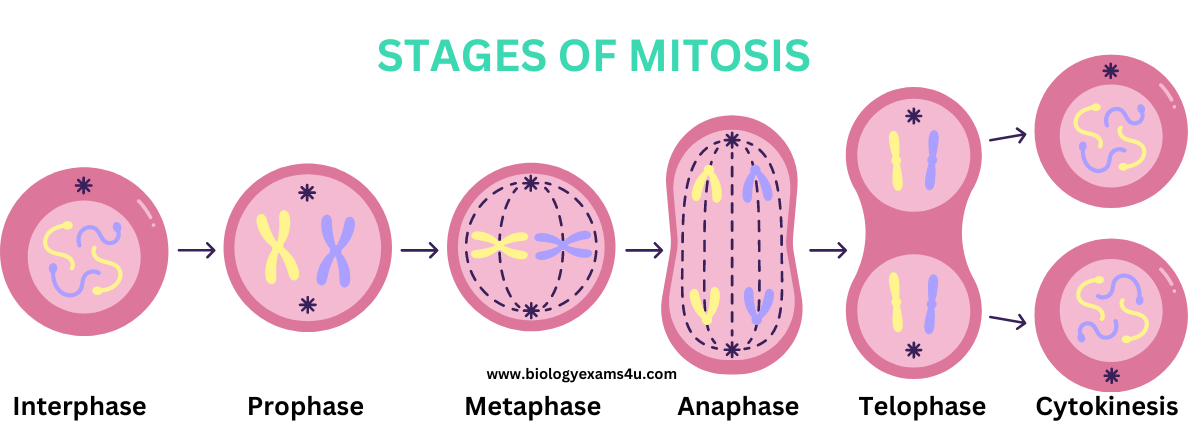
stages of mitosis
spindles begin to for in prophase
structures animal cells have that plants do not
cilia (1)
glycogen (granules) (1)
(2)
flagella
question of what happens w a polypeptide chain in a cell
(the percentage of) labelled amino acids {decreases inside the
cell / increases outside the cells} (1)) - q spesific description of infor in Q
polypeptide is packaged into vesicles by rER /
{(rER) vesicles fuse with / protein enters} Golgi (1)
{protein is modified / carbohydrate added to protein} (in Golgi)
(1)
(enzyme(s) / glycoprotein(s)) packaged into (secretory) vesicles
(by Golgi) (1)
{enzyme(s) / (glyco)protein(s)} leave cell by exocytosis / some
(intracellular) {enzyme(s) / (glyco)protein(s)} remain in cells
discription of drug trial from a plant with antibacterial properties (6)
compound needs to be extracted from trees and used to make a drug
compounds tested on Y. pestis in vitro
tested on {animals / human cells}
(phase 1 / preliminary) (small scale) tests on healthy {people / volunteers}
review by independent {scientists / medics} to see if work can progress to stage 2
(phase 2) - drug tested on {small / 100 to 500} groups of {patients / people} who have the {plague / disease}
appropriate concentrations identified
(phase 3) - drug tested on {larger groups of / 1000 to 3000} {patients / people} who have the plague
placed randomly in two groups - one group receives {treatment / drug containing the chemical compounds} and the
other receives placebo
double blind test
analyse results with (appropriate) statistical test / test for significant difference
cortical reaction in process of fertilization
cortical {granules / vesicles} fuse with (egg cell surface) membrane
and release enzymes (1)
zona pellucida hardens (1)
to prevent {polyspermy / more than one sperm (nucleus) entering
egg cell} / to ensure that the nucleus is diploid (1)
how totipotent become pluripotent
differential gene expression (1)
some genes have been (permanently) {inactivated / switched off}
(1)
by epigenetic modification (1)
{proteins / enzymes} {made / synthesised} (from active genes)
which permanently modify the cell (1)
evidence for classification system
(evidence from) molecular phylogeny (1)
identification of (similarities / differences) in (DNA / RNA / proteins / enzymes / ribosomes / membrane components / cell wall components) (1)
role of pollen tube in fertilization
(tube) grows (through style) to (ovary / ovule / egg cell) / transports the (male nuclei / generative nucleus / male gametes) to {ovary / ovule / egg cell) (1)
• (and secretes) digestive enzymes used to aid growth of tube (to ovule) (1)
• (therefore) male nuclei can fuse with (egg cell (nucleus) )
polar nuclei) (1)
• (causing) the formation of a {3n/ triploid} endosperm
(nucleus) (1)
species def
(a group of) organisms that are capable of {(inter)breeding / mating / reproducing) and producing fertile offspring | |||
role of scientific community in varrifying clasification system
peer review (1) • repetition of experiments (by other scientists to see if samedata are collected) (1) • {analysis / evaluation / discussion / comparison} of data (1) | ||
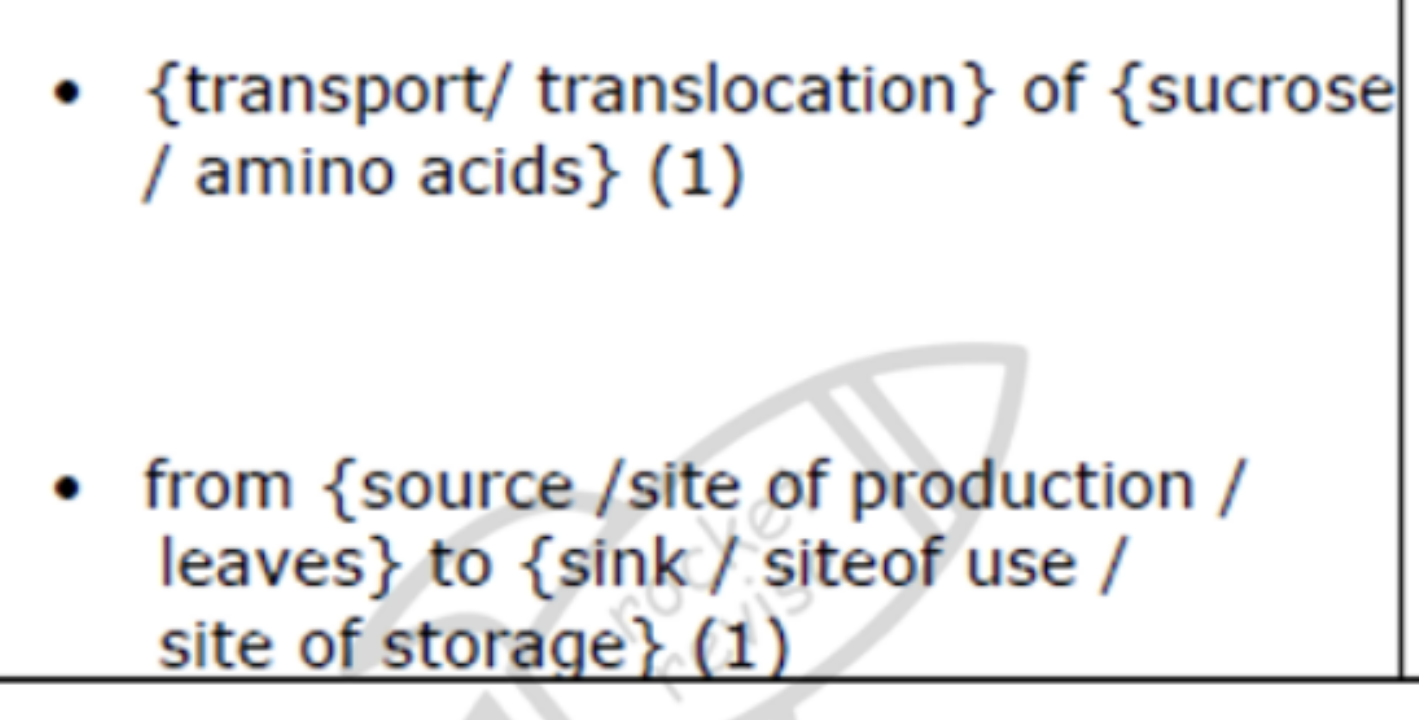
role of phloem
different forms of adaptations
Anatomical - form and structure of organism
Physiological - way the body works → biochemical pathways eg enzymes
Behavioral - programmed instinctive behaviour
how …(ability) developped → this case ability to poison
(genetic) mutation(s) occurred (1)
(new) allele coding for poison production (1)
(which then) conferred a selective advantage / (those with poison) more likely to (survive and reproduce / pass alleles
to offspring) (1)(therefore) increasing allele frequency (1)
(resulting in) new species of frog with the ability to produce poison evolved (1)
why use stain in mitosis experiment
make CHROMASOMES visible
Some cells in the flowers undergo meiosis.
Explain how the separation of chromosomes in meiosis gives rise to genetic variation in the offspring of pea plants. (3)
independent assortment (of chromatids) (1)
will result in {mixture of (maternal and paternal) chromatids
/ different combination of alleles} in the gametes (1)which gametes are involved (in fertilisation) are random (1)
6 mark checklist
data discription
SD + sample size/ variablitity
when explain → why it causes eg an increased mucus production → goblet cells etc.
why not 25% for each combination of alles → recombination
due to) linkage (1)
• A and B are on same chromosome (1)
• {genes/ alleles / AB / ab / 48%} are not separated due
to crossing over / {AB / ab} are inherited together (1)
• {Ab / aB / 2%} formed by crossing over (1)
other q:
-RAndom assortment in metaphase 1
*diagram of pre and mature mRNA* how diff ploypeptides from same RNA (5)
reference to post transcriptional changes / (pre-)RNA
splicing (1)
• {introns / P, R, T, V and X} removed by enzymes (1)
• rearrangement of {exons / Q, S, U and W} / removal of
some exons (1)
• credit two different permutations of exon order given (1)
• (therefore) a different {primary sequence / sequence of
amino acids / polypeptide} (1)
why plant cells increase in size after cell division (2)
because of water uptake / increased {volume of cytoplasm
/ size of vacuole} (1)
(increase in size due to) {synthesis/production} of
{organelles / (named) proteins / enzymes} (1)
ACCEPT organelles increase in size
therefore {synthesis/production} of {new/more} cell
{membrane / wall} (1)
habitat definition
place where {organisms / species} live
polygenetic inheritance
many genes / genes at different loci (1)
{contribute to / code for} the same {characteristic / trait} (1)
sim and dif between pre and active mRNA (4)
Similarities
• both are single-stranded (1)
• both contain the bases A,U,C,G / both contain a base, phosphate
group and ribose (sugar) / both contain phosphodiester bonds (1)
• an exon on pre-mRNA contains same base sequence as the
matching exon on active mRNA (1)
Differences
• pre-mRNA contains both introns and exons whereas active RNA only
contains exons (1)
• active mRNA may have {fewer / different order of} exons (than pre-
mRNA) (1)
role of spindles in mitosis
the {attachment/binding} of centromeres (to the spindle
fibres) (1)
• to allow the separation of the {(daughter) chromatids /
chromosomes} (1)
• so that each daughter cell gets identical genetic material (1)
why so much variation in eg. skin (6)
description of table data e.g., the more dominant alleles present in the zygote increases the darkness of the skin,
• description of polygenic inheritance
• recognition that {3 genes / 6 alleles} involved with this phenotype / each gamete contains 3 alleles involved with this
phenotype
• description of graph data
• e.g., phenotype shows normal distribution / phenotype shows continuous variation
• e.g., offspring have highest probability of inheriting {3 dominant alleles/medium skin colour}
• consideration that large variation due to crossing over of {genetic material / allele / DNA} in prophase I
• description of crossing over
• consideration that large variation due to random assortment of chromosomes in metaphase I
• description of random assortment
• consideration that random fertilisation of genetically different gametes increases variation
• consideration of probability of different types of mutation e.g., silent
• consideration of {environmental variation / mutation} increasing variation e.g. sun tan, DNA methylation
• explanation of how {environmental variation / mutation} would increase variation e.g. pigment production
why reduction in species
deforestation (of mangroves) causing habitat loss (1) • reduction in food due to {deforestation (of mangroves) / competition with other species / overfishing} (1) • {pollution / change in salinity} of river making it unsuitable habitat (for the crocodile) (1) • {disease / hunting} (causing death of crocodiles) (1) | ||||
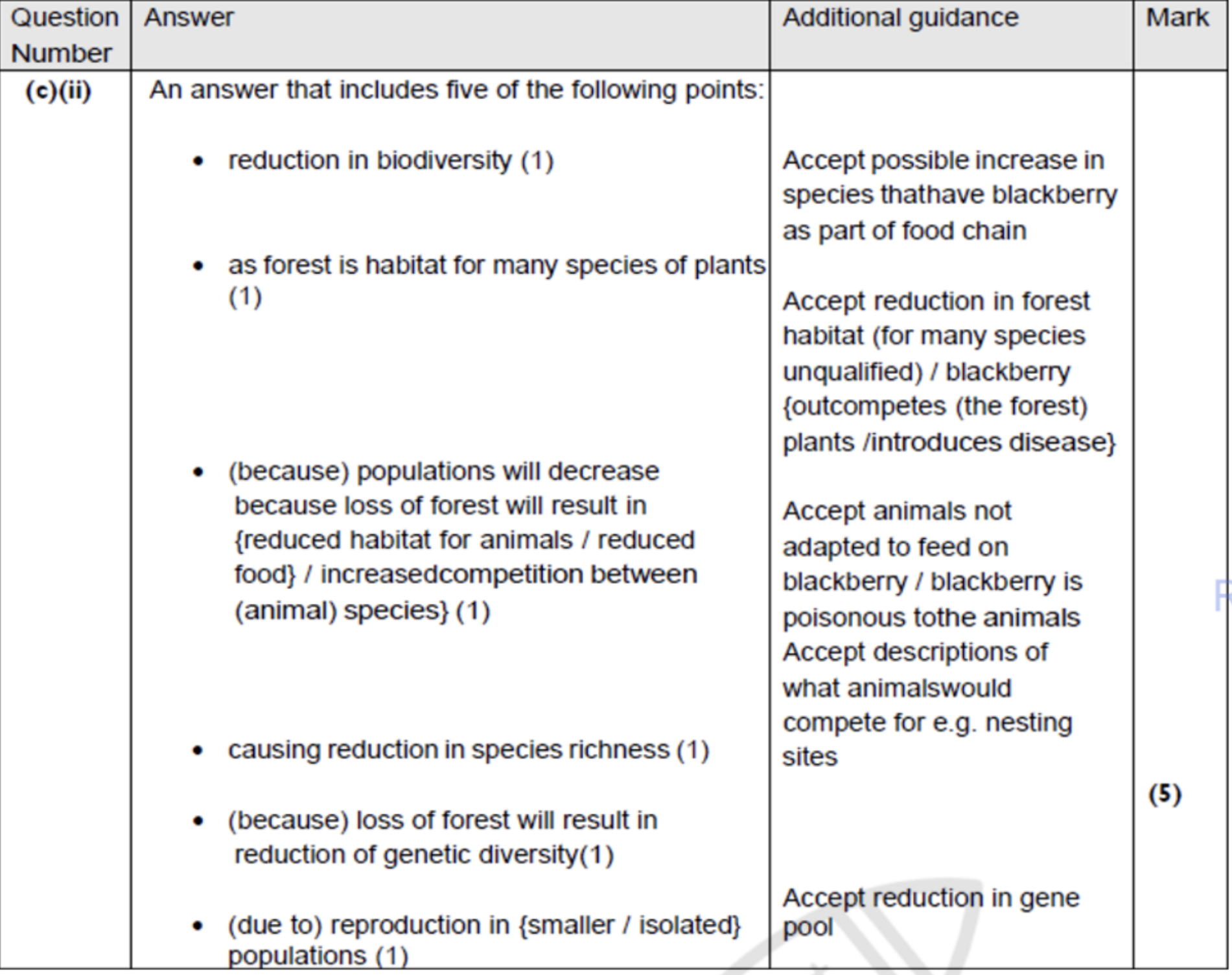
how the spread of an invasive species reduces biodiversity
how to determine if archea
presence of {(peptidoglycan) cell wall / circular chromosome(s) /DNA associated with histones / 70S ribosomes / RNA polymerase} (1) • absence of {nucleus / membrane bound organelles} (1) | ||||
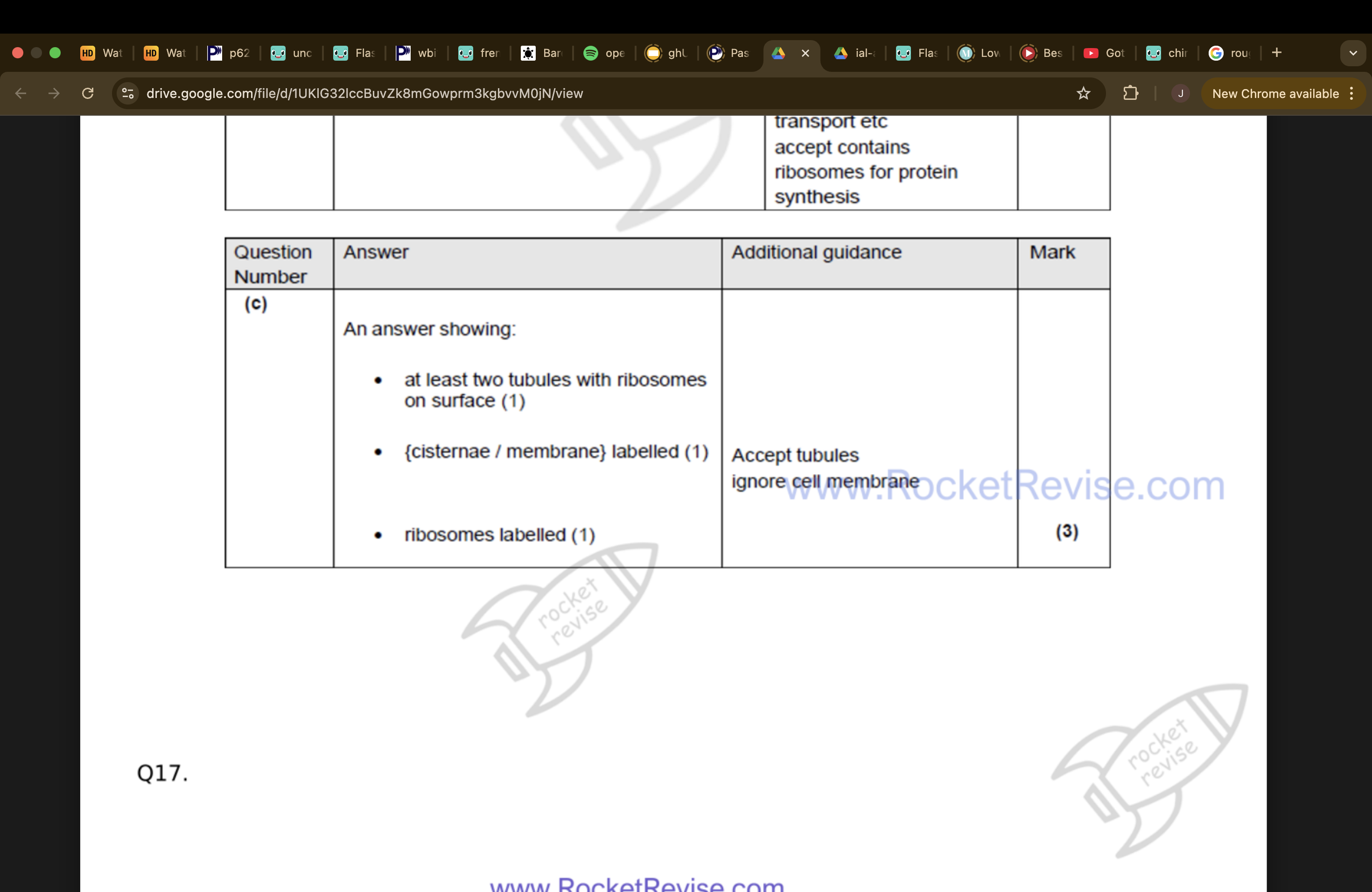
how to draw RER
why cells in morula genetically idenntical
they are all (genetically identical due to being) derived from the zygote (cell) (1)
• {DNA/ chromosomes} are replicated (in interphase / in semi-conservative replication) (1)
• (therefore) each cell receives one identical copy of each {strand of DNA / chromosome} (1
why expected version of (polygenic trait) may not be what expected, eg height
{height / phenotype / a characteristic} is also affected by the environment (1)
• {malnutrition / lack of nutrients} (1)
• example of another environmental factor (which would reduce energy available for growth) (1) • height depends on the combination of alleles inherited (1)
comment on conclusion that they have the same optimum
both (appear to) have optimum at 0.4 mol dm−3 (1)
• (but for either) it could be anywhere between above 0.2 mol dm−3 and below 0.8 mol dm−3 (1)
• values for optimum could be different (to each other) / they might not have the same optima / one optimum might not be 0.4 mol dm−3 (1)
• more concentrations of sucrose (between 0.2 and 0.8 mol dm−3) should be investigated (1)
describe acrasome reaction (3)
acrasome fuses with sperm cell membrane
digestive enzymes released
breakdown zona pellucida
sperm cell membraine fuses with egg cell membrane
how to select, prepare and store seeds for seed bank (4)
genetically different seeds selected
x rayed
prepared by being dried
treated with antimacrobial
seeds stored in → temps below 0, store in vacuum etc.
how change in allele frequency determined
DNA analysis to identify different alleles (1) • use of Hardy-Weinberg equation / p?+2pq+q} (1) • (in order to) compare (recessive) allele frequency in previous generation(s) with current generation (1) | ||||
locus definition
the location of genes on a chromasome
how chromasomes of egg cells and body cells could differ
(egg cells are) haploid (1) (egg cell chromosomes) have {an altered base sequence / different alleles} (than body cell chromosomes) (1) due to {(random) mutations (during DNA replication) / crossing over / random assortment / independent assortment) (1) | ||||
golgi function
modify and package proteins
advantages of drying seeds for seed banks
extends storage time of the seeds (1) • (because drying) prevents germination of seeds / keeps seeds dormant (1) • (because removal of water) slows {enzyme activity / metabolic reactions (in seed cells)} (1) | |||
niche definition
role of an organism in its enviroment
similarities and differences in lysomes and acrosome
Similarities
• both contain (digestive / hydrolytic)
enzymes (1)
• both {have single membrane / membrane bound (organelles)} (1)
Differences (max 2)
a lysosome is spherical whereas an acrosome is {curved / not} (1)
a lysosome is involved with intracellular digestion whereas an acrosome is involved with extracellular digestion (1)
a lysosome (enzyme) is involved in breaking down {cell components / microbe cells / virus } whereas an acrosome (enzyme) is involved in digesting the {outer layers of an egg cell / zona pellucida} (1)
why people agree w use of adult skin cells as stem cells
(hiPSC) are {from skin cells / from (another) adult} (1) • (therefore) no {destruction / harming) of {embryos / life} (1) • treatment occurs in {liver/somatic} cells, therefore no changes to {gametes / germ cells} (1) • treatment {is long lasting / doesn't need to be repeated} (1) |
what happens during interphase
at start DNA unrap from histones unrap/ Chromasomes uncoil
DNA is replicated
DNA undergoes transcription
how dna methylation works
methy group added to cytosine
so genes become switched off
describe crossing over
sections of chromasomes exchangged at the chiasmata
between maternal and paternal chromatids
organ system definition
group of organs that work together to perform {one / one or more / specific} functions
magnification definition
how many times bigger an object appears in an image than in real life / how many times larger the image length is than the actual length
roles off tube and generative nucleu (4)
Tube nucleus (max two): • controls the growth of the pollen tube (1) • controls the production of {digestive / hydrolytic} enzymes (1) • (which allows) the (male) {nucleus / nuclei / gamete(s)} to {enter / reach} {ovule / ovary / micropyle / egg cell / polar nuclei / female gamete} (1) Generative nucleus: • (divides to) form two {male / haploid} nuclei (1) • one nucleus {fertilizes / fuses with} the egg cell nucleus / one nucleus {fertilizes / fuses with} the polar nuclei (1)
what is the prokaryotic cell wall made of
peptidoglycan / murein