Lecture 24: Bacterial Organelles and Substructures
 Call Kai
 Learn
Learn Practice Test
 Spaced Repetition
 Match
Match Flashcards
 Knowt Play
1/115

There's no tags or description
Looks like no tags are added yet.
Name | Mastery | Learn | Test | Matching | Spaced | Call with Kai |
|---|
No analytics yet
Send a link to your students to track their progress
116 Terms
organelles are a _____ structure inside a cell
specially restricted
organelles are typically surrounded by either a _____ or _____ barrier to keep it separate from other cell contents and it performs a _____ function at a specific sub cellular _____
proteinaceous; membranous; specialized; location
sometimes factors must be partitioned from the rest of the cell to _____ their function from _____ chemicals or enzymes (what is an example of this?)
protect; incompatible; carboxysome
organelles must be _____ or _____ during replication as well as properly _____ into daughter cells
synthesized; expanded; segregated
true or false: Every bacterial cell has some type of sub-cellular structure
TRUE! (ex. nucleoid)
the bacterial nucleotide is a highly _____ region in the center of the cell where the _____ resides
compacted; DNA
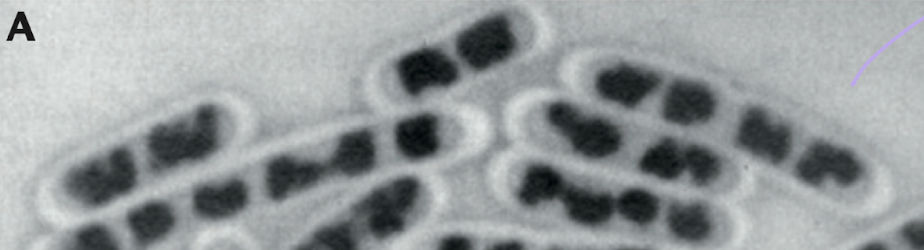
What is being stained in this cell?
DNA
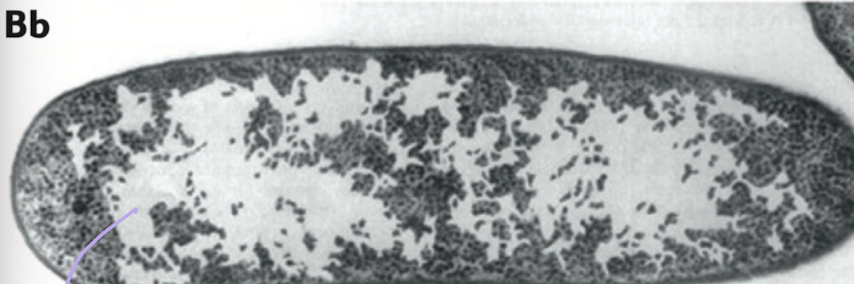
What is being stained in this cell?
ribosomes
in bacterial cells, ribosomes are found where DNA _____
ISN’T
each cell has 2 _____ of SNA which helps keep replicated chromosomes _____
lobes; separated
True or False: the nucelois is surrounded by a membranous barrier to separate it form the rest of the cell
FALSE: it need to be accessible!
the compacted DNA IS accessible to _____ proteins, but is not permeable to _____ components like _____
medium/smaller; larger; ribosomes
the nucleoid serves an _____ function in all bacteria by organizing the DNA in a _____ YET _____ manner and _____ it into daughter cells before devision
ESSENTIAL; compact; accessible; segregating
most bacterial have a _____, _____ chromosome
single; circular
True or False: all bacterial chromosomes are aligned horizontally with the origin at one pole and the terminus at another
FALSE: some are vertical, like E. coli
how are E. coli chromosomes aligned in slow growth?
terminus and origin are at the center (vertically)
how are sporulating B. subtitles bacterial chromosomes aligned?
two copies, termini in center and origin at either poles (origin → terminus → terminus → origin)
bacteria are _____ meaning that have 1 instance of each gene, what is the abbreviation for this?
haploid; 1n
humans have 23 pairs of _____ chromosomes with 2 _____ instances of each gene, what is the abbreviation of this?
homologous; non-identical; 2n
before replication, we refer to the single bacterial chromosome as _____, AFTER replication there are 2 _____ copies, which is called _____
1c; identical; 2c
non-identical = _____ and identical = _____
n; c (remember: c like Copies, n in Non)
DNA replication STARTS at the _____ and ENDS at the _____
origin of replication; terminus
bacterial chromosome replication proceeds _____ from the origin
bi-directionally
in rich media, the cell will begin _____ at the origin _____ finishing the previous replication; what is this called?
replication; BEFORE; multifork replication
Why do cells do multifork replication?
DNA rep is slower than the cell’s growth, if they have an abundance of nutrients, you can speed up this process and give it a head start
DNA replication is _____ than cell growth
SLOWER
We can determine where specific genomic loci localize within a cell through a system called _____
FROS
what does FROS stand for?
fluorescent reporter operator system
FROS uses a ligand- _____ transcriptional regulator by fusing it with a _____
dependent; fluorescent protein
what is an example of a transcriptional regulator/operator system used in FROS?
LacI and LacO
what is LacI
reporter
What is LacO?
operator
FROS uses a _____ DNA binding protein fused to a _____ protein
site specific'; fluorescent
to visualize a specific loci, you can play an array of _____ near the locus you want to investigate and the fluorescence will _____ into a focus at that site
binding sites; coalesce
different DNA-binding protein/sites labeled with different colors can be used to probe _____
multiple sites!
What happens if you use the same operator AND reporter to visualize different loci?
both sites will be indistinguishable (same color)
in prokaryotes, transcription and translation are _____
COUPLED
Why doesn’t translation and transcription occur simultaneously in eukaryotes?
processes occur in different parts of cell → needs to be transported to be transl.
what is it called when the genes encoding a MEMBRANE protein are transcribed, translated, and the polypeptide is inserted into the membrane at the SAME time?
transertion
the circular chromosome is highly _____
supercoiled
the DNA is _____ for transcription by RNAP and the _____ mRNA is translated by ribosomes
available; nascent
Transcription causes the DNA to _____, potentially through formation of _____ or multiple _____ interacting with each other
CONDENSE; supercoils; RNAPs
Translation causes DNA to _____, likely because the ribosomes lie _____ the nucleoid and the DNA must travel to the membrane for _____
expand; outside; transertion
if a cell is inhibited for transcription, what would you expect to see?
expansion of DNA
if a cell is inhibited for translation, what would you expect to see?
contraction of DNA
what chemical is used to inhibit transcription?
rifampicin
what chemical is used to inhibit translation?
chloramphenicol
_____ are used to compact the bacterial chromosome
proteins
_____ proteins bind to DNA and help compact it
nucleoid-associated
some regions, like the _____ of replication are more highly _____ than others
origin; organized
what are the two main proteins used for organization of the DNA?
ParABS and SMC proteins
ParB is a _____ protein that binds to binding sites called _____ that are close to the _____
DNA-binding; ParS; origin
once bound, ParB proteins _____ along the DNA near the ParS site, _____ it and recruiting _____ proteins
spread out; condensing; SMC
what does SMC stand for?
structural maintenance of chromosomes
SMC is a _____ shaped protein complex that is thought to encircle the _____
ring; DNA double helix
_____ of SMC proteins are found in all domains of life!
analogs
what are the human analogs of SMC in humans?
cohesin and condensin
SMC rings are loaded at _____ sites and travel _____ the chromosome, this helps to _____ and _____ the newly replicated chromosomes
parS; down; compact; resolve
the SMC must traverse _____, _____, and _____ complexes, which _____ the SMC process
DNA loops; DNA binding protein; trascription/translation; slows down
protein ParA binds to _____ and _____ the replicated chromosomes apart
ParB; pulls/pushes
What are the two main proteins involved in segregating replicated chromosomes?
SMC and ParA
the double helix makes a _____ every 10 bp
full turn
to separate the 2 replicated stands, they need to be _____
unlinked
what is a chromosome concatenation?
interlinked chromosomes
what is a chromosome dimer?
2 chromosomes fused together (make one large circle)
_____ are enzymes that cut and twist DNA to relax it, they remove many of the _____ during replication
topoisomerase; links
Often topoisomerase doesn’t finish the job and the chromosomes end up _____
linked
_____ between the replicated chromosomes can turn them into a single chromosome dimer
homologous recombination
True or False: chromosomes dimers are extremely rare
FALSE: 15% of E. coli cells do this!
linked chromosomes are resolved during _____ at the closing _____
cell division; septum
resolving of linking happens at the _____ region of the chromosomes
terminus
what protein is primarily responsible for recruiting the necessary proteins to resolve linkages and dimers
FtsK
FtsK is a _____ machine that pumps the DNA _____ towards the _____
DNA-pumping; outwards; terminus
once FtsK reaches the _____, it activates _____ and _____ to fix the linkages and dimers
terminus; topoisomerase; recombinases
FtsK activates _____ to resolve concatenated DNA
topoisomerases
FtsK activates _____ to resolve DIMERS
recombinases
what are the two recombinases that FtsK activates
XerC and XerD
Where (in the cell) does the segregation of replicating chromosomes occur?
closing septum
what are two examples of topoisomerase that are used to prevent linkages?
gyrase and topoIV
XerCD only works at a specific region of the _____ called the _____ region
terminus; dif
other than the nuceloid, what are 4 main functions of other organelles?
nutrient storage, energy generation/metabolism, motility, protecting contents
organelles that store nutrients are often called _____
storage granules
what are 3 examples of nutrients stored in granules?
polyhydroxybutyrate, polyphosphate, sulfur
storing all the nutrients as one large molecule reduces _____
osmotic pressure
granules are _____ bound
membrane
polyhydroxybutyrate granules are used in __(species)__. They form during _____ starvation under _____ conditions and act as a _____ reservoir
Ralstonia; nitrogen; carbon-rich; carbon
the polyhydroxybutyrate granules can be used as a source of _____ under conditions of _____
carbon; carbon starvation
Polyphosphate storage granules are formed in _____ under _____ starvation and are used as a _____ reservoir
P. aeruginosa; nitrogen; phosphate
Polyphosphate storage granules are used as a phosphate reservoir for _____ synthesis and _____ synthesis. They can also accumulate _____ and other ions
ATP; phospholipid; Ca2+
what are iron storage granules called?
ferrosomes
ferrosomes are _____ bound _____ storage compartments
membrane; iron
ferrosomes store _____ and some other _____ and are very important for the _____!
Fe2+; cations; ETC
what genes are responsible for the assembly of ferrosomes?
fez genes
fez proteins were ID via the _____ of ferrosomes
mass spectrometry
expression of fex genes in E coli resulted in _____
ferrosome formation
are fez genes sufficient or necessary for ferrosome formation?
sufficient → expression in E. coli = ferrosome formation
ferrosome membranes contain an _____ called _____ that helps to accumualte Fe2+
iron pumping channel; FezB
Magnetosomes are _____ bound inclusions of _____ or _____ that form linear chains
membrane; magnetite; greigite
magnetosomes enable _____
magnetotaxis
magneto taxis is locomotions oriented along the _____
Earth’s magnetic field