Structure and properties of alkanes.
 Call Kai
 Learn
Learn Practice Test
 Spaced Repetition
 Match
Match Flashcards
 Knowt Play
1/7

Earn XP
Description and Tags
https://www.youtube.com/watch?v=lW-8QR6ePzc
Name | Mastery | Learn | Test | Matching | Spaced | Call with Kai |
|---|
No analytics yet
Send a link to your students to track their progress
8 Terms
What do covalent bonds around each carbon atom in alkane form
A tetrahedral structure, with bond angles of around 109.5 degrees.
These bonds are called sigma bonds.
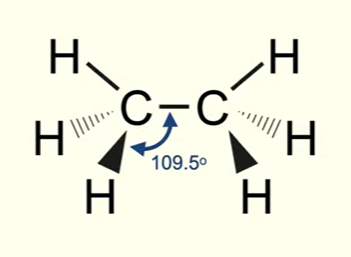
When are sigma bonds formed
When electron orbitals from adjacent atoms directly overlap. They contain a pair of electrons, one from each atom on either side of the bond.
Keyfeature of sigma bonds
They are fully rotational, bonds are also strong and take alot of energy to break in alkanes.
Why are alkanes non polar molecules
Carbon and hydrogen atoms have a very similar electronegativity.
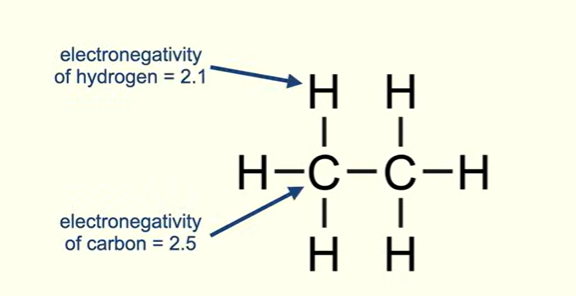
Properties of alkanes (solubility)
They are insoluble in water, this is because water molecules form hydrogen bonds with each other, alkanes have no permanent dipoles and cannot form hydrogen bonds
Properties of alkanes (reactivity)
They are generally unreactive, this is because of the strong covalent bonds within alkane molecules.
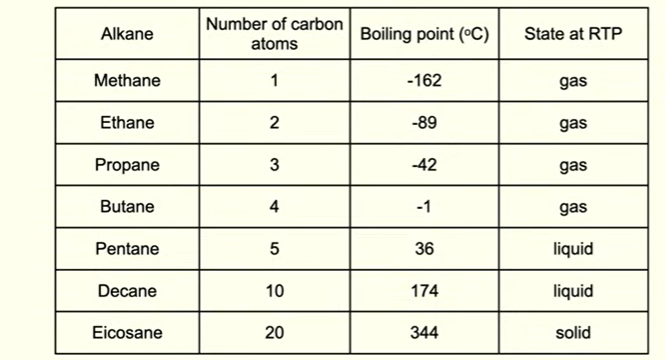
Explain trend of boiling points in alkanes
As length of carbon chain increases, boiling point increases
Alkanes are non polar molecules, intermolecular forces acting between them are induced dipole dipole interactions
When boiling alkane, these have to be broken, london forces are weak and easy to break
As chain increases, strength of london forces increases (more electrons and more surface area)
Why does branched isomer have a lower boiling point than a straight chain isomer.
Branches prevent alkane molecules from getting close.
London forces are strongest over short distances.