Ethics Quiz 3
 Call Kai
 Learn
Learn Practice Test
 Spaced Repetition
 Match
Match Flashcards
 Knowt Play
1/45

There's no tags or description
Looks like no tags are added yet.
Name | Mastery | Learn | Test | Matching | Spaced | Call with Kai |
|---|
No analytics yet
Send a link to your students to track their progress
46 Terms
What is Culture?
the characteristic beliefs, values, language, history, and shared challenges of groups of people.
Normative Model of Physical Therapist Professional Education
The therapist is to “be sensitive to individual and cultural differences when engaged in physical therapy practice”.
- 1.A Physical therapists and physical therapist assistants shall strive to acknowledge and respect an individual’s known identity and culture.
- 1.B Physical therapists and physical therapist assistants shall strive to recognize their explicit and implicit personal biases.
A patient’s cultural background can and will affect:
◦ Experience of illness
◦ Response to health-care professionals
What is cultural competence?
The ability to think and behave in ways that enable a member of one culture to work effectively with members of another culture.
Assimilation
Individuals assimilate into the dominant culture, learning its language and adopting its customs.
Pluralism
Members of minority cultures also preserve the basic elements of their ethnic identities.
What is the difference between assimilation and pluralism?
Assimilation involves adopting the dominant culture, while pluralism allows minority cultures to preserve their identities.
What are the three stages of developing cultural competence?
1. Develop knowledge of self and how one’s self is influenced by one’s culture and beliefs
2. Develop awareness of people who have their own values, and willingness to treat others as they wish to be treated
3. Develop the ability to empathize with and to respect individuals with different world views.
Individualist culture
focus on autonomy, individual rights, competitiveness, nonverbal communication is minor
Collectivist culture
Focus on group well-being, concerned with tradition, communication is both verbal and non-verbal
As therapists we must appreciate the differences that cultural background can have on:
◦ Perception of language
◦ Pain tolerance
◦ Religious beliefs
◦ Different social interaction styles
◦ Belief in folk medicine
What to do when a not legal guardian is given consent to make decisions?
A legal guardian can give verbal consent for a PT to discuss PHI with other family members
• The legal guardian still has to give the final approval for all treatment decisions (Uncle can say “let’s do this”, but Mom has to at least agree)
Prejudice
to make a judgment based on prior experience; or any preconceived opinion or feeling, either favorable or unfavorable.
The strongest obstacle to multicultural appreciation
When power is added, it is then labeled as an “ism
Can be favorable (predicting behavior or forewarning dangers) or negative
(discrimination).
Bigotry
Intolerance toward those who hold different opinions from oneself
Bias
A preference or an inclination, especially one that inhibits impartial judgment
Discrimination:
unfair treatment of a person or group on the basis of prejudice
Ethnocentrism
pride in one’s own ethnic group; or belief that one’s own cultural ways are superior, or pride in one’s culture
Can be healthy and can be dangerous
ADA Defines disability in 3 ways:
1. Persons are disabled if they have a physical or mental problem that substantially limits a major life activity
2. All individuals who have been substantially limited in the past are covered
3. Extends to situation where a problem is created by the attitudes of other
ADA Reasonable accommodation
Accommodations that enable individuals to perform tasks at a satisfactory level
Employers do not have to make accommodations that cause financial hardship or will severely disrupt operations
Employers may not ask questions during an interview about a person’s disability
They also can’t order a medical examination until after a job offer has been made and only if all other applicants are also subject to an examination
Items not covered by the ADA:
Sexual orientation
• Inability to read (unless dyslexia)
• Obesity (unless a glandular condition)
• Disability due to current illegal drug use
• Behavioral disorders such as compulsive gambling and pyromania
• Psychological characteristics such as aggressive behavior
Feminism
work that takes gender and sex as centrally important analytic categories and seeks to understand their operation in the world and strives to change the distribution and use of power to stop the oppression of women
Race
defined by skin color, hair texture, and other appearance variables
Genetic differences between races is not greater than any 2 persons of the same race
Affirmative Action
Original meaning – taking positive steps to ensure equal opportunity for minorities and, subsequently women.
Any business that receives federal funds is required to keep records of women and minorities in each level of the organization and compare it t the hiring pool
Businesses cannot use race as the only factor in hiring or set rigid percentages of placements
Weak preferential treatment
Providing the advantage to members of minority groups and women when they compete against white males having comparable credentials.
Strong preferential treatment
Giving women and minorities an advantage even when they are less qualified than white males with whom they are competing
At present, affirmative action plans contain one or any mixture of the following
◦ Outreach programs that identify and recruit minorities for opportunities.
◦ Aid through financial incentives or technical assistance.
◦ Mentoring that guides or coaches qualified candidates.
◦ Treating race or gender as an advantage factor in the selection process
Advocates for Affirmative action:
•View it as a way to overthrow racism and sexism
•Believe the only way to overcome the “white majority” is to make race- conscious decisions in education, employment, and politics
Opponents for Affirmative Action:
•View it as a self-contradictory attempt to seek justice by imposing justice
•State the past cannot be corrected by used the same methods that caused the injustice
•View preferential treatment programs as an insult to minorities by emphasizing the stigma that these groups can’t compete without an advantage
Ethnicity
Refers to a person’s sense of belonging to a group of people sharing a common origin, history, and set of social beliefs
May also refer to an individual’s place of geographical or nation origin
Gender
Sexual identity, especially in relation to culture or society
Ageism
discrimination of old people
Race
Local geographic or global human population distinguished as a more or less distinct group by genetically transmitted physical characteristics.
Why does race place an issue in healthcare
◦ Distrust of medical profession
◦ Income discrepancy (Black and Hispanics have lowest median income; Asians households had the highest)
◦ Uninsured rate
WHAT IS ARTIFICIAL INTELLIGENCE?
The use of technology to perform intelligent tasks
that have traditionally been performed by humans
only
Reading
Writing
Analyzing
Problem-solving
Weak/Narrow AI
Performs specific tasks only (Siri, self-driving vehicles
Strong AI
Theoretical
AI that has intelligence equal to or surpassing human intelligence
Machine learning
Processes large amounts of data via supervised learning – data is structured by humans to tell the program how to extract information
Deep learning AI
Processes large amounts of data via unsupervised learning – no structure provided
Generative AI: Deep learning AI that generates the most probable output when prompted. Able to go beyond classifying information and create information (ie., AI generated photos)
Precision medicine
“predicting what treatment protocols are likely to succeed on a patient based on various patient attributes and the treatment contex
HOW IS AI USED IN HEALTHCARE?
Precision medicine
Disease prediction
Surgical robots
Completing prior authorizations, patient records, and billings
Use of chatbots for refilling prescriptions, making appointments, and answering basic patient questions about certain conditions or medical procedures
Radiomics
detection of imaging data beyond what the human eye can see
Recognition of lesions in radiology studies/images
Natural Language Processing:
Preparation of reports
Transcription of patient interactions
Medical diagnosis and treatment:
IBM Watson used to diagnosis cancer and recommend treatment – however, found to be difficult to “teach”
Problems with AI
Bias: Influenced by the social, sexist, and racist biases in the information it is provided in the large datasets.
Not always accurate
Will provide false information in order to fill in the blanks
May be “stubborn” – the em dash dilemma
Currently – AI chatbots cannot outperform actual human physicians
Relies on supplied information – it can’t go out and seek it like a human can. Will “hallucinate” information when that information doesn’t exist in its database
ETHICAL ISSUES SURROUNDING USE OF AI ?
HIPPA
How can AI programs protect PHI once it is in the database?
Should third party companies be able to access that information?
Risk of discrimination for vulnerable populations
Collection of excess data – “behavioral data surplus”
Transparency: AI can provide a cancer diagnosis but can’t tell you WHY. AI is not empathetic.
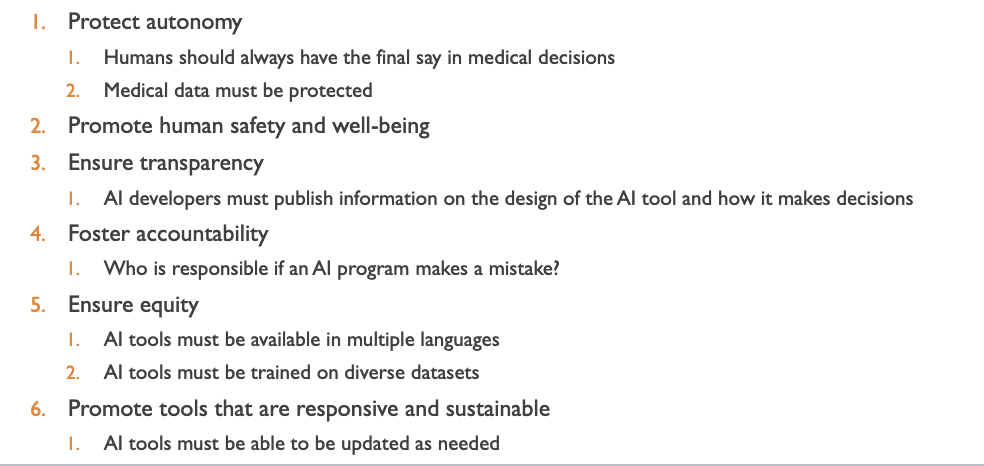
World Health Organization has developed 6 key principles to ensure safe use of AI in healthcare: