20 Biogeography
 Call Kai
 Learn
Learn Practice Test
 Spaced Repetition
 Match
Match Flashcards
 Knowt Play
1/31

There's no tags or description
Looks like no tags are added yet.
Name | Mastery | Learn | Test | Matching | Spaced | Call with Kai | Chat |
|---|
No analytics yet
Send a link to your students to track their progress
32 Terms
Biogeography
Study of spatial patterns of biological diversity
- How and why does biodiversity vary over the surface of the Earth
Why were early naturalists like Darwin and Wallace important for biogeography?
They traveled to different regions, collected specimens, and noticed that different places had different organisms; These observations helped scientists realize that species distributions are not random; shaped by geography, evolution, isolation, dispersal, and history
Why are the Philippines and New Guinea less similar than expected?
Closer does not always mean more similar; Seperated by Wallace’s Line; Even though New Guinea is closer to the Philippines than Africa is, the Philippines shares more mammal families with Africa than with New Guinea
Wallace’s Line: Pangolins
Pangolins occur in Africa and the Philippines, but not in New Guinea
What are Wallace’s biogeographic regions?
Wallace’s biogeographic regions are large areas of the world with distinct communities of organisms; Wallace’s line expanded
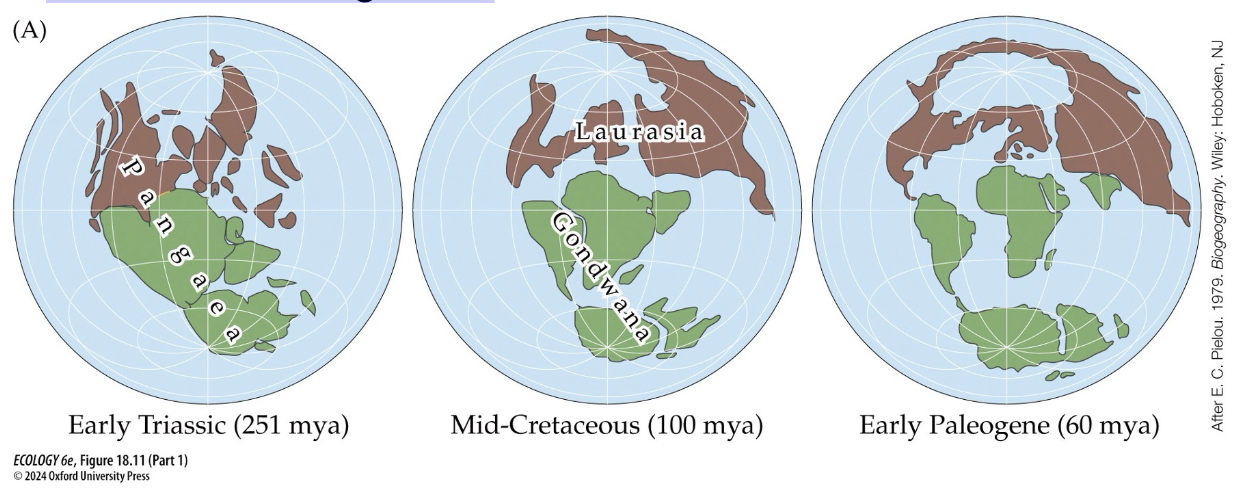
Continental Drift, or Plate tectonics
Sections of Earth’s crust (plates) move across the surface
- Originally oceans and continents were thought to be fixed
Plate tectonics: implications for ecology
Need to consider Earth’s history when interpreting modern day distributions of organisms
Vicariance
When a species or population gets split apart by a new geographic barrier, and the separated groups can eventually evolve into different species
Vicariant event
Some environmental change creates a barrier to dispersal, isolating previously connected and interbreeding populations
Examples:
rising sea level can separate land masses
– plate tectonics: mountain ranges arise, land masses split and move apart
If a population was split by a vicariant event and then speciated, should the
divergence time of the resulting species occur before or after the vicariant event?
Divergence should occur after the vicariant event
Hypothesis (Testing Vicariant Hypothesis)
The modern day distribution of species is due to a vicariant event in the past
Prediction (Testing Vicariant Hypothesis)
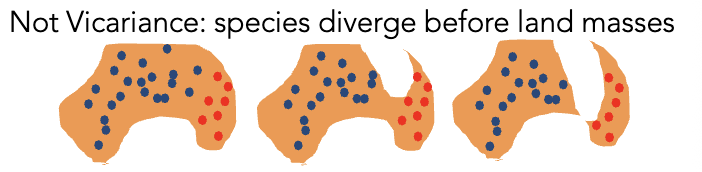
Hypothesis predicts that seperate species will form after land masses diverge
Test (Testing Vicariant Hypothesis)
In order to test a vicariant hypothesis, we must compare species divergence times of species to separation times of land masses
Not Vicariance
Species diverge before land masses
Ratites
Taxonomix group often large and flightless
Ratites occur all over the world, does vicariance explain theit distribution?
Vicariant Hypothesis
Ratites are found on different continents today because their common ancestor lived when the continents were still connected;
We see different ratities speceis all over the world because their common ancestor evolved way back when the land masses were connected, and then as the land masses separarted due to plate tectonics, the populations on each land mass because geentically isolated and evolved into the species today
Ratites: If vicariant hypothesis true, then predict:
Same land mass should be more closely related; Ratites that co-occur on the same land mass should be more closes related to each other than ratites on other land masses
Ratites species should be more recent since it should happen after the landmasses split; The timing of divergence between the ratites should be more recent than divergence of land masses
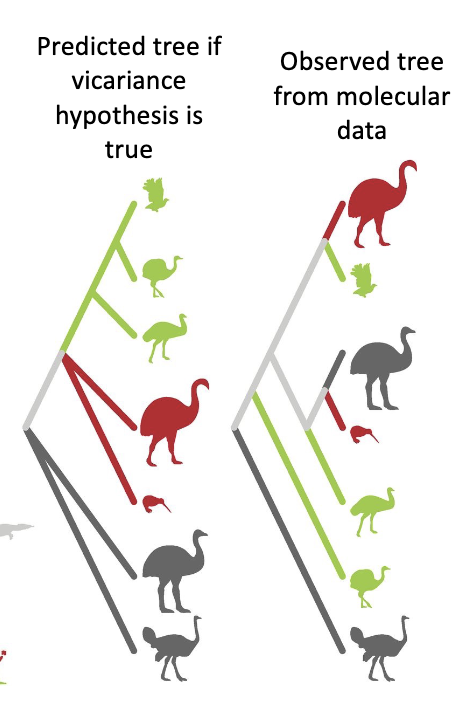
What does the Gondwana-origin/vicariance hypothesis predict about ratite relationships?
If ratites were split by the breakup of Gondwana, then their evolutionary relationships should match the order that landmasses separated
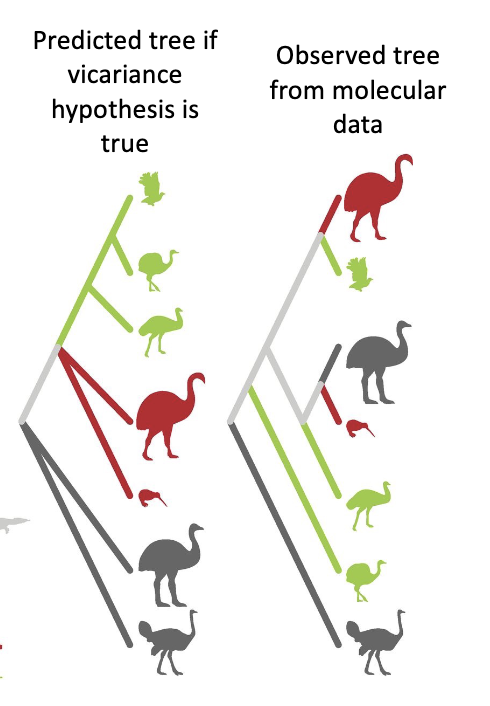
Does the Gondwana-origin prediction support vicariance?
The observed molecular tree does not support the simple Gondwana-vicariance explanation for ratite distribution; We would’ve expect land masses that were connected the longest to have ratites that are the most closely related
What is the species-area relationship?
Larger areas tend to have more species due to greater habitat diversity and lower extinction risk
Species-Area Curves Axes
X-Axis: Area
Y:Axis: Number of Species
More Area = More Species
Kipuka
Fragment forests by lava flows
islands of a forest in a sea of lava
How does the size of kipuka sites affect bird species diversity?
Larger kipuka sites support more vegetation and greater habitat diversity (resources and conditions), leading to more bird species (richness)
What happens to predator diversity when forests become fragmented?
Predator diversity decreases, which can lead to increased mouse populations and higher Lyme disease rates
How can studies of the Hawaiian Islands provide insight into how communities form over short and long time periods?
Studies of the Hawaiian Islands help show community formation on both short and long time scales because Hawaiʻi has islands and lava flows of different ages;
- Can study early direct succession and can compare young and old sires
Formation of the Hawaiian Islands
How movement of the Pacific plate over a hot spot created a chronosequence at the island-level
Islands differ in age, Habitat on Kauai available longer than Big island
Progression Rule: Hawaiian islands
Pattern: Concordance between species relatedness and island age; older lineages on older islands and younger lineages on younger islands
- Hypothesized process: Species originate on oldest then disperse to younger islands as they emerge
What factor of determining species composition (abiotic, biotic, & dispersal) in a community does vicariance fall under?
Dispersal; Change in community composition by changing which species can disperse to or remain connected with a place
Why is a historical perspective important for understanding contemporary patterns of distribution and abundance?
Today’s species distributions are partly shaped by past events; Modern distribution and abundance reflect both current ecology and past history
If a species evolved 200 million years ago in South America, where might its closest relatives be found?
Australia; South America and Australia connected for the longest time
What are other potential relatives of a species from South America?
Africa, Antarctica, New Zealand, and Madagascar
Why do the Philippines and New Guinea have dissimilar faunas despite being geographically close?
Wallace's Line separates the plates, leading to different evolutionary histories