004 Binocular Vision
 Call Kai
 Learn
Learn Practice Test
 Spaced Repetition
 Match
Match Flashcards
 Knowt Play
1/63

There's no tags or description
Looks like no tags are added yet.
Name | Mastery | Learn | Test | Matching | Spaced | Call with Kai | Chat |
|---|
No analytics yet
Send a link to your students to track their progress
64 Terms
What is the importance of binocular vision test for children?
BV problems can lead to permanent vision loss
BV test require attention
What are the three key components that allow both eyes to work together?
Alignment – proper positioning of both eyes
Fusion – combining images into one
Accommodation – focusing adjustment for clear vision
What is ocular alignment and what disorders are associated with it?
Alignment: Eyes are properly directed at the same target
Disorders:
Strabismus – manifest misalignment (eyes visibly not aligned)
Phoria – latent misalignment (only appears when fusion is disrupted)
What is fusion and what are its two components?
Fusion: Brain combines images from both eyes into one
Motor fusion: eye movements align images (vergence)
Sensory fusion: cortical processing merges images
What is the epidemiology of strabismus in early childhood?
Occurs in ~3.7% of children aged 6–72 months
Infantile strabismus (6–12 months): ~1.1%
What are the major risk factors for strabismus?
Prematurity (~8%)
Smoking during pregnancy (~5.8%)
Down syndrome (~6.3%)
Cerebral palsy (~16.7%)
What are the common binocular vision disorders and their epidemiology by age?
Convergence insufficiency (CI):
5–7% in 6–18 year olds
7.7% in college-age patients
Convergence excess (CE):
4–8% in 6–18 year olds
1.5% in college-age patients
How does the prevalence of convergence insufficiency change with age?
Convergence insufficiency increases with age in this slide’s data:
5–7% in children/adolescents
7.7% in college-age patients
How does the prevalence of convergence excess change with age?
Convergence excess decreases with age in this slide’s data:
4-8% in children/adolescents
1.5% in college-age patients
What is the epidemiology of accommodative disorders by age?
Accommodative disorders:
6% in 6-18 year olds
17% in college-age patients
Suggests accommodative dysfunction is more common in college-age populations
How does the prevalence of convergence insufficiency change with age?
Convergence insufficiency increases with age in this slide’s data:
5-7% in children/adolescents
7.7% in college-age patients
How does the prevalence of convergence excess change with age?
Convergence excess decreases with age:
4-8% in children/adolescents
1.5% in college-age patients
What is the epidemiology of accommodative disorders by age?
Accommodative disorders:
6% in 6-18 year olds
17% in college-age patients
Suggests accommodative dysfunction is more common in college-age populations
What should be included in the examination when assessing binocular vision?
Case history
Visual acuity
Binocular vision (if VA is adequate enough to assess BV)
Refractive error
Ocular health
How should significant refractive error be managed before a thorough binocular vision assessment?
Prescribe the refractive correction first
Allow the patient to adapt for ~1 month
Then reassess binocular vision thoroughly
A trial frame at the first visit usually will not show a large change in binocularity
Why should binocular vision not be fully assessed while the patient is cyclopleged?
Do not assess fully while cyclopleged
Cycloplegia is needed to find the correct prescription
The refractive error itself may be contributing to the binocular vision problem
BV assessment often requires follow-up after glasses wear
What is the key clinical sequence for evaluating binocular vision when refractive error is present?
Cycloplege to determine accurate Rx
Prescribe correction if significant refractive error is present
Allow glasses adaptation
Reassess binocular vision at follow-up
What abnormal head postures may be seen on direct observation during binocular vision assessment, and what do they suggest?
Head turn
Head tilt
Chin tipping
These may be compensatory postures used to maintain single binocular vision or reduce symptoms from ocular misalignment.
What is angle kappa?
Angle kappa = the distance/angle between the center of the pupil and the corneal light reflex
Important when interpreting apparent ocular alignment
What is the normal angle kappa/light reflex position?
Average angle kappa ≈ ±5°
In normal adult alignment, the light reflex is ~0.5 mm nasal to the center of the pupil
Why is angle kappa clinically important when assessing strabismus?
A normal angle kappa can make the eyes appear slightly misaligned, so it must be considered when interpreting the corneal light reflex and screening for strabismus/pseudostrabismus.
What is pseudostrabismus, and why is it clinically important?
Pseudostrabismus = false appearance of ocular misalignment when true strabismus is not present
Important because facial anatomy or abnormal angle kappa can mimic eso- or exotropia
What can cause a pseudoesotropia (esotropia appearance)?
Epicanthal folds
Narrow interpupillary distance (IPD)
Deep-set eyes
Negative angle kappa = corneal light reflex appears temporally
May occur if the fovea is dragged medially by a retinal condition
What can cause a pseudoexotropia (exotropia appearance)?
Wide IPD / hypertelorism
Positive angle kappa = corneal light reflex appears nasally
May occur if the fovea is dragged temporally, such as with:
ROP
High myopia
Congenital retinal folds
How is the Hirschberg test performed?
Perform with the kappa test in mind
Hirschberg should be done first
Hold a transilluminator/bright penlight ~40 cm away
Test is done binocularly
Have the patient fixate on the light (or use a fixation target like a lighted puppet)
How do you interpret the Hirschberg test for strabismus?
If the corneal light reflex position is the same in binocular and monocular viewing → no strabismus
If the binocular reflex differs from the monocular reflex, the eye with the monocular difference is generally the strabismic eye
What are the limitations of the Hirschberg test?
Must be interpreted with angle kappa
Can be difficult/unreliable in:
Paralytic strabismus
Mechanical strabismus
How is the Krimsky test performed?
Place a prism with the appropriate base orientation in front of the fixating eye
Increase prism power until the corneal light reflex in the deviating eye matches the expected angle kappa position
What does the endpoint of the Krimsky test indicate?
When the deviating eye’s corneal reflex is aligned to the normal angle kappa position, the prism amount = magnitude of the tropia
What is the key principle behind the Krimsky test?
It is a prism-based modification of the Hirschberg test used to quantify a manifest deviation (tropia) by neutralizing the corneal light reflex asymmetry
What is the Brückner test used for?
Used to detect the presence of strabismus
Compares the red reflex brightness between the two eyes
How is the Brückner test performed?
Child fixates on the direct ophthalmoscope in a dark room
Examiner illuminates both eyes simultaneously with the direct ophthalmoscope
Examiner stands about 1 meter from the child
How is the Brückner test interpreted in strabismus?
The brighter eye is the strabismic eye
What can cause false positives on the Brückner test?
Media opacities
Posterior pole abnormalities
Anisocoria
Anisometropia
What is the key limitation of the Brückner test?
Unequal reflex brightness is not always due to strabismus
Must consider other causes such as anisometropia, anisocoria, media opacity, or retinal/posterior pole disease
What are the age-related limitations of the Brückner test in infants?
<2 months: infants do not show normal fundus reflex dimming with fixation
2-8 months: about 25% of children can have fundus reflex differences despite no strabismus
Why is the Brückner test less reliable in children younger than 8 months?
Normal infants may show asymmetric fundus reflexes without true strabismus
This creates a high false-positive rate, especially from 2-8 months
In what age group should the Brückner test generally not be used to detect strabismus?
Do not use in children younger than 8 months
What are the basic requirements for performing a cover test in a child?
The child must be able to see the fixation target with both eyes
Can be performed on any child who can fixate briefly
Usually feasible in children older than ~1.5 years
Unilateral cover test can be obtained on most children
What should be done before performing a cover test if the child has an abnormal head posture?
Straighten the child’s head first if an anomalous posture is present
A full sensorimotor exam includes cover testing in all directions of gaze
What are practical tips for performing a cover test in young children?
Use engaging fixation targets
Ask questions about the target to ensure attention stays on it
If the child looks at the examiner instead, use the examiner’s face as the fixation target
How can prism use be adapted during cover testing in young children?
Choose the prism wisely
Loose prisms may work better early on because the child can look through them gradually
A prism bar may be more intimidating and easier for the child to swat away
What is the key goal during pediatric cover testing?
Maintain steady fixation on a visible target with both eyes long enough to detect ocular misalignment accurately
What are the two main components of fusion, and what does each represent?
Sensory fusion = cortical combination of images from both eyes into one percept
Includes stereopsis
Motor fusion = eye movement response that maintains alignment
Includes fusional vergence
What is stereopsis, and why is it clinically important?
Stereopsis = depth perception from binocular disparity
It is a form of sensory fusion
Clinically, it is an indirect indicator of strabismus
What is the difference between global and local stereoacuity?
Global stereoacuity = random dot stereopsis
Requires bifoveal fixation
Local stereoacuity = contour stereopsis
May still be present in some patients with small-angle strabismus
Which type of stereopsis is more sensitive to binocular misalignment?
Global stereoacuity is more sensitive because it requires bifoveal fixation
Local stereoacuity may still show gross stereopsis even with small-angle strabismus
What do vectographic stereopsis tests measure, and what type of stereopsis do they assess?
They assess stereopsis as part of sensory fusion
These slides focus on global stereopsis
Global stereopsis is tested with random dot targets
Which vectographic stereopsis test uses preferential looking?
Stereo Smile
It is a global stereopsis / random dot test
Response is based on preferential looking, making it useful for very young children
Which vectographic global stereopsis tests use a 2-alternative fixed-choice format?
PASS Test
Random Dot E
Both are random dot global stereopsis tests using a 2-alternative fixed-choice response style
What is Preschool Randot used for?
A vectographic global stereopsis test
Uses random dot stereopsis
Designed for preschool-age children, typically with child-friendly picture/shape targets
What are the key features of the Frisby stereotest?
Real depth stereopsis test
Assesses global stereopsis
No glasses required
Uses plates of different thicknesses to create disparity
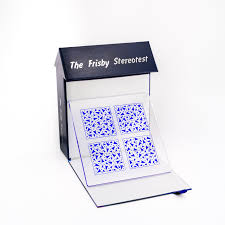
What stereoacuity levels are tested with the Frisby stereotest on this slide?
340 arcsec
170 arcsec
55 arcsec
These represent progressively finer stereoacuity.
What are the key features of the Lang stereotest?
Prism stereopsis test
Assesses global stereopsis
No glasses required
Turn the test 90° to eliminate disparity and help check for non-stereo cues
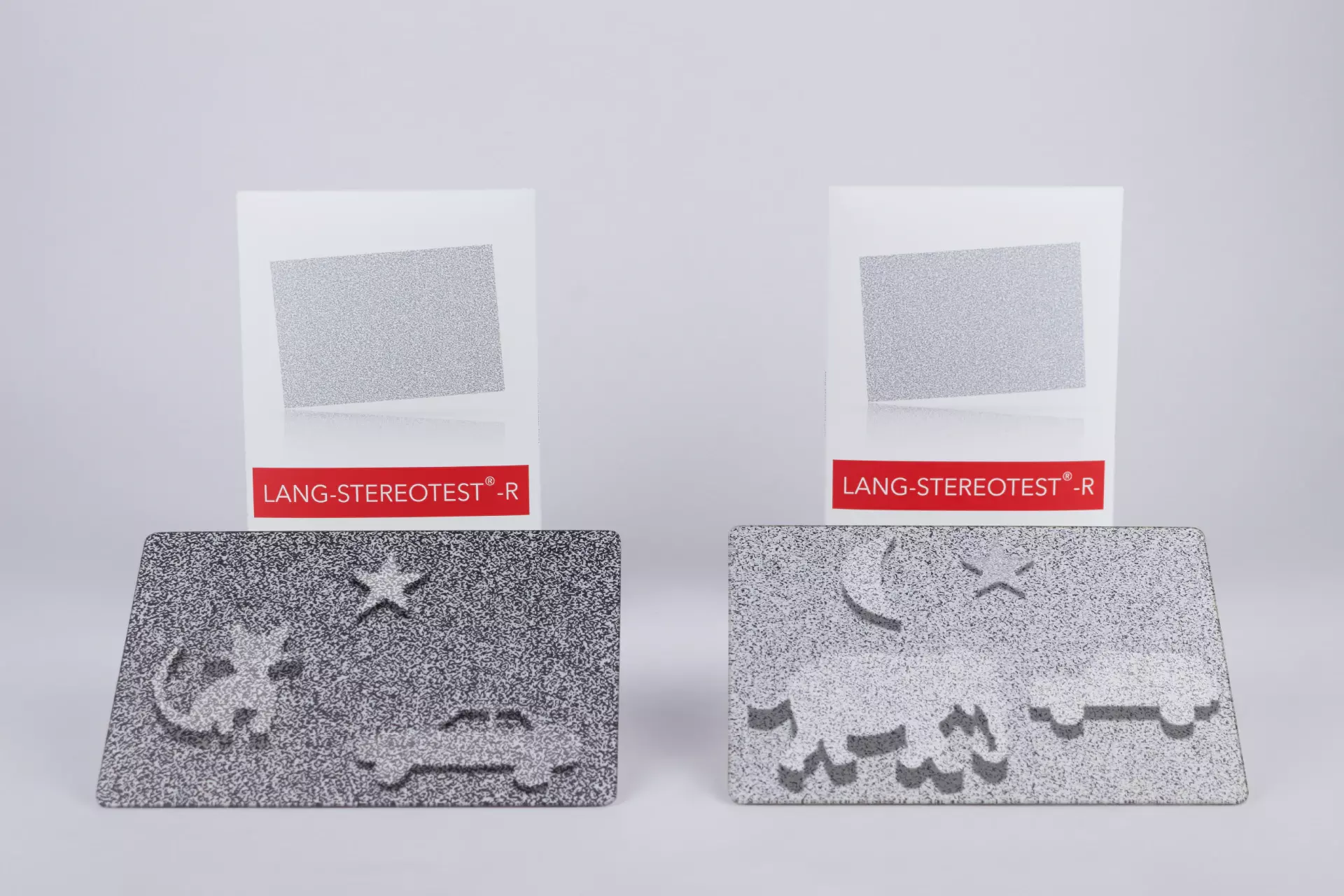
What is the difference between Lang I and Lang II stereotests?
Lang I: no monocular target
Lang II: the star is a monocular target
How is the 10Δ base-out (BO) reflex fusion test performed, and what is the normal response?
Place 10Δ BO prism over the preferred eye while the patient looks at a near target
Normal response in the non-preferred eye:
Abducts
Then adducts
If both phases occur, fusion is present
How is the 10Δ BO reflex fusion test interpreted?
Abduction then adduction of the non-preferred eye = fusion present
Abduction only = no fusion
How can fusional vergence be assessed in children who cannot describe blur/break/recovery?
Use prism bar vergence ranges in children with steady fixation
If the child cannot report blur / break / recovery, observe the eyes directly for the response
How is near point of convergence (NPC) tested in younger vs older children?
Older children: test the same as adults
Younger children: perform similarly, but watch for an eye to drift instead of asking about diplopia
Very young children: move a small target toward the patient and watch for a convergence response
What are the 3 main aspects of accommodation that should be assessed?
Magnitude – how much accommodation the patient can produce
Accuracy – how accurately the accommodative response matches demand
Flexibility – how quickly/easily focus can change
How is accommodative magnitude tested, and what does it measure?
Measures amplitude of accommodation
Tested with push-up or pull-away methods
Assesses the maximum accommodative ability
What does MEM retinoscopy assess, and how is it performed?
Assesses accommodative accuracy
Performed on each eye
Done at 40 cm or Harmen distance (forearm length)
What is a normal MEM lag of accommodation?
Normal lag is +0.50 to +0.75 D
More plus = greater lag of accommodation
What test is used to assess accommodative flexibility?
Accommodative facility testing
Evaluates how quickly/easily the patient can change focus