Organocatalysis: A case study: CO2 activation
 Call Kai
 Learn
Learn Practice Test
 Spaced Repetition
 Match
Match Flashcards
 Knowt Play
1/5

There's no tags or description
Looks like no tags are added yet.
Name | Mastery | Learn | Test | Matching | Spaced | Call with Kai |
|---|
No analytics yet
Send a link to your students to track their progress
6 Terms
why
era of transition metal catalysis is over
need for organocatalysis for sustainability
we look specifically into CO2 activation
= use CO2 as building block for organic materials
Use of CO2
renewable resource, but poor reactivity due to kinetic inertness
high activation barrier
so lower barrier using catalysis
Direct use of CO2 is much better than sequestration
sequestration = CO2 capture from the atmosphere
but low conc (although too high) so not very efficient
using CO2 directly (eg produced by a plant) is much more efficient
metal catalysis has been explored in depth for a long time but has shortcommings
rather toxic
expensive (Pd, Rh,…)
active catalysts often very sensitive (like Pd to air —> complicates synthesis)
even immobilization of homogenous catalyst is sufficient to obtain traceless (metal-free) products
photosynthesis is good example in nature of CO2 incorporation, but uses metals
through enzymatic catalysis with non toxic, abundant metals like Mg or Fe
but harnessing catalytic power of such metals is much more difficult than just using Pd, …
organocatalysts
cheaper, non-toxic and readily available
can be derived from biomass and in some cases even be extracted from it
main drawback is lower catalytic activity
solve by using higher catalyst loadings
not a problem due to availability and lower cost
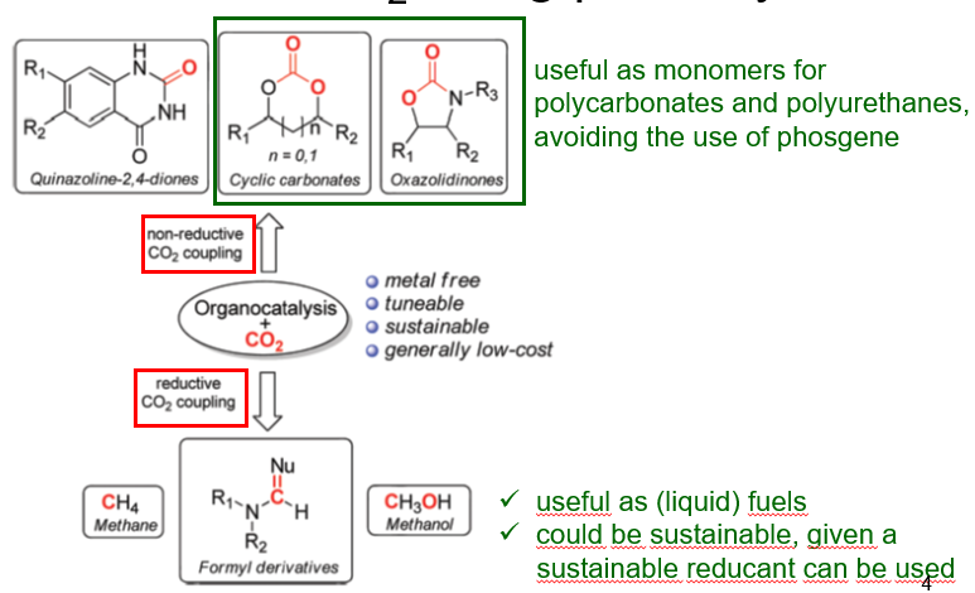
Main CO2 using pathways
non-reductive pathways
produces cyclic carbonates, cyclic carbamates and quinazolin-2,4-diones
can be used for the production of polycarbonates or polyurethanes
their production is currently not sustainable
bisphenol A is hormone disrupting
phosgene = toxic dangerous gas
reductive pathwyas
produces methanol, methane or formyl derivatives
useful as (liquid) fuelss
BUT sustainable reductant is not trivial
holy grail would electrochemistry (but not there yet)
Activation modes for CO2 incorporation in cyclic carbonates
Two pathways
activation of CO2
base attacks on CO2 forming more nucleophilic O that can attack and ring open an epoxid which after ringclosure regenerates the base
activation of the epoxide
bas ring opens the epoxide, epelled oxygen can attack on CO2, base is expelled again after ringclosure
however: SM is epoxides and are still toxic
Dual activation = combine both mechanisms
funcitonalized IL (ionic liquids)
NHC (N-heterocyclic carbenes)
FLP (frustrated lewis acid base pair)