NSG 526 Clin Modal. EXAM 1 questions and answers
 Call Kai
 Learn
Learn Practice Test
 Spaced Repetition
 Match
Match Flashcards
1/185

There's no tags or description
Looks like no tags are added yet.
Name | Mastery | Learn | Test | Matching | Spaced | Call with Kai |
|---|
No analytics yet
Send a link to your students to track their progress
186 Terms
a syndrome characterized by clinically significant disturbance in an individual's cognition, emotion, regulation, or behavior that reflects a dysfunction in the psychological, biological, or developmental process underlying mental funcioning
they are associated with significant distress, disability in social occupational, or other important activities
mental disorder/psychiatric illness
criteria that are offered as guidelines for making diagnoses
Diagnostic Criteria
when the symptom presentation does not meet full criteria for any disorder and the symptom cause clinically significant distress/impairment what categories should be used in the diagnosis
"other specified"
"unspecified"
when the symptom presentation does not meet full criteria and "other specified" and "unspecified" categories are used in the diagnosis, what should the main diagnosis be corresponding to?
main diagnosis should correspond to the most predominant symptoms.
ex: Bipolar disorder, unspecified
the coding system that is used in the U.S. for diagnosing and documenting psychiatric disorders
ICD-10-CM
(international classification of disease-10th revision-clinical modification)
true or false: the diagnosis of a mental disorder is not equivalent to a need for treatment
TRUE - clinicians should treat based on symptom severity, clinical presentation, etc.
1. A nurse is assessing a client who is experiencing occasional
feelings of sadness because of the recent death of a beloved pet. The client's appetite, sleep patterns, and daily routine have not changed. How should the nurse interpret the client's behaviors?
1. The client's behaviors demonstrate
mental illness in the form of
depression.
2. The client's behaviors are extensive,
which indicates the presence of mental
illness.
3. The client's behaviors are not congruent
with cultural norms.
4. The client's behaviors demonstrate no
functional impairment, indicating no
mental illness.
4. The client's behaviors demonstrate no functional impairment, indicating no mental illness.
2. At what point should the nurse determine that a client is at risk
for developing a mental illness?
1. When thoughts, feelings, and behaviors
are not reflective of the DSM-5 criteria.
2. When maladaptive responses to stress
are coupled with interference in daily
functioning.
3. When a client communicates
significant distress.
4. When a client uses defense mechanisms
as ego protection.
2. When maladaptive responses to stress are coupled with interference in daily functioning.
6. During an intake assessment, a nurse asks both physiological
and psychosocial questions. The client angrily responds, "I'm here for my heart, not
my head problems." Which is the nurse's best response?
1. "It is just a routine part of our assessment.
All clients are asked these same
questions."
2. "Why are you concerned about these types
of questions?"
3. "Psychological factors, like excessive
stress, have been found to affect medical
conditions."
4. "We can skip these questions, if you like.
It isn't imperative that we complete this
section."
3. "psychological factors, like excessive stress have been found to affect medical conditions"
8. A fourth-grade boy teases and makes jokes about a cute girl
in his class. This behavior should be identified by a nurse as indicative of which
defense mechanism?
1. Displacement
2. Projection
3. Reaction formation
4. Sublimation
3. Reaction formation
Reaction formation is the
attempt to prevent undesirable thoughts
from being expressed by expressing
opposite thoughts or behaviors.
11. When under stress, a client routinely uses alcohol to excess.
Finding her drunk, her husband yells at the client about her chronic alcohol abuse.
Which action alerts the nurse to the client's use of the defense mechanism of denial?
1. The client hides liquor bottles in a closet.
2. The client yells at her son for slouching in
his chair.
3. The client burns dinner on purpose.
4. The client says to the spouse, "I don't
drink too much!"
4. the client says to the spouse, "I don't drink too much!"
10. Which nursing statement regarding the concept of psychosis is most
accurate?
1. Individuals experiencing psychoses are
aware that their behaviors are maladaptive.
2. Individuals experiencing psychoses
experience little distress.
3. Individuals experiencing psychoses are
aware of experiencing psychological
problems.
4. Individuals experiencing psychoses are
based in reality.
2. individuals experiencing psychoses experience little distress
The nurse should understand that the client with psychosis experiences little distress owing to his or her lack of awareness of reality. They are unaware of their psychological problems
15. How would a nurse best complete the new DSM-5 definition of a mental disorder?
"A health condition characterized by significant dysfunction in an individual's
cognitions, or
behaviors that reflect a disturbance in ..." which of the following?
1. Psychosocial, biological, or
developmental process underlying
mental functioning
2. Psychological, cognitive, or
developmental process underlying
mental functioning
3. Psychological, biological, or
developmental process underlying mental
functioning
4. Psychological, biological, or
psychosocial process underlying
mental functioning
3. psychological, biological, or developmental process underlying mental functioning.
16. A nurse is assessing a client who appears to be experiencing some anxiety during
questioning. Which symptoms might the client demonstrate that would indicate
anxiety? (Select all that apply.)
1. Fidgeting
2. Laughing inappropriately
3. Palpitations
4. Nail biting
5. Limited attention span
1. fidgeting
2. laughing inappropriately
4. nail biting
Which documentation of a patient's behavior best demonstrates a psychiatric advanced practice nurse's professional observations regarding the patient's psychotic symptoms?
A) Isolates self from others. Frequently fell asleep during group. Vital signs stable.
B) Calmer; more cooperative. Participated actively in group. No evidence of psychotic thinking.
C) Appeared to hallucinate. Frequently increased volume on television, causing conflict with others.
D) Wore four layers of clothing. States, "I need protection from evil bacteria trying to pierce my skin.
D. wore four layers of clothing. states "i need protection from evil bacteria trying to pierce my skin"
In using the communication technique of reflection, the psychiatric advanced practice nurse:
A) Interprets the difference between a patient's thoughts and his or her behaviors.
B) Repeats something that the patient has said to encourage the patient to give more information.
C) Provides prompts such as "tell me more."
D) Seeks more information in order to have a more clear understanding.
B. repeats something the patient has said to encourage the patient to give more information
Which one of the following is not true regarding the mental status examination?
A) Racing thoughts are considered part of the thought process
B) Blunted is a term used to describe affect
C) Hallucinations are part of thought content
D) Delusions are part of thought content
C. Hallucinations are a part of thought content.
**** Delusions are a part of thought content
** suicidal thoughts, homicidal thoughts, and thoughts of self-harm are all covered in thought content -- think - it is the CONTENT of your thoughts!!!
*** The thought process is the WAY in which a client thinks. - often evidenced by their speech
***illusions and hallucinations are covered under perceptual disturbances
The PMHNP has a new patient in the clinic. While looking at the materials the patient filled out in the waiting area, the PMHNP ascertains the patient has a substance abuse history. The PMHNP immediately says, "stupid drug addicts, they're so annoying. There such a waste of time. They never want to get better. "This is an example of:
A) Projection
B) Transference
C) Countertransference
D) ResistanceFsaf
C. countertransference
Which comment(s) by an elderly person best indicates successful completion of developmental tasks? Select all that apply.
A) "I am proud of my children's successes in life."
B) "I should have given to charities more often."
C) "My relationship with my father made life more difficult for me."
D) "I often wonder what would have happened if I had chosen a different career."
A. I am proud of my children's success in life
The purposes of the psychiatric interview include all except:
A) Gaining an understanding of the patient's illness.
B) Obtaining information efficiently.
C) Providing education about psychiatric disorders.
D) Establishing a therapeutic alliance.
C. providing education about psychiatric disorders
operates to the pleasure principle. Seeking please and avoiding pain. It drives wishes, desires and fantasies.
No real perception of reality. It uses primary process... Seeks to
satisfy its needs.
ID
ID has 2 major instincts, what are they?
EROS - focus on pleasure-seeking tendencies
such as sexual urges.
THANATOS - motivates people to use aggressive urges to destroy.
aware of reality and understands that behaviors have consequences. It uses
secondary processes... perception, recognition, judgement, memory, reasoning,
problem-solving, impulse control and formation of relationships
EGO
contains morals and values and is developed from our parents through
childhood and society. Contains the rules of right and wrong.
SUPER EGO
7. What reason does the nurse give the patient for the emphasis and attention being paid to the recovery phase of their treatment plan?
a. Recovery care, even when intensive, is less expensive than acute psychiatric care.
b. Effective recovery care is likely to result in fewer relapses and subsequent hospitalizations.
c. Planning for recovery care is time consuming and involves dealing with many complicated details.
d. Recovery care is usually done on an outpatient basis and so is generally better accepted by patients.
B. Effective recovery care is likely to result in fewer relapses and susequent hospitalizations.
Which activity shows that a therapeutic alliance has been established between the nurse and patient?
a. The nurse respects the patients right to privacy when visitors are spending time with the patient.
b. The patient is eagerly attending all group sessions and working independently on identifying their personal stressors.
c. The patient is freely describing their feelings related to the physical and emotional trauma they experienced as a child with the nurse.
d. The nurse dutifully administers the patients medications on time and with appropriate knowledge of the potential side effects.
C. the patient is freely describing their feelings related to the physical and emotional trauma they experienced as a child with the nurse.
2. When preparing to conduct a nursing history and assessment on a patient transferred from the emergency department (ED) whose family believes the patient to be a questionable historian due to cognitive impairment, the nurse initially begins the interview by:
a. Reviewing the ED chart
b. Contacting the admitting physician
c. Directing the questions to the family members
d. Establishing a line of communication with the patient
D. establishing a line of communication with the patient
4. When engaging in outcomes identification, the nurse:
a. Interviews and collects patient-focused data
b. Re-assesses the patients physical and emotional status evaluation
c. Reviews the patients existing problems and projects the results of the nursing care
d. Considers the patients presenting symptoms and identifies nursing-related problems
C. reviews the patients existing problems and projects the results of the nursing care
If a client makes a threat to harm a specific individual, the PMH-APRN must notify that individual per the _________ law.
Tarasoff Law
Individuals can be involuntarily committed for a psychiatric evaluation for only three reasons.
what are they?
1. They are a danger to themselves due to a mental illness.
2. They are a danger to others due to a mental illness.
3. They are gravely disabled due to a mental illness.
true or false:
Multiple diagnoses must be presented in a hierarchy from the condition of most significance to that of least concern
true
The main diagnoses is considered the principle diagnosis. I will be documented as:
Patient Y meets the criteria for two DSM-5 diagnoses: (F41.1) Generalized Anxiety Disorder (Principal Diagnosis), (F43.21) Adjustment Disorder with Depressed Mood
Example of Patient with a Mental Health Disorder and a Primary Medical Condition:
Patient X meets the criteria for the following DSM-5 and ICD-10 diagnoses:
(250) Diabetes Mellitus (Primary Diagnosis), (F43.12) Post Traumatic Stress Disorder, Chronic.
what are the four lobes of the brain
1. frontal
2. temporal
3. occipital
4. Parietal
dense collections of nerve cells with common specific functions
nuclei
This lobe is generally involved in self-awareness (introspection, physical and emotional sensation) and executive functions (focusing, planning, judgment, decision making, and social functioning).
This lobe regulates the expression of emotion and of motor behavior.
Frontal Lobe
This LOBE is noted to be involved in clinical psychiatric syndromes such as schizophrenia, disorders of attention (i.e., ADD), obsessive compulsive disorder, and mood disorders.
Frontal lobe
This lobe is generally associated with the coordination of sensation and motor behavior (such as the coordination of language functions), spatial orientation (knowing where your body is, in a physical sense), and recognition of people and objects.
Parietal
This lobe is intimately involved in memory formation: language, and learning.
Temporal Lobe
euphoria, auditory hallucinations, and delusions are usually associated with impaired function of the dominant (usually left) _______ lobe,
temporal lobe
dysphoria, depression, irritability, and inappropriate affect are associated with abnormalities of the non-dominant (usually right) ___________ lobe.
Temporal lobe
lobes associated with vision and visual memory.
occipital lobes
this tract allows each hemisphere of the brain to receive and send information to the other hemisphere, so that functions can be coordinated between the left and right sides of the brain.
Corpus Collosum
True or false:
the Cingulum has been implicated as abnormal in schizophrenia and ADHD
FALSE
the Corpus Callosum has been implicated as abnormal in schizophrenia and ADHD
As a body (corpus) of nerve fibers of colossal proportions, this tract allows each hemisphere of the brain to receive and send information to the other hemisphere, so that functions can be coordinated between the left and right sides of the brain. It has been implicated as abnormal in schizophrenia and attention deficit hyperactivity disorder (ADHD).
Corpus Callosum
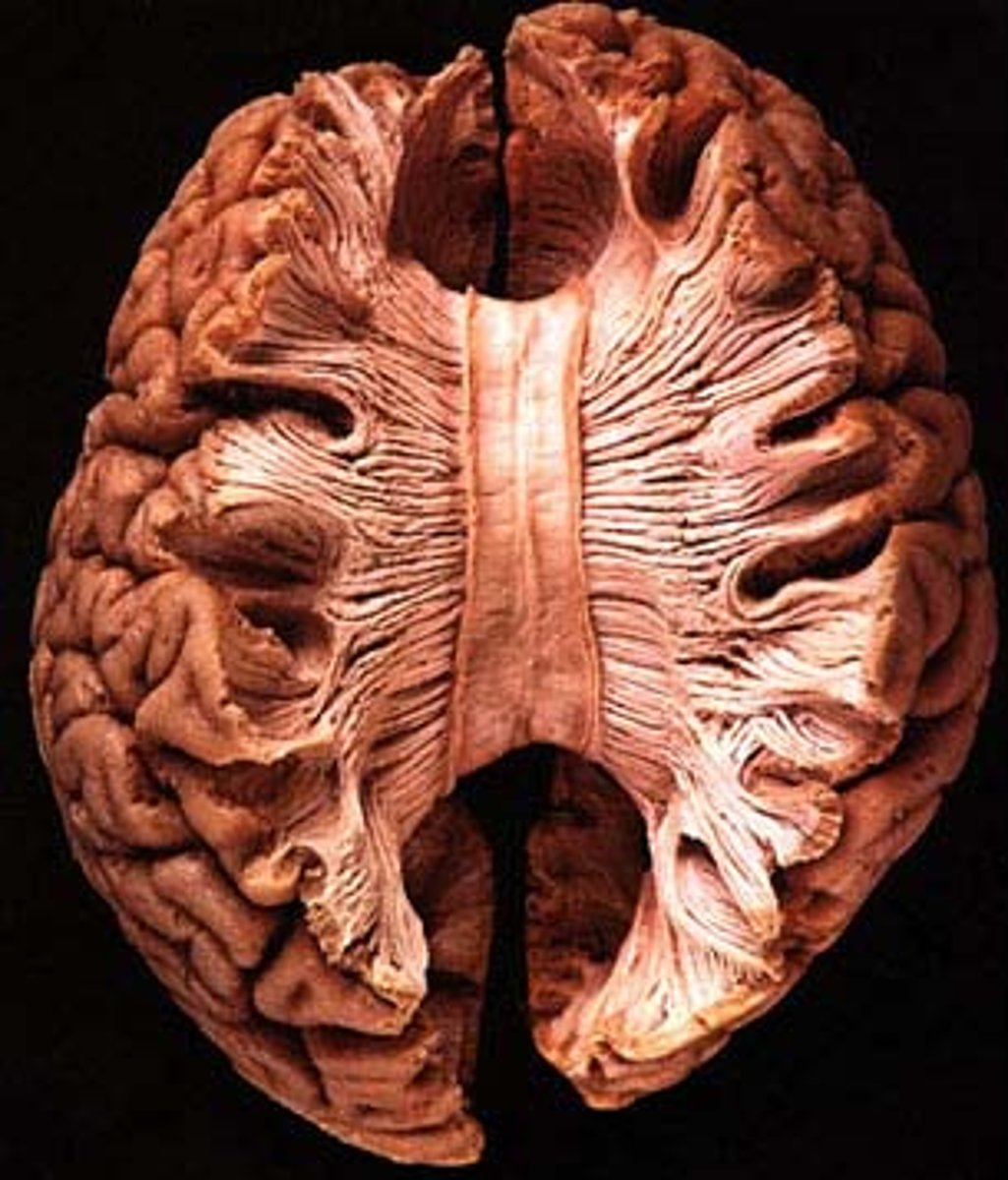
On the same level as the corpus callosum is the main information highway of emotion, the __________. This central highway seems to be involved with the summation and integration of emotion and thinking in preparation for final input to the hypothalamus, a central integrating station.
the _______ facilitates an integration from higher (thinking and emotion) to lower (the hypothalamic nuclei) brain regions.
Cingulum
** this is larger in women
REWARD tract
The various tracts (mesocortical and mesolimbic tracts) involved in the processing of pleasurable experience and reward come together in a pathway called the _____________________
This bundle of reward fibers interconnects areas of the brain involved in the mediation of emotion, learning, arousal, memory, and hormonal control. It runs between the hypothalamus and the septal region.
*****This tract has clinical importance in depression, mania, and schizophrenia. Researchers have postulated that there is a fundamental imbalance of activity between the median forebrain bundle reward system and the inhibitory (punishment) center of the brain. In mania, the pleasure centers are hypothesized to be overactive and/or the inhibitory centers, underactive. In depression, the reverse would be so.
median forebrain bundle.
PUNISHMENT tract
This tract follows a path around (peri) the fluid-filled spaces within the interior parts of the brain (the ventricles), connecting the emotional, thinking, and hormonal functions of the brain.
This is the primary inhibitory or punishment pathway in the brain; activation of this pathway seems to initiate avoidance behaviors.
This tract is in balance with the reward tract, mentioned above. Together they modulate varying degrees of excitation and inhibition of behavior in various areas of the brain involved in learning, emotion, arousal, and hormonal activation.
The Periventricular System
reinforcement
These two pathways carry information between a part of the brain stem called the mid (meso) brain and the limbic system and frontal lobes of the brain, respectively.
The pathways that appear most involved in reinforcement are the mesolimbic and mesocortical pathways.
These two pathways join to pass through the median forebrain bundle. Abnormal function of nerve cells in these two tracts has been implicated in the positive symptoms of schizophrenia, such as hallucinations (mesolimbic tract), and the deficit symptoms, such as flat affect (mesocortical).
Mesolimbic and Mesocortical Tracts
kernel-like aggregates of nerve cells, which are the hub of specialized functions
The brain has numerous ___________, all of which are involved in a complex network of communication. Certain nuclei have been identified as having a clear role in specific clinical states.
nuclei
The purpose of the _____________ is to gather information necessary to understand, diagnose, and treat the client.
psychiatric interview
echopraxia (a mimicking of the interviewer's behavior), catatonia (statue-like immobility), and waxy flexibility (when limbs can be moved by the interviewer into positions that the client maintains)
this would be documented under what section of the mental status examination
Behavior and general appearance
Observe for evidence of dysarthria (physical difficulty in vocalizing), echolalia (the repetition of the interviewer's words), perseveration (the repetition of the same words or themes), aphasia (difficulties in understanding or producing speech), and other disorders or oddities of speech.
this would be documented under what section of the mental status examination
Speech
We ask the patient about DELUSIONS in what section of the mental status examination
Thought content
intrusive thoughts or ideas that the client recognizes as "crazy" but act in accordance with anyway
obsessions
delusions involving death or destruction
nihilistic delusions
delusions involving bodily concerns
somatic delusions
believing that benign environmental occurrences relate to or have special meaning for the client
referential delusions
true or false
The validity of delusions should not be questioned by the interviewer; such questioning is ineffective in changing the client's beliefs and often causes alienation and anger
true
evaluation of suicidal and homicidal thoughts are under what section of the MSE
thought content
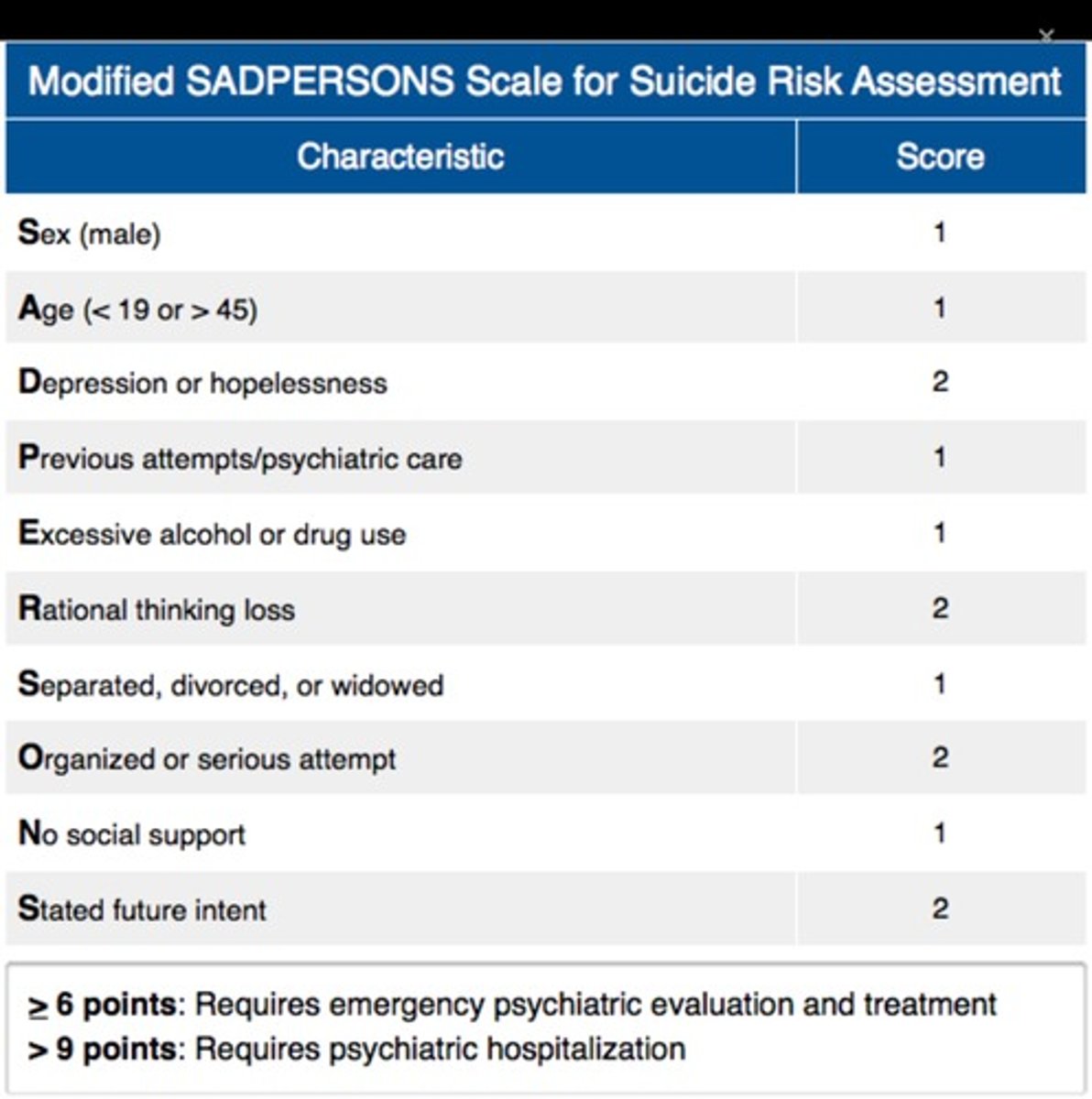
what scale can be used to evaluate suicide risk
SADPERSONS
S sex male
A age <19 or >45 D depression
P previous attempt
E ethanol
R rational thinking loss
S social supports lacking
O organised plan N no partner
S sickness
**Score one point for each factor Use calculated score to help determine outcome
0-2 home with appropriate follow up
3-6 admit or discharge with appropriate follow up
7-10 admit to hospital
illogical , difficult to follow shifting of ideas
loose associations
when client wanders from the subject at hand to a related one and is unable to come back to the original topic
Tangential thinking
Tangential thinking is noted under which section of MSE?
THOUGHT PROCESS
completely nonsensical combination of words
word salad
made up words
neoglisms
loose associations, tangential thinking, word salad, and neoglisms often indicate what????
Schizophrenic disorders.
demonstrated by clients who get lost in details but eventually return to the relevant thought
Circumstantial thought
occurs when thinking process stops altogether and the mind goes "blank"
thought blocking
involves pressures speech with rapid topic changes, the topics may be associated but in a strange way
flight of ideas
often seen in mania
fabrication of information to fill in our memory gaps
confabulation - often indicated dementia.
A client with a ________thought process as opposed to an abstract thought process is only able to understand conversations literally.
concrete
A client's ability to think abstractly may be ascertained by assessing the client's interpretation of a proverb such as "people in glass houses should not throw stones"
Concrete thought is common in clients with schizophrenic disorders. A concrete thought process is not pathological when exhibited by children, however, who developmentally may not have the capacity for abstract thought until early adolescence
are misinterpretations of true stimuli. An example is when a curtain in a dark room is mistaken for a person
illusions
common in delirium
illusions and hallucinations are documented/assessed under what section of the MSE
perceptual disturbances
defined as sensations experienced by the client without real external stimuli
hallucinations
documented under perceptual disturbances
what are the most common type of hallucination
auditory
the more unusual hallucinations such as visual, gustatory, olfactory, and tactile hallucinations may indicate what??
medical illness or substance intoxication or withdrawal
false sensory perceptions that occur while falling asleep
hypnagogic hallucinations
false perceptions that occur while waking from sleep
hypnopompic hallucinations
is a perceptual difficulty in which the client feels unreal, dead, or mechanical
depersonalizaiton
he sensation that the outside world is unreal
derealization
True or False:
Hypnagogic and hypnopompic hallucinations, derealization, and depersonalization are considered within the normal range of experience and are not considered pathologic unless they cause undue distress or problems with daily functioning.
True.
the ability to delay, modulate, or inhibit the expression of behaviors and feelings
impulse control
clues to the client's ability to control their impulses are found in the _______ and ______ of the general interview
thought content and process
A client who describes a recent history of binge drinking and indiscriminate sexual contacts has ______ impulse control
poor impulse control
accessing the client's ability to control impulses is an integral part of determining potential for acting on _______ and ______ thoughts
suicidal and violent thoughts
level of consciousness , orientation, concentration and memory are assessed under what section of the MSE?
Cognition and Sensorium
the capacity to identify possible course of action, anticipate their consequences, and choose the appropriate behavior
judgement
evaluate judgment with the "stamped envelope" scenario.
the extent of the client's awareness of illness and maladaptive behaviors.
insight
what are the sections of the MSE?
1. Appearance
2. Attitude
3. Behavior
4. Speech
5. Affect
6. Mood
7. Thought Process
8. Thought Content
9. Perception
10. Orientation
11. Memory/ Concentation
12. Insight / judgement
________ develops when the client experiences feelings toward the nurse/therapist that were originally held toward significant others in his or her life.
When this occurs, these feelings become available for exploration with the client.
Transference
***This exploration helps the client better understand certain feelings and behaviors
_________ is the advance practice psychiatric mental health nurse's unconscious, personal response to the client.
Ex: is the client reminds the nurse of someone the nurse does not like, the nurse may unconsciously react as if the client were that individual
Countertransference
what are the three phases of Hildegard Pepleu's interpersonal relations in nursing?
1. Orientation / Identification Phase.
2. Working / Exploitation phase
3. Termination Phase
In this phase of Peplau's nurse-client relationship theory, the nurse-client
Establish:
Rapport & Trust
Set parameters of the relationship (Time frame)
Purpose of the meeting
Formal or informal contract - spells out the participation & responsibilities of both parties
Confidentiality
Termination begins
First phase - orientation / identification phase
What phase of Peplau's nurse-client relationship theory does this activity fall into?:
Maintain relationship
Gather further data
Promote clients:Problem-solving skills, Self-esteem, Use of language
Facilitate behavioral change
Overcome resistance behaviors
Evaluate problems & goals - Redefine them as necessary
Promote practice & expression of alternative adaptive behaviors
Working/Exploitation phase
What phase of Peplau's client-nurse relationship theory does this fall into?:
Deal with intense feelings regarding the experience
Summarize goals & objectives achieved
Evaluates outcome attainment
Review client's plans for future
Finalize termination
Termination phase
Holistic treatment that relies on the nurse's processing of that the patient is experiencing
pscyhotherapy
True or false
The use of touch may only be considered after taking in the client's social, cultural, and moral views into account. It should not be the first approach taken by the PMH-APRN in clinical situations.
true
in a SOAPIE/SOAPIER note, what does I, E, and R stand for?
I = implementation of consideration of the services to be provided
E = the evaluation of service provision
R = response to diagnostic process, treatment planning, and intervention efforts
this is an assessment tool/scale used to assess depression.
DSM-IV depression diagnostic criteria with other leading major depressive symptoms into a brief self-report tool.
a multipurpose instrument for screening, diagnosing, monitoring and measuring the severity of depression
PHQ-9 scale
8. The nurse shows an understanding of the appropriate use of nursing outcomes regarding
triggers for a patient diagnosed with chronic alcohol abuse when stating:
a. Can you work on identifying three situations that cause you to abuse alcohol?
b. Ill help you to identify three triggers for your drinking during todays session.
c. Im pleased youve identified three situations that trigger your abuse of alcohol.
d. Do you think you will be able to avoid the three triggers that cause you to drink?
C. i'm pleased you identified three situations that trigger your abuse of alcohol
9. When a patient experiencing acute depression asks what the difference is between a medical
and a nursing diagnosis, the nurse responds best when stating:
a. Actually they are very similar in that they both are concerned with helping you get better and lead a happier life.
b. Medical diagnoses are focused on why you are depressed whereas nursing diagnoses are concerned about making your life less sad.
c. Nursing diagnoses are more directed at caring for you, unlike medical diagnoses that focus on finding the cause for your problem.
d. The medical diagnosis identifies that you are experiencing depression whereas the nursing diagnosis identifies how the depression is affecting you.
D. the medical diagnosis identifies that you are experiencing depression whereas the nursing diagnosis identifies how the depression is affecting you