Male Repro Physiology
 Call Kai
 Learn
Learn Practice Test
 Spaced Repetition
 Match
Match Flashcards
 Knowt Play
1/109

There's no tags or description
Looks like no tags are added yet.
Name | Mastery | Learn | Test | Matching | Spaced | Call with Kai |
|---|
No analytics yet
Send a link to your students to track their progress
110 Terms
What is the role of the male reproductive system?
production of gametes (sperm) and secretion of testosterone
What is the male gamete?
spermatozoa (sperm)
What forms the zygote?
sperm penetrates zona pellucida of the egg via acrosomal reaction
What is the primary male sex organ?
testes
What are the secondary male sex organs?
epididymis, vas deferens, seminal vesicles, ejaculatory ducts, prostate gland, bulbourethral glands
What makes up the male external genitalia?
penis and scrotum
What makes up the male internal genitalia?
testicles, epididymis, vas deferens, ejaculatory duct, prostate gland, seminal vesicles, bulbourethral glands
What are male secondary sex characteristics?
facial, pubic, and axillary hair growth
increase in size of larynx leads to lower voice
increased muscle mass and male pattern hair distribution
What is genetic sex?
XY for males and XX for females
What is the role of the SRY gene?
triggers testes development at week 7 in males
absence results in ovaries at week 9
What is gonadal sex?
defined by presence of testes or ovaries
What is made by male germ cells?
spermatogonia
What is phenotypic sex?
defined by physical characteristics of internal and external genitalia
At what point in development are male and female genitalia formed?
week 12
What is the anatomical destination of the pair of labioscrotal folds in males and female?
scrotum in males
labia majora and mons pubis in females
What is the anatomical destination of the pair of urogenital folds in males and female?
penis in males
labia minora in females
What is the anatomical destination of the genital tubercle in males and female?
gland of penis in males
clitoris in females
What are the male and female homologous structures?
glans of penis and clitoris
penis and labia minora
scrotum and labia majora and mons pubis
How do the internal ducts develop?
testes make testosterone —> testosterone triggers Wolffian duct growth and male external genitalia —> Wolffian ducts develop into male structures
What is the fate of Wolffian (Mesonephric) Ducts in males?
triggered by testosterone to become epididymis, vas deferens, seminal vesicles, and ejaculatory ducts
What is the fate of Mullerian (Paramesonephric) Ducts in males?
degenerate due to AMH released from Sertoli cells
What leads to external genitalia development in males?
dependent on conversion of testosterone to dihydrotestosterone and functional androgen receptors
How do male gonads descend?
testes migrate from abdominal cavity through inguinal canal into scrotum
guided by gubernaculum and requires testosterone
What is the most common site of hernias in males?
inguinal canal
What are the individual structures that pass into the scrotum with descent?
testes, testicular vessels, lymphatic vessels, nerves, and spermatic ducts
When in development do the testes descend?
starts at week 6, completes by month 7
What is cryptochordism?
undescended testes
What can result from uncorrected cryptochordism?
sterility or testicular cancer
What is adrenarche?
increased adrenal androgens starting at age 6-8, leads to pubarche
What hormones are involved in adrenarche?
DHEA, DHEAS, androstenedione
What is DHEA?
dehydroepiandrosterone
What is DHEAS?
dehydroepiandrosterone sulfate
What physical changes occur in gonadarche?
growth and maturation of genitals, secondary sex characteristic formation, growth spurt, spermarche
What is spermarche?
initiation of sperm production in testes
What hormones are involved in gonadarche?
increased FSH and LH release
How does GnRH change with puberty?
GnRH secretion is pulsatile, which causes pulsatile FSH and LH
GnRH receptors are unregulated and have increased sensitivity
How does the LH/FSH ratio change with puberty?
LH levels become higher than FSH during adult reproductive period
How does REM sleep impact puberty?
large pulses of LH is released
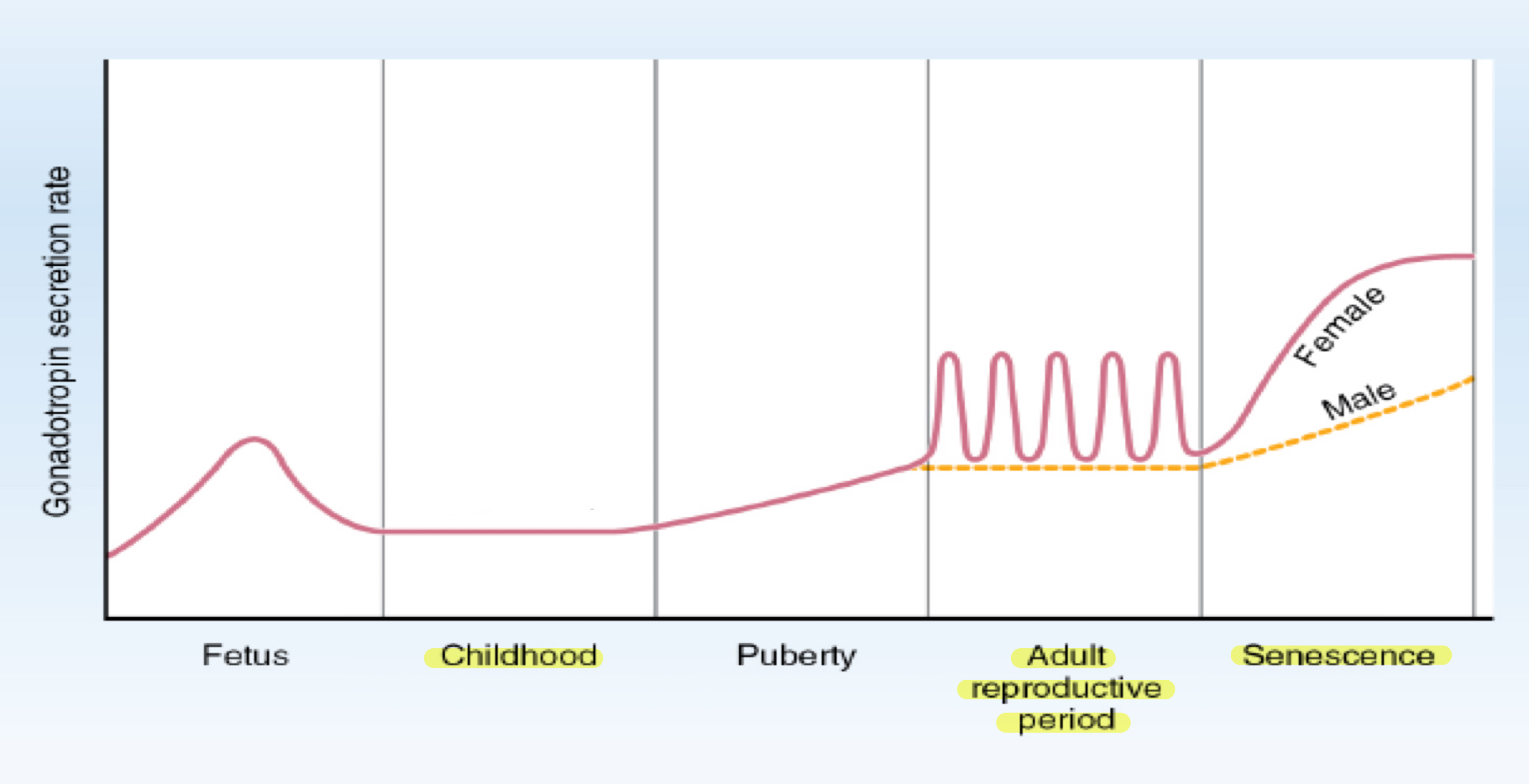
What is the relationship between FSH and LH in childhood?
FSH > LH
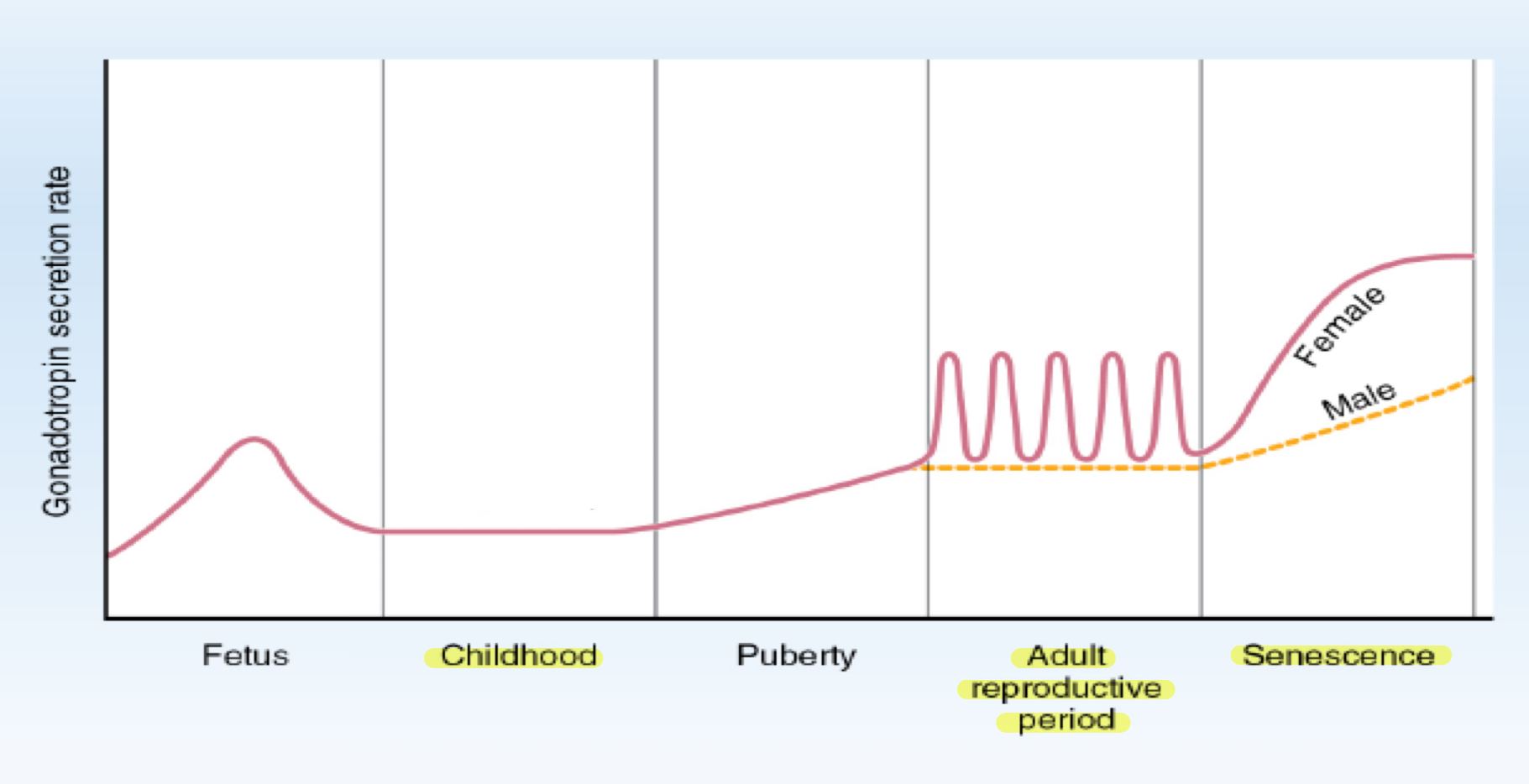
What is the relationship between FSH and LH in the adult reproductive period?
LH > FSH
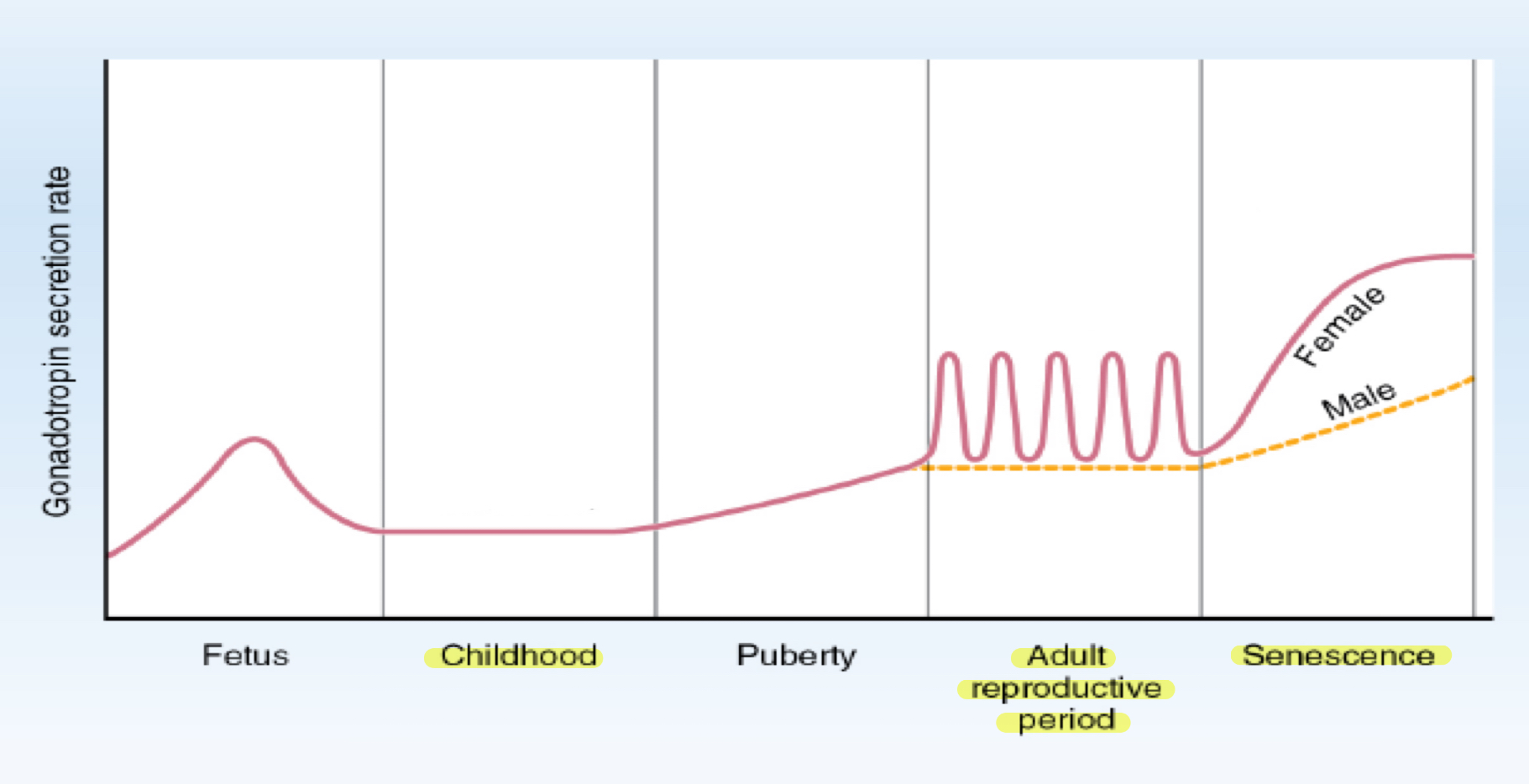
What is the relationship between FSH and LH after the adult reproductive period ends?
FSH > LH
What pubic hair is seen in Tanner stage 1?
no pubic hair is present, only vellus hair
What pubic hair is seen in Tanner stage 2?
pubic hair is sparse, mainly at base of penis or along labia majora
What pubic hair is seen in Tanner stage 3?
pubic hair is darker, coarser, curlier, and spreads above the pubis
What pubic hair is seen in Tanner stage 4?
adult type, but covers an area smaller than in most adults
What pubic hair is seen in Tanner stage 5?
adult pattern
What male genital development is seen in Tanner stage 1?
penis, scrotum, and testes are the same size and relative to body size
What male genital development is seen in Tanner stage 2?
scrotum and testes are enlarged
What male genital development is seen in Tanner stage 3?
penis is enlarged, predominantly in length
scrotum and testes are further enlarged
What male genital development is seen in Tanner stage 4?
penis is further enlarged in length and diameter, scrotum and testes are further enlarged
What male genital development is seen in Tanner stage 5?
adult pattern
What female breast and genital development is seen in Tanner stage 1?
only papillae are elevated
What female breast and genital development is seen in Tanner stage 2?
breast buds begin to develop, breasts and papillae are both elevated, areolar diameter increases
What female breast and genital development is seen in Tanner stage 3?
breasts and areola further enlarge
vagina enlarges and begins producing a discharge, menstrual period may begin
What female breast and genital development is seen in Tanner stage 4?
areola and papillae project outward beyond level of breast tissue
menstruation and ovulation begin, likely to be irregular
What female breast and genital development is seen in Tanner stage 5?
further breast enlargement, areola on same level as the rest of the breast, only papillae project
adult pattern
What is the role of the scrotum?
maintains testes at optimal temperature of 2C lower than body temperature
How is temperature of the testes regulated?
facilitated by cremaster and dartos muscle
countercurrent heat exchange in testicular vessels
What is the role of the seminiferous tubules?
specific site of sperm production
What is the spermatic cord?
passes through the inguinal canal and contains testicular vessels, lymphatic vessels, nerves, and the vas deferens
What is the role of the epididymis?
site of sperm maturation and storage
What is the role of the vas deferens?
transports sperm from epididymis to urethra via ejaculatory duct in sexual arousal
What is the role of the ampulla of the vas deferens?
stores sperm and secretes citrate and fructose
What forms the ejaculatory duct?
union of vas deferens and duct of seminal vesicle
What is the role of the ejaculatory duct?
carries semen to the urethra
What is the role of the testes?
produce sperm in tubules and testosterone in Leydig cells
Where are Leydig cells located?
between seminiferous tubules
What is the role of Leydig cells?
produce testosterone in response to LH in the testes
What is the role of Sertoli cells?
act to phagocytose excess cytoplasm made in spermiogenesis
maintain environment for sperm
secrete fluid to aid in sperm transport
What is the Blood Testes Barrier?
formed by tight junctions between Sertoli cells to protect developing gametes from the immune system
What hormones are secreted by the Sertoli Cells?
androgen binding protein, inhibin, AMH, and estrogen
What is the role of inhibin in men?
inhibits FSH
What is the role of androgen binding protein?
concentrates testosterone in proximity of developing gametes
What is spermatogenesis?
process of sperm production in seminiferous tubules over 64-74 days
What are spermatogonia?
stem cells that divide via mitosis to form primary spermatocytes
What are primary spermatocytes?
undergo meiosis I to form spermatocytes
What are secondary spermatocytes?
undergo meiosis II to form haploid spermatids
What is spermiogenesis?
differentiation of spermatids into mature spermatozoa
What makes up semen?
fructose, citrate, prostaglandins, calcium, alkaline mucus, and enzymes
sperm
What triggers semen secretion?
sympathetic impulses during emission phase, causing prostate and seminal vesicles to contract
What is the role of the prostate gland?
secrete alkaline milky fluid to neutralize vaginal acidity
What is in the fluid secreted by the prostate?
fibrinolysin and prostate specific antigen
What is the role of fibrinolysin?
liquefy semen and increase motility
What is the role of prostate specific antigen?
used as cancer marker
What is the role of the seminal vesicles?
produce majority of seminal fluid
What is in seminal fluid from the seminal vesicle?
citrate and fructose, prostaglandins, and fibrinogen
What is the role of citrate and fructose in seminal fluid?
sperm nourishment
What is the role of prostaglandins in seminal fluid?
sperm motility and increases penetrability of cervical mucus
What is the role of fibrinogen in seminal fluid?
sperm clumping in vagina
What is the role of Bulbourethral (Cowper’s) Glands?
secrete alkaline mucus for lubrication and pH neutralization before ejaculation
What mediates erection?
pudendal nerve of parasympathetic nervous system
What mediates emission?
sympathetic nervous system via T12-L2
What triggers ejaculation?
sympathetic nervous system spinal reflex triggered by semen in urethra
What occurs in the erection phase?
increased mucus secretion from urethral and bulbourethral glands
nitric oxide or VIP is released —> cGMP forms
penile arteries relax and corpora cavernosa and corpus spongiosum engorge
What occurs in the emission phase?
contraction of vas deferens and accessory glands to move semen into urethra with seminal fluid
What occurs in the ejaculation phase?
rhythmic contractions of ischiocavernosus and bulbocavernous muscles expel the semen
What is capacitation in fertilization?
removal of inhibitory factors from seminal fluid
withdrawal of cholesterol from the sperm
redistribution of sperm surface proteins
What causes capacitation in fertilization?
acrosomal reaction between sperm and ova
What releases GnRH?
arcuate nuclei of hypothalamus
What is the role of GnRH in the HPG axis?
stimulates anterior pituitary to release LH and FSH