Alkenes
 Call Kai
 Learn
Learn Practice Test
 Spaced Repetition
 Match
Match Flashcards
 Knowt Play
1/46

Earn XP
Description and Tags
Name | Mastery | Learn | Test | Matching | Spaced | Call with Kai |
|---|
No analytics yet
Send a link to your students to track their progress
47 Terms
Give the general formula of alkenes containing one double bond.
CnH2n
What are alkenes?
Unsaturated hydrocarbons (containing at least one C=C double bond).
True or false? Alkenes can undergo addition reactions.
True.
Why can alkenes undergo addition reactions?
They are unsaturated.
Why are alkenes quite reactive?
Their double bonds are very electron dense making them quite reactive.
True or false? Alkenes attract nucleophiles.
False. ALKENES ATTRACT ELECTROPHILES.
Why do alkenes attract electrophiles?
Due to their electron dense C=C double bond.
What is an electrophile?
An electron pair acceptor as they are deficient in electrons.
What two types of species can be electrophiles?
Positively charged ions.
Delta + atoms.
What can you use to test for alkenes? What is the positive result for this test?
Bromine water. If an alkene is present the bromine water will be decolourised (from orange-brown to colourless).
Give the general word equation for the reaction between an alkene and bromine.
Alkene + bromine → dibromoalkane
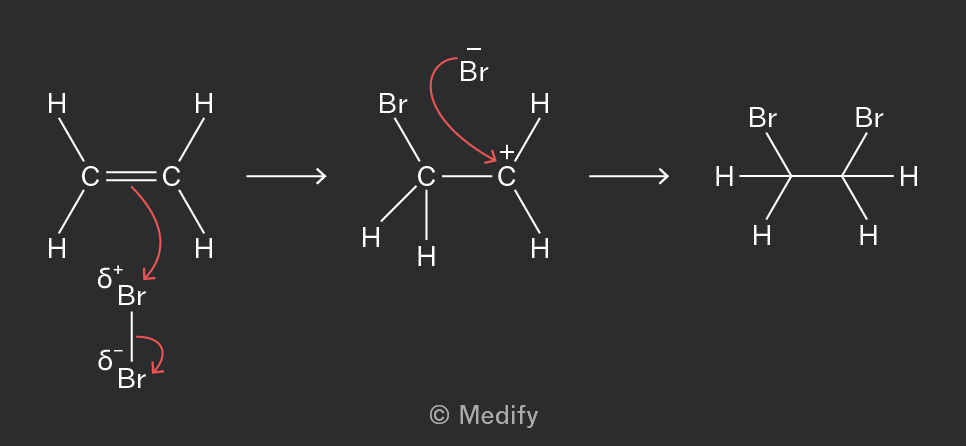
Talk me through the reaction between ethene and bromine.
1) The bromine molecule is polarised as it approaches the ethene due to the double bond in ethene repelling the electrons (the bromine atom further away from the ethene becomes delta negative and the bromine atom nearer the ethene becomes delta plus).
2) An electron pair in the C=C bond is attracted to the delta plus bromine so they form a bond, breaking the C=C and Br-Br bond.
3) A carbocation intermediate is formed, it is attracted to the remaining bromide ion, forming a dibromoethane.
Draw the reaction mechanism for the reaction between ethene and bromine. Name this mechanism.
Electrophilic addition.
Give the general word equation for the reaction between alkenes and hydrogen halides.
Alkene + hydrogen halide → halogenoalkane
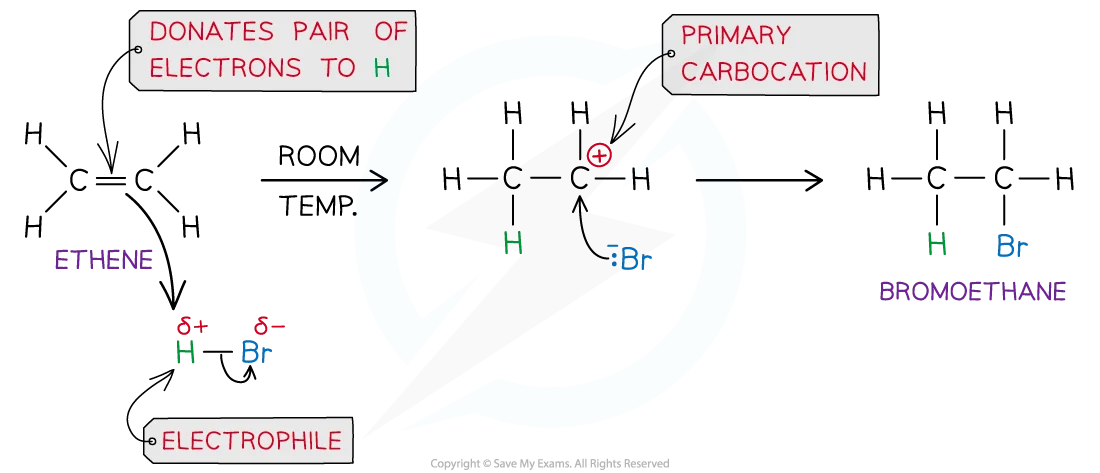
Name the reaction mechanism for the reaction between an alkene and a hydrogen halide.
Electrophilic addition.
Describe how hydrogen halides are polarised.
Delta plus hydrogen, delta minus halogen.
Draw the reaction mechanism for the reaction between ethene and hydrogen bromide.
True or false? Reacting unsymmetrical alkenes with hydrogen halides produces a mixture of two products.
True.
How is the amount of each of the two products formed determined when reacting unsymmetrical alkenes with hydrogen halides?
The stability of each carbocation intermediate formed during the reaction mechanism.
True or false? The more alkyl groups in the carbocation, the less stable the carbocation.
False. THE MORE ALKYL GROUPS IN THE CARBOCATION, THE MORE STABLE THE CARBOCATION.
Why do alkyl groups in a carbocation make the carbocation more stable?
Alkyl groups push electrons (inductive effect) towards the positively charged carbocation, which helps stabilise it’s positive charge.
True or false? The more stable the carbocation, the more likely it is to form.
True.
Draw the displayed formula of a primary carbocation.
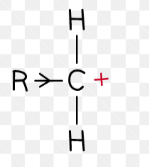
Draw the displayed formula of a secondary carbocation.
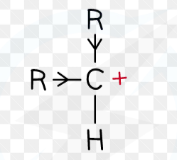
Draw the displayed formula of a tertiary carbocation.
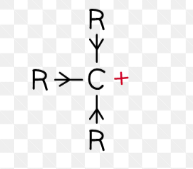
Order secondary, tertiary, primary carbocations from most stable to least stable.
Tertiary carbocation → secondary carbocation → primary carbocation
When an unsymmetrical alkene reacts with a hydrogen halide, which of the two products will be the major product?
The product derived from the most stable of the carbocations formed during the reaction.
What is the intermediate formed when alkenes react with cold, concentrated sulfuric acid?
Alkyl hydrogen sulfates
What conditions are needed to form alkyl hydrogen sulfates (as intermediates) from alkenes and sulfuric acid?
Sulfuric acid must be cold.
Sulfuric acid must be concentrated.
What is the catalyst when making an alcohol from an alkene?
Sulfuric acid (H2SO4).
Draw the displayed formula of sulfuric acid.

Draw and name the reaction mechanism between ethene and sulfuric acid to form an ethyl hydrogen sulfate.
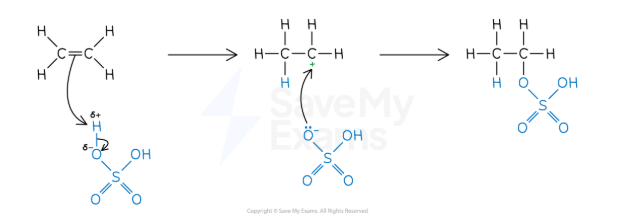
Electrophilic addition.
How do you form alcohol from alkyl hydrogen sulfates? What is the name of this process?
Add cold water to warm alkyl hydrogen sulfates. Hydrolysis.
Draw the displayed formula for the reaction of the hydrolysis of ethyl hydrogen sulfate.
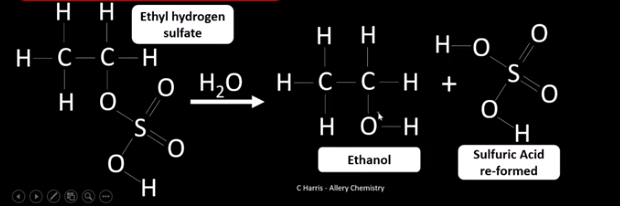
True or false? Alkenes are monomers that can join to form addition polymers.
True.
Draw the repeat unit of poly(propene).
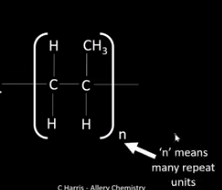
True or false? Poly(alkenes) are unsaturated molecules.
False. POLY(ALKENES) ARE SATURATED MOLECULES.
Why are poly(alkenes) so unreactive?
The contain stable, non-polar bonds and they are saturated which make them unreactive.
Which intermolecular forces exist between poly(alkenes)?
Van der Waals intermolecular forces.
As poly(alkene) chain length increases, strength of Van der Waals…
increases.
Why do more branched and shorter polymer chains tend to be weaker?
They cannot pack as tightly together and have weaker Van der Waals intermolecular forces.
What is the IUPAC name of PVC?
Poly(chloroethene).
Why is PVC stronger than most other poly(alkenes)?
PVC contains a halogen bonded to a carbon which is a polar bond meaning PVC chains form both Van der Waals and dipole-dipole intermolecular forces between one another, which require more energy to overcome.
What do plasticisers do?
Make polymers more flexible.
How do plasticisers make polymers more flexible?
Plasticisers slide in between the polymer chains, separating them, weakening the Van der Waals intermolecular forces between chains, and allowing chains to slide over each other making the polymer softer and more flexible.
Give one use of PVC without plasticisers.
Material that makes drain pipes.
Give two uses of PVC when it has been mixed with plasticisers.
Cable insulation.
Clothing.