3. Unemployment, Inflation, Consumption, Investment
 Call Kai
 Learn
Learn Practice Test
 Spaced Repetition
 Match
Match Flashcards
 Knowt Play
1/66

There's no tags or description
Looks like no tags are added yet.
Name | Mastery | Learn | Test | Matching | Spaced | Call with Kai | Chat |
|---|
No analytics yet
Send a link to your students to track their progress
67 Terms
Define the labour force.
The labour force consists of:
employed workers
unemployed workers actively searching for work
It excludes economically inactive individuals.
What is cyclical unemployment?
Unemployment caused by short-run fluctuations in economic activity and aggregate demand.
What is the Natural Rate of Unemployment (NRU)?
The unemployment rate that would prevail in the absence of cyclical unemployment. Consists of structural and frictional unemployment
What determines equilibrium employment in the classical labour market model?
Equilibrium occurs when:
LS=LD
Labour supply equals labour demand.
What does the classical labour market model predict about unemployment?
The market-clearing wage eliminates excess labour supply. Where Ls=Ld there is no involuntary unemployment
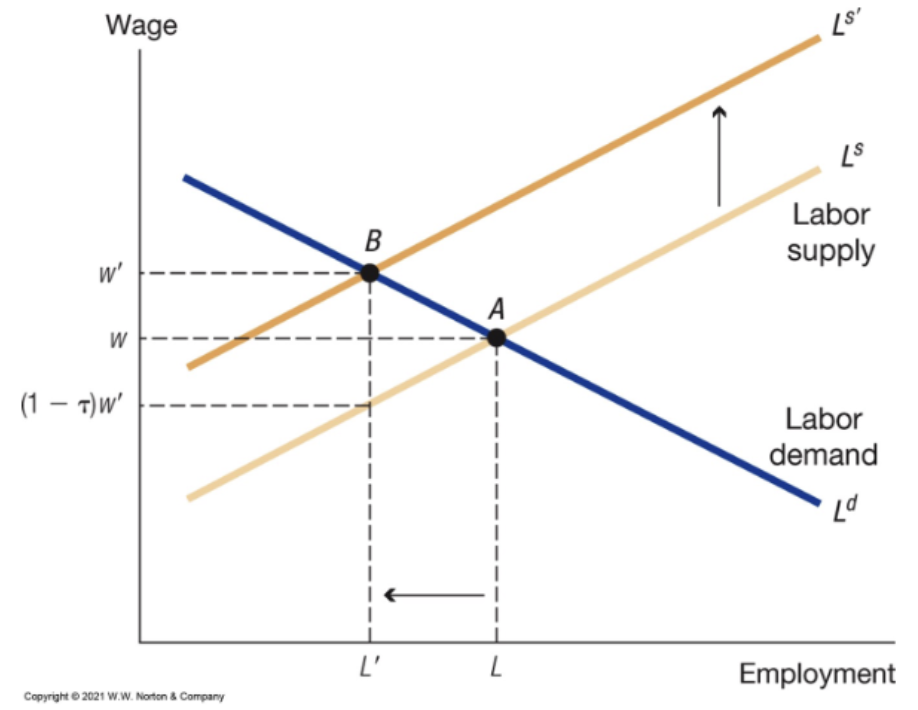
What happens when a tax is imposed on labour income?
Workers receive a lower after-tax wage. Labour supply falls. The labour supply curve shifts upward/leftward.
What is wage rigidity?
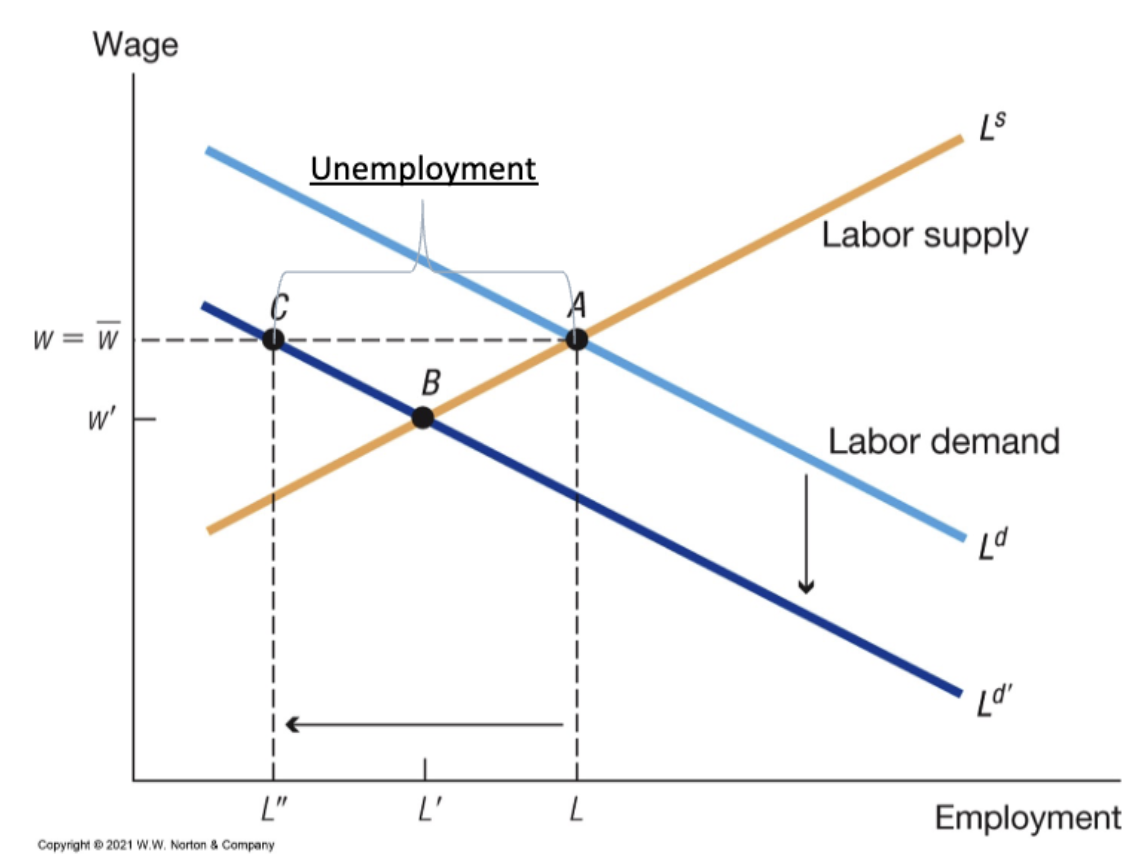
A situation where wages remain above the market-clearing level and do not adjust downward sufficiently.
Why does wage rigidity create unemployment?
If wages exceed the market-clearing level:
Ls>Ld
More people want jobs than firms want to hire. The result is involuntary unemployment.
Wage rigidity diagram: where is unemployment shown? (following a fall in Ld)
Why do labour demand shocks generate large employment fluctuations when wages are rigid?
Because wages cannot adjust to restore equilibrium. Adjustment occurs through employment instead.
What are the three major causes of wage rigidity?
Trade unions and collective bargaining.
Minimum wage laws.
Efficiency wages.
What is efficiency wage theory?
The theory that firms voluntarily pay wages above market-clearing levels because higher wages increase worker productivity. Higher wages may:
reduce shirking (moral hazard),
attract better workers (adverse selection),
reduce turnover,
improve worker health.
Why can't wages simultaneously clear the labour market and provide efficiency incentives?
The wage needed to maximise productivity may exceed the market-clearing wage.
What are the two endogenous variables in the Bathtub Model?
Et → Employment
Ut → Unemployment
What is the job separation rate?
s → The probability an employed worker loses their job.
What is the job finding rate?
f → The probability an unemployed worker finds a job.
State the labour-force identity in the Bathtub Model.
Et + Ut = L
Employment plus unemployment equals the labour force.
State the law of motion for unemployment in the Bathtub Model.

What condition characterises steady-state unemployment?
Inflow into unemployment equals outflow from unemployment.
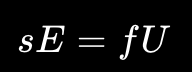
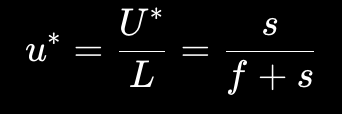
State the formula for steady-state unemployment.
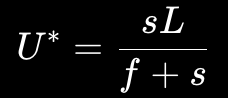
State the formula for the natural rate of unemployment in the Bathtub Model.
Define inflation
Inflation is:
a general increase in the price level,
a fall in the purchasing power of money.
What is expected inflation?
Inflation that households and firms correctly anticipate.
Its costs include:
shoe-leather costs,
menu costs,
relative price distortions,
tax distortions.
What is unexpected inflation?
Inflation that differs from what people anticipated.
It causes:
arbitrary redistribution of purchasing power,
greater uncertainty,
all the costs associated with expected inflation.
Why might moderate inflation be beneficial?
Helps reduce real wages when nominal wages are downwardly sticky.
Gives central banks more room to reduce real interest rates.
Generates seigniorage revenue.
What is seigniorage?
Revenue obtained by the government from creating money
State the Quantity Equation.
Where:
M = money supply
V = velocity of money
P = price level
Y = real output

What is velocity of money?
The average number of times a unit of money is used in transactions during a year.
Under the Quantity Theory, what variables are exogenous?
M - the money supply
Y - real GDP
V - velocity
According to the Quantity Theory, what is the key long-run determinant of the price level?
The money supply
According to the Quantity Theory, why does inflation occur?
There is too much money chasing too few goods
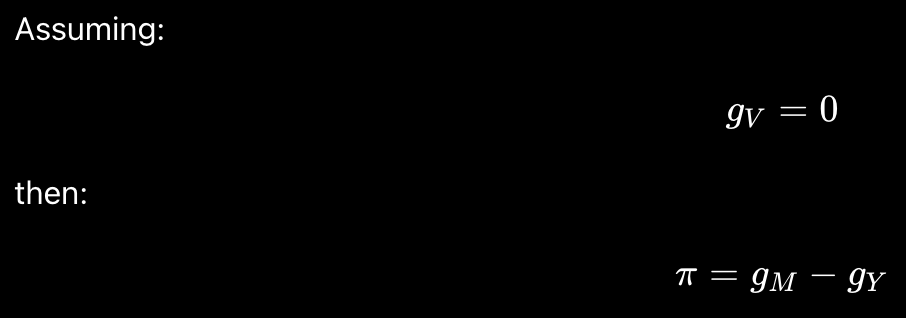
Derive the Quantity Theory expression for inflation.
Inflation equals money growth minus real output growth.
Why is the relationship between money growth and inflation stronger in the long run than in the short run?
In the short run:
velocity changes,
output changes,
prices adjust slowly.
In the long run these effects average out.
What variables explain inflation according to the Phillips Curve?
Economic activity (output gap or unemployment).
Inflation expectations.
Other factors (e.g. exchange rates).
Define the real interest rate.
The return measured in goods and services

Define the nominal interest rate.
The return measured in money
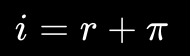
State the Fisher Equation.
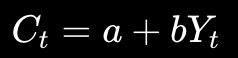
State the Keynesian Consumption Function
where:
a = autonomous consumption (the minimum level of essential spending that households must make even when they have zero disposable income)
b = marginal propensity to consume (MPC)
Yt = disposable income
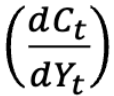
Define the marginal propensity to consume (MPC).
Measures how much consumption changes in response to changes in income
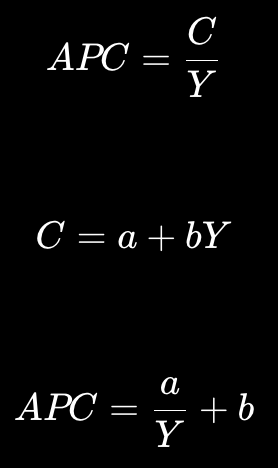
Define the average propensity to consume (APC).
The percentage of total income that a household or economy spends on goods and services rather than saving
How does APC vary with income in the Keynesian model?
APC falls as Y rises
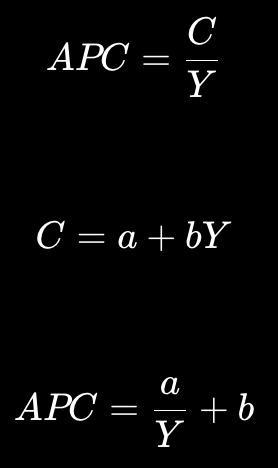
Why was the prediction that APC falls with income considered a failure of the Keynesian consumption function?
It predicts that over time richer economies should consume a smaller fraction of income and save a larger fraction.
However, Kuznets found that APC was approximately constant in the long run.
What is the key decision in the intertemporal consumption model?
How much to consume today versus how much to consume in the future.
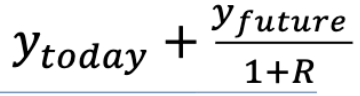
Define human wealth.
Human wealth is the present discounted value of future labour income.
What does ctoday equal in the intertemporal model?

What does cfuture equal in the intertemporal model?

State the intertemporal budget constraint.

What is total wealth in the intertemporal consumption model?

What does present discounted value of consumption equal in the intertemporal consumption model?
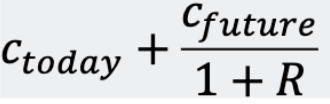
State the slope and intercepts of the consumption diagram with cfuture on the y-axis and ctoday on the x-axis
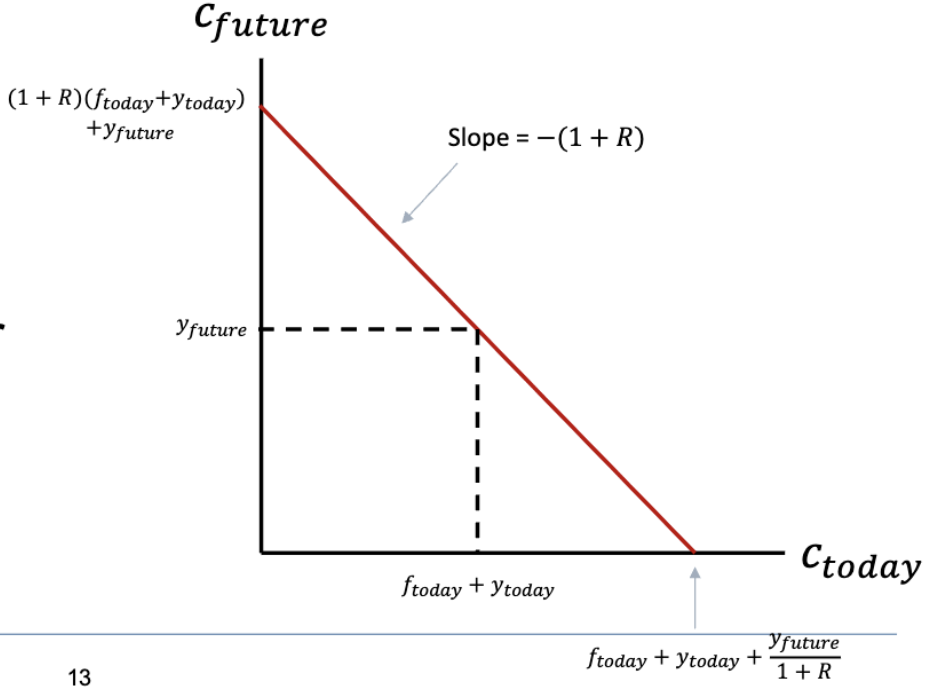
What does the discount factor β represent?
Measures the weight placed on future utility.
β=1: present and future treated equally.
β<1: future discounted.
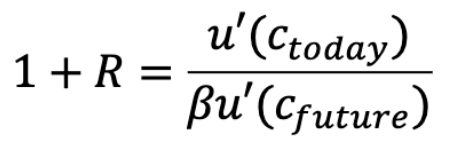
State and interpret the Euler equation
MU of consuming 1 more unit today = discounted MU of consuming 1 + 𝑅 more units in the future

What is the tangency condition for intertemporal utility max?
State the Life-Cycle Hypothesis.
Individuals smooth consumption over their lifetime by borrowing, saving, and dissaving as income changes with age.
According to the Life-Cycle Hypothesis, what happens over the life cycle?
Young: Borrow or receive transfers
Middle: save
old: dissave
Explain why the income and substitution effect for ctoday when R rises
Substitution effect: higher interest makes saving more attractive.
But Ct could also increase due to income effect: higher 𝑅 can make a saver richer, so they want to consume more in all periods
State the Permanent Income Hypothesis (PIH).
Consumption depends primarily on permanent income rather than current income.
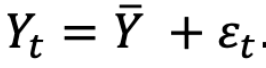
How does PIH decompose income?
where:
Ybar = permanent income
εt = transitory income
According to PIH, how does consumption respond to temporary income changes?
Only weakly. Temporary income shocks are largely saved.
What is Hall's Random Walk Hypothesis?
If expectations are rational, consumption changes only when unexpected information arrives.
Consumption therefore follows a random walk.
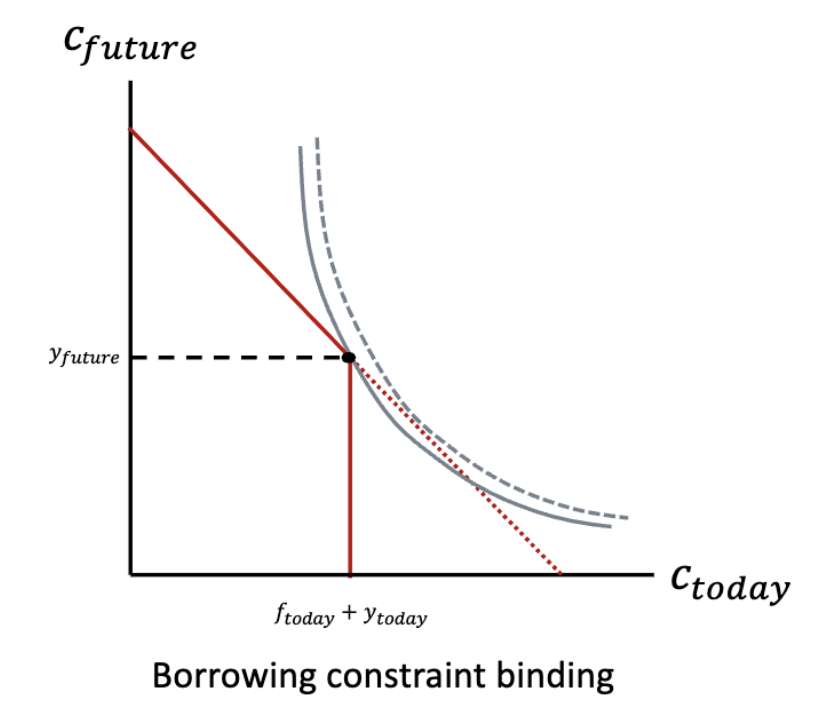
What is a borrowing constraint?
A restriction preventing households from borrowing as much as they would like.
Why do borrowing constraints make current income more important?
Households cannot smooth consumption perfectly. Consumption becomes tied more closely to current income.
Borrowing constraint diagram.
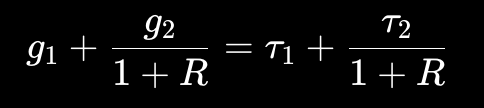
State the government intertemporal budget constraint.
What is Ricardian Equivalence?
Given government spending, the timing of taxes does not affect consumption.
A tax cut today implies higher taxes later.
Why does Ricardian Equivalence imply tax cuts may be ineffective?
Rational households save the tax cut because they anticipate future taxes.
Consumption does not rise.
Why might Ricardian Equivalence fail?
Myopia: Not all consumers think so far ahead, so see the tax cut as a windfall
Borrowing constraints: Many consumers cannot borrow enough to achieve their optimal consumption, so they rationally spend much of a tax cut
Future generations bear taxes
Proportional taxation: Affect decisions on work and investment.