Chap 9: Problems of Group Living
 Call Kai
 Learn
Learn Practice Test
 Spaced Repetition
 Match
Match Flashcards
 Knowt Play
1/49

There's no tags or description
Looks like no tags are added yet.
Name | Mastery | Learn | Test | Matching | Spaced | Call with Kai |
|---|
No analytics yet
Send a link to your students to track their progress
50 Terms
How do we explain cooperation among non-kin?
Reciprocal altruism
What is reciprocal altruism?
When an individual acts to enhance the fitness of another individual, at a cost to its own fitness, with the expectation of receiving similar treatment from them in the future
What are 2 evidences of the evolution of altruism among non-relatives?
Social exchange occurs across all human cultures, including hunter gatherer and in other species (animals)
Primates (human and non-human) engage in reciprocal helping
How could adaptations that provide benefits to non-relatives evolve?
If the delivery of benefits is reciprocated in the future (individuals take turns being giver and recipient)
Eg. meat sharing from hunting
What is the social dilemma?
Choosing between self-interest (often immediate) vs. group interest (often LT)
What is a two-person prototype that explains this social dilemma?
The Prisoner’s dilemma
What is the best group outcome (for both people)?
If both cooperate with e/o and stay silent
What is the best individual outcome?
To defect/confess
For one-shot dilemma games (game is only played once), what is the most economically rational strategy?
To defect and take as much benefits as possible
But, what is the real results?
Almost half of anonymous players make the economically irrational choice to cooperate with their partner
Why is that so?
Because people evolved to cooperate with e/o
(and in ancestral times, there was no one-shot exchange)
In games that has multiple rounds, what is the winning strategy deemed as?
Tit for tat
How does this strategy work?
In the first round, automatically cooperate
In the next round, reciprocate what the other person did in the previous round
If other cooperated previously, cooperate in the current round
If other defected previously, defect in the current round
Are there any sex differences in who is more cooperative in general?
No
In which 2 conditions are men more cooperative than women?
In male groups
In repeated interactions
In which condition is women more cooperative than men?
In mixed-sex groups
Why is there a difference in when men and women are more cooperative?
Men may have evolved to form coalitions with e/o
Women cooperate to signal kindness to potential mates
According to Axelrod, what are 5 strategies to promote cooperation in one’s life? (CTIRC)
Consider more for your future self
Teach reciprocity
Insist on equity (don’t take more than you give, on avg)
Respond quickly to provocation/defection
Cultivate reputation as a reciprocator
What is an example of an animal species that engage in cooperation?
Vampire bats
How do they cooperate with e/o?
Bats in close proximity regurgitate blood to e/o more than half of the time, especially when “friends” are close to starvation
Why have they adapted to cooperate and reciprocate?
Most bats frequently fail to obtain blood by themselves
What do baboons do when they are in conflict with another male over female sexual access?
They request help from another male baboon
What do males who request help have higher of?
Higher mating success
From whom are female vervet monkeys most attentive to calls for grooming help?
From nonkin who have previously groomed them (and only somewhat attentive to requests from kin)
What is the theory that explains the ways to enforce reciprocation and avoid cheaters?
Social contract theory
What are the 5 capacities that motivate cooperation in us and to help us deal with potential cheaters? (RRCUR)
Recognise different humans
Remember aspects of interactions with others
Communicate your values to others
Understand the specific needs of others
Represent (compare) the costs and benefits of items exchanged
How well do we identify people we haven’t seen in very long? (+ ev)
Very well, we have a recognition rate of 90+% for people we haven’t seen for up to 34 years
Which 2 aspects of interactions sticks in our memory?
Whether other person is a reciprocator or cheater
Whether one owes the other money and how much
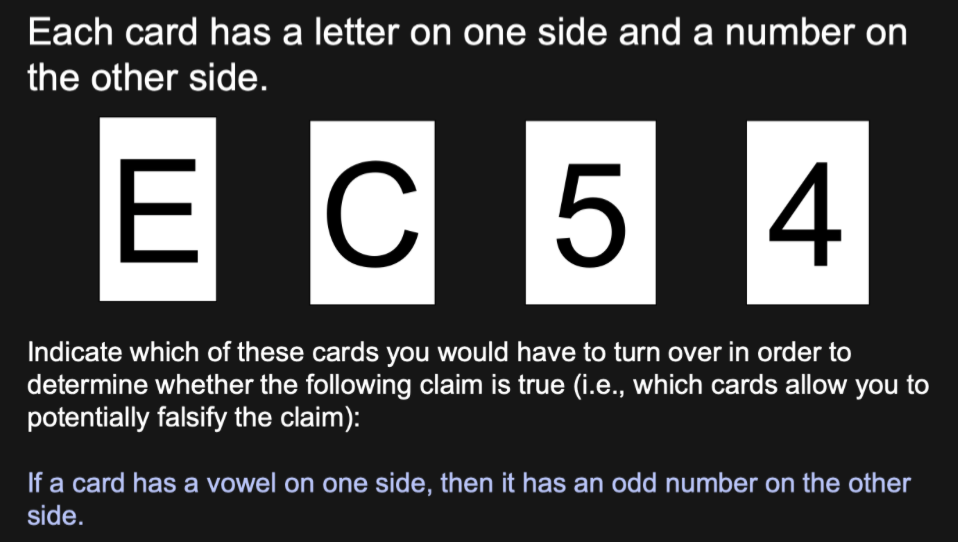
What explains why humans are bad at solving pure logic tasks? (eg. vowel and odd-even no. card selection task)
We didn’t evolve to solve pure logic problems
What did we then evolve to solve problems of?
Problems of social exchange
eg. “if you give Prof $1000, he will raise your grade by 20 points” card selection
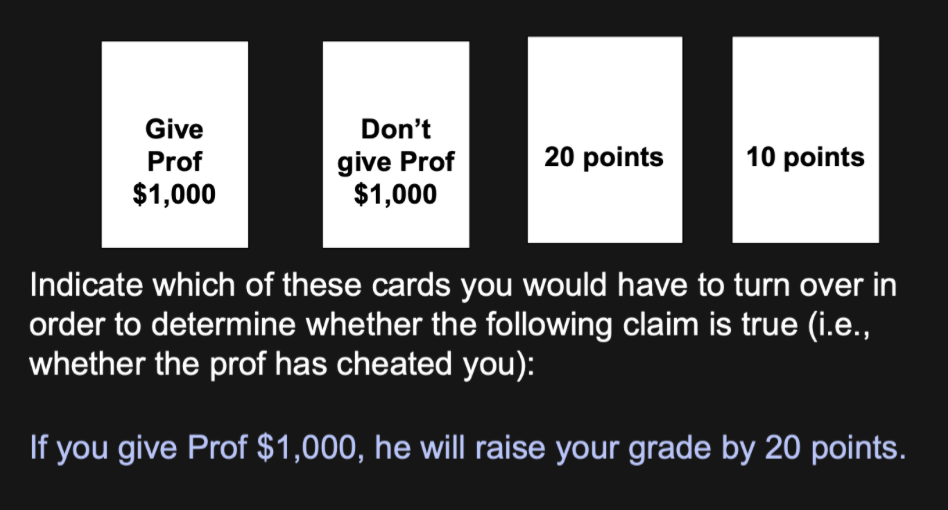
In what condition would people be able to solve logical problems?
When it is framed as a social contract, even if the rules are strange and unfamiliar
What is an evidence that proves there is a part of the brain that evaluates social contract?
People with a particular brain damage can solve problems with “precaution rules” but not social contract problems (cannot detect cheaters)
What is the outcome of these types of people?
Become susceptible to scams, exploitative r/s, and unfavourable business deals
Which 2 groups of people’s faces do we remember better?
Known cheaters (vs known cooperators)
People who defected against us in a cooperative game even if we don’t explicitly remember who
What do people who have been asked to remember when they’ve been cheated do better in?
Solving a cheater-detection problem
What does cheater detection have the same pattern as?
Cooperator (altruist) detection (people also evolved to look for cooperators/altruists)
What is the cost signalling theory?
People may display acts of altruism to signal their (high) value as potential cooperators/allies
When asked to volunteer at different charities, what is the choice difference when done anonymously vs publicly? (Bereczkei et al, 2010)
Anonymous: people chose least costly option (taking blood pressure)
Public: people chose most costly option (assisting mentally handicapped children)
What is a relationship that might NOT be based on reciprocal exchange?
Friendships
In sum, what are the 3 possible paths to benefit-bestowing adaptations?
Hamilton’s rule of kin selection (helping kin)
Reciprocal altruism (helping non-kin)
Deep engagement (friendships)
What leads to the doubts on the genuinity of friendships in the modern day?
Not enough critical events to naturally test the strength of friendships
What do same-sex friendships have higher of?
Sexual rivalry; intrasexual competition (due to shared competition for potential mates)
What are 4 benefits of opposite-sex friendships? (PSIB)
Protection for women
Sexual access for men
Information about the opposite sex
Back up mates (if cannot find anyone else)
What are 2 possible types of problems in cooperative coalitions?
Defection by group members in situations where cooperation is necessary, such as war (eg. yanomamo men claiming stomach ache or thorn in the foot)
Free-riding in a group
What is the solution to these?
Evolved “punitive sentiment” aka strong desire to punish defectors/slackers
What is the degree of desire to punish non-cooperators affected by?
Degree of one’s involvement in the group
To whom is punishment harsher?
In-group members who don’t cooperate than out-group members
Which part of the brain is activated when punishing non-cooperators?
Dorsal striatum (linked with reward and anticipated satisfaction)
Why is it activated?
Observing noncooperators get inflicted with pain is rewarding, especially in men
What are the 6 ways to help you develop into a cooperator/reciprocator? (PRCSAD)
Promote your reputation by highlighting attributes
Recognise attributes that are valued by others
Cultivate specialised skills
Seek for groups that will appreciate you
Avoid groups that won’t appreciate you
Drive off competitors for your unique niche