M4L3 - Co-translational Targeting

0.0(0)
Studied by 0 people
call kaiCall Kai
learnLearn
examPractice Test
spaced repetitionSpaced Repetition
heart puzzleMatch
flashcardsFlashcards
GameKnowt Play
Card Sorting

1/27

encourage image

There's no tags or description

Looks like no tags are added yet.

Last updated 8:00 PM on 1/6/26
Name
Mastery
Learn
Test
Matching
Spaced
Call with Kai

No analytics yet

Send a link to your students to track their progress

28 Terms

1
New cards

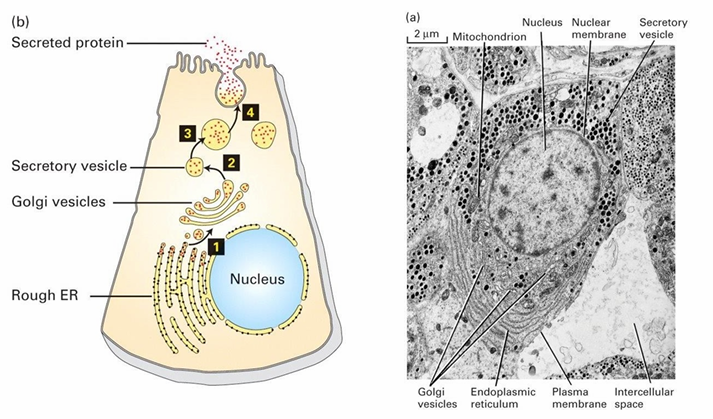
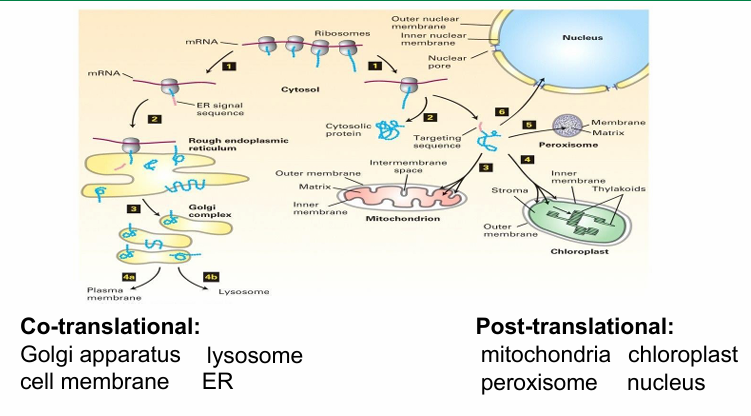
Secretory Pathway

  • Proteins transported to ER is co-translational instead of post-translational

  • Secreted pathways are synthesized in ER before vesicle-based transport carries them out of the cell

2
New cards

RER Characteristics

  • Bound by single membrane (it’s also continous with outer nucleus membrane 

  • No genome (RER proteins all encoded in nuclear genome

  • Site of protein synthesis and modification 

  • First destination for secreted proteins

3
New cards

TEM of ER

  • RER is continous with nucleus membrane 

  • Punctate black dots is membrane-bound ribosomes 

    • They synthesize secreted proteins 

<ul><li><p>RER is continous with nucleus membrane&nbsp;</p></li><li><p>Punctate black dots is membrane-bound ribosomes&nbsp;</p><ul><li><p>They synthesize secreted proteins&nbsp;</p></li></ul></li></ul><p></p>
4
New cards

TEM of RER

  • ER associated ribosomes are on cytosolic side of the ER membrane

  • At any given time, there will be free and ER-associated ribosomes 

  • Both are translationally active and come from the same common pool of ribosomes 

  • They just cycle on and off the ER membrane 
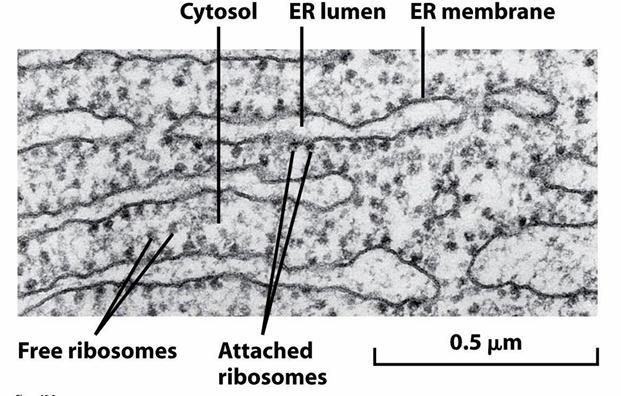
<ul><li><p>ER associated ribosomes are on cytosolic side of the ER membrane</p></li><li><p>At any given time, there will be free and ER-associated ribosomes&nbsp;</p></li><li><p>Both are translationally active and come from the same common pool of ribosomes&nbsp;</p></li><li><p>They just cycle on and off the ER membrane&nbsp;</p></li></ul><p></p>
5
New cards

Proteins Targeted while Translation is Active Experiment

  • Microsomes used to mimic ER membrane

    • Made by disrupting the ER membrane by homogenization

    • They spontaneously assemble into spheres mimicing normal ER behaviour 

  • Two experiments were conducted 

  1. Treat microsomes with detergent

  • This releases the proteins inside

  • Protease is added to digest the proteins

  • This shows that the protease can digest proteins

  1. Protease added with intact microsome

  • The newly synthesized proteins are protected inside microsome

Conclusion: Newly synthesized proteins move directly into the microsome without being exposed to external env
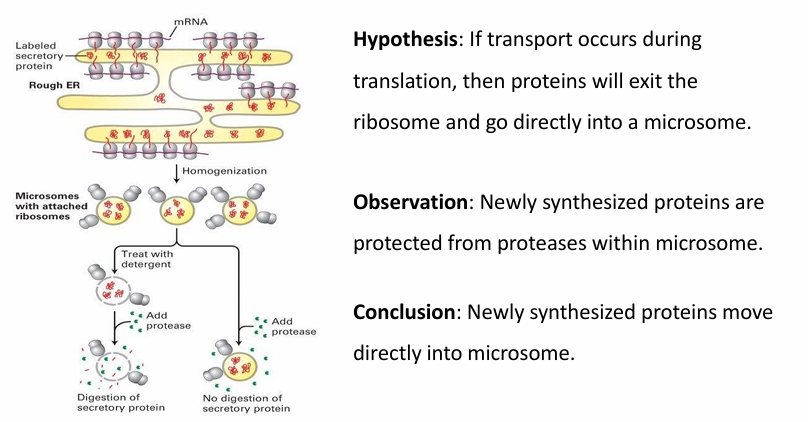
<ul><li><p>Microsomes used to mimic ER membrane</p><ul><li><p>Made by disrupting the ER membrane by<em> homogenization</em></p></li><li><p>They spontaneously assemble into spheres mimicing normal ER behaviour&nbsp;</p></li></ul></li><li><p>Two experiments were conducted&nbsp;</p></li></ul><p></p><ol><li><p>Treat microsomes with detergent</p></li></ol><ul><li><p>This releases the proteins inside </p></li><li><p>Protease is added to digest the proteins </p></li><li><p>This shows that the protease can digest proteins </p></li></ul><p></p><ol start="2"><li><p>Protease added with intact microsome</p></li></ol><ul><li><p>The newly synthesized proteins are protected inside microsome </p></li></ul><p></p><p>Conclusion: Newly synthesized proteins move directly into the microsome without being exposed to external env</p><p></p>
6
New cards

Translation and Translocation Co-occurance Experiment

  • Can protein transport to ER occur post-translationally? 

  • Hypothesis: If proteins have completed translation, import won’t occur into ER 

Control: Figure b

  • ER-targeted proteins are synthesized in vitro in presence of microsomes

  • Mature proteins are found inside microsomes 

Experiment: Figure a

  • ER proteins synthesized in vitro in absence of microsomes

  • The translated proteins are added to a solution with microsomes

  • They’re unable to enter after full translation

Conclusion: Import must occur co-translationally 
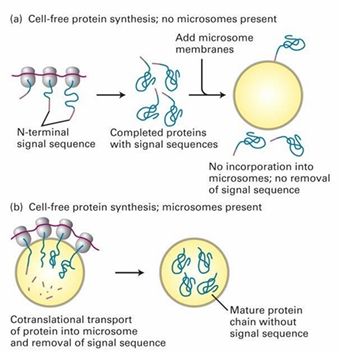
<ul><li><p>Can protein transport to ER occur post-translationally?&nbsp;</p></li><li><p>Hypothesis: If proteins have completed translation, import won’t occur into ER&nbsp;</p></li></ul><p></p><p>Control: Figure b</p><ul><li><p>ER-targeted proteins are synthesized<em> in vitro</em>&nbsp;in presence of microsomes</p></li><li><p>Mature proteins are found inside microsomes&nbsp;</p></li></ul><p></p><p>Experiment: Figure a</p><ul><li><p>ER proteins synthesized in vitro in absence of microsomes </p></li><li><p>The translated proteins are added to a solution with microsomes </p></li><li><p>They’re unable to enter after full translation </p></li></ul><p></p><p>Conclusion: Import must occur co-translationally&nbsp;</p><p></p>
7
New cards

Co-Translational Protein Transport Rules

  1. Signal sequence

  2. Receptor for signal sequence

  3. Translocation channels 

  4. E requirement (GTP hydrolysis) 

  5. Method of targeting proteins to different organelle locations 

8
New cards

Rule 1: ER protein Transport

  • Domain of 16-30 amino acids needed

  • Sequence located at N-terminus carrying 

    • A short (+) domain 

    • Hydrophobic domain 

    • Polar domain 

  • Signal Sequence is produced first bc N-terminus 

    • First part of nascent protein translated 

  • 2 roles: 

    • Targets protein to ER 

    • Guides ribosome translating the protein to ER membrane 
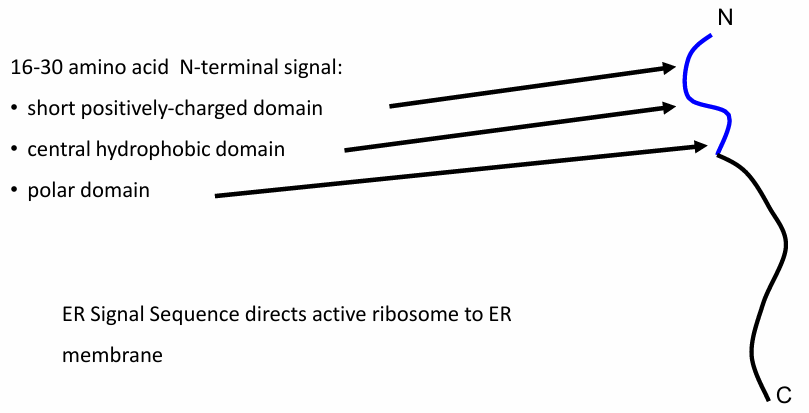
<ul><li><p>Domain of 16-30 amino acids needed </p></li><li><p>Sequence located at N-terminus carrying&nbsp;</p><ul><li><p>A short (+) domain&nbsp;</p></li><li><p>Hydrophobic domain&nbsp;</p></li><li><p>Polar domain&nbsp;</p></li></ul></li><li><p>Signal Sequence is produced first bc N-terminus&nbsp;</p><ul><li><p>First part of nascent protein translated&nbsp;</p></li></ul></li><li><p>2 roles:&nbsp;</p><ul><li><p>Targets protein to ER&nbsp;</p></li><li><p>Guides ribosome translating the protein to ER membrane&nbsp;</p></li></ul></li></ul><p></p>
9
New cards

Rule 2: ER protein Transport

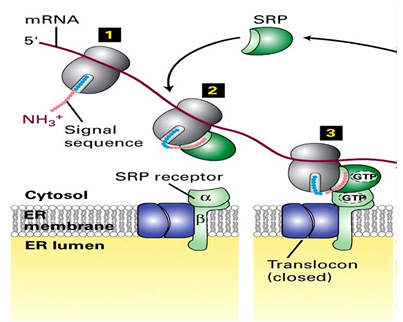
  • Signal Recognition Particle (SRP) 

  • Made of 6 proteins and functional RNA (300 nucleotides long) 

  • It binds to 

    • N terminal ER sequence

    • Large subunit of Ribosome

  • This pauses translation for a bit

  • If the sequence was on the C-terminus, translation would be complete before SRP binding

    • No ribosome = no transport bc this is co-translational

  • The SRP receptor has hydrophobic bindng groove that recognizes the hydrophobic domain of ER signal sequence
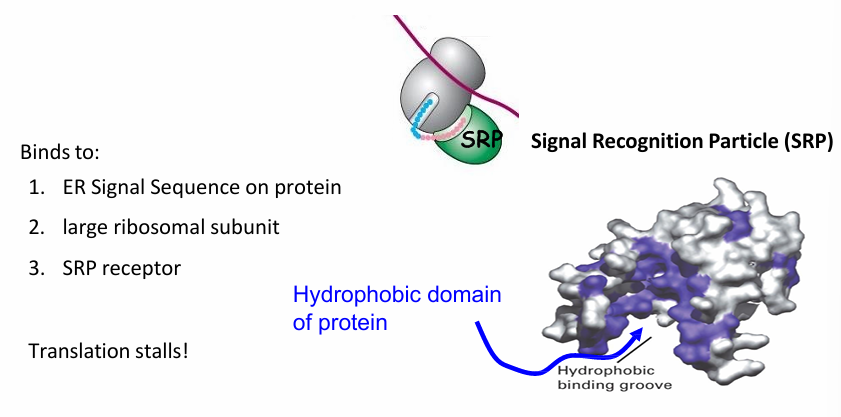
<ul><li><p>Signal Recognition Particle (SRP)&nbsp;</p></li><li><p>Made of 6 proteins and functional RNA (300 nucleotides long)&nbsp;</p></li><li><p>It binds to&nbsp;</p><ul><li><p>N terminal ER sequence</p></li><li><p>Large subunit of Ribosome</p></li></ul></li><li><p>This pauses translation for a bit</p></li><li><p>If the sequence was on the C-terminus, translation would be complete before SRP binding</p><ul><li><p>No ribosome = no transport bc this is co-translational </p></li></ul></li><li><p>The SRP receptor has hydrophobic bindng groove that recognizes the hydrophobic domain of ER signal sequence</p></li></ul><p></p>
10
New cards

SRP Cytosolic Complex

  • Requires:

    • SRP 

    • SRP receptor on ER membrane 

  • SRP Receptor

    • transmembrane dimer with an alpha and beta subunit

    • SRP and alpha subunit of SRP receptor are GTP-binding 

  • SRP receptor is associated with ER translocon 
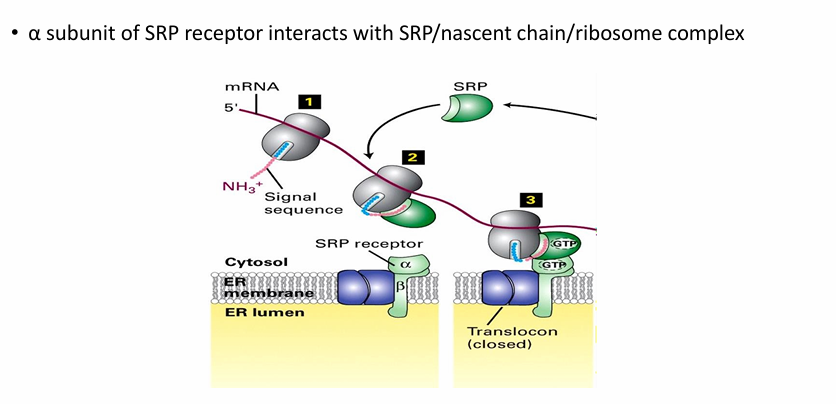
<ul><li><p>Requires:</p><ul><li><p>SRP&nbsp;</p></li><li><p>SRP receptor on ER membrane&nbsp;</p></li></ul></li><li><p>SRP Receptor</p><ul><li><p>transmembrane dimer with an alpha and beta subunit</p></li><li><p>SRP and alpha subunit of SRP receptor are GTP-binding&nbsp;</p></li></ul></li><li><p>SRP receptor is associated with ER translocon&nbsp;</p></li></ul><p></p>
11
New cards

Components Associated with ER Membrane Surface During Co-Translational Protein Transport 

  • Ribosome

  • mRNA

  • N-terminus of nascent protein 

  • SRP 

  • SRP receptor

  • closed translocon

<ul><li><p>Ribosome</p></li><li><p>mRNA</p></li><li><p>N-terminus of nascent protein&nbsp;</p></li><li><p>SRP&nbsp;</p></li><li><p>SRP receptor </p></li><li><p>closed translocon</p></li></ul><p></p>
12
New cards

Rule 3: ER protein Transport

  • The translocon is initially closed

  • Opens as the nascent peptide is transferred to interior 

  • SRP dissociates from ER signal sequence during translation 

    • Translation then continues 

    • Ribosome remains associated with ER membrane

  • As translation continues, the nascent peptide is pushed through translocon 
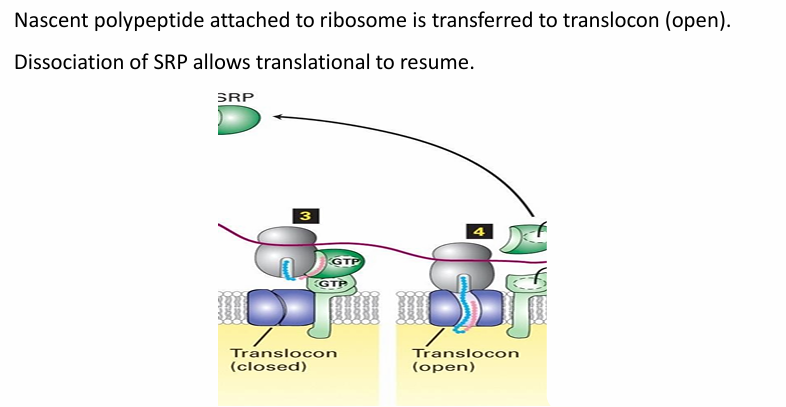
<ul><li><p>The translocon is initially closed</p></li><li><p>Opens as the nascent peptide is transferred to interior&nbsp;</p></li><li><p>SRP dissociates from ER signal sequence during translation&nbsp;</p><ul><li><p>Translation then continues&nbsp;</p></li><li><p>Ribosome remains associated with ER membrane</p></li></ul></li><li><p>As translation continues, the nascent peptide is pushed through translocon&nbsp;</p></li></ul><p></p>
13
New cards

Rule 4: ER protein Transport

  • SRP and SRP receptor have intrinsic GTPase activity 

  • Both hydrolyze GTP for E 

  • Powers the transfer of nascent peptide into translocon and opens it 
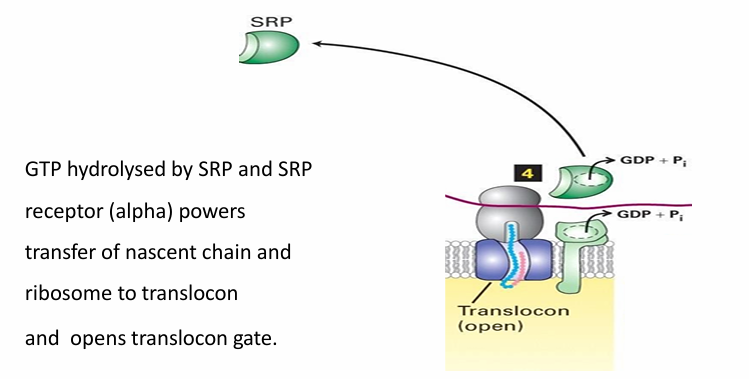
<ul><li><p>SRP and SRP receptor have intrinsic GTPase activity&nbsp;</p></li><li><p>Both hydrolyze GTP for E&nbsp;</p></li><li><p>Powers the transfer of nascent peptide into translocon and opens it&nbsp;</p></li></ul><p></p>
14
New cards

Ribosome-Translocon Complex: Co-Translational Protein Transport 

  • The large ribosomal subunit directly interacts with translocon

  • Minimal space exposes the nascent polypeptide emerging from ribosome to cytosol

    • So not susceptible to protease in external env

  • This close association gives the rough ER speckled appearance 
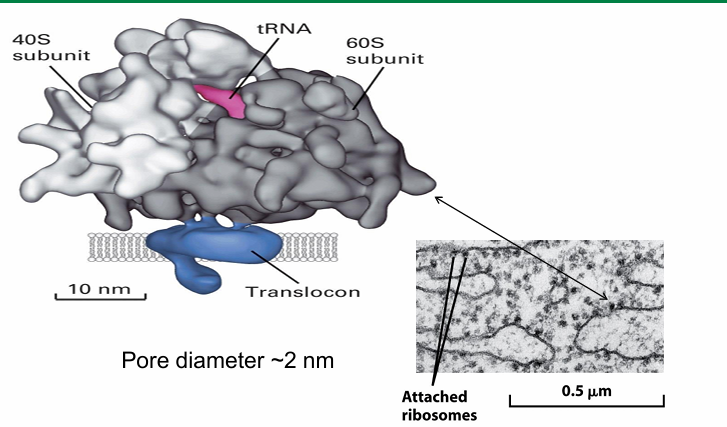
<ul><li><p>The large ribosomal subunit directly interacts&nbsp;with translocon </p></li><li><p>Minimal space exposes the nascent polypeptide emerging from ribosome to cytosol </p><ul><li><p>So not susceptible to protease in external env </p></li></ul></li><li><p>This close association gives the rough ER speckled appearance&nbsp;</p></li></ul><p></p>
15
New cards

What Happens when the N-terminus of the nascent protein reaches the lumen of RER

  • ER signal sequence is cleaved by signal peptidase

  • Peptide is pushed through translocon as translation continues 

  • After translation, it’s released into the lumen where folding occurs 

  • Translocon closes and ribosome dissociates 

  • Depending on the mRNA the ribosome binds to next, it can be a free ribosome or bound 
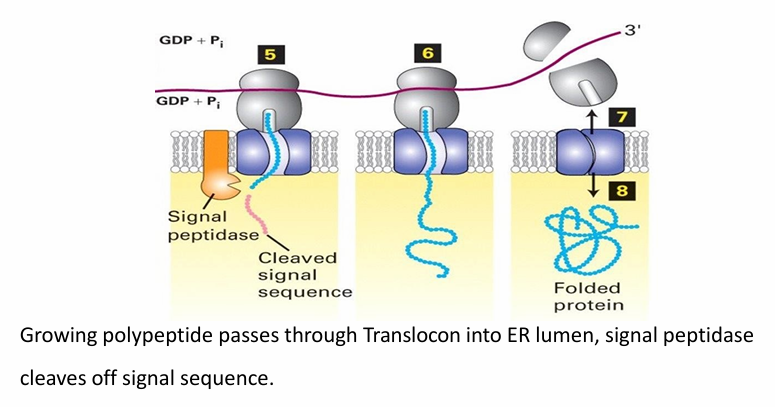
<ul><li><p>ER signal sequence is cleaved by signal peptidase </p></li><li><p>Peptide is pushed through translocon as translation continues&nbsp;</p></li><li><p>After translation, it’s released into the lumen where folding occurs&nbsp;</p></li><li><p>Translocon closes and ribosome dissociates&nbsp;</p></li><li><p>Depending on the mRNA the ribosome binds to next, it can be a free ribosome or bound&nbsp;</p></li></ul><p></p>
16
New cards

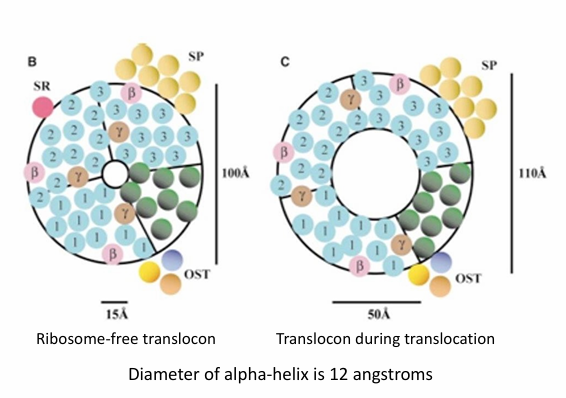
Co-Translational Protein Transport Translocon Structure

  • Comprised of many transmembrane a-helices forming the wall 

  • Inner circle is the inner diameter of the translocon 

  • When no ribosome present, the opening is narrow (15Å) 

  • When ribosome is attached, the open conformation is adopted

    • Nascent protein goes through 

    • opening widens to 50Å in diameter

<ul><li><p>Comprised of many transmembrane a-helices forming the wall&nbsp;</p></li><li><p>Inner circle is the inner diameter of the translocon&nbsp;</p></li><li><p>When no ribosome present, the opening is narrow (15Å)&nbsp;</p></li><li><p>When ribosome is attached, the open conformation is adopted</p><ul><li><p>Nascent protein goes through&nbsp;</p></li><li><p>opening widens to 50Å in diameter</p></li></ul></li></ul><p></p>
17
New cards

Rule 5: ER protein Transport

  • The proteins here are soluble 

  • They either

    • Remain in ER 

    • Transported via secretory vesciles to GA

    • Transported to lysosomes 

    • Transported out of the cell 

  • Needs a second signal sequence 

18
New cards

Topogenic Sequence

  • Embeds proteins in the ER membrane during co-translational transport

  • 25 amino acid long sequence forming a hydrophobic a-helix with ability to embed in membrane

  • Determines topology (# of times the protein crosses membrane and orientation of it)

  • There are 4 classes of proteins based on their topology and sequences used 

    • Type I / II / III: Span the membrane once

    • Type IV: Span the membrane multiple times 
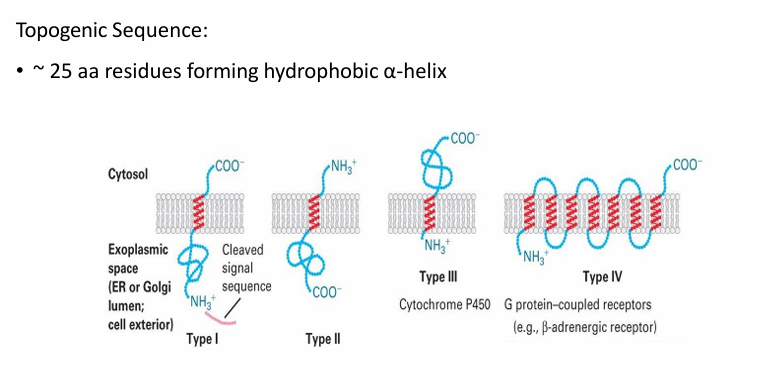
<ul><li><p>Embeds proteins in the ER membrane during co-translational transport </p></li><li><p>25 amino acid long sequence forming a hydrophobic a-helix with ability to embed in membrane</p></li><li><p>Determines topology&nbsp;(# of times the protein crosses membrane and orientation of it) </p></li><li><p>There are 4 classes of proteins based on their topology and sequences used&nbsp;</p><ul><li><p>Type I / II / III: Span the membrane once</p></li><li><p>Type IV: Span the membrane multiple times&nbsp;</p></li></ul></li></ul><p></p>
19
New cards

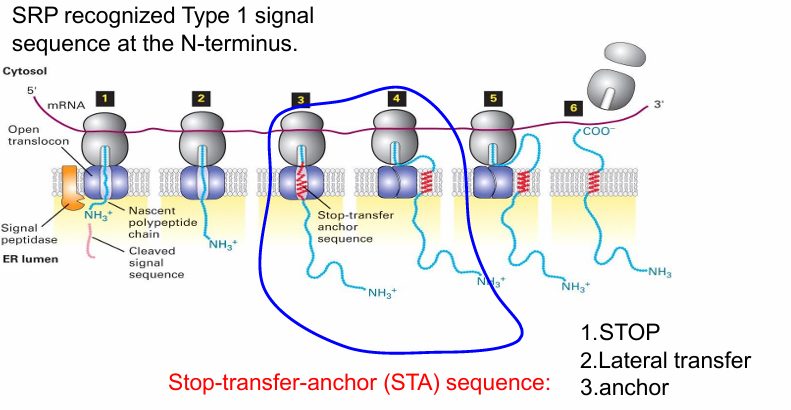
Type 1 Proteins

  • Same N-terminal signal sequence in soluble ER proteins

  • STA: Stop-Transfer-Anchor internal togogenic sequence 

    • Forms hydrophobic alpha helix embedding the protein in the ER membrane 

    • Stops translocation through translocon to transfer the protein to membrane 

    • Anchors protein in place 

  • The protein maintains this topology even when moving to other locations via vesicle transport 

    • N-terminus faces exoplasmic space (inside ER or GA lumen)

    • C terminus always faces cytosolic space 
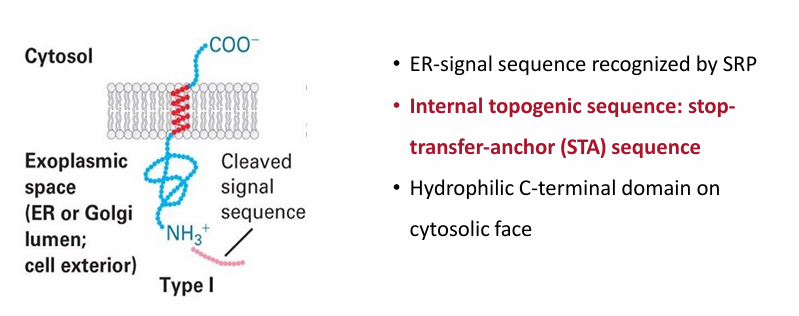
<ul><li><p>Same N-terminal signal sequence in soluble ER proteins</p></li><li><p>STA: Stop-Transfer-Anchor internal togogenic sequence&nbsp;</p><ul><li><p>Forms hydrophobic alpha helix embedding the protein in the ER membrane&nbsp;</p></li><li><p>Stops translocation through translocon to transfer the protein to membrane&nbsp;</p></li><li><p>Anchors protein in place&nbsp;</p></li></ul></li><li><p>The protein maintains this topology even when moving to other locations via vesicle transport&nbsp;</p><ul><li><p>N-terminus faces exoplasmic space (inside ER or GA lumen)</p></li><li><p>C terminus always faces cytosolic space&nbsp;</p></li></ul></li></ul><p></p>
20
New cards

Transport and Insertion of Type I Protein

  • N terminal sequence recognized by SRP and brought to SRP receptor 

  • N-terminal sequence threaded into translocon 

  • Protein synethesis pushes the protein through 

  • When STA sequence is translated, it folds into an a-helix

    • Recognized by interior wall of translocon 

    • Stops translocon and causes it to open laterally 

    • Allows topogenic sequence to diffuse into surrounding membrane

    • Keeps protein anchored in place

  • After translation/translocation is complete the C and N terminal domains fold within their envs
<ul><li><p>N terminal sequence recognized by SRP and brought to SRP receptor&nbsp;</p></li><li><p>N-terminal sequence threaded into translocon&nbsp;</p></li><li><p>Protein synethesis pushes the protein through&nbsp;</p></li><li><p>When STA sequence is translated, it folds into an a-helix</p><ul><li><p>Recognized by interior wall of translocon&nbsp;</p></li><li><p>Stops translocon and causes it to open laterally&nbsp;</p></li><li><p>Allows topogenic sequence to diffuse into surrounding membrane </p></li><li><p>Keeps protein anchored in place</p></li></ul></li><li><p>After translation/translocation is complete the C and N terminal domains fold within their envs </p></li></ul><p></p>
21
New cards

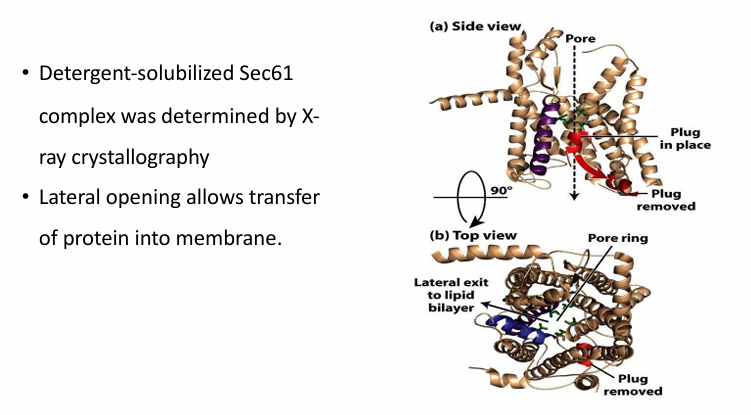
Sec61 Complex

  • Part of traanslocon in co-transloation protein transport

  • Red a-helix is the plug swinging down to open the pore during translocation 

  • Blue helix illustrates the lateral opening of the translocon 

  • This complex was determined by x-ray crystallography 
<ul><li><p>Part of traanslocon in co-transloation protein transport </p></li><li><p>Red a-helix is the plug swinging down to open the pore during translocation&nbsp;</p></li><li><p>Blue helix illustrates the lateral opening of the translocon&nbsp;</p></li><li><p>This complex was determined by x-ray crystallography&nbsp;</p></li></ul><p></p>
22
New cards

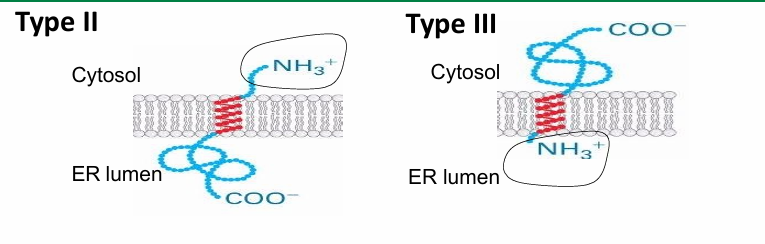
Type II / III Proteins

  • Single-pass proteins 

  • Lack N-terminal signal sequence 

  • They have a single signal sequence 

    • SA Sequence: Signal Anchor 

    • Signal for both SRP and topogenic sequence 

Type II:

  • Oriented with N-terminus on cytosolic side 

  • C-terminus on luminal side 

Type III:

  • Oriented same way as Type I

  • N terminus on luminal side

  • C terminus on cytosolic side 

  • Have very short N-terminus (allows it to be threaded through)
<ul><li><p>Single-pass proteins&nbsp;</p></li><li><p>Lack N-terminal signal sequence&nbsp;</p></li><li><p>They have a single signal sequence&nbsp;</p><ul><li><p>SA Sequence: Signal Anchor&nbsp;</p></li><li><p>Signal for both SRP and topogenic sequence&nbsp;</p></li></ul></li></ul><p></p><p>Type II:</p><ul><li><p>Oriented with N-terminus on cytosolic side&nbsp;</p></li><li><p>C-terminus on luminal side&nbsp;</p></li></ul><p></p><p>Type III:</p><ul><li><p>Oriented same way as Type I</p></li><li><p>N terminus on luminal side</p></li><li><p>C terminus on cytosolic side&nbsp;</p></li><li><p>Have very short N-terminus (allows it to be threaded through)</p></li></ul><p></p>
23
New cards

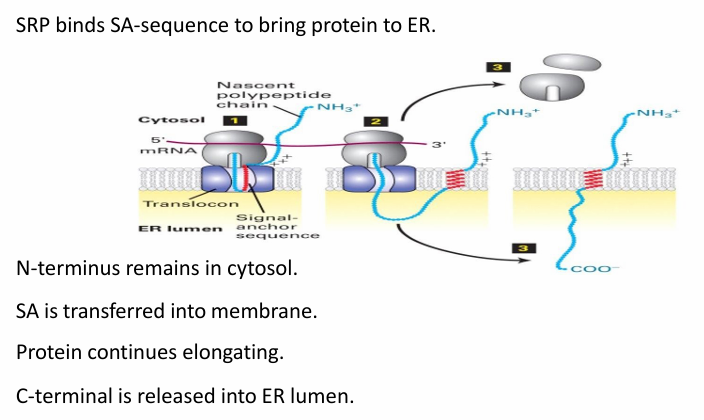
Type II Membrane Protein Transport

  • The SA sequence (red) is recognized by SRP to bring the protein and ribosome to ER membrane 

  • SA sequence is then transferred to translocon 

  • (+) residues prevent transfer of N-terminal portion of protein into translocon 

  • Translocon opens laterally to allow diffusion of SA sequence into membrane 

  • C-terminus pushed through translocon into ER lumen 
<ul><li><p>The SA sequence (red) is recognized by SRP to bring the protein and ribosome to ER membrane&nbsp;</p></li><li><p>SA sequence is then transferred to translocon&nbsp;</p></li><li><p>(+) residues prevent transfer of N-terminal portion of protein into translocon&nbsp;</p></li><li><p>Translocon opens laterally to allow diffusion of SA sequence into membrane&nbsp;</p></li><li><p>C-terminus pushed through translocon into ER lumen&nbsp;</p></li></ul><p></p>
24
New cards

Type III Membrane Protein Transport

  • SA sequence (red) is recognized by SRP to bring to ER membrane 

  • A short N-terminal sequence threaded into translocon 

  • SA sequence enters allowing translocon to open laterally

  • (+) residues ensure the sequences neighbouring SA sequence stay in cytosol

  • Newly synthesized protein is pushed away from ribosome-translocon complex while being translated

  • The C-terminus stays on cytosol side and folds there

25
New cards

Type IV Integral Membrane Protein 

  • Pass through multiple times 

  • May be even/Odd # of topogenic sequences

  • Every time it passes through, there must be a sequence 
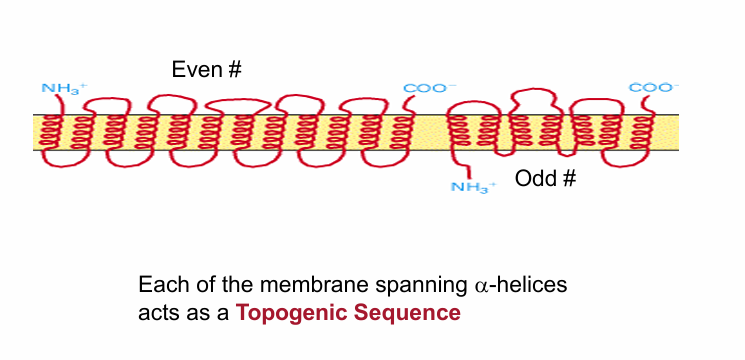
<ul><li><p>Pass through multiple times&nbsp;</p></li><li><p>May be even/Odd # of topogenic sequences</p></li><li><p>Every time it passes through, there must be a sequence&nbsp;</p></li></ul><p></p>
26
New cards

Type IV Integral Membrane Protein: 2 Examples

  • They differ at N-terminus 

  • After N-terminus location decided, the rest is threaded through the membrane by alternating between STA sequence (Type I protein) and SA-II Sequence

Type IV-A

  • N-terminus is on cytosolic side 

  • SA-II Sequence keeps N-terminus on cytosolic side 

Type IV-B

  • N-terminus is on luminal side 

  • SA-III Sequence keeps N-terminus on luminal side 
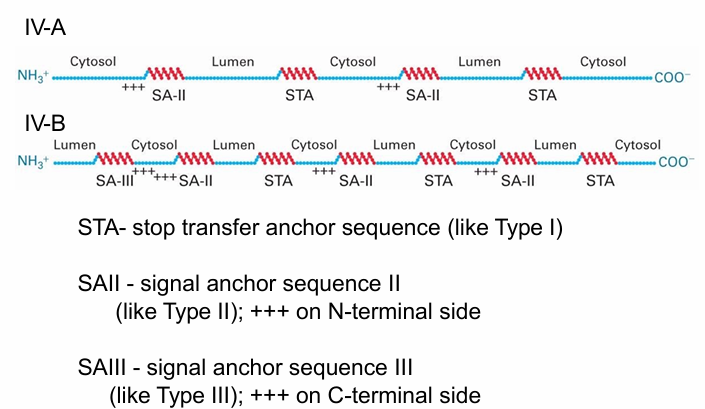
<ul><li><p>They differ at N-terminus&nbsp;</p></li><li><p>After N-terminus location decided, the rest is threaded through the membrane by alternating between STA sequence (Type I protein) and SA-II Sequence </p></li></ul><p></p><p>Type IV-A</p><ul><li><p>N-terminus is on cytosolic side&nbsp;</p></li><li><p>SA-II Sequence keeps N-terminus on cytosolic side&nbsp;</p></li></ul><p></p><p>Type IV-B</p><ul><li><p>N-terminus is on luminal side&nbsp;</p></li><li><p>SA-III Sequence keeps N-terminus on luminal side&nbsp;</p></li></ul><p></p>
27
New cards

Hydropathy Profile

  • Graphic representation of all amino acids on polypeptide

  • Left —> Right on X axis 

    • Amino acids from N to C-terminus

  • y axis: hydrophobicity of each amino acid 

  • Cluster of hydrophobic residues (peaks) represent topogenic sequences

Type I

  • Hydrophobic peak at N-terminus

  • Typical for an ER signal sequence 

  • Middle is another strong hydrophobic peak

    • Represents STA sequence 

Type II

  • No hydrophobic sequence at N-terminus

  • Single hydrophobic peak representing SA sequence 

Differentiating between Type II / III

  • Type II have longer N-terminus

  • Amino acids before SA sequence is also an indicator

    • (+) on N-terminal side suggest type II 

    • (+) on C-terminal side suggests type III

Multipass Protein 

  • Multiple hydrophobic peaks throughout

  • Suggests multiple topogenic sequences

  • Amount of peaks = amount of sequences = amount of passes through membrane 
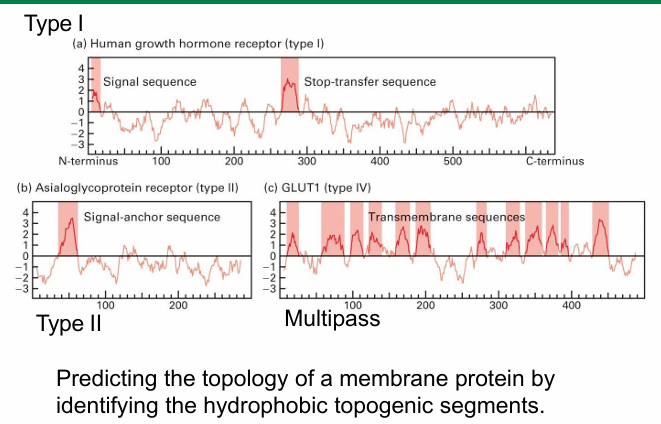
<ul><li><p>Graphic representation of all amino acids on polypeptide</p></li><li><p>Left —&gt; Right on X axis&nbsp;</p><ul><li><p>Amino acids from N to C-terminus</p></li></ul></li><li><p>y axis: hydrophobicity of each amino acid&nbsp;</p></li><li><p>Cluster of hydrophobic residues (peaks) represent topogenic sequences</p></li></ul><p></p><p>Type I</p><ul><li><p>Hydrophobic peak at N-terminus </p></li><li><p>Typical for an ER signal sequence&nbsp;</p></li><li><p>Middle is another strong hydrophobic peak</p><ul><li><p>Represents STA sequence&nbsp;</p></li></ul></li></ul><p></p><p>Type II</p><ul><li><p>No hydrophobic sequence at N-terminus </p></li><li><p>Single hydrophobic peak representing SA sequence&nbsp;</p></li></ul><p></p><p>Differentiating between Type II / III</p><ul><li><p>Type II have longer N-terminus </p></li><li><p>Amino acids before SA sequence is also an indicator</p><ul><li><p>(+) on N-terminal side suggest type II&nbsp;</p></li><li><p>(+) on C-terminal side suggests type III</p></li></ul></li></ul><p></p><p>Multipass Protein&nbsp;</p><ul><li><p>Multiple hydrophobic peaks throughout </p></li><li><p>Suggests multiple topogenic sequences</p></li><li><p>Amount of peaks = amount of sequences = amount of passes through membrane&nbsp;</p></li></ul><p></p>
28
New cards

Overview Diagram

knowt flashcard image