Baltzan Chapter 1: Management Information Systems
 Call Kai
 Learn
Learn Practice Test
 Spaced Repetition
 Match
Match Flashcards
 Knowt Play
1/84

There's no tags or description
Looks like no tags are added yet.
Name | Mastery | Learn | Test | Matching | Spaced | Call with Kai |
|---|
No analytics yet
Send a link to your students to track their progress
85 Terms
Fact
The confirmation or validation of an event or object
Information age
The present time, during which infinite quantities of facts are widely available to anyone who can use a computer
Examples of the power of business and technology
• Amazon – Not a technology company; primary business focus is selling books
• Netflix – Not a technology company; primary business focus is renting videos
• Zappos – Not a technology company; primary business focus is selling shoes
Internet of Things (IoT)
A world where interconnected Internet-enabled devices or “things” have the ability to collect and share data without human intervention
Machine-to-Machine (M2M)
Refers to devices that connect directly to other devices
The core drivers of the information age
• Data
• Information
• Business intelligence
• Knowledge
Data
Raw facts that describe the characteristics of an event or object
Structured data
Stored in a traditional system such as a relational database or spreadsheet
The 2 types of data
1.) Machine-generated data
2.) Human-generated data
Machine-generated data
Created by a machine without human intervention
Human-generated data
Data that humans, in interaction with computers, generate
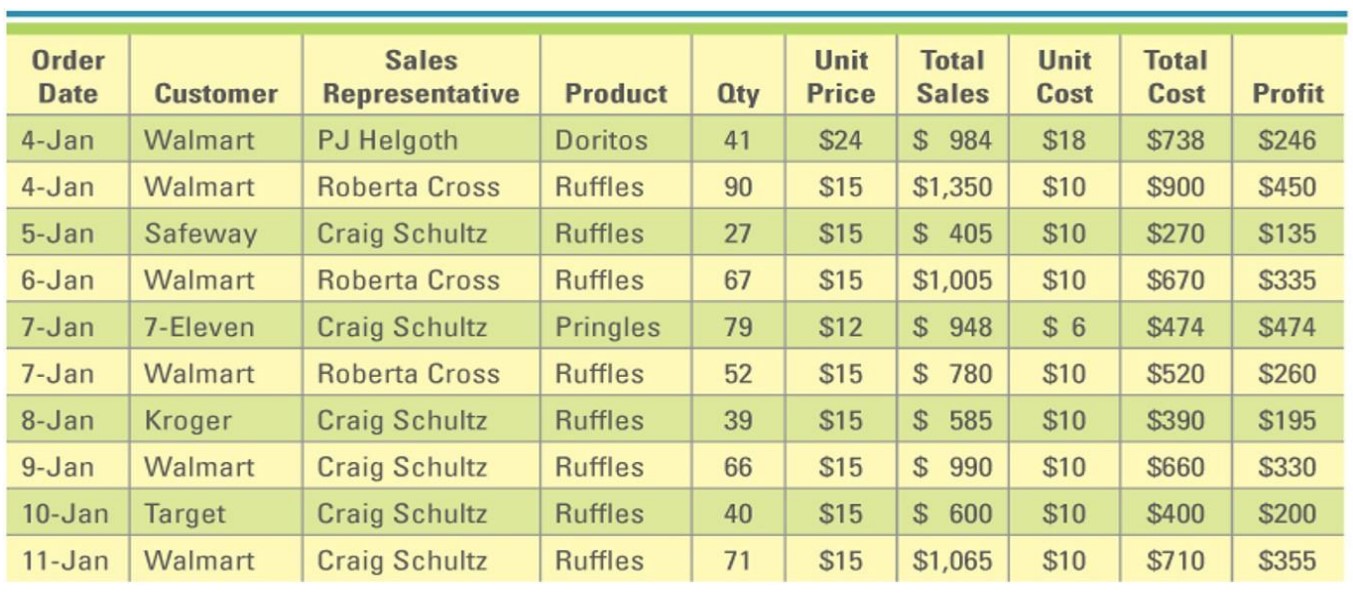
Example of Unstructured Data
Not defined and does not follow a specified format
Big data
A collection of large, complex data sets, including structured and unstructured data, which cannot be analyzed using traditional database methods and tools.
Snapshot
A view of data at a particular point in time.
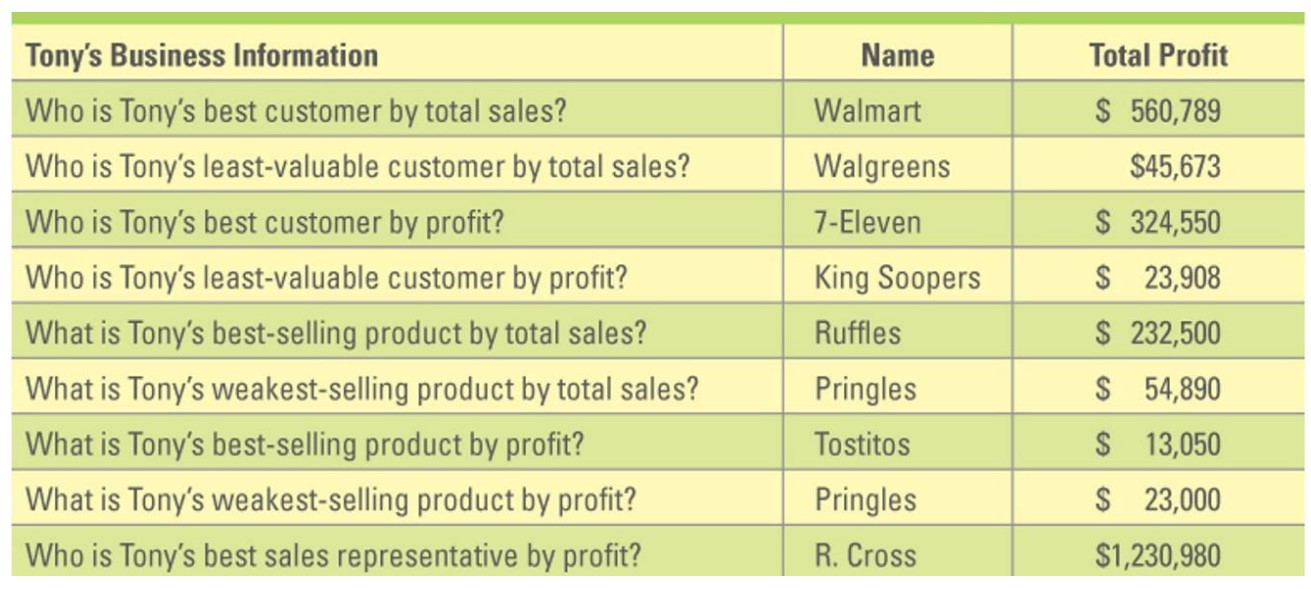
Information
Data converted into a meaningful and useful context
Report
A document containing data organized in a table, matrix, or graphical format allowing users to easily comprehend and understand information
2 types of Report
1.) Static report
2.) Dynamic report
Static report
Created once based on data that does not change
Dynamic report
Changes automatically during creation
Business intelligence
Information collected from multiple sources such as suppliers, customers, competitors, partners, and industries that analyzes patterns, trends, and relationships for strategic decision making
Analytics
The science of fact-based decision making
The types of Analytics
• Descriptive Analytics
• Predictive Analytics
• Prescriptive Analytics
Descriptive Analytics
Techniques that describes past performance and history.
Example: Creating a report that includes charts and graphs that explains the data
Predictive Analytics
Techniques that extract informon from data and uses it to predict future trends and identify behavioral patterns.
Example: Using past sales data to predict future sales
Prescriptive Analytics
Techniques that create models indicating the best decision to make or course of action to take.
Example: Airline using past purchasing data as inputs into a model that recommends the best pricing strategy across all flights allowing the company to maximize revenue
Knowledge
Skills, experience, and expertise coupled with information and intelligence that creates a person’s intellectual resources
Knowledge worker
Individual valued for their ability to interpret and analyze information
Common Departments in a business
Accounting
Finance
Human Resources
Operations
Sales
What does Accounting Department do?
Records, Measures, and Reports monetary Transactions
What does Finance Department do?
Tracks strategic financial issue including money, banking, credit, investments, and asset.
What does Human Resources Department do?
Maintain policies, plans, and procedures for the effective management of employees.
What does Marketing Department do?
Supports sales by planning, pricing, and promoting goods or services.
What does Operations Department do?
Manages the process of converting or transforming resources into goods or services.
What does Sales Department do?
Performs the function of selling goods or services.
Data of Accounting Department (Business Decisions)
Transactional Data
Purchasing Data
Payroll Data
Tax Data
Data of Finance Department (Business Decisions)
Investment Data
Monetary Data
Reporting Data
Data of Human Resource Department (Business Decisions)
Employee Data
Promotion Data
Vacation Data
Data of Marketing Department (Business Decisions)
Promotion Data
Sales Data
Advertising Data
Data of Operations Department (Business Decisions)
Manufacturing Data
Distribution Data
Production Data
Data of Sales Department (Business Decisions)
Potential Customer Data
Sales report Data
Commission Data
Customer Support Data
What are “Goods” in a business?
Material items or products that customers will buy to satisfy a want or need.
Example:
Cars
Groceries
Clothing
What are “Services” in a business?
Tasks people perform that customers will buy to satisfy a want or need.
Example:
Teaching
Waiting Tables
Cutting Hair
Systems Thinking Layout
Input → Process → Output
Systems Thinking with feedback
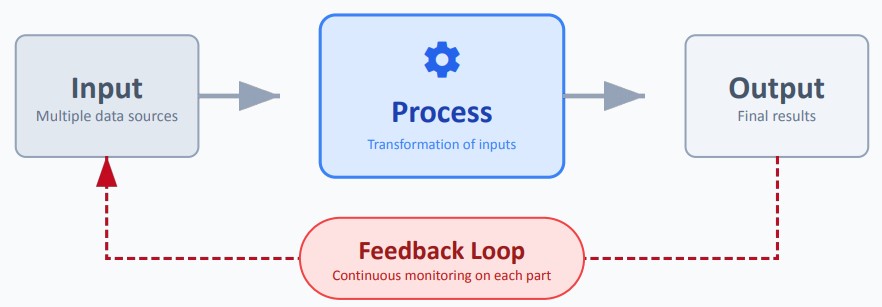
A way of monitoring the entire system by viewing multiple inputs being processed or transformed to produce outputs while continuously gathering feedback on each part.
Management Information Systems (MIS)
A business function, like accounting and human resources, which moves information about people, products, and processes across the company to facilitate decision-making and problem-solving
Management Information Systems Departments
Chief information officer (CIO)
Chief knowledge officer (CKO)
Chief privacy officer (CPO)
Chief security officer (CSO)
Chief technology officer (CTO)
Chief information officer (CIO)
Oversees all uses of IT and ensures the strategic alignment of IT with business goals and objectives
Chief knowledge officer (CKO)
Responsible for collecting, maintaining, and distributing the organization’s knowledge
Chief privacy officer (CPO)
Responsible for ensuring the ethical and legal use of information
Chief security officer (CSO)
Responsible for ensuring the security of IT systems
Chief technology officer (CTO)
Responsible for ensuring the throughput, speed, accuracy, availability, and reliability of IT
Types of Technology Officer
Chief intellectual property officer
Chief automation officer
Chief user experience officer
Business strategy
A leadership plan that achieves a specific set of goals or objectives such as
Developing new products or services
Entering new markets
Increasing customer loyalty
Attracting new customers
Increasing sales
Competitive Advantage
A product or service that an organization's customers place a greater value on than similar offerings from a competitor.
First-mover advantage
Occurs when an organization can significantly impact its market share by being first to market with a competitive advantage.
Tools for identifying competitive advantages
SWOT Analysis
Evaluates project osition
The 5 Forces Model
Evaluates industry attractiveness
The 3 Generic Strategies
Chooses Business Focus
Value Chain Analysis
Executes Business Strategy
SWOT Analysis
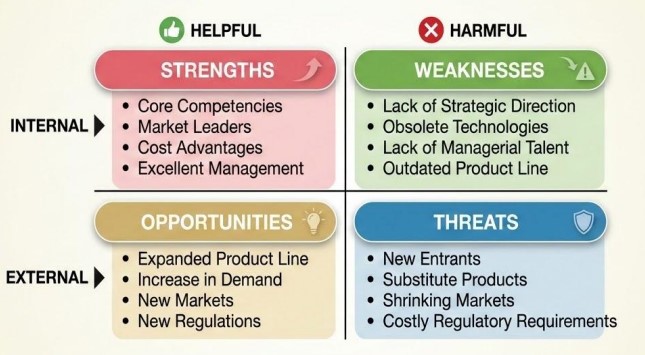
Evaluates an organization's strengths, weaknesses, opportunities, and threats to identify significant influences that work for or against business strategies
The 5 Forces Model
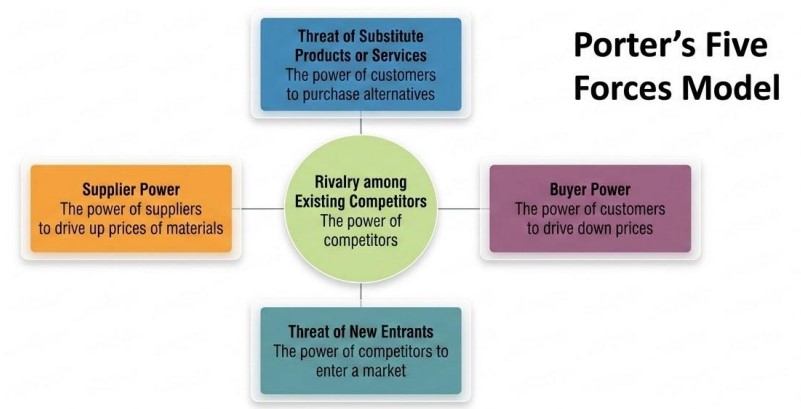
Evaluates industry attractiveness
Buyer Power
The power of customers to drive down the prices
The ability of buyers to affect the price of an item
Switching Cost
Loyalty Program
Switching Cost (Buyer Power)
Manipulating costs that make customers reluctant to switch to another product
Loyalty Program (Buyer Power)
Reward customers based on the amount of business they do with a particular organization
Supplier Power
The supplier’s ability to influence the price they charge for supplies
Supply chain - Consists of all parties involved in the procurement of a product or raw material.
Suppliers → Company → Customers
Rivalry among existing competitors
High when competition is fierce in a market and low when competitors are more complacent
Product differentiation – Occurs when a company develops unique differences in its products or services with the intent to influence demand
Threat of substitute products or services
High when there are many alternatives to a product or service and low when there are few alternatives.
Threat of new entrants
High when it is easy for new competitors to enter a market and low when there are significant entry barriers
Entry barrier - A feature of a product or service that customers have come to expect and entering competitors must offer the same for survival
Porter’s Three Generic Strategies
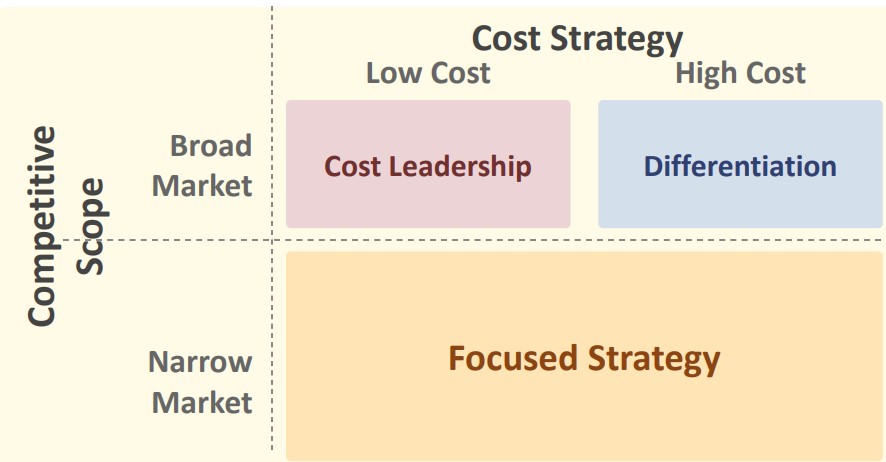
1.) Cost Leadership
2.) Differentiation
3.) Focus Strategy
Business process
A standardized set of activities that accomplish a specific task, such as a specific process
Value chain analysis
Views a firm as a series of business processes that each add value to the product or service
Porters Value Chain
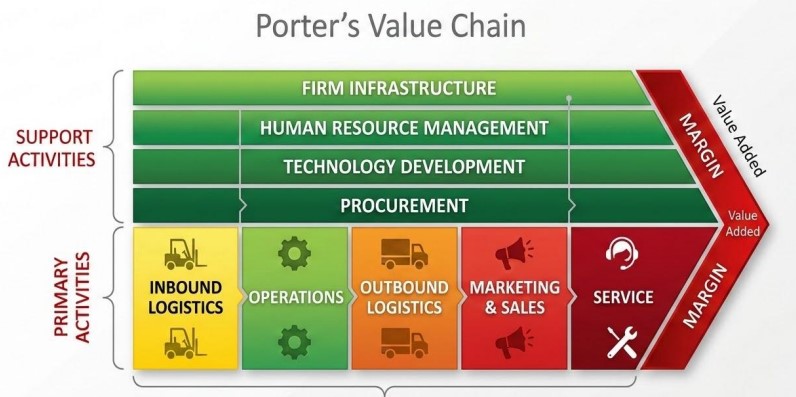
Inbound logistics (VALUE CHAIN ANALYSIS)
Acquires raw materials and resources, and distributes
Operations (VALUE CHAIN ANALYSIS)
Transforms raw materials or inputs into goods and services
Outbound logistics (VALUE CHAIN ANALYSIS)
Distributes goods and services to customers
Marketing and sales (VALUE CHAIN ANALYSIS)
Promotes, prices, and sells products to customers
Service (VALUE CHAIN ANALYSIS)
Provides customer support
Firm infrastructure (VALUE CHAIN ANALYSIS)
Includes the company format or departmental structures, environment, and systems
Human resource management (VALUE CHAIN ANALYSIS)
Provides employee training, hiring, and compensation
Technology development (VALUE CHAIN ANALYSIS)
Applies MIS to processes to add value
Procurement (VALUE CHAIN ANALYSIS)
Purchases inputs such as raw materials, resources, equipment, and supplies
Generic Competitive Advantages
Cost Advantage
Product Differentiation
First-Mover Advantage
Niche Market Focus
Brand Loyalty
Access to Intellectual Property
Economies of Scale
Cost Advantage (Generic Competitive Advantages)
Producing goods or services at a lower cost than competitors, allowing for higher margins or lower consumer prices.
Product Differentiation (Generic Competitive Advantages)
Offering unique features, superior quality, or innovative designs that customers value more than competing offerings.
First-Mover Advantage (Generic Competitive Advantages)
Being the first to enter a market with a new product, capturing significant market share and brand recognition.
Niche Market Focus (Generic Competitive Advantages)
Concentrating resources on a specific, narrow segment of the market to serve its unique needs better than broad-market competitors.
Brand Loyalty (Generic Competitive Advantages)
Developing a strong reputation and emotional connection with customers, leading to repeat purchases and reduced price sensitivity.
Access to Intellectual Property (Generic Competitive Advantages)
Holding patents, trademarks, or proprietary technology that prevents competitors from replicating key product features.
Economies of Scale (Generic Competitive Advantages)
Achieving lower per-unit costs through large-scale production and efficient resource utilization.