ERTH 2312 Final Exam
 Call Kai
 Learn
Learn Practice Test
 Spaced Repetition
 Match
Match Flashcards
 Knowt Play
1/106

There's no tags or description
Looks like no tags are added yet.
Name | Mastery | Learn | Test | Matching | Spaced | Call with Kai |
|---|
No analytics yet
Send a link to your students to track their progress
107 Terms
Paleoecology
the study of ancient organisms in the context of their environments that can be used to decipher the lifestyles of organisms and their relationships to each other
“ancient ecology”
Ecology
study of adaptations of animals and plants to their environments (habitats), as well as interactions with organisms and flow of energy in communities
Differentiate between ecology and paleoecology
ecology studies interactions that are dynamic in space over short intervals of time whereas paleoecology studies data that is static in space and can be tracked over longer periods of geologic time
The principles of ecology can be applied to paleoecology
Actualism
ecology of modern organisms can inform our interpretation of the past. however, sometimes the past can be vastly different from the present with no modern analogues
What was unique about the Carboniferous Trophic Structures?
Unlike modern ecosystems, detritivores occupied the trophic level of primary consumers
Autoecology
ecology of the individual organism (ex. lifestyles, behaviour)
Synecology
the interactions between organisms and their environment (ex. ecosystem, community)
Paleoautoecology
study of traits of singular fossil organisms, which includes tooth wear, stable isotope analysis, trace fossils, paleopathology, and functional morphology, to understand behaviour and lifestyle
tooth wear = diet preferences (ex. rough ate wood, soft ate fruits)
stable isotopes = look at bone enrichment
trace fossils = ex. coprolites
Paleosynecology
different levels above the individual, includes:
population
community
habitat
ecosystem
macroecology (ex. climate)
Population
more than one individual of a species, living near one another, and potentially interacting
Community
groups of organisms that live together and interact with each other
(paleocommunities are usually named for one or more conspicuous species that live there)
Habitat
the environmental setting in which a community, or population, live (ex. forest, tundra, mud puddle, reef, etc.)
Ecosystem
the combination of habitats and organisms that exist together in a certain time and space
Ecotone
unique environments that are formed in the transitional areas between habitats
Ex. Intertidal ecotone presents a challenging environment for organisms found there. Characterized by tremendous fluctuations in a number of parameters including water cover, temperature, and salinity.
Describe the diversity and abundance in an ecotone
low diversity, but the few species that live there are often found in abundance (seen in trace fossil assemblages like Cruziana ichnofossils)
Ex. Foraminifera are highly zones in salt marsh ecotones and can be used to reconstruct paleo sea levels
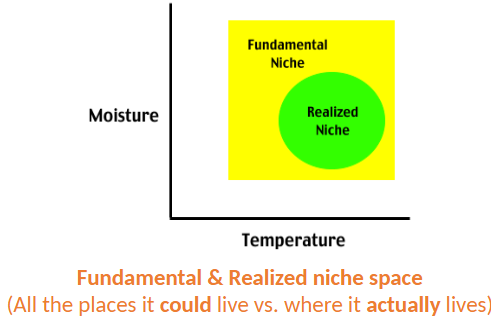
Ecological niche
ecological space an organism occupies and the role it plays in its community and habitat
most habitats are occupied by several species in separate niches (fundamental — realized)
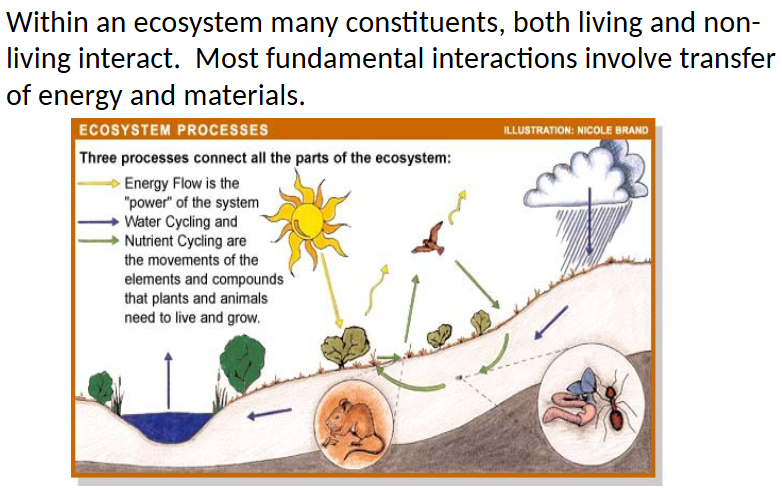
Ecological interactions
Thermodynamics (in the context of paleontology) states…
you need energy (enthalpy) to decrease chaos (entropy) and induce organized systems so life therefore consumes energy/enthalpy (photosynthesis/chemosynthesis) to decrease entropy on planetary scale
On a universal scale life is thermodynamically favored because it increases the rate energy is consumed and induces entropy long term
What is energy flow?
movement of energy throughout the food chain
food chain: direct sequence from producers to consumers
food web: combinations of many food chains
What are the different trophic levels?
Producers: converts solar energy into food (autotrophs)
Consumers: organisms that consumes other organisms to obtain energy (heterotrophs)
Primary
Secondary
Tertiary
Decomposers: directly consumes dead organisms (occurs at all levels)
Detritivores: consume detritus including waste (occurs at all levels)
Detritus is loose, dead particulate organic matter (decaying plant/animal material) or inorganic debris (rock fragments, rubble) produced by disintegration or wearing away
Biomass
amount of living matter in the ecosystem, or any part
Describe ecosystem dynamics in trophic pyramid
energy is lost as it flows through the system
biomass usually decreases at each trophic level (only about ~10% is transferred, ~90% is lost)
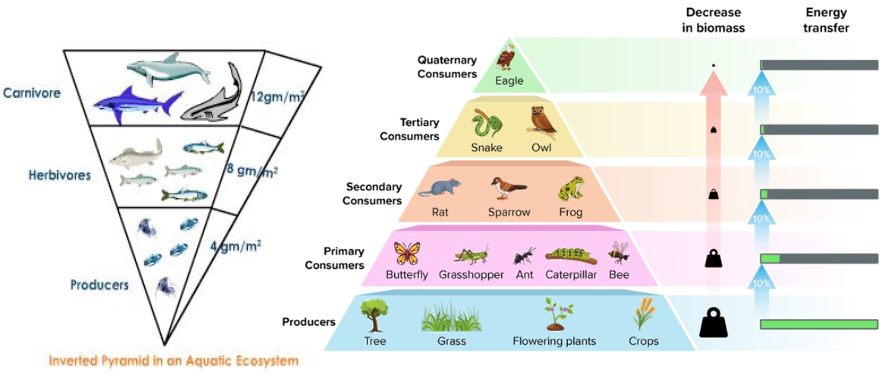
Why are aquatic trophic pyramids inverted?
primary producers, such as phytoplankton, have an extremely high turnover rate, reproducing and dying quickly while being rapidly consumed. Though their total mass at any given moment is low, their high production rate supports a larger biomass of zooplankton and fish
Why would we expect to find fewer Tyrannosaurus that Edmontosaurus specimens in a formation?
Tyrannosaurus eats Edmontosaurus, so Edmontosaurus should be more abundant
How are terrestrial species distributed?
Horizontal distribution (changes of environment, climate, etc.)
How are marine communities distributed?
Horizontal distribution of marine species controlled by changes in sediment, salinity, turbulence, etc. (particularly in costal areas)
continental shelf: submerged border of continent
continental margin: edge of shelf which drops off down continental slope to abyssal plain @ 5000m
Vertical distribution important to understanding ecology of marine species (primary factor is light)
Photic zone — Portion of water column penetrated by light where photosynthesis occurs
Pelagic zone — Water column
Benthic zone — Bottom dwellers
Who inhabits pelagic zone?
Nektic (active swimmers)
Planktic (transported by waves/currents)
Phytoplankton (microscopic floating “plants”)
Zooplankton (microscopic floating “animals”)
What are the different lifestyles for the benthic zone?
Epifaunal — live on substrate
Infaunal — live in substrate
Vagile — capable of locomotion
Sessile — immobile
Marine tiering became _____________ throughout the phanerozoic.
more complex
Note: Tiering can occur within communities due to competition for resources (vertical ecological structure)
Feeding groups of marine ecology
Grazers: feed by selectively removing organics from the substratum
Deposit feeders: animals which feed on the detritus deposited on the bottom (ex. sand dollar (echinozoa))
Suspension feeders: animals that feed by selecting suspended microorganisms and detritus from the water column (ex. crinoids)
Carnivores: animals that feed mainly on other animals (ex. shark)
Life Assemblage (Biocoenosis)
the organisms that truly lived together and interacted while alive
Death Assemblage (Thanatocoenosis)
the organisms found in together after death and decay
Fossil Assemblage (Taphocoenosis)
fossils preserved together in a single horizon/locality
Paleocommunity
assemblages, or associations, of organisms that are inferred to have interacted with one another
Why are fossil assemblages (taphocoenosis) not a perfect reflection of life assemblages (biocoenosis)?
Fossil material is altered, or lost, due to taphonomy. This includes processes like decay, disarticulation, transport, compaction, time averaging.
Time averaging
Make things appear synchronous in the geologic record that were not in reality, which can artificially increase the diversity of the death assemblage (thanatocoenosis)
Life Assemblage —> Death Assemblage —> Fossil Assemblage
Fossil assemblages (taphocoenosis) from different depositional environments will have different temporal and spatial resolutions
How does time averaging differ from signor-lipps effect?
signor-lipps states that the last fossil of a species is rarely the last individual record of the species. time averaging instead looks at how fossil deposits may contain fossils from different life assemblages in the same sedimentary layer.
What is fidelity?
How well the death or fossil assemblage matches the living assemblage
tracks changes between living assemblage and death assemblage in modern localities
assessed experimentally, or using lagerstatten
We must always take these preservational biases into account and mitigate them while designing studies and interpreting paleoecological data
Why might the size distribution of a fossil assemblage differ from the life assemblage?
Preservation bias
larger fossils likely have a higher survival
the energy level of transport impacts size distribution
Macroecology
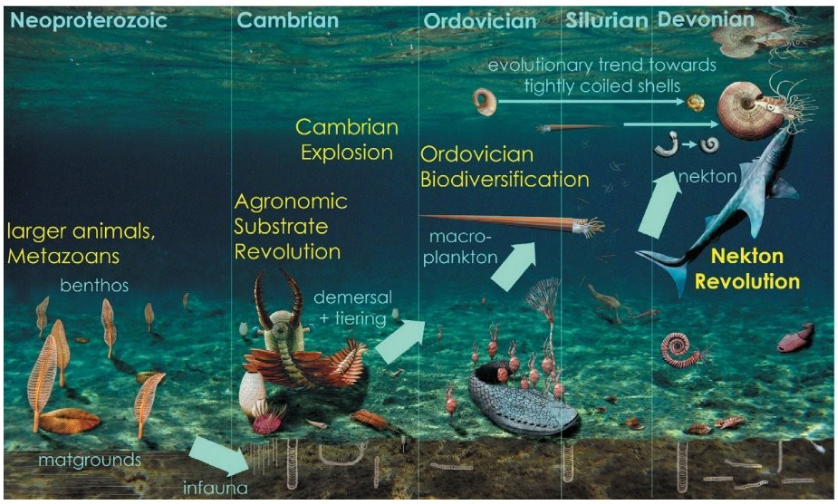
Evolution of new body plans and ecologies drove huge macroecological and macroevolutionary changes from the Ediacaran through the Devonian
Ediacaran fauna
Small shelly fauna
Cambrian explosion
Great Ordovician biodiversification
Nekton revolution
Ediacaran Biota
oldest assemblage of large complex organisms
soft body, high surface-volume ratios, radial or bilateral symmetry
most species had worldwide distributions, and predators and scavengers had yet to evolve in great numbers
no evidence the species were infaunal or pelagic —> life restricted to seabed
few predators and scavengers —> short food chains dominated by suspension and deposit feeders
tiering of benthos (evolution of stalks)
Small Shelly Fauna
first evidence of hard skeletonization
some thought to be worms or worm-like organisms
some show evidence of predation or scavenging
likely mobile and sessile
Oceanic Shift:
change to ocean between Late Proterozoic-Early Phanerozoic
evolution of new trophic mode of planktonic suspension feeders changed ocean water quality
new ecospaces
Cambrian explosion
Rapid appearance of new body plans, diversification of Bilateria
Cambrian substrate revolution indicates the evolution of a new feeding ecology, and increased tiering
Increase predation, driven by sight
Increased biomineralization, nutrient availability and defense
Great Ordovician Biodiversification
No new phyla (except Bryozoa), but extensive radiation, many crown groups emerge
Evolution of the plankton –diversification of acritarchs, development of feeding larvae
Diversification of predators led to “evolutionary arms race” and increasingly complex food webs
Nekton Revolution
Oversaturation of ecological space on the seabed drove evolution of nektonic forms
major Paleozoic ecological shift where actively swimming animals (nekton) rapidly colonized the marine water column, evolving from bottom-dwelling (benthic) ancestors
Primarily cephalopods and fish
Diversification continued well into the Devonian
Limiting Factors
variables in the environment that can restrict the growth, abundance, distribution of a population of organisms in an ecosystem
only one factor can be limiting at any one time
Examples:
space
environmental conditions (i.e. temperature, salinity, etc.)
predation
shelter
resource availability (i.e. nutrients, water, etc.)
Liebig’s Law of the Minimum
the scarcest resource is the limiting factor
Law of limiting factors
Biological or ecological processes that depend on multiple factors are limited by the slowest factor (ex. photosynthesis)
Law of tolerance
An organism success or survival is dependent on a complex set of conditions with maximum, minimums and optimal ranges of environmental factors
What are the limiting factors in a marine environment?
light
required for most ecosystems to operate, light intensity effects distribution of coral reefs, blue light penetrates deepest
oxygen
low oxygen ~ low biodiversity, required for metabolism
temperature
varies with latitude, geographic distributions, decreases with depth
salinity
Freshwater, Brackish water (Lower diversity), Sea water, Hypersaline water (Very low diversity), Brine
Most organisms have a low range of tolerances for salinity, characteristic species, or assemblages, can give evidence for changes in salinity/sea-level (reconstruction)
depth
related to other factors, including pressure
Carbonate Compensation Depth (CCD) limits distribution of organisms with carbonate skeletons
substrate
grain size ~ energy level ~ community distribution, sessile epifaunal (deposit feeders, suspension feeders)
What is horizontal distribution in paleontology?
spatial distribution of a species in stratigraphic section determined by biotic factors (species ecology/life strategy) and abiotic factors (ex. climate, preservation bias, etc.)
Define Tissues and Organs
Tissue: groups of differentiated cells united for a common function
Organs: groups of tissues organized into structures for a common function
What are Germ Layers and the different types?
The three primary cell layers
Endoderm — digestive tract, liver, lungs, etc.
Mesoderm — kidney, muscle, bones, etc.
Ectoderm — skin, hair, nails, nervous system, etc.
Differentiate between a Protostome and Deuterostome?
Protostome:
Eight-cell stage — spiral cleavage
Gastrulation — blastophore becomes the mouth
Examples — molluscs, arthropods, worms, lophophorates, etc.
Deuterostome:
Eight-cell stage — radial cleavage
Gastrulation — blastophore becomes the anus
Examples — echinoderms, chordates, etc.
What makes the hypothesized origin of Porifera unique?
Porifera may be paraphyletic
What is a sponge? What are its groups?
no true germ layers
sessile, benthic, filter feeders with porous bodies
some of the earliest, most basal, metazoans — can produce trace fossils
global distribution (marine and freshwater, any depth, Antarctic waters)
Groups:
Demospongea (common sponges) — silica (sometimes calcite) spines + larger
Calcarea (calcareous sponges) — small, less complex, calcite spicules
Hexactinellida (glass sponges) — silica spicules, looks like glass, small + complex
Archaeocyathid (extinct)
Stromatoporoid (extinct)
Describe the morphology of a sponge
body of spongin
skeletal structure made of spicules (calcite or silica) ← most likely to fossilize
sack-shaped body with central opening (spongocel) and small pores (ostia)
amoeboid sites eat trapped food, have cells for reproduction, have regenerating capacity
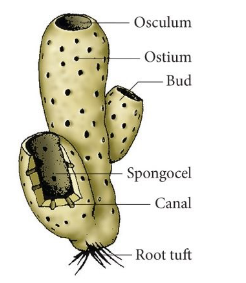
How do sponges feed?
By pumping water into their bodies using their ostia (pores). Water is moved by choanocytes (cells with flagella), and food is digested with amoeboid cells. Water is then expelled through the osculum (large opening at the top).
can process ~1000 L per day
How do sponges reproduce?
Asexually — budding (new sponge grows as an outgrowth (bud) on the parent's body. The bud may fall off and grow elsewhere, or remain attached to form a colony)
Sexually — spawning (sponges release large amounts of sperm into the water column, which enters another sponge through its pores (ostia). Specialized cells called choanocytes (collar cells) trap the sperm and transfer it to an egg within the body)
Describe the evolution of sponges
Earliest fossil thought to be from 890 mya
First appeared in Cambrian (Cambrian Explosion)
Began thin-walled, evolved ridged bodies for reef building
Which group of sponges dominated the Ordovician?
Demosponges (thick walled)
What are Stromatoporoids?
Mound/sheet shaped with calcareous skeletons
Marine, shallow, carbonate rocks
Grew together in bioherms, or biostromes and often “hosted” epibiont species
Densely layered calcite skeletons, most with no spicules
Different morphologies reflected the environment
Small bumps called mamelons and cracks called astrorhizae that likely expelled water
Horizontal laminae and vertical pillars
Early Cambrian — Late Devonian
What are Archeocyathids?
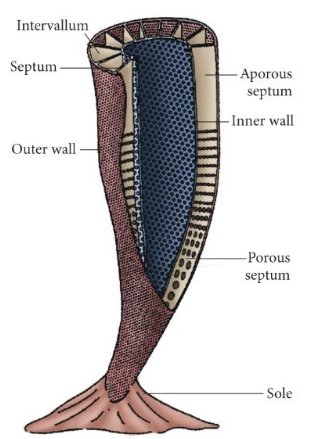
cup-shaped organisms
outer wall, inner wall, intervallum, septum, holdfast anchors
shallow, marine water, tropical deposits
first reefs
evolved in Early Cambrian, reached global distribution, and went extinct before end of Cambrian (Biostratigraphy)
What groups are included under Cnidarians?
Anthozoa (Rugosa, Tabulata, Scleractinia)
Corals, sea anemones, sea fans, sea pens
Hydrozoa
Jellyfish, fire corals
Scyphozoa
moon jellies, compass jellies
What are Cnidarians? What are their common traits?
least complex of metazoans
radially symmetrical with limited tissues and only two germ layers: Endoderm and Ectoderm
global distribution - predominantly live in shallow, warm, marine waters
Stinging Cells = Cnidoblasts
Live as polyps (sessile/attached) or medusae (free-swimming) ← often exist as both during life cycle
Describe Cnidarian morphology?
Hydra represents general body plan
Enteron = open body cavity with a single opening for mouth, a n u s and reproduction
Mouth surrounded by tentacles with stinging cells
Nematocysts = stingers found in entire cell called cnidoblasts
Body made of two walls (endoderm and ectoderm) with gelatinous substance called mesoglea
Describe Coral reproduction
Asexual — budding polyps with colony, fragmentation where coral falls away and establishes a new colony
Sexual — gametes mix to form planulae which disperse via currents and establish new colonies
When were the earliest fossil Cnidarians?
Possibly in Ediacaran biota, appeared in Cambrian
Of the coral group Anthozoa, which groups are extant vs extinct?
Rugosa = extinct
Tabulata = extinct
Scleractinia = extant
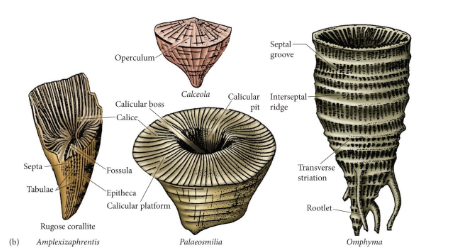
Anthozoa: Rugosa
solitary or colonial
calcite skeletons
robust, horn-shaped
prominent septa (6 primary, secondary arranged in 4 spaces
Middle Ordovician to End Permian
Anthozoa: Tabulata
colonial (many corallites living together)
calcite skeletons
reduced speta
prominent tabulae
Middle Ordovician to End Permian
Anthozoa: Scleractinia
solitary or colonial
aragonite skeletons
prominent septa (divisible by 6
absent tabulae
Triassic — Recent (all modern corals)
Describe coral ecology
corals are benthic
reef building organisms that provide habitat/shelter
some natural predators (boring animals, parrot fish)
All modern corals form two groups:
Hermatypic — symbiotic algae called zooxanthellae (dinoflagellates)
Ahermatypic — no symbiotic algae and grow slow in cold deep water
What are the two most productive ecosystems?
Reefs and Rainforests
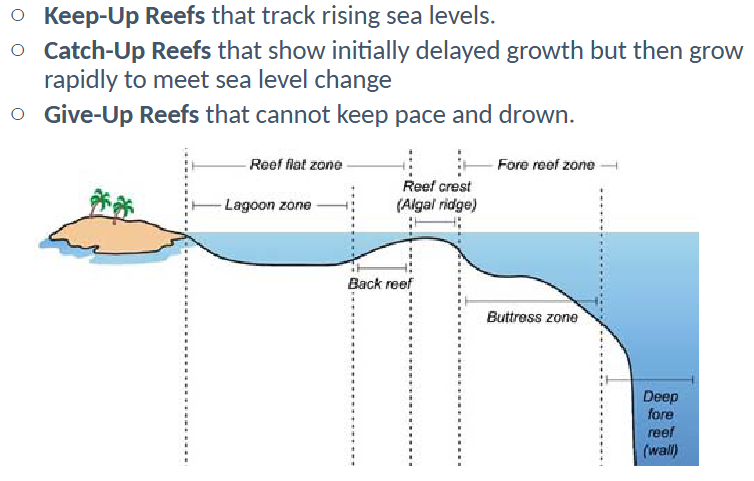
What are keep-up, catch-up, and give-up reefs?
What are the three major kinds of coral reefs?
Fringing
Barrier
Atoll
Darwin’s Reef Formation VS Daly’s Reef Formation
Darwin and Daly's theories of reef formation differ primarily on the driving mechanism for the transition from fringing reefs to atolls: Darwin proposed a long-term subsidence (sinking) of volcanic islands, while Daly argued for changes in eustatic sea level (glacial control) over pre-existing platforms
Fringing → Barrier → Atoll
Both partially right
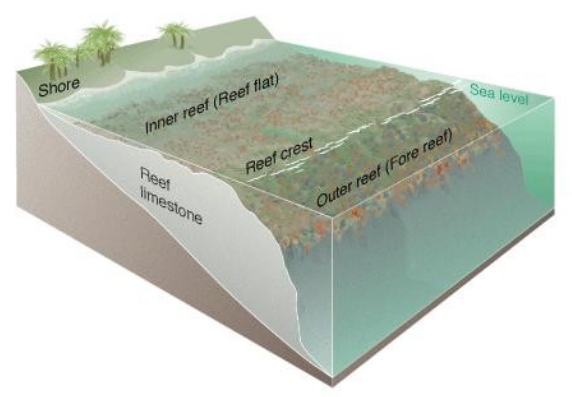
Describe Reef Anatomy
The 'Fore Reef Slope' (Zone 10), is the portion of the reef below storm wave base. Coral forms are often platy to catch sunlight
The 'Fore Reef Escarpment' (Zone 11) the most seaward part of the reef, consists primarily of storm derived coral rubble
The lowermost part of the 'Reef Crest' is known as the barren zone (Zone 6) and is almost exclusively comprised of Elkhorn coral groves in Caribbean reefs
The middle part of the 'Reef Crest' (Zone 5) is the highest part of the reef.
Large portions of the reef crest and flats (Zone 4) can be exposed during low tide.
The rear 'Back Reef' zone of the 'Reef Crest' (Zone 3) begins where the reef flats begin to slope downwards towards the lagoon and continues to the point where the reef flats
The 'Lagoon' (Zone 2) is usually floored by fine calcareous mud derived primarily breakdown of coralline algae and can also be covered by sea grass
Lophophores
complex tentacled feeding structures
Lophophorates
organisms with lophophores
similarities in structure of body cavities
Brachiopods and Bryozoans
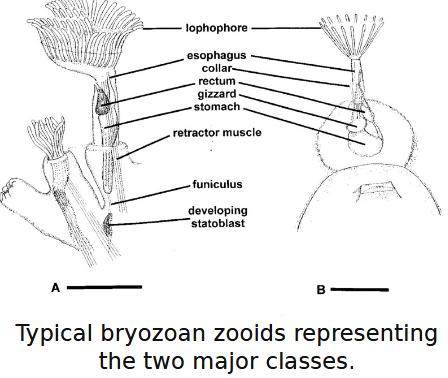
Bryozoan Morphology
“moss animal” → colony of zooids
each zooid encased in a protective covering
skeleton mineralized with calcite → zooecia
funiculus — tissue cords that connect zooids (to distribute nutrients)
each zooid has a lophophore feeding structure (8-100 tentacles - circular or u-shaped)
lophophore tentacles gather and put food in mouth (center)
u-shaped guts (mouth is next to anus)
Bryozoan Reproduction
Asexual — budding of new zooids for colony expansion, broken pieces start new colony
Sexual — release sperm + eggs for external fertilization, captured with tentacles, brood chamber, produces free-living larvae that will settle
Bryozoan Ecology
marine, sessile benthos
sublittoral zone
some deep water forms
body plans linked to feeding strategy and environment
colony ~ environmental conditions
zooid size ~ water temperature (proxies)
facies dependent
fan-like shape = low energy
coral-like shape = high energy
Bryozoan Evolution
first appearance in lower Ordovician (possibly early Cambrian)
Brachiopods are split into two groups…
Inarticulate (no hinge) and Articulate (hinge)
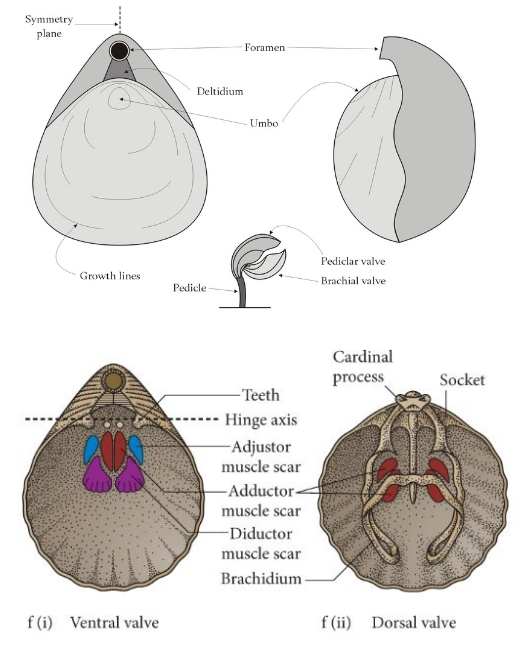
Brachiopod Morphology
Two valves — brachial (dorsal) valve and pedicle (ventral) valve → not identical, symmetric midline
pedicle valve usually larger
interlocking teeth and cardinal process (articulate species)
Lophophore anchored to upper brachial valve
Pedicle for anchoring to substrate
Muscles for opening and closing (muscle scars on valves)
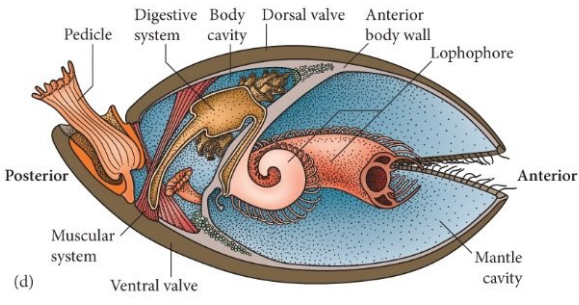
Brachiopod Feeding
Lophophores capture food particles brought to mouth along brachial groove
Draw water from sides and expel through front (produce little solid waste)
Unlike Bryozoans, lophophore is not retractable and has supports (brachidium)
In some inarticulate forms there is a u-shaped gut with a separate anus, other species have a curved gut that just ends
Most forms reverse the movement of the lophophore cilia or “sneeze” to expel blockages or any solid waste
Brachiopod Reproduction
Sexual Reproduction
external fertilization (release sperm + eggs in water)
some have brood chamber
distinct male/female
Lingulid larvae swim and filter feed as plankton
swim and feed with lophophore
increase size, sink to bottom and become sessile
Articulate brachiopods only exist as plankton for a few days
Brachiopod Ecology
suspension feeding benthos
anchor to substrate using pedicle and filter feed with lophophores
some infaunal and unattached forms
coral-like forms
valve morphology ~ environmental conditions + energy levels
some with clasping spines to connect with substrate
stable isotopes in shells reflect environmental conditions
Brachiopod Evolution
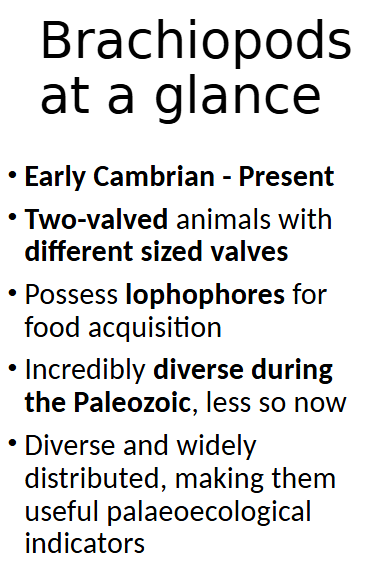
Early Cambrian — Recent
Survived 5 mass extinctions
Late Ordovician extinction reduced 80%
Permo-Triassic extinction reduced 90%
What are the origins of Brachiopods?
Outdated — Brachiopod Hypothesis
evolved from Halkieria-like ancestor
two protective shells on either size of body that folded in on itself
Current, Accepted Hypothesis
related to tommotiids (extinct Cambrian invertebrates)
two valves
evolved as a result of retaining the bivalved larval characteristics of some tommotiid taxa
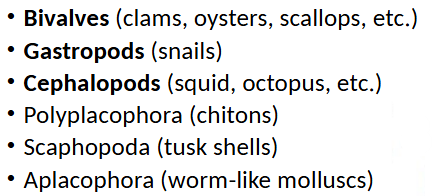
Mollusca Groups include…
General Mollusca Morphology
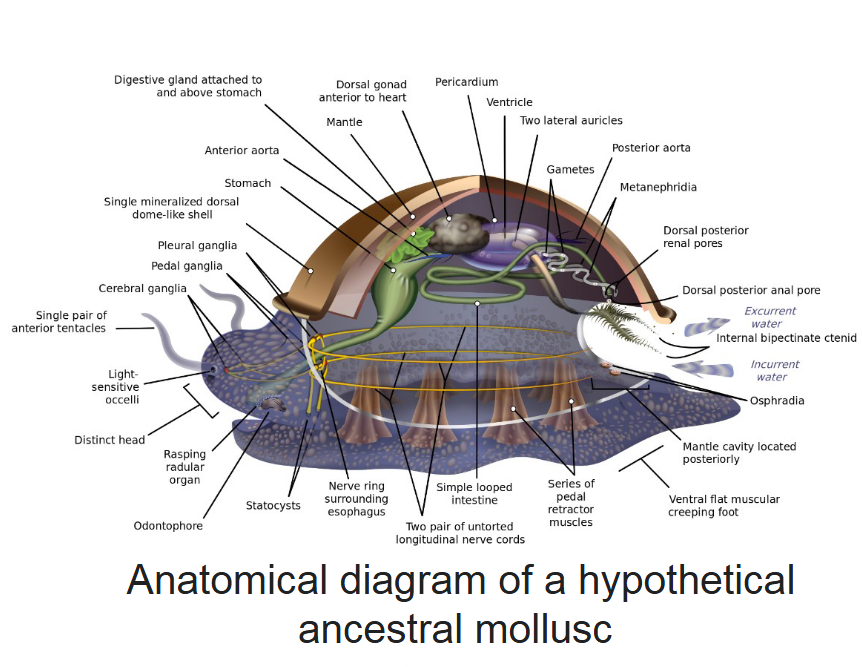
unsegmented, soft body
bilateral symmetry (distinct head and tail)
feeding structure = radula (except for bivalves)
muscular foot for movement (burrowing, swimming) — can be highly modified
calcareous shell for protection
head - contains sensory organs and radula (made of chitin)
visceral mass - digestive, excretory, reproductive, circulatory systems in celomic cavity
mantle - sheet of tissue, dorsal to visceral mass, secretes the shell
What are Monoplacophorans?
single-shelled mollusc that inhabit deep water (once thought to be extinct)
soft-parts are segmented; shell is limpet-like in shape
What are Bivalvia?
clams, oysters, etc.
2 valves
intertidal to marine and freshwater
variety of ecological strategies (attached, free swimming, burrowing, etc.)
good facies fossil
Bivalve Morphology
two valves, secreted by mantle
plane of symmetry parallel to commissure
no head - anterior determined by position of the mouth
interlocking teeth and sockets called dentition
ligament along hinge line pops shell open
adductor muscles keep shell closed
pallial line is scar where mantle attaches
beak/umbo — earliest part of shell to form, where growth lines extend from
Bivalve Reproduction
male or female, some hermaphroditic
marine bivalves release sperm/eggs in water
larvae mature in plankton (some feeding, some exist on yolk sac)
Bivalve Feeding
mostly detritivores
some scrape detritus off sea floor
gills (ctenidia) modified into filter-feeding apparatus
water pulled into shell from posterior (sometimes uses siphons), passes over gills and then is expelled
food particles moved by cilia through mucus on gills to mouth
exceptions
some “suck” prey into mouths
giant clams + symbiotic algae
ship worms + bore into wood
endosymbiotic form in sea cucumber esophagus
Bivalve Evolution
earliest forms have 2 valves with a working hinge and ligament
may have evolved from Rostroconcha (no functional hinge)
Early Cambrian — Present
appeared in Early Cambrian
evolved rapidly in Ordovician
stable low diversity in Paleozoic
radiated in the Mesozoic
Long siphons (burrowing) and muscular foot (mobility) may have been advantageous over brachiopods
General increase in size over history
Bivalves VS Brachiopods
Brachiopods
2 valves
feed with lophophore
middle of valve symmetry (intravalve)
attach via pedicle
Bivalves
2 valves
filter feed with gills
symmetry between valves (intervalve)
muscular foot