Macroevolution (Ch16) edit
 Call Kai
 Learn
Learn Practice Test
 Spaced Repetition
 Match
Match Flashcards
 Knowt Play
1/24

There's no tags or description
Looks like no tags are added yet.
Name | Mastery | Learn | Test | Matching | Spaced | Call with Kai |
|---|
No analytics yet
Send a link to your students to track their progress
25 Terms
Define macroevolution
Evolution above the species level
Explain the transitional stages to determine the origin of major life forms
Intermediate steps are often documented in the fossil record, however transitional stages may not have lasted long and may not have left much fossil evidence.
Some common themes emerge:
→Many characters evolve gradually
→Evolution is usually mosaic
→Modular elements become individualized
→Major changes in form often associated with changes in function
Bones in the middle ears of mammals evolved from the bones of the
skull and lower jaw of synapsid ancestors:
articular and quadrate bones that originally served for jaw articulation, became the sound-transmitting middle-ear bones in mammals.
Explain gradualism and saltation in the origin of major life forms
→Gradualism: Darwin proposed that evolution proceeds gradually by small steps
→Saltation:
Gradualism, a concept proposed by Darwin, suggests that major life forms originate through the accumulation of small, incremental steps over long periods,. This process is often documented in the fossil record through intermediate stages, such as the gradual increase in body size within the horse family or the evolution of complex organs like the eye through useful gradations,,.
Saltation is the theory that higher taxa arise in single evolutionary steps as entirely new genetic systems. While this idea—originally associated with the concept of "hopeful monsters"—has been largely repudiated, some large evolutionary changes can result from single mutations, such as the loss of tails in apes caused by a specific transposon insertion,.
A related concept, punctuated equilibrium, describes a pattern where long periods of stability (stasis) are interrupted by rapid bursts of change, which may be the most common method of macroevolution,.
How can paleontology come to the rescue?
Paleontology "comes to the rescue" by providing fossil evidence for intermediate steps that are otherwise missing among living (extant) species. This is particularly crucial for explaining puzzling features that might seem to require a sudden, saltational origin because their transitional stages are difficult to imagine.
Key examples include:
The Turtle's Shoulder: The discovery of the fossil Odontochelys solved the mystery of how the shoulder blade moved from outside to inside the rib cage.
Whale Evolution: Fossils document the gradual transition of land-dwelling mammals into aquatic whales through various intermediate forms like Pakicetus and Rodhocetus.
Tetrapod Origins: The fossil record illustrates the gradual acquisition of limbs and other land-dwelling features from lobe-finned fish ancestors.
What are 2 examples of large evolutionary changes that resulted from a single mutation?
Loss of tail in apes: caused by the insertion of a transposon into a gene called TBXT. Causes one of the gene’s exons to be spliced out of the RNA transcript, disrupting a key pathway in tail development.
Alleles with large effect contribute importantly to Müllerian
mimetic phenotypes in Heliconius
In some cases, the mutation merely extends or truncates an evolutionary trajectory
The few genetic changes that determine
the difference between metamorphosing
tiger salamanders and the paedomorphic
axolotl truncate an integrated
developmental pathway
Explain the evolution of complex characters, using the eye example
The evolution of complex characters, such as the eye, occurs through numerous useful gradations where each intermediate stage provides a survival advantage to the organism. The specific evolutionary steps "a" through "f" illustrate this gradual progression:
a) Region of photosensitive cells: Simple photoreceptors and nerve fibers allow for basic light detection.
b) Depressed/folded area: Folding of the photosensitive region provides limited directional sensitivity.
c) "Pinhole" eye: A water-filled chamber with a small opening allows for finer directional sensitivity and limited imaging.
d) Transparent humor in an enclosed chamber: The development of transparent humor within the chamber begins to refine the internal structure.
e) Distinct lens: A lens develops behind a cornea to focus light more effectively.
f) Iris and separate cornea: The final stage adds an iris for light regulation and a separate cornea for protection and focus, resulting in a complex camera-type eye.
While stages "a" and "b" are widespread among simple organisms, and "c" is common in molluscs, fully image-forming eyes (stages "d" through "f") have evolved independently at least 12 times across diverse lineages.
Explain the evolution of novelty, include exaptation
Novelty in evolution refers to the emergence of a new phenotypic trait, while an innovation is a novel character that significantly impacts an organism's ecology and evolutionary trajectory.
Exaptation is a key mechanism for generating novelty, where a feature originally evolved for one purpose is co-opted for a different function. Examples include:
Penguin wings: Ancestral flight structures were modified for underwater swimming.
Wasp stingers: These evolved from modified ovipositors (egg-laying structures).
Mammalian middle ears: The bones for hearing evolved from bones that originally provided jaw articulation in synapsid ancestors.
Novelty also arises through decoupling functions, which "frees" a structure from ancestral constraints to evolve in new ways—such as lungless salamanders co-opting bones used for breathing to create specialized, long-extension tongues. Additionally, novelty stems from descent with modification, where existing homologous structures are reshaped into diverse forms, and changes in genetic regulatory networks that allow for the independent expression of shared pathways (deep homology) across distant lineages.
Novelty due to decoupling multiple functions of an ancestral feature
Decoupling occurs when a structure that originally performed multiple functions is "freed" from one or more of those roles, relieving functional constraints. This allows the feature to evolve in entirely new ways that were previously restricted.
A primary example is the loss of lungs in Plethodontidae (lungless salamanders). In other salamanders, specific bones are required for both supporting the tongue and moving air in and out of the lungs. Because these salamanders no longer need the bones for breathing, the structure was decoupled from that function and modified into a highly specialized, long-extension tongue used to catch prey.
Novelty due to changes in development
Novelty can arise from significant alterations in developmental pathways, often triggered by single mutations or shifts in genetic regulation:
Disruption of Key Pathways: A single mutation can have a large effect by interrupting development. For example, the loss of tails in apes was caused by a transposon insertion in the TBXT gene, which disrupted the normal pathway for tail formation.
Truncation (Neoteny): Mutations can truncate integrated developmental pathways. The axolotl is a prime example; while the tiger salamander undergoes metamorphosis, the axolotl retains its larval form into adulthood due to a truncated developmental trajectory.
Identity Frameshifts: Novelty can result from shifting the "identity" of developing structures. In the evolution of bird hands, a developmental "frameshift" transformed the identity of digits from their ancestral positions in theropod dinosaurs.
Deep Homology: Shared character identity networks, such as the genetic pathway governed by the Distal-less gene, can be independently expressed to create diverse body outgrowths across distantly related lineages.
Explain homology and the emergence of novelty.
The emergence of novelty often relies on homology, as "new" characters frequently arise through "descent with modification" by repurposing and individualizing existing structures. This process is supported by character identity networks, where ancient genetic pathways are co-opted to create vastly different features, such as mammalian middle ear bones evolving from ancestral jaw bones. These innovations represent novel phenotypic traits that can significantly alter an organism's ecological role and overall evolutionary trajectory.
→Example: The false “thumb” in pandas is not a true digit, but rather an enlarged sesamoid. And the patella is a modified sesamoid
Evolution of novelty related to character identity networks
Character identity networks are comprised of strongly interacting gene groups that establish the developmental foundation for homologous features across different species. These networks can lead to deep homology, where ancient genetic regulatory pathways are independently expressed in distantly related lineages to create vastly different structures, such as limbs or other body wall outgrowths.
→Example: Genetic pathway governed by Distal-less gene is the basis for very different structures in distantly related animals; common feature is
that they are outgrowths of the body wall.
From Microevolution to Macroevolution
Macroevolution refers to evolutionary patterns occurring above the species level, utilizing the same basic processes as microevolution but differing significantly in its vast scale.
→This transition occurs as small, adaptive changes accumulate over long periods, often fueled by the availability of open niches and shifts in natural selection pressures.
Rates of Evolution
Rates of evolution can be highly variable within a lineage, though average rates of change are typically lower over long geological periods than over short intervals.
→While "living fossils" demonstrate that some organisms change very little over millions of years, even low evolutionary rates can produce large-scale phenotypic changes if given enough time.
Punctuated Equilibrium
Punctuated equilibrium is an evolutionary model characterized by long periods of stasis, where little to no morphological change occurs, interrupted by brief, rapid bursts of significant change.
→This pattern, the most common method of evolution, suggests that major phenotypic shifts often happen relatively quickly in geological time rather than through a slow, constant progression.
Is Evolution Predictable?
Predictability vs. Historical Contingency
So…Yes AND No
Explain predictability in evolution
Selection equations deterministically predict allele frequency changes in large populations
→Ex: Organisms conform to physical principles, and some morphologies have evolved repeatedly in similar ecological contexts
Convergent evolution supports the idea of predictability.. however?
While convergent evolution supports the idea of predictability, the course of evolution often depends on historical contingency, such as rare mutations and the specific sequence of environmental changes.
→Furthermore, unpredictable mass extinction events can cut short the evolutionary future of various lineages, making survival a matter of being in the right place at the right time.
What do mass extinction events cause?
Mass extinction events cut short the possible evolutionary future of many lineages. Who survives is often a matter of being in the right place at the right time.
Evolutionary Trends
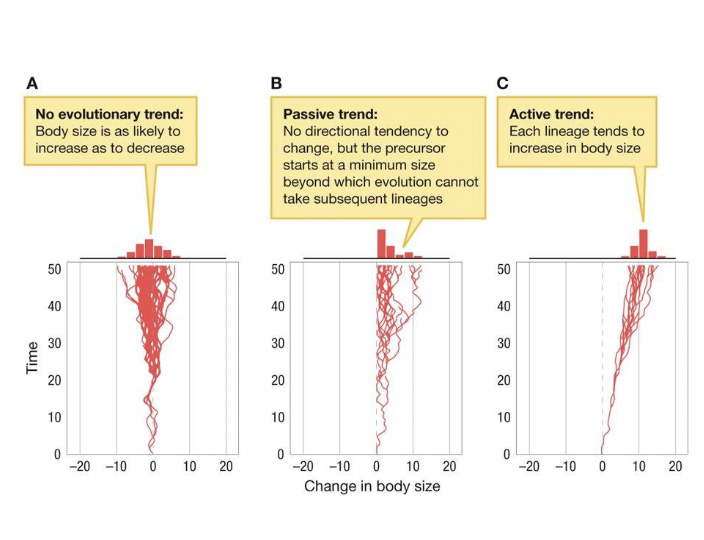
Evolutionary trends are persistent, directional changes in the average value of a specific phenotypic feature within a clade over the course of time. These patterns are categorized as:
→Passive trends: Where change is limited by a physical boundary
→Active trends: Where lineages exhibit a consistent tendency to shift toward a specific trait value, such as increasing body size or complexity.
Explain Cope’s rule
Cope’s rule is a macroevolutionary trend characterized by a persistent, directional increase in the average body size of organisms within a clade over time.
→Example: The horse family (Equidae), which saw its body mass increase tenfold over the last 25 million years as lineages evolved from small ancestral forms like Hyracotherium to the much larger modern horse.
Explain Evolution of Complexity
The evolution of complexity is an active trend where a clade’s mean complexity increases over time, driven by either parallel directional changes across lineages or the selective survival of more complex subclades.
→This macroevolutionary pattern allows for the development of sophisticated features (like the eye, through a series of gradual functional stages that are each beneficial to the organism)
Explain the 2 processes responsible for active trends
Active trends are caused by either the fortuitous extinction and origination of a few major subclades that happen to have different mean trait values or by driven trends, where parallel directional changes occur within most constituent lineages.
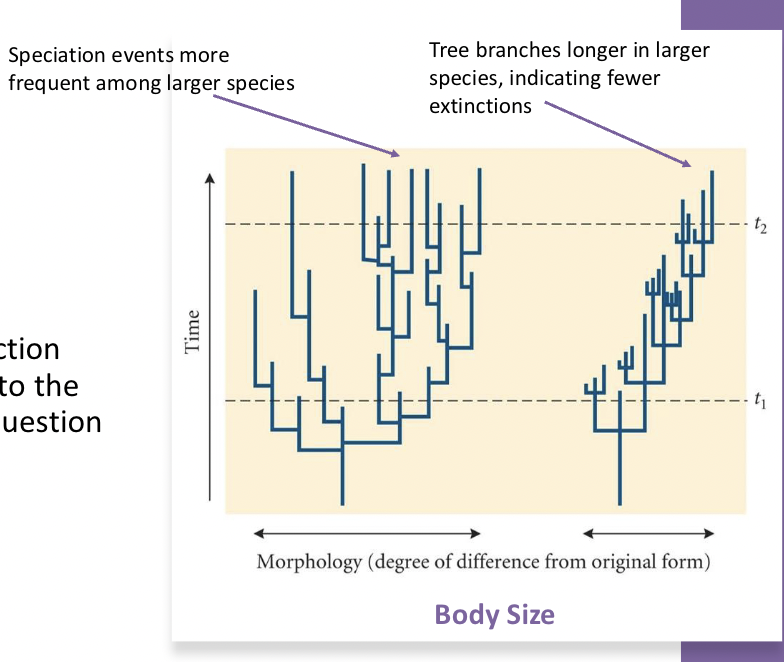
→This macroevolutionary pattern is often the result of species selection, a process where the rates of speciation and extinction vary according to the specific value of a phenotypic trait.
Explain species selection
Species selection is where the rates of speciation and extinction vary based on the specific value of a phenotypic trait.
→This means certain characteristics become more prevalent over time if the lineages possessing them produce more daughter species or survive longer than lineages with alternative traits.