Psychology part A, ch. 6 - Cognitive Ergonomics
 Call Kai
 Learn
Learn Practice Test
 Spaced Repetition
 Match
Match Flashcards
 Knowt Play
1/24

There's no tags or description
Looks like no tags are added yet.
Name | Mastery | Learn | Test | Matching | Spaced | Call with Kai |
|---|
No analytics yet
Send a link to your students to track their progress
25 Terms
Ergonomics
“the study of how humans accomplish work-related tasks in the
context of human-machine system operation, and how behavioral
and nonbehavioral variables affect that accomplishment” (Meister,
1989)
—> broad interpretation “human-machine system”
What are the two main objectives in ergonomics?
Improvement of effectiveness and efficiency (effectiveness - correct execution of tasks, efficiency - ration work output / human effort)
Improvement in terms of human values (safety, comfort, fatigue, stress)
Tell me about the shift away from traditional approach ergonomics
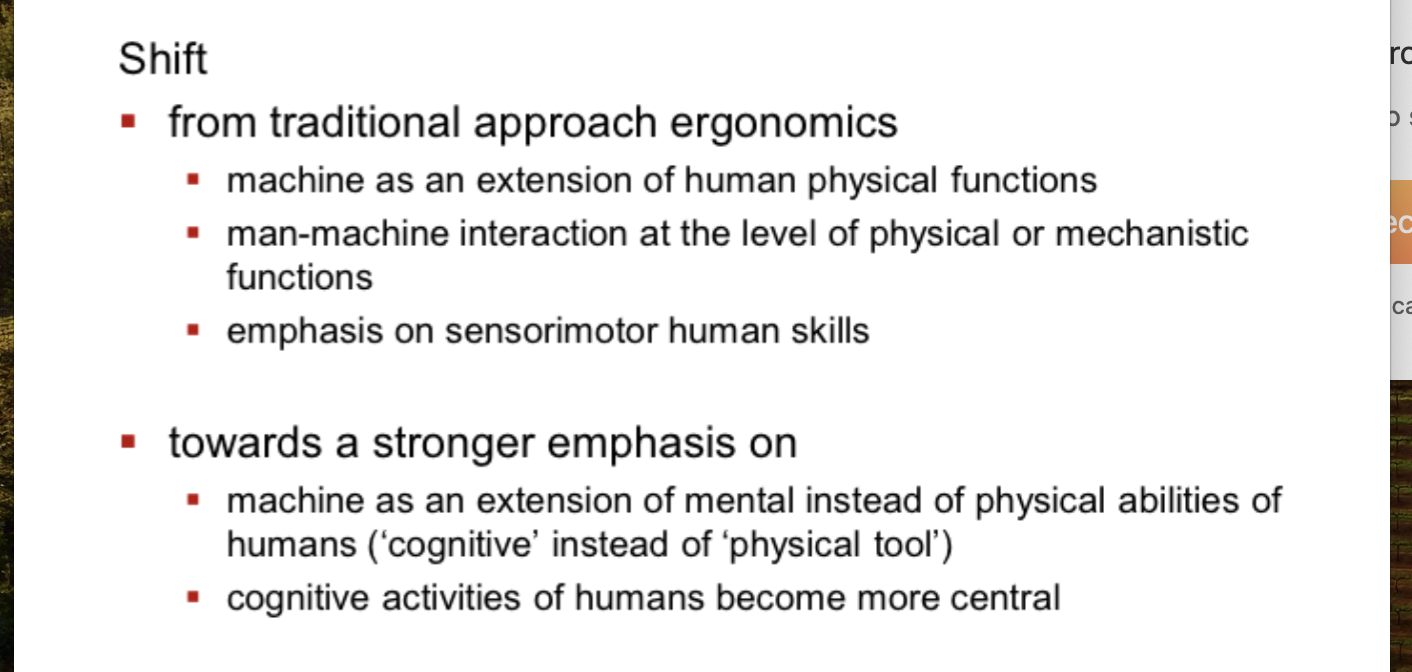
cognitive ergonomics
Cognitive ergonomics is the study of how mental processes — such as attention, memory, perception, decision-making, and problem-solving — interact with systems, technology, and environments.
whats the goals of cognitive ergonomics?
develops models of human performance that can aid designers of human-machine systems
applies psychological principles to the design of human-machine systems
improvement of effectiveness and efficiency (e.g., increase
productivity & quality, reduction of training time)Improvement in terms of human values (increase in terms of
safety, comfort, usability, user satisfaction, and decrease in terms of fatigue/exhaustion, stress, errors, accidents, injuries…)
tell me cognitive human components 4
attention
information processing
memory (STM/LTM)
decision making
Wickens model of human information processing
Wickens’ Model explains how humans process information step-by-step when interacting with their environment. It is commonly used in cognitive ergonomics and human factors psychology.
Allows a better understanding of potential restrictions / limitations of human performance
Model provides different perspectives to examine and analyze real situations and point towards (potential) human error.
What restrictions and limitations do humans have? 7
Absolute threshold
difference/differential threshold (JND)
Inattentional blindness / change blindness
Working memory or short-term memory contain a limited amount of attended information that has been perceptually processed
multitasking
task-switching
automatic and controlled processing
Whats the hazard control hierarchy?
design out / eliminate hazard
guard against hazard
warn
Why do we use symbols instead or words as warnings? 4
sometimes to avoid language barriers
compact presentation of message
a picture is worth a thousand words… if it’s the right one
symbol often faster processed compared to word(s) IF the symbol visually represents what it is supposed to in a reliable and accuratemanner
give examples of graphic symbols
entrance, exit, information desk
tell me what is needed so the intended message of a symbol Is clear
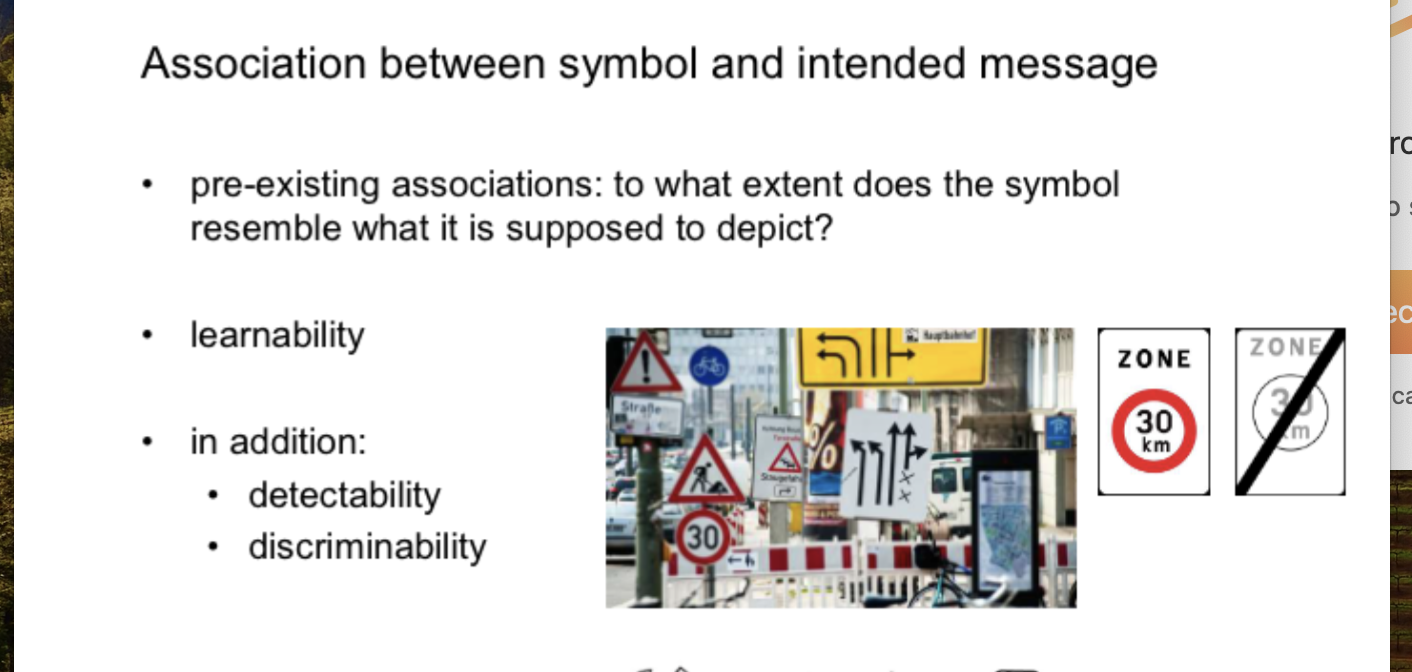
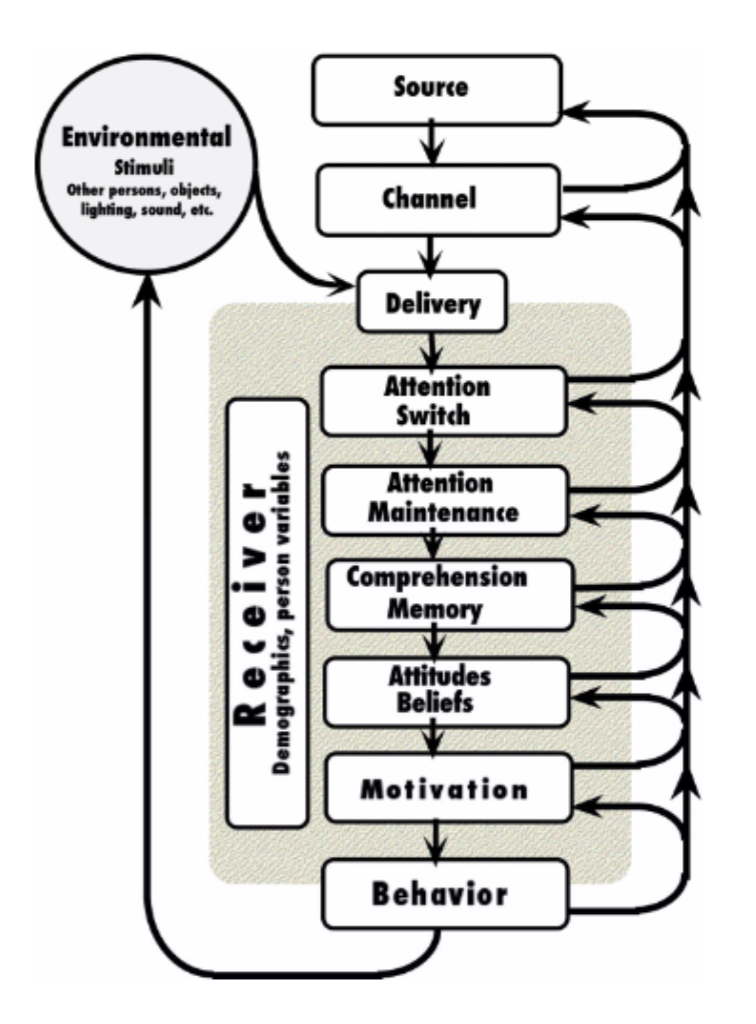
Look at the communication human information processing (C-HIP) model
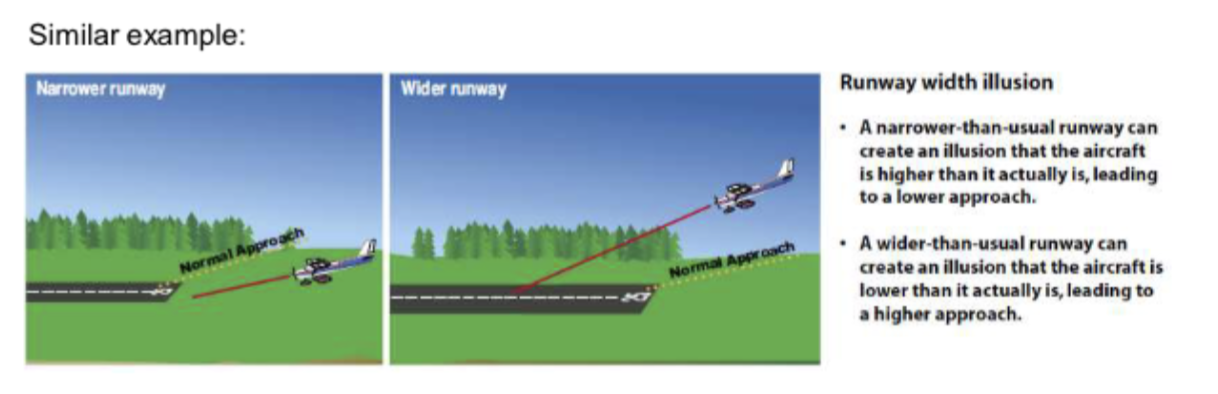
Runway width illusion
What are the three main memory stores in human information processing?
1. Sensory Store
Holds incoming sensory information for a very short time
Large capacity, but information fades quickly
Information comes from senses like vision and hearing
Examples:
Iconic memory = visual
Echoic memory = auditory
2. Short-Term / Working Memory
Temporarily stores and processes information currently being used
Limited capacity (about 7 ± 2 items) (recently only 4 or 5 +- 2)
Information lasts around 15–30 seconds without rehearsal
Functions:
Mental calculations
Following instructions
Problem-solving
3. Long-Term Memory
Stores information for long periods (minutes to lifetime)
Very large or possibly unlimited capacity
Information is encoded meaningfully
Examples:
Facts
Skills
Personal memories
Brown-Peterson paradigm:
The Brown-Peterson Paradigm is a psychology experiment used to study short-term memory duration without rehearsal.
Procedure:
Participants are shown items to remember (e.g., three letters: “XQF”).
Immediately after, they perform a distracting task (like counting backwards by 3s).
After a delay, they try to recall the original items.
Findings:
Recall decreases rapidly as the delay increases.
Without rehearsal, information in short-term memory fades quickly (within about 15–30 seconds).
Key Idea:
The paradigm demonstrated that rehearsal is important for keeping information active in short-term memory
memory span
maximum number of items that can be perfectly recalled after single presentation
integrative/elaborative rehearsal:
a memory strategy where new information is linked to existing knowledge, meanings, or experiences to improve long-term memory storage.
Instead of simply repeating information, the person:
connects ideas together
thinks about meaning
creates examples or associations
Elaborative rehearsal leads to deeper processing and stronger long-term memory than simple repetition (maintenance rehearsal).
maintenance rehearsal
Maintenance rehearsal is a memory strategy where information is kept in short-term memory by simple repetition, without focusing on meaning.
Key features:
Involves rote repetition (e.g., repeating a phone number over and over)
Helps keep information active in short-term memory
Does not strongly transfer information into long-term memory
Key idea:
Maintenance rehearsal keeps information temporarily available, but it is less effective for long-term retention compared to elaborative rehearsal.
What are the free recall task and serial position curve?
free recall task: A memory task where participants are shown a list of items and later asked to recall them in any order (no cues provided).
Purpose:
To study how information is stored and retrieved from memory.
Serial position curve: A pattern of results from free recall tasks showing that recall depends on an item’s position in a list.
Key idea: We remember the first and last items best, but the middle items are usually forgotten.
what two main effects does the serial position curve have?
1. Primacy Effect
Better recall of items at the beginning of the list
Because they are rehearsed more and stored in long-term memory
2. Recency Effect
Better recall of items at the end of the list
Because they are still in short-term/working memory
Simon effect
The Simon effect is a phenomenon where reaction times are faster and more accurate when the stimulus location matches the response location, even if location is irrelevant to the task.
Example:
Pressing a left/right button faster when a stimulus appears on the same side as the correct response.
Key idea:
Irrelevant spatial information still influences attention and response selection.
Stroop effect
The Stroop effect occurs when there is interference between automatic reading and color naming, slowing down reaction time.
Example:
The word “RED” printed in blue ink → harder to say “blue” because reading the word is automatic.
Key idea:
Automatic processes (reading) interfere with controlled processes (color naming), showing limits of attention and cognitive control.
Location compatibility
Location compatibility refers to how well the spatial location of a stimulus matches the required response location, which affects how quickly and accurately people respond.
Key idea:
People respond faster and more accurately when the stimulus and response locations are compatible (aligned), and slower when they are incompatible.
movement compatibility
Movement compatibility refers to how the direction or nature of a required response matches the direction or nature of a stimulus or intended movement, influencing how quickly and accurately a response is made.
Key idea:
Responses are faster and more accurate when the required movement is compatible with the stimulus movement or direction, and slower when it is incompatible.