L21 - Time Course of Drug Action
 Call Kai
 Learn
Learn Practice Test
 Spaced Repetition
 Match
Match Flashcards
 Knowt Play
1/127

There's no tags or description
Looks like no tags are added yet.
Name | Mastery | Learn | Test | Matching | Spaced | Call with Kai |
|---|
No analytics yet
Send a link to your students to track their progress
128 Terms
What is pharmacodynamics?
The biochemical and physiological action of a drug on the body. This included its mechanism of action and correlation of the magnitude of the drug's effect with its chemical structure and concentration
What is the aim of drug therapy?
To achieve and maintain an optimal concentration of drug at site of action
If the concentration of a drug at a receptor site is too low, how does this alter its effect?
There will be little to no effect
If the concentration of a drug at a receptor site is too high, how does this alter its effect?
There will be side effects and toxicity
What two factors play a role in achieving the optimal concentration at the receptor site?
The dose administered and the pharmacokinetics of the drug (ADME)
Can we measure the actual concentration at the receptor site in a person?
Not really, but we can measure plasma concentration to know extent and duration of drug action
Pharmacodynamics
The relationship between drug concentration at receptor sites and pharmacological response. What the drug does to the body
Pharmacokinetics
Quantitative description of the relationship of the dose, concentration of the drug in various body fluids, and time. What the body does to the drug
What does understanding pharmacokinetics allow?
Understanding of the temporal (time) and spatial (space) distribution patterns of that drug in the body
What controls the amount of drug in each compartment/fluid in the body?
ADME or the pharmacokinetics of the drug
Absorption allows:
The drug to enter the blood stream and circulation
Distribution allows:
The drug to reach the receptor site
Metabolism and Excretion allow:
The removal of the drug from the body
What is done in order to understand the amount of drug that has entered the circulation and the PK/PD of the drug?
The drug is administered and blood samples are collected repeatedly over time. This allows a diagram showing the drug concentration curve
The concentration of the drug can be found in the blood using either:
Plasma or serum
What is plasma?
The liquid portion of the blood that contains fibrin and clotting factors
What is serum?
Plasma without fibrin or clotting factors
Plasma and serum concentrations are relatively the same except when?
Unless the drug is targeting clotting factors or is taken up by blood cells
What is meant by "plasma perfuses all the time"?
It refers to a continuous flow or circulation of plasma throughout the body
Because plasma perfuses all the time, this ensures what?
That drugs are most likely going to reach their target tissue if they have the correct physicochemical characteristics
Since it is hard to measure drug concentration is tissues, what is used instead?
Plasma concentrations and physicochemical properties
Drugs exist in two forms in the body, what are they?
Free drug and bound to proteins
Can free drugs or bound drugs leave the circulation to enter tissues?
Free drug
1 multiple choice option
The rate of drug distribution depends on?
The extent of perfusion of the tissue by the blood
Drug distribution in well perfused tissue
The drug is in dynamic equilibrium with the blood and tissue instantaneously. If drug concentration increases in the blood, so does the concentration in the tissue
Drug distribution in poorly perfused tissue
The drug equilibrium with the tissue is slow and delayed. If drug concentration decreases in the blood, it could still be increasing in the tissue
When does concentration of drug become the same in the tissue and the blood regardless of perfusion?
At equilibrium
We can use the plasma concentrations of a drug to develop mathematical models to describe?
Drug disposition (its distribution and elimination)
What are the two kinds of pharmacokinetic compartment models used to describe drug disposition?
One compartment and Two compartment model
One compartment model
The plasma and well-perfused tissue the drug penetrates behave as if they were in ready equilibrium with the blood. There is instantaneously distribution
Two compartment models
Consists of a central compartment and peripheral compartment. The central compartment has instantaneous distribution. The peripheral compartment is secondary to the central compartment to receive the drug. This is the poorly perfused tissue and there is slow distribution.
What is the plasma level curve?
A graph of drug concentrations in the plasma as a function of time after dose administration. Graphed as plasma concentration (y) vs time (x)
The concentration of a drug in the plasma as a function of time after dose administration is determined by the rate of what two processes?
The rate of drug appearance into the plasma (administration) and the rate of elimination from the plasma (metabolism + excretion)
What is Cmax?
The maximal concentration of a drug in the plasma
What is Tmax?
The time to reach maximum concentration (Cmax)
The rate and extent of absorption varies with the type of administration. List three common types
Oral drug administration, IV drug administration, and topical administration
What factors affect the rate and extent of absorption in oral drug administration?
The dissolution rate of the drug, the physicochemical properties, the formulation, its stability in GI fluids, etc.
Describe the rate and extent of absorption in IV drug administration
The drug is injected directly into the blood stream so there is no absorption taking place.
IV bolus administration
Drug enters the plasma instantly
IV infusion administration
The drug is slowly dripped into the vein and the input rate of the drug into the plasma is equal to infusion rate
Describe the rate and extent of absorption in topical drug administration
The drug mainly remains at site of administration but may be absorbed and cause unwanted effects
What is a first-order process?
The rate of change is directly proportional to the concentration of a single substance.
What is a zero-order process?
The rate of change is independent of the concentration of the substance involved. The process occurs at a constant rate, regardless of how much of the substance is present
Absorption is a ______-order process
first
2 multiple choice options
What is meant by absorption is a first order process?
The rate at which absorption occurs is dependent on the amount of drug available for absorption
The absorption rate is dependent on what physiochemical properties of the drug?
Its ionization state (unionized) and its partition coefficient (high-ish)
Give the equation to find the absorption rate
Absorption rate = Ka x Ca
What is Ka? Ca?
The absorption rate constant; the concentration of the drug available
Drugs are sometimes absorbed by carriers and transporters, how does this affect the absorption rate constant at LOW concentrations of the drug?
The absorption rate will be a first-order process because not all carriers are saturated, and it is still dependent on concentration.
The rate constant will be equal to (Vmax/Km).
Reminder: What is Km?
The substrate concentration at which an enzyme/carrier operates at half of its maximum velocity (Vmax).
Drugs are sometimes absorbed by carriers and transporters, how does this affect the absorption rate constant at HIGH concentrations of the drug?
The absorption rate will be a zero-order process because all carriers are saturated and not dependent on concentration.
The rate constant will equal (Vmax)
What is bioavailability?
The percentage of the administered dose that reaches the systemic circulation. It is an indicator of the extent of absorption
What route of administration exhibits 100% bioavailability?
IV administration
Why do other routes of administration not reach 100% bioavailability?
Incomplete dissolution, insufficient time, decomposition/metabolism (by stomach acid), poor permeability, and efflux at the absorption site
Even if other drugs are able to be absorbed into the circulation, what factors can decrease its bioavailability?
Pre-systemic metabolism, physiological/pathological issues in patients, and drug-drug/drug-food interactions
When does Cmax start?
When the rate of absorption equals the rate of elimination. No longer being absorbed, max concentration
The blue line
What line exhibits a drug being absorbed into the central compartment?
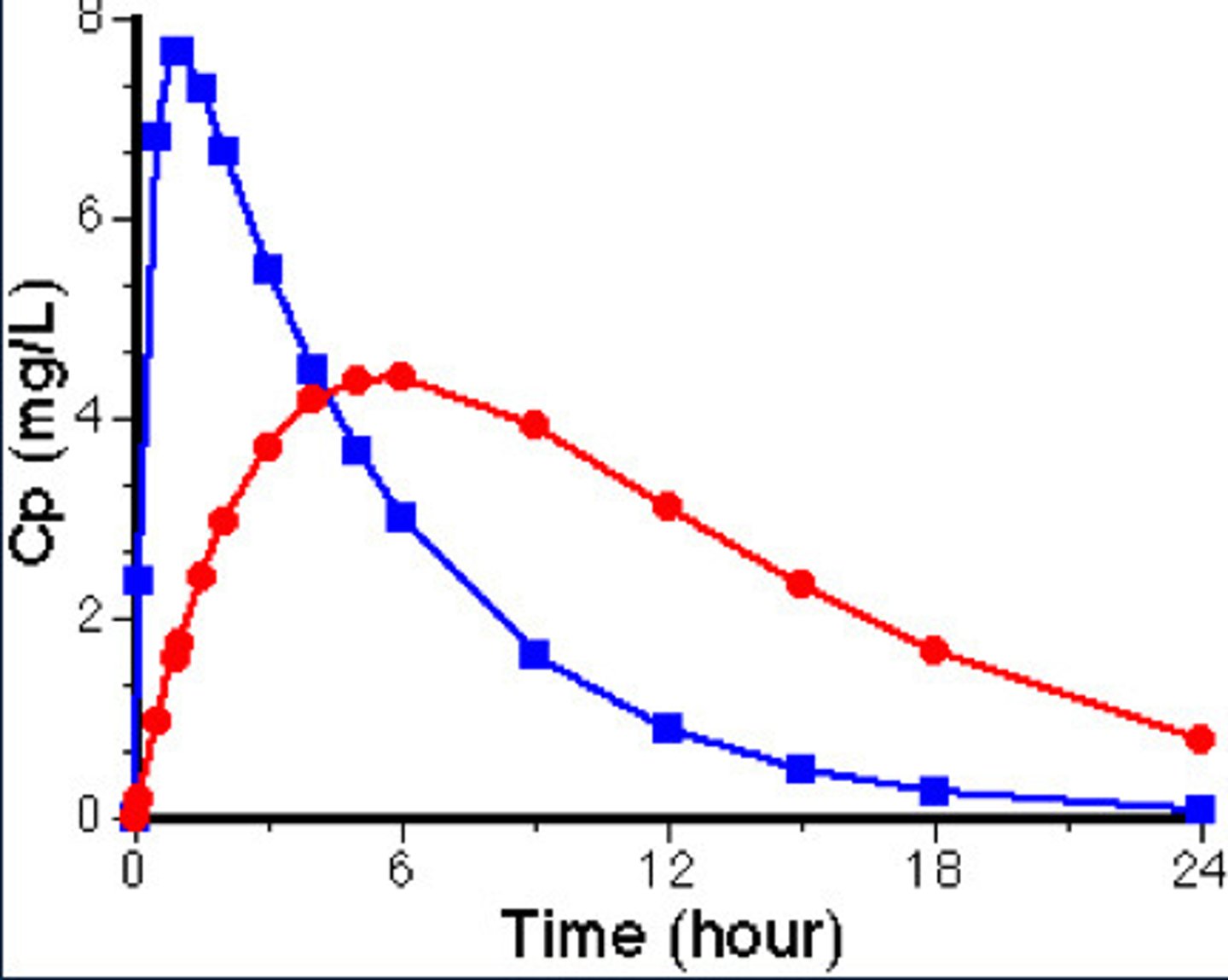
The red line
What line exhibits a drug being absorbed into the peripheral compartment?
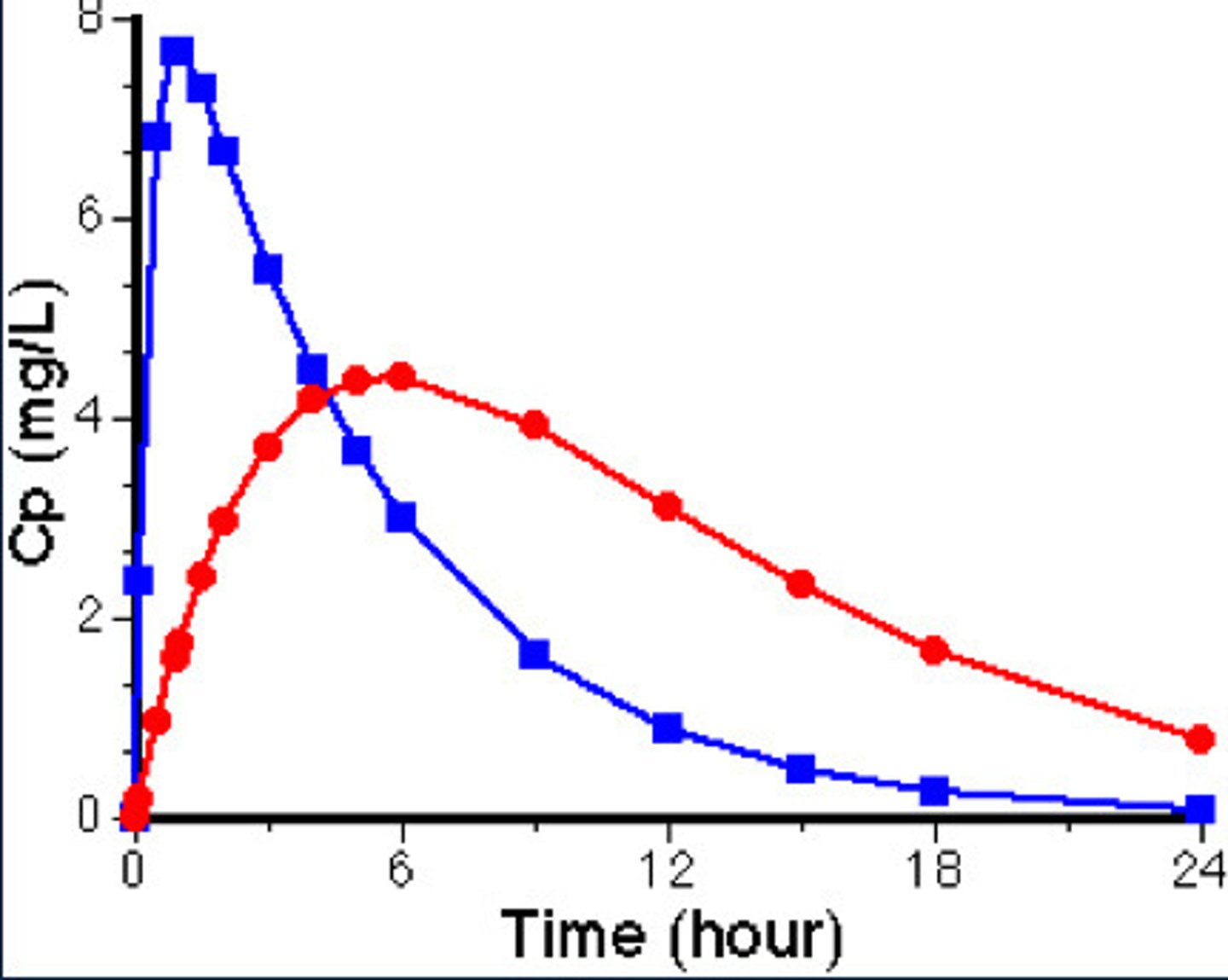
Define drug distribution
The reversible transfer of drug from one location in the body to another. (from vascular space to extravascular space)
Vascular space vs extravascular space
Vascular space: blood vessels
Extravascular space: the rest of the body, including tissues and organs
Why is the rate of distribution a property of just the drug molecule and not the formulation?
Once the drug is absorbed into the bloodstream, it has dissolved from the formulation and exists only as the API
What controls the rate of distribution?
Blood flow
The initial plasma concentration of a drug is determined by?
The dose administered and the volume of distribution
Give the equation to find the initial plasma concentration of a drug
Cp(0) = X / Vd
Cp(0) = initial plasma concentration
X = dose
Vd = volume of distribution
Reminder: What is the volume of distribution?
Theoretical volume that drugs have to distribute in body.
Drugs that can enter the interstitial fluid and even further into the intracellular fluid have a _______ volume of distribution because the total body volume is 40 L
large
1 multiple choice option
Drugs that only remain in the plasma have a _______ volume of distribution because the plasma is 3 L
small
1 multiple choice option
What could lower the volume of distribution?
The drug being bound to plasma proteins
What is the equation to find volume of distribution?
Vd = X / Cp(0)
Distribute the total volume of fluid in the human body between intracellular fluid, interstitial fluid, and the plasma
intracellular: 28 liters
interstitial: 9 liters
plasma: 3 liters
Intracellular fluid
Fluid within cells
Interstital fluid
Fluid between cells
Plasma
The fluid portion of the blood
The plasma and the interstitial fluid compose the ______cellular fluid
extra
1 multiple choice option
Drugs can further move from the interstitial space (extracellular) to the _______cellular fluid
intra
Well-perfused tissues receive the drug immediately and have a higher volume of distribution, so they will have a ________ concentration of drug in the plasma
lower
1 multiple choice option
What is the main reason for the decline in plasma concentrations in plasma near well-perfused tissue after drug distribution?
Elimination
Poorly-perfused tissues receive the drug slowly and have a lower volume of distribution, so they will have a ________ concentration of drug in the plasma
higher
1 multiple choice option
What is the main reason for the decline in plasma concentrations in plasma near poorly-perfused tissue?
Both distribution and elimination since distribution occurs slowly
What is elimination of a drug?
The decline in the plasma concentration of a drug over time
The rate of elimination depends on?
The clearance of drug from plasma and how much drug is in the plasma that can go through the kidneys and liver
A drug must be in the _______ to be eliminated
plasma
1 multiple choice option
If the volume of distribution is large, the drug is more likely to be found in the ________ and not be eliminated
tissues (extravascular space)
How is all the drug from the body able to be excreted if only the drug in plasma is acted on?
As the drug is eliminated from plasma, drug from tissue is pulled back into plasma to maintain equilibrium. The process continues until all the drug is removed from the body
What are the two major ways a drug is removed from the body?
Urine and metabolism
Metabolism and excretion are _____-order processes
first
2 multiple choice options
The higher the concentration of drug in the plasma, the _____ drug is removed
more
1 multiple choice option
The lower the concentration of drug in the plasma, the _____ drug is removed
less
1 multiple choice option
First-order processes follow ______ kinetics
linear
Linear kinetics
The rate of drug elimination is represented by a constant FRACTION per unit of time
(ex: 5 unit/h > 2.5 unit/h > 1.25 unit/h)
Zero-order processes follow ______ kinetics
non-linear
Non-linear kinetics
The rate of drug elimination is represented by a constant AMOUNT per unit of time
(ex: 2.5 unit/h > 2.5 unit/h > 2.5 unit/h)
What is half life?
A property of the drug that represents the time required for plasma concentration to decrease by 1/2 its value
If a drug is eliminated rapidly, it will have a ______ half-life
short
1 multiple choice option
If a drug is eliminated slowly, it will have a ______ half-life
long
1 multiple choice option
After about _______ half-lives, most drugs are considered to be effectively removed from the body (3% remaining)
5
Knowing that most drugs are considered eliminated after 5 half-lives, how long will it take a drug that has a half-life of 4 days to be eliminated?
20 days
(5 x 4 = 20)
Knowing that most drugs are considered eliminated after 5 half-lives, how long will it take a drug that has a half-life of 7 hours to be eliminated?
35 hours
(5 x 7 = 35)
Rank the rate of distribution, absorption, and elimination from fastest to slowest
Distribution > Absorption > Elimination
Absorption is _____ times faster than elimination
10