Week 2 - Sensory Physiology
 Call Kai
 Learn
Learn Practice Test
 Spaced Repetition
 Match
Match Flashcards
 Knowt Play
1/18

There's no tags or description
Looks like no tags are added yet.
Name | Mastery | Learn | Test | Matching | Spaced | Call with Kai |
|---|
No analytics yet
Send a link to your students to track their progress
19 Terms
2 Definitions: Receptors
General definition:
Receptors are protein molecules within a cell membrane or nucleus that chemical messengers can bind to, triggering responses within target cells. (e.g ligands connecting to chemically-gated ion channels)
Specific Definition to the nervous system:
Receptor cells that convert environmental stimulus into neural signals/electrical signals. Additions to the nervous system, not nerves themselves.
Receptor cells are also called “sensors”.
e.g mechano receptors transduce physical stimuli, chemoreceptors transduce chemical stimuli, thermoreceptors transduce changes in temperature, etc.
Classifying sensory receptor cells: Structural types & Functional types
3 factors:
Structural types:
Based on cell type & position in relation to stimuli sensed within the body
Type classifications:
Neuron with free nerve ending
Neuron with encapsulated ending
Specialised receptor cell (not a neuron)
Position classifications:
Exteroceptors
Interoceptor
Proprioceptors
Functional types:
Classifications based on how the sensory neuron functions
How sensory neuron transduces
What stimuli is transduced
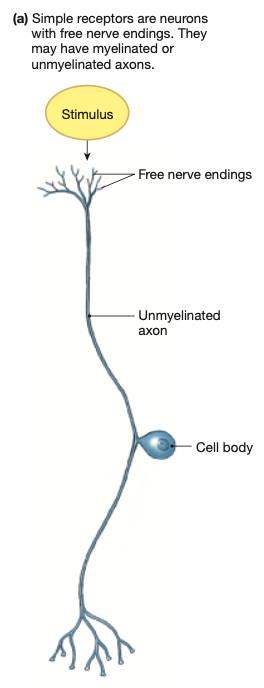
Sensory neuron receptor Structural types: Neuron with free nerve ending
The “free nerve ending” is the dendrites which are embedded within tissue. Can be myelinated or not.
Example:
Nociceptors (pain) & Thermoreceptors (temperature) in skin
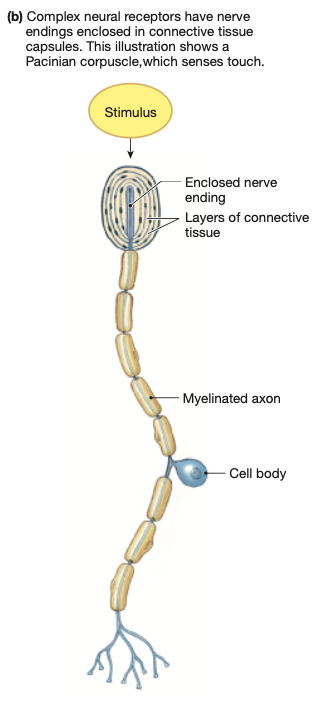
Sensory neuron receptor Structural types: Neuron with encapsulated ending
Similar to the neuron with a free nerve ending, however this time the dendrites are ‘encapsulated’.
Dendrites all surrounded by connective tissue to increase sensitivity.
Example:
Pressure & mechanoreceptors (touch) in skin
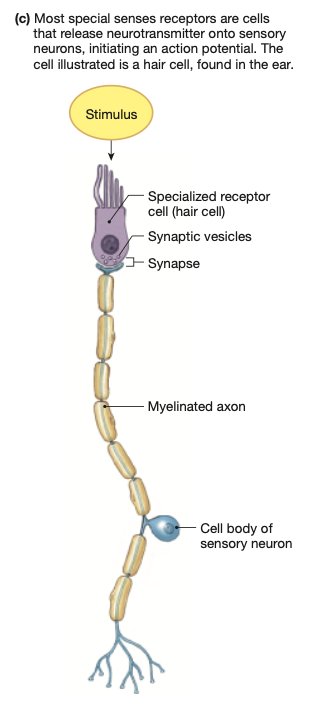
Sensory neuron receptor Structural types: Specialised receptor cells
NOT A NEURON, but an additional cell that transmits neurotransmitters to neurons. Many different variations of cell shape possible, the diagram is only one example of photoreceptors in the eye.
Hyperspecified structure of sensory cells are “specialised” cells.
Sensory neuron receptor Structural position: Exteroceptors
Positioned close to stimuli experienced from the OUTSIDE environment.
e.g touch receptors on skin
Sensory neuron receptor Structural position: Interoceptors
Positioned close to stimuli experienced from INSIDE the body (i.e organs, tissues, etc.).
e.g baroreceptors on heart, aorta
Sensory neuron receptor Structural position: Proprioceptors
Positioned at a MOVING section of the body (i.e skeletal muscle). Interprets the position of tissues. Constantly advises brain of the body’s position.
Pro-prioceptors occur in skeletal muscles, tendons, joints, and ligaments and in connective tissue coverings of bones and muscles
Sensory neuron receptor Functional types: How receptor cells transduce
Receptor cells/sensors can be classified based on how they transduce a stimulus:
having chemicals bind to transmembrane proteins
ions can bing to chemically-gated/ligand-gated ion channels on the cell membranes of sensory neurons to open them and trigger action potentials
physical variations in the environment causing membrane potential changes
e.g stretching of mechanoreceptors (mechanical deformation) can PHYSICALLY stretch the cell membrane of sensory neurons and open ion channels to cause graded/action potentials.
electromagnetic radiation from physical light
light can trigger changes in sensory neuron cell membranes that open ion channels
Changes in temperature can trigger ion channels to open
Sensory neuron receptor Functional types: What stimuli is transduced
Receptor cells/sensors can be classified based on what stimuli they transduce:
Chemical stimuli: chemoreceptor
chemicals from tissue damage: nociceptors (pain)
changes in solute concentration: osmoreceptor (taste & smell)
Physical stimuli: mechanoreceptors
temperature: thermoreceptors
Sensory transduction
Process of changing an environmental stimulus into an electrochemical signal that travels through the nervous system.
stimulus is received as “graded receptor potentials”
Graded receptor potentials
Factors that increase the strength:
more SIZE in stimulus
more LENGTH in TIME of stimulus
How the brain differentiates between different action potentials
3 aspects:
Location of stimulus
Intensity of stimulus
Type of stimulus
All three aspects achieve sparkle SENSATION sparkle
Sensation: Type?
The different receptor types provide different info to the brain.
i.e. if nociceptor is stimulated, brain will always sense pain
MULTIPLE receptor types can be activated at once.
Sensation: Where?
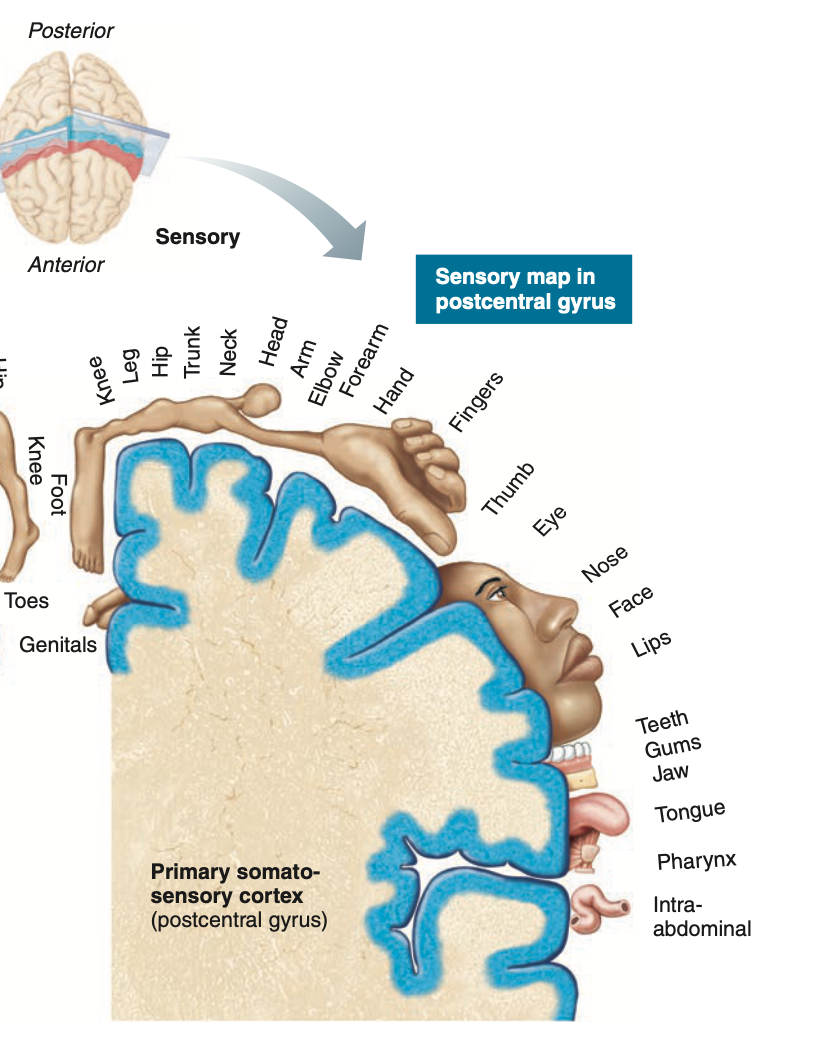
Afferent pathway transmits all sensory stimuli to the brain, to the somatosensory cortex.
Action potentials received from certain locations of the body go to specific portions of the somatosensory cortex.
Sensation: Intensity?
The larger the receptor potential and the longer the receptor potential, the more action potentials can can consecutively result
The greater number of receptor potentials stimulated from different sensory neurons, the greater the number of action potentials that can be simultaneously sent
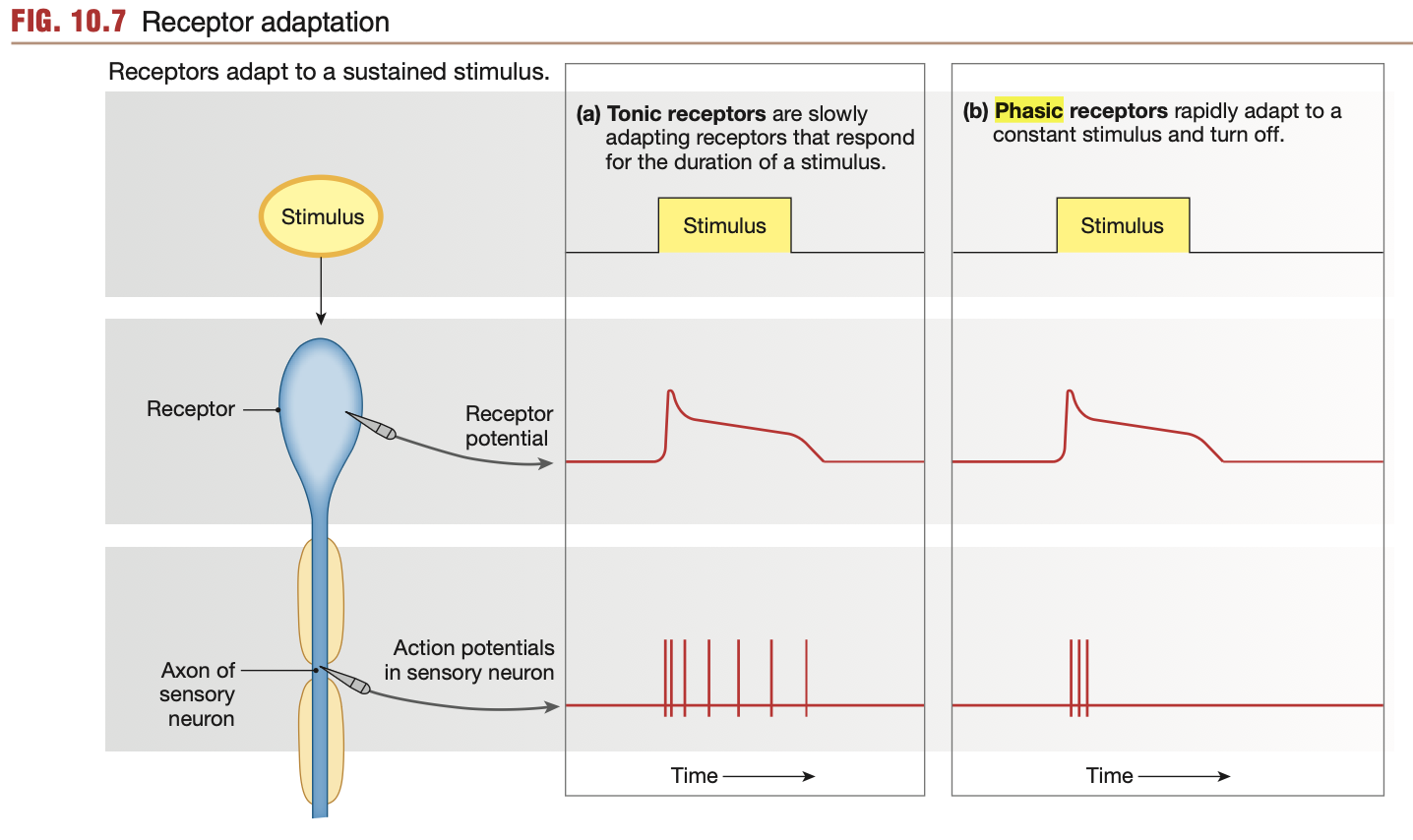
Stimulus adaption: Phasic receptors
All receptors are either phasic or tonic, not both
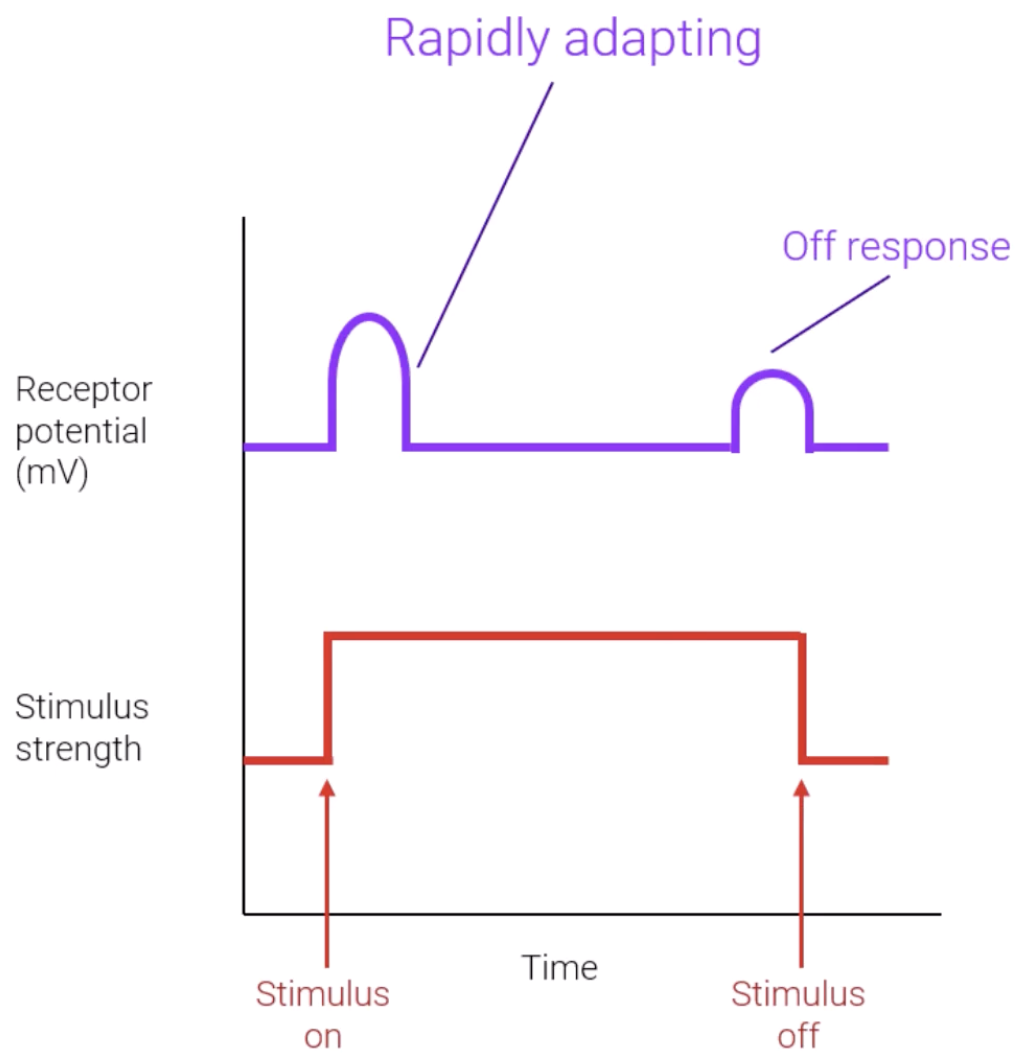
When a constant stimulus is felt at the same level/intensity for a long time, phasic receptors adapt such that constant action potential are not being sent to the brain, neurons adapt.
When the constant stimulus’ intensity changes again, this sudden change triggers another rush of action potentials to the brain, as the previously adapted neurons must adapt again.
Phasic receptors: Adapt quickly, only providing info on any quick changes to stimulus intensity.
e.g touch receptors for pressure, smell receptors (osmoreceptors)
Putting on socks, you feel the pressure when you put them on, but forget about it as the day goes by, only feeling the pressure again when you take them off
Stimulus adaption: Tonic receptors
All receptors are either phasic or tonic, not both
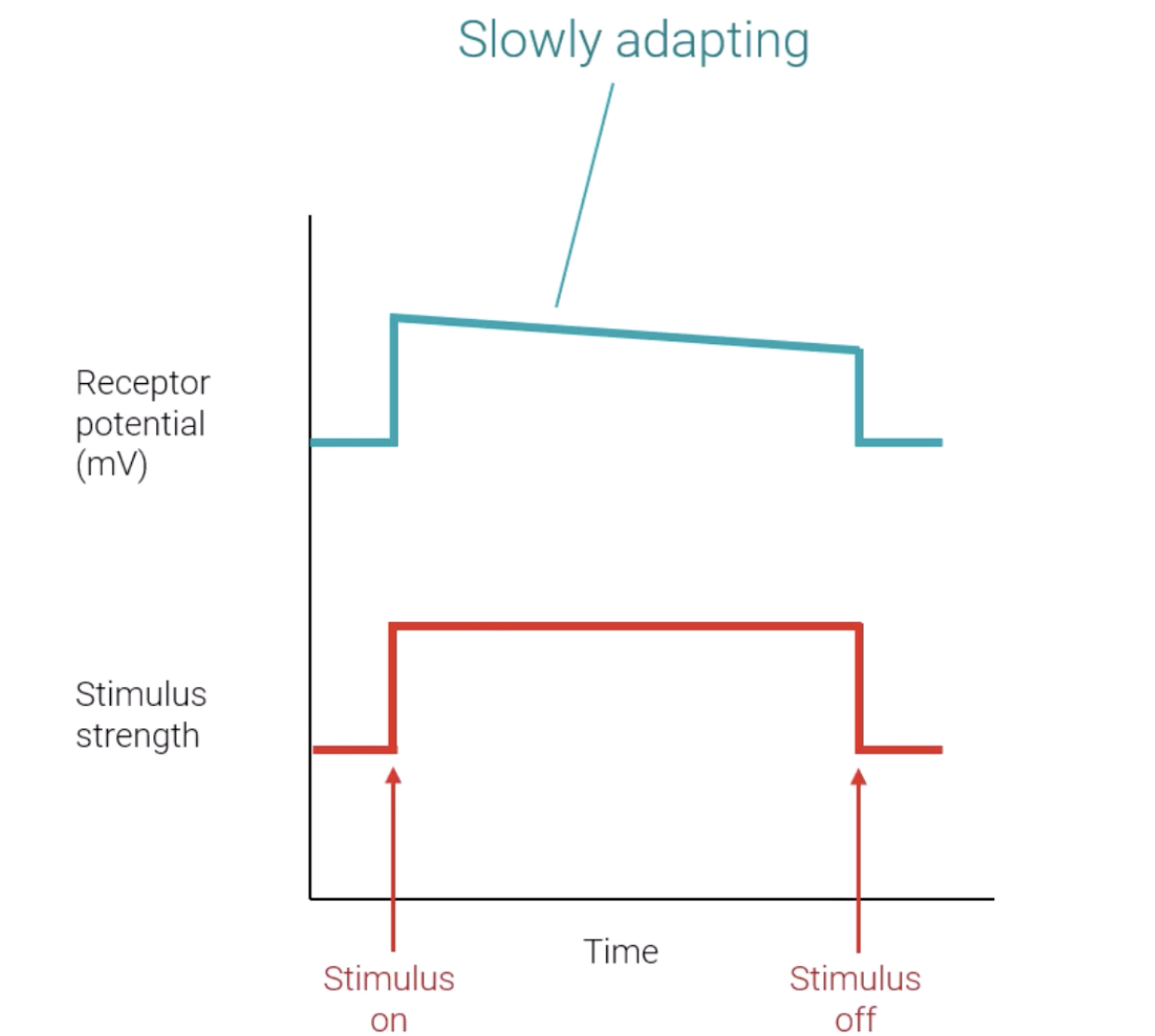
When a constant stimulus is felt at the same level/intensity for a long time, tonic receptors adapt such that action potentials are continuously being sent to the brain throughout the duration of the stimulus.
Over time, the rate of action potentials sent declines, and if left long enough will decrease to where no action potentials are being sent, hence tonic receptors do also adapt eventually, but slowly, slower than phasic receptors.
When the constant stimulus’ intensity stops, then this slew of action potentials to the brain stops.
Tonic receptors: Adapt slowly, constantly providing info on certain stimuli.
e.g nociceptors (pain), constantly providing info about injuries
proprioceptors constantly providing info about body balance and position
Tonic vs Phasic
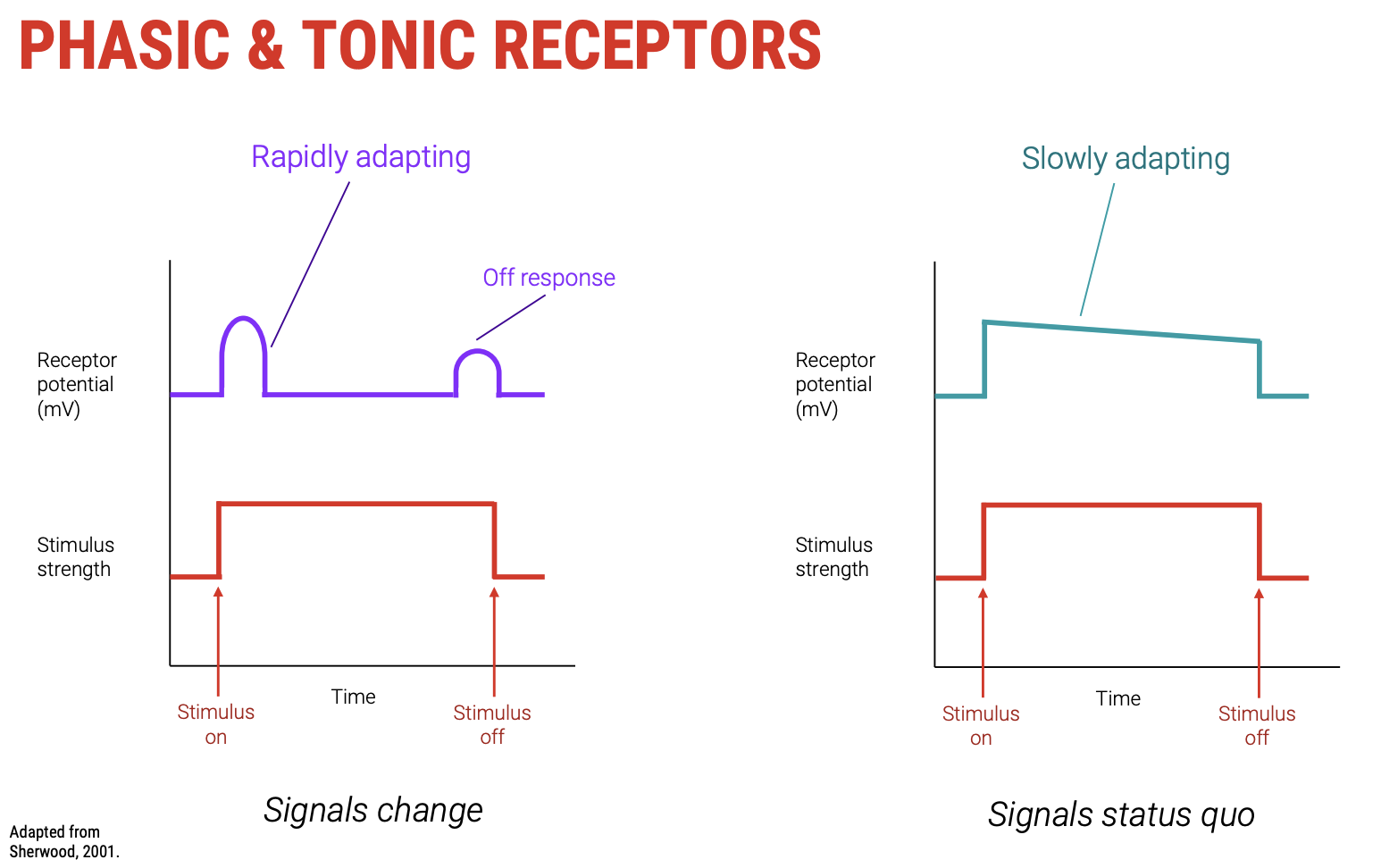
Notice in diagram, same stimulus duration for tonic and phasic
However, tonic receptors adapt at a slower pace