SOCY200 Final - DeLoatch
 Call Kai
 Learn
Learn Practice Test
 Spaced Repetition
 Match
Match Flashcards
 Knowt Play
 Podcast
1/45

There's no tags or description
Looks like no tags are added yet.
Name | Mastery | Learn | Test | Matching | Spaced | Call with Kai | Chat |
|---|
No analytics yet
Send a link to your students to track their progress
46 Terms
Technology
the application of science and knowledge to solve daily life problems, encompassing both material tools (artifacts) and nonmaterial processes (knowledge, skills, and organization)
Diffusion of Technology
The process by which new innovations, ideas, or products spread through a social system, such as a community or organization, over time
Cultural Evolution
The theory that social change occurs through the transmission, variation, and selection of information—such as beliefs, behaviors, and technologies—acquired via learning rather than genetics
Agricultural Innovation
The study of how new technologies, practices, and organizational forms are introduced, adopted, or rejected within farming communities and food systems, focusing on social interactions, power dynamics, and adoption behaviors
The Economics of Agricultural States
These societies produce significant food surpluses, leading to permanent settlements, complex social hierarchies, and the emergence of specialized roles.
The Moral Economy
An economic system based on goodness, fairness, and justice rather than purely on market prices. In sociology, it often refers to the traditional rights of peasants to food and protection, where social obligations take precedence over individual profit.
Why are some societies more industrially advanced than others?
Societies became more industrially advanced primarily due to environmental advantages rather than differences in intelligence or culture. Regions like Eurasia had access to more domesticable plants and animals, which led to the early development of agriculture. Agriculture created food surpluses, allowing populations to grow and specialize in fields such as technology, writing, and governance. Larger, denser populations also helped spread innovations and diseases, giving Eurasians immunity that later aided conquest.
Geography also mattered: Eurasia’s east–west axis allowed crops, animals, and ideas to spread more easily than in continents with north–south axes. Over time, these advantages led to stronger states, advanced technology, and organized governments.
Industrialization itself (as described in ) was built on these earlier developments. In Europe, systems like the “putting-out system” evolved into factories, increasing production and efficiency. Access to global trade networks, raw materials (like cotton), and markets—often through colonization—fueled industrial growth. European powers also used coercion and trade control (e.g., in India and China) to dominate global production.
In short, industrial advancement resulted from a long chain: geography → agriculture → population growth → specialization → technology → global trade and industrialization, not from inherent superiority.
What is the difference between Modernity and Modernism
Modernity is, in particular, a period divided into three distinct phases that describe the emergence of capitalism, industrialization, and, finally, the modern world shaped by the division of labor.
Modernism is reflected in the development and acceptance of new technologies. Modernity is a time period, whereas modernism refers to trends in art, culture, and social relations that develop within a modern world.
Characterisitcs of Modernity
A broad term encompassing several concepts, but in particular it refers to a historical period that saw the evolution of capitalism and industrialization. Key Characteristics: the rise of capitalism, bureaucratic nation-states, intense urbanization, scientific rationality, individualism, and a strong belief in progress and technological advancement
Scientific Racism
Carl Linnaeus laid the foundation for modern biological classification with his binomial nomenclature system in the Systema Naturae.
Homo Europeans
- Described as: white, sanguine, and muscular
- Traits assigned: intelligent, inventive, governed by laws
Homo Asiaticu
- Described as: yellow, melancholic, and rigid
- Traits assigned: severe, greedy, ruled by opinion
Homo Afer
- Described as: black, phlegmatic, and relaxed
- Traits assigned: crafty, indolent, governed by caprice
Homo Americanus
- Described as: red, choleric, and upright
- Traits Assigned: stubborn, freed, governed by custom
How are horticultural societies organized?
They typically feature semi-permanent villages, lineage-based social structures, and "Big Man"(merit not inherit) leadership styles, where status is earned through redistribution and charisma rather than formal laws
What are the main results of the European conquests of the New World?
1. Demographic Collapse: Massive loss of Indigenous lives due to disease and warfare.
2. Global Trade: The rise of the Atlantic slave trade and the "Columbian Exchange" (transfer of plants, animals, diseases, and technology).
3. Colonization: The forced imposition of European languages, religions, and administrative systems.
How did European germs change the New World?
Europeans brought diseases such as measles, chickenpox, Smallpox, Yellow Fever, Malaria, Influenza (Flu), and the Common Cold. Europeans were immune due to living in large, dense populations, exposure to animals, and greater genetic diversity. About 80-95%, or roughly 40 to 95 million of the Indigenous people died because there was no germ theory about contact, and many of the European diseases were transmitted through air and touch. That is why, in many cases, Native Americans became sick even before they had direct contact with Europeans or through trade goods that traveled from tribe to tribe, though middlemen were often the vector of disease. Because so many of the native Americans died, Europeans imported labor from Africa to make up for their loss of labor.
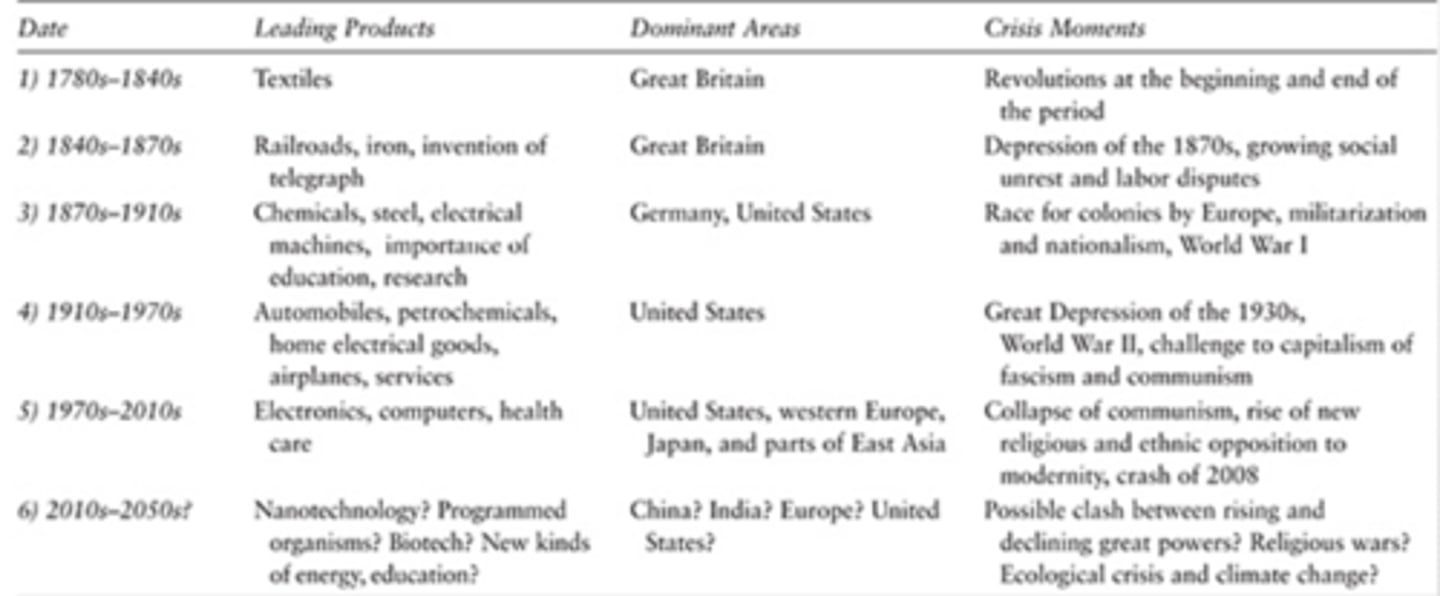
The Industrial Cycle
The recurring, cyclical patterns of boom-and-bust in capitalist economies, encompassing stages of crisis, stagnation, average prosperity, and boom
What beliefs does Diamond aim to disprove through the arguments he makes central to his book?
Diamond disproves of the racist biological explanations of history. Instead, he argues that global inequality stems from environmental and geographic factors, not innate differences in intelligence or ability.
What kinds of explanations for human history do not make sense, according to Diamond?
1. Racial/Genetic Superiority
2. Cold Climate (Europeans are smarter/more creative because of the colder climate)
What is Polynesia a particularly good example of?
It is a good example of "natural experiment of history" because they had the same ancestral line, but due to different environments, there were different social outcomes (geography molds society)
What does Diamond name as a prerequisite for conquering other societies?
Food production(agriculture and herding), because when there is a food surplus, there is population growth, technology, and skills specilization(resulting in power based on skill)
How were some of the first diseases transmitted to humans?
Domesticated animal(livestock)
Why is population density important?
It is necessary to sustain "crowd diseases" that generate immunity/genetic diversity and enable the development of complex political systems and specialized labor that cannot exist in small, mobile groups.
What does Diamond mean by the "natural experiment of history" when comparing societies?
It is used when comparing societies of the same ancestry, but that were separated into different environments, allowing researchers to see how those environments shaped development within societies
Why did food production emerge in some regions earlier than others?
Some regions had more domesticable plants/animals and favorable climates for agriculture
What characteristics made certain plants and animals suitable for domestication?
Plants
1. Easy to grow/breed
2. Productive/fast working
Animals
1. Follow-the-leader-society
2. Non-aggressive
3. Useful (food, labor, etc)
What is the difference between hunter-gatherer societies and food-producing societies in terms of social organization?
Hunter-gatherer societies are generally small, egalitarian, and mobile, while food-producing societies are large, sedentary, and hierarchical, with centralized leadership.
How does food production lead to population growth and societal complexity?
Allows people to live in permanent settlements and have a specialized skill workforce. This leads to population growth and the need for a centralized government to manage resources and resolve conflicts among thousands of people.
How does surplus food contribute to social stratification and inequality?
Surplus food allows a "non-producing" elite (kings, bureaucrats, priests) to exist. This creates social classes, where those who control the food surplus hold power over those who produce it.
What are the advantages and disadvantages of farming compared to foraging?
Advantages of Farming
- more food --> population growth & technology creation
Disadvantages of Farming
- diseases
- social inequality (elites control food supply)
- poor diets
- hard/long labor
How does Diamond explain the spread of agriculture across regions?
Agriculture spread through diffusion (people moving), where farmers migrated and displaced foragers, and through adoption (ideas spreading), where foragers adopted farming practices from neighboring societies to survive.
What role does geography play in determining whether farming spreads quickly or slowly?
The continental axis made Europe and Western Asia especially conducive to the spread of domesticable plants and animals because regions at the same latitude share similar climates and day lengths. This allowed crops and livestock to spread more easily along an east–west axis. In contrast, diffusion was much slower along north–south axes (like in the Americas and Africa) because species had to adapt to very different climates, limiting their spread.
How did domesticated animals contribute to the development of infectious diseases?
Living in close proximity to livestock allowed animal microbes to jump to humans and evolve into human-specific pathogens.
Why were Eurasian populations more resistant to diseases than others?
Eurasians lived with domestic animals and crowd diseases, which led to the evolution of genetic and immune resistance, which is why populations in the Americas and Africa decreased significantly due to a lack of immunity.
How did germs function as a tool of conquest during encounters between societies?
In encounters like the Spanish conquest of the Incas, germs killed the vast majority of the indigenous population (up to 95%), decimating their armies and destabilizing their governments before most battles even began(weakened enemies).
Why does Diamond describe germs as an unintended but powerful weapon?
Germs are "unintended" because the conquerors did not realize they were carrying them, as they were immune, and the diseases were transferable through air and contact. Germs were powerful as they weakened/killed enemies more than weapons could.
How do leaders maintain power in early states?
1. Control of food/redistributing resources
2. Religion/ideology to justify their authority
3. Military force to maintain their monopoly
Are modern governments fundamentally different from the "kleptocracies" Diamond describes? Why or why not?
Diamond suggests they are not fundamentally different. He defines a kleptocracy as a government that transfers wealth from commoners to the upper classes. The difference is one of degree: modern "good" governments provide more services in return for the taxes they take
How do food production, germs, and political organization work together to produce global inequality?
Food production leads to high populations and surpluses; surpluses lead to political organization (states and classes) and technology (steel/guns); and high-density living with animals leads to lethal germs and eventually immunity. Together, these give one society the power to overwhelm others
What is Diamond's central argument about why some societies became more powerful than others?
History followed different courses for different people because of differences in their environments, not because of biological differences in the people themselves.
What does the narrator answer when Ishmael asks him, in Chapter 5, what man's destiny is?
The narrator answers that man's destiny is to conquer and rule the world. He explains that the world was made for man to be its master and to turn it into a paradise suited for human life.
How does Ishmael describe civilization's progress in Chapter 7?
Ishmael describes it as a "cultural stampede." He notes that Takers believe they are following the only right way to live, and even those who are unhappy feel they must keep running because there is no other path.
When does Ishmael say the Take population will contract?
Ishmael argues that the Taker population will only contract when the food supply stops growing. He asserts that as long as Takers continue to increase food production, the population will continue to rise to meet and exceed that supply.
How does Ishmael characterize man's progress, once he discovered agriculture?
Ishmael characterizes it as the moment man began to live "outside" the law of nature. By adopting "totalitarian agriculture," man decided that he, not the gods, should decide who lives and who dies on the planet.
Who is Ishmael and what is he?
Ishmael is a full-grown gorilla who can communicate telepathically with humans. He is a philosopher and a teacher who seeks to help a human pupil understand the "story" that is holding their culture captive.
What temptation does Ishmael say Adam succumbed to when he took the fruit from Eve in the Bible story?
Ishmael says Adam succumbed to Eve's temptation to "be as gods," specifically the temptation to believe he could possess the knowledge of good and evil aka the knowledge of who should live and who should die.
In Chapter 12, how does Ishmael say man became man?
Ishmael argues that man became man by living in the hands of the gods for millions of years. This means living according to the same biological laws as all other creatures, which allowed for the evolution of the human spirit.
What looming crisis does Ishmael imply will correct the 'Takers'' excesses?
Ishmael implies that the collapse of the ecosystem will correct the Takers' excesses. He argues that the Taker story is fundamentally "anti-life" and that the Earth will eventually become unable to sustain a culture that acts as if the world were made solely for human consumption.
What does Ishmael say 'Eve' means?
Ishmael explains that "Eve" represents life (the mother of all living). In the context of his teaching, she represents the Leaver life that Takers "took" from in order to begin their own story of conquest.