Week 7: Psychological skills 1
 Call Kai
 Learn
Learn Practice Test
 Spaced Repetition
 Match
Match Flashcards
 Knowt Play
1/37

There's no tags or description
Looks like no tags are added yet.
Name | Mastery | Learn | Test | Matching | Spaced | Call with Kai |
|---|
No analytics yet
Send a link to your students to track their progress
38 Terms
What is the ultimate goal of Psychological Skills Training (PST)?
Self-regulation
What is Psychological skills training (PST)?
Consistent practice of mental or psychological skills to enhance performance, increase enjoyment, or achieve greater sport and physical activity self-satisfaction
Which country was the first to systematically engage in mental skills training in the 1950s?
The Soviet Union
Name basic skills that must be achieved before advanced skills in PST.
Relaxation, goal setting, imagery, self-talk
What are some advanced skills in PST?
Controlling anxiety, self-confidence, motivation, attention
According to coaches, what percentage of sport is considered mental?
50%, with some sports being 80%-90% mental
What are the two sources of evidence we use to inform our use of PST?
Research on elite athletes
Experiences from coaches and athletes
What characteristics did Krane and Williams (2021) find in more successful athletes?
Higher confidence, self-regulation, concentration, positive thoughts, imagery, determination
What did Greenleaf et al (2001) and Hodge (20130 find about Olympic athletes?
Plans for competition, performance evaluation, and dealing with disruptions
What did Brown and Fletcher (2017) conclude about the effectiveness of PST?
Psychological and psychosocial improved performance
Performance effects lasted about a month after the completion of the intervention
Interventions are better when coaches deliver
Somewhat greater effects for men vs. women
Outline the 3 phases of PST
Education phase - increase athlete awareness of the role that mental skills play in performance
Acquisition phase - focus on strategies and techniques for learning the various psychological skills
Practice phase: actually putting the skills into practice - 3 primary objectives:
automate skills through overlearning
teach people to integrate psychological skills into their performance
simulate skills people will want to apply in actual connection
What is self-regulation in the context of PST? Why is it important?
The ability to work toward one's goals by monitoring and managing thoughts, feelings, and behaviours
athlete should be able to self-regulate their internal functioning in the desired manner and successfully adapt to changes after PST
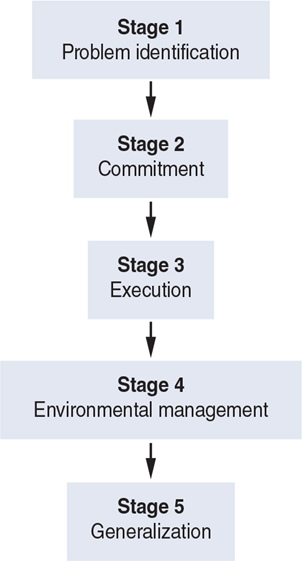
Outline Kirschenbaum’s 5-stage model of self-regulation
Stage 1: Problem identification
Stage 2: Commitment
Stage 3: Execution
Stage 4: Environmental management
Stage 5: Generalisation
When should PST be implemented? By who?
PST implemented by?
Sport psychologist or consultant
Coaches
When to implement?
Off-season/pre-season
Outline the three types of anxiety in athletes
Cognitive - Worry and negative thoughts
Somatic - Nervousness and tension, increased perspiration, pounding heart
Behavioural (less research) - Tense facial expressions and changes in communication
What is problem-focused coping? Provide some examples
Efforts to alter or manage the issue causing stress - more situation-specific
E.g. information gathering, goal-setting, self-talk, time-management
What is emotion-focused coping? Provide some examples
Regulating emotional responses to the problem causing anxiety/stress
E.g. meditation, relaxation, mental and behavioural withdrawal
Name some somatic anxiety reduction techniques
progressive relaxation
breath control
biofeedback
Name some cognitive anxiety reduction techniques
relaxation response
autogenic training
Name some multimodal anxiety reduction techniques
stress inoculation training
cognitive-affective stress management training
What does the Matching Hypothesis state about anxiety management techniques?
Anxiety management techniques should match the type of anxiety problem
Cognitive anxiety = mental relaxation
Somatic anxiety = physical relaxation
What is Progressive Muscle Relaxation (PMR)? (Jacobsen, 1938)
Tensing specific muscle groups and then relaxing them to reduce anxiety
→ Tension and relaxation are mutually exclusive - not possible to be tensed and relaxed at the same time
How does breathing relate to anxiety levels?
Breathing patterns change with anxiety; calm breathing is smooth and deep, while anxious breathing is short and shallow
When you’re calm, confident, and in control, your breathing is likely to be smooth, deep, and rhythmic
When you’re under pressure and tense, your breathing is more likely to be short, shallow, and irregular
Breathing in and holding increases muscle tension
Breathing out decreases muscle tension
What did Conlon et al. (2022) discover about diaphragmatic breathing?
Conlon et al. (2022) found 5-minute diaphragmatic breathing decreased cognitive anxiety in pistol shooters, but not in performance
When should breath control be performed during sports?
Breaks in play, e.g. before tennis serve
To enhance skill execution, e.g. powerlifting
What is pressure training?
Strategies used to expose athletes to pressure in practice to improve performance in competition
Conlon et al. (2022) found 5-minute diaphragmatic breathing decreased cognitive anxiety in pistol shooters, but not in performance
How can a pressure training environment be created?
1. Demands of training
Task stressor
Performer stressor, e.g. sabotaging warm-up - removing cones etc
Environment stressor, e.g. coach making training very loud with a speaker
2. Consequences of training
Positive or negative based on performance, e.g. if you lose you run laps
3. Education
Teach athletes how to cope, build awareness, and tell them why you’re doing pressure training
What is the role of self-talk in sports psychology?
It can enhance self-confidence and concentration or act as a negative internal distractor
What did Hatzigeorgiadis et al (2011) discover about self-talk?
Results of a meta-analytic review of 32 studies on self-talk revealed that self-talk was consistently positively related to performance improvements
Name 2 cognitive therapies often used in sport
Rational Emotional Behaviour Therapy (REBT; Ellis, 1957)
REBT focuses on challenging the client's belief systems
Cognitive Therapy (later developed in CBT; Beck, 1975)
What are the 3 different types of self-talk?
Positive, e.g. ‘I can do it’
Instructional, e.g. ‘keep your eyes on the ball’
Negative, e.g. ‘that was a bad shot’
Outline 2 components of organic self-talk
Spontaneous self-talk: unintended statements that come to mind in the moment
Goal-directed self-talk: rational response to spontaneous processes, e.g. emotions, thoughts and self-talk
→ directed at self-regulation and performance enhancement
What is strategic self-talk?
Predetermined self-talk plans that trigger responses serving instructional and motivational functions
What are some techniques for effective self-talk?
Mastery and coping skills, cognitive restructuring, thought-stopping, reframing, self-affirmations, countering
What is thought-stopping?
The process of consciously stopping negative self-talk using a trigger word or cue
What are some limitations of thought stopping?
Can exacerbate the negative thoughts
Draws attention to negative thoughts
Should not be used as a long-term coping mechanism and needs to be used in conjunction with other techniques (Hardy et al., 2008)
What are Mikes' six rules for creating effective self-talk?
Keep your phrases short and specific.
Use the first person and present tense.
Construct positive phrases.
Say your phrases with meaning and attention.
Speak kindly to yourself.
Repeat phrases often
What do the 2 of the most successful self-talk involve?
Two of the most successful involve thought stopping and changing negative self-talk to positive self-talk