chapter 19: Doppler
 Call Kai
 Learn
Learn Practice Test
 Spaced Repetition
 Match
Match Flashcards
 Knowt Play
1/104

There's no tags or description
Looks like no tags are added yet.
Name | Mastery | Learn | Test | Matching | Spaced | Call with Kai |
|---|
No analytics yet
Send a link to your students to track their progress
105 Terms
doppler shift AKA
doppler frequency
a change or difference in frequency of sound as a result of motion between the sound source and the receiver is known as?
doppler shift
is a lower frequency that rides on top of the much higher transducer frequency. this is?
doppler shift
doppler shift is created when?
transmitted sound strikes moving RBCs
doppler shift is used to measure?
the velocity of blood in the circulation
doppler shift ranges from…
20Hz-20,000Hz
extraction of the Doppler frequency (doppler shift) from the transducer’s frequency is known as?
demodulation
what is the equation used to calculate the positive to negative shift?
doppler shift (Hz) = reflected frequency - transmitted frequency
when the doppler shift is positive the blood cells are traveling in what direction?
toward the transducer
During a doppler examination, sound with a frequency of 5,000,000 Hz is transmitted from the transducer and reflects off of moving red blood cells. the frequency of the reflected signal is 5,003,000Hz. what was the doppler shift?
the doppler shift was +3,000 Hz the shift is positive because the reflected sound has a higher frequency than the transmitted sound
when blood cells move toward the transducer, the doppler shift is?
positive
in a positive doppler shift, the reflected frequency is…than the transmitted frequency
higher
when blood moves away from the transducer, the doppler shift is?
negative
in a negative doppler shift the reflected frequency is…than the transmitted frequency
lower
what do doppler frequencies indicate? what do they NOT indicate?
velocity
does not indicate speed
indicates the distance that a RBC moves in 1 second
magnitude
distance/time
speed
defined by a magnitude (speed) and a direction, known as?
velocity
negative doppler shifts have…wavelength
longer
negative doppler shifts are color coded?
blue
positive doppler shifts have…wavelength
shorter
postive doppler shift is color coded?
red
what is the relationship between doppler shift, velocity and frequency of transmitted sound?
direct
what is the doppler shift equation?
doppler shift = 2 x velocity of blood x transducer frequency x cos (theta 0) / propagation speed
what does the number 2 mean in the doppler shift equation? pg 306
2 doppler shifts are occurring
first shift is when sound strikes moving blood
second shift is the reception of sound wave from moving RBC
if velocity is 1/2, the doppler shift is…
halved
is velocity is 2x, the doppler shift is…
2x
transducer frequency doubled, the Doppler shift is…
doubled
transducer frequency is halved, the doppler shift is…
1/2
blood cells moving parallel (directly toward or away) to the sound beam provide a…accurate velocity
100%
what happens to velocity if there is an angle in the way blood cells are moving?
the velocity will be less than the true velocity
frequency is measured in?
velocity is measured in?
Hz
m/s
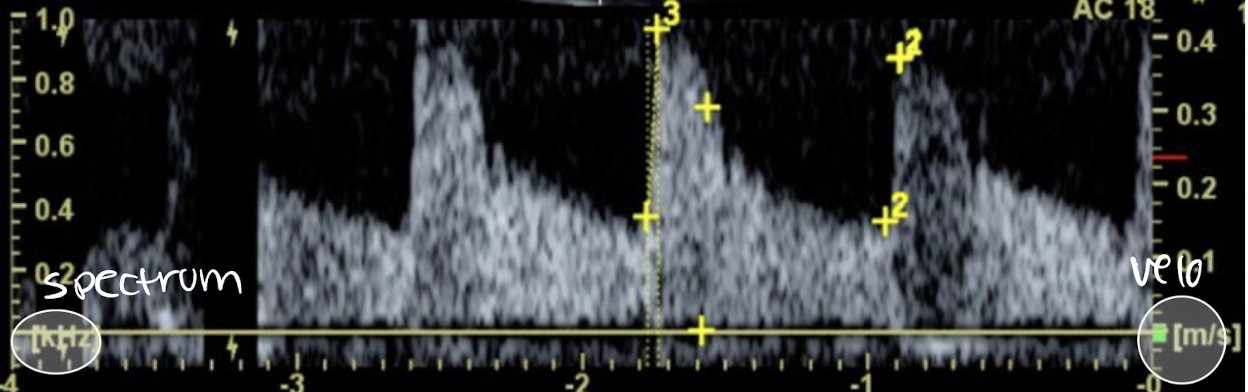
if the sound beam and flow direction are not parallel, what determines how much of the velocity is measured?
the percentage of true velocity that is measured depends on the cosine of the angle between the sound beam and the direction of motion
measured velocity = true velocity x cos 0 (pg 309)
what is the relationship between doppler shift and cosine of theta, the angle between the direction of flow and the direction sound?
direct
if cosine is halved, the doppler shift is…
1/2
if cosine is 2x, doppler shift is…
2x
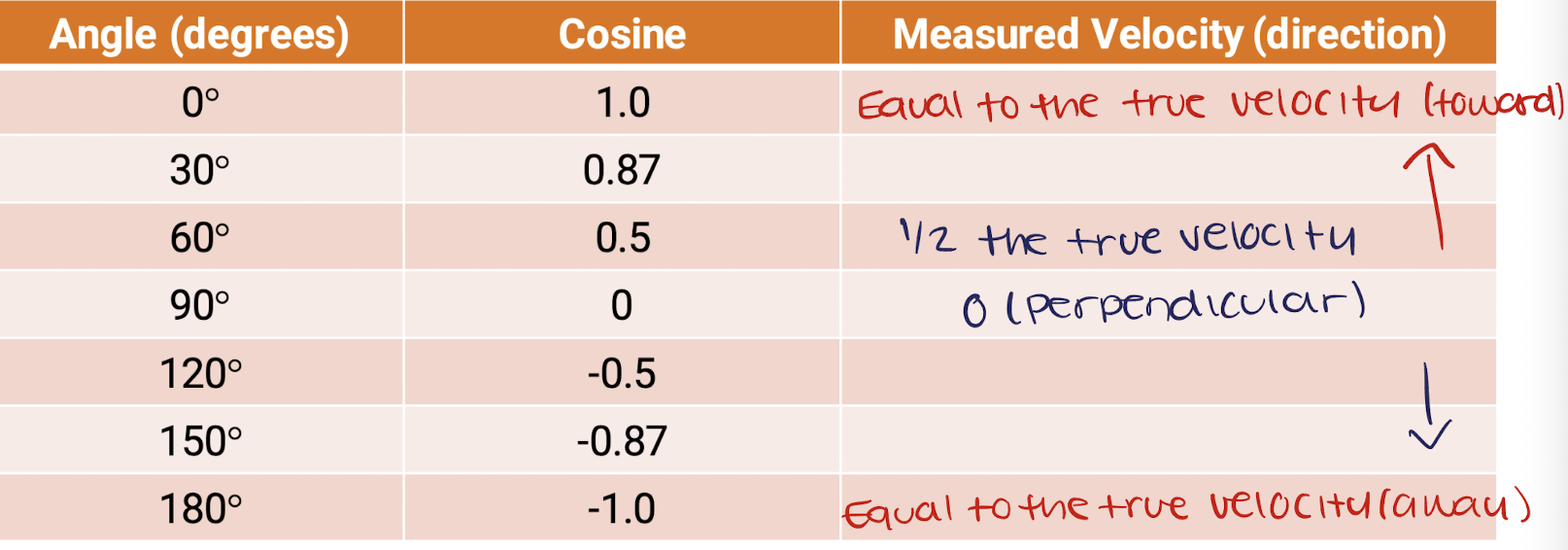
what is the relationship between the actual velocity and measured velocity when blood moves parallel to the sound beam? pg 310
when the angle between is 0 degrees or 180 degrees, flow is parallel to the sound beam
measured and true velocities are equal and flow toward the transducer when cosine 0 degrees = 1.0 cosine
cosine 180 is -1, indicating flow away
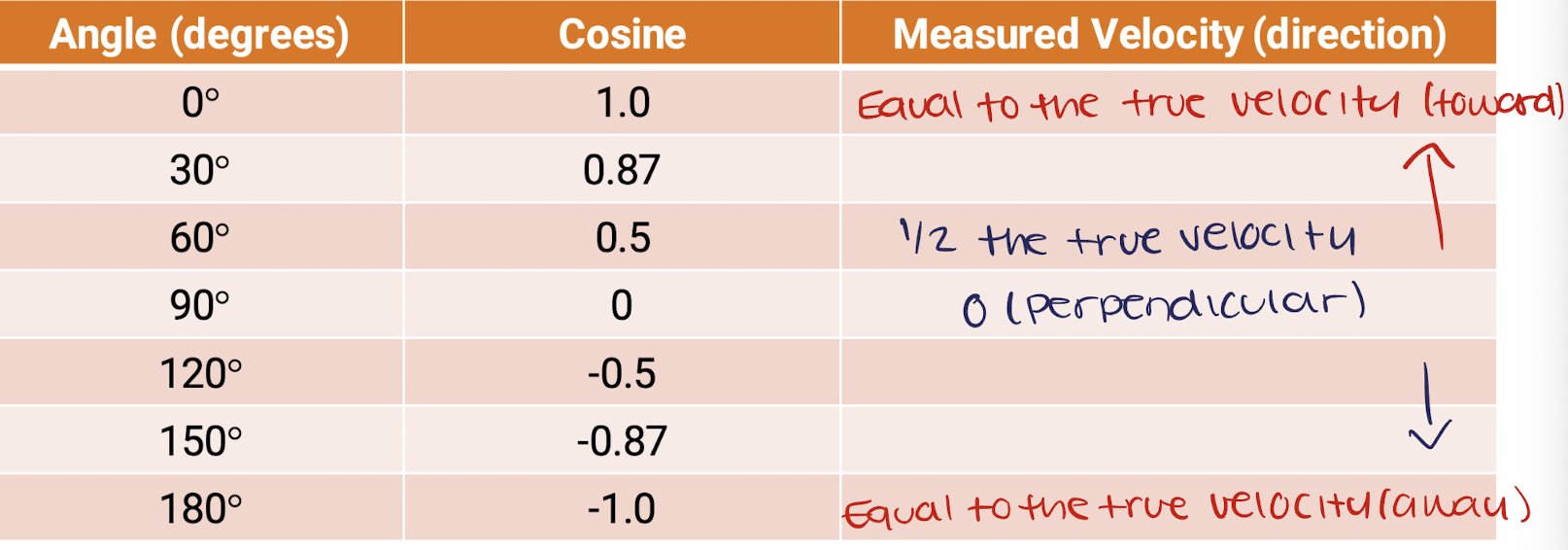
what is the relationship between actual measured velocities when blood moves perpendicular to the sound beam?
when the direction flow is perpendicular (90) to the sound beam, the measured velocity is zero because the cosine of 90 is zero.
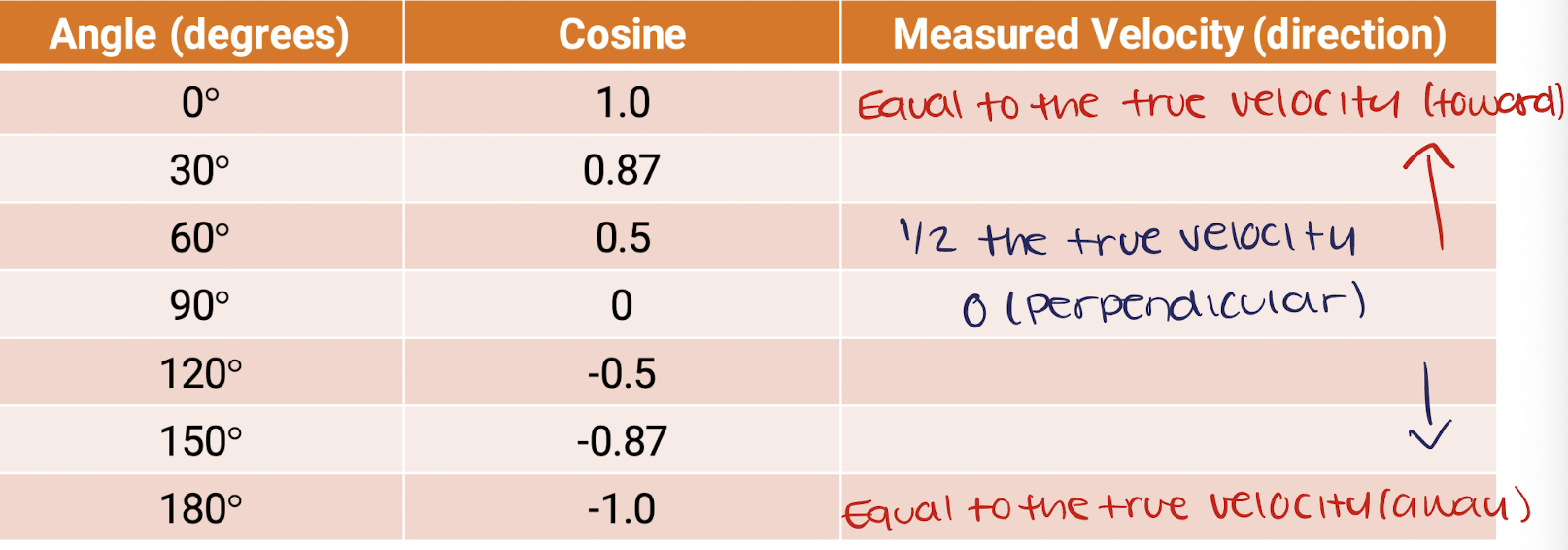
T/F doppler shifts and velocities can be measured with perpendicular incidence
false. doppler shifts and velocities cannot be measured when 90 because cosine is zero
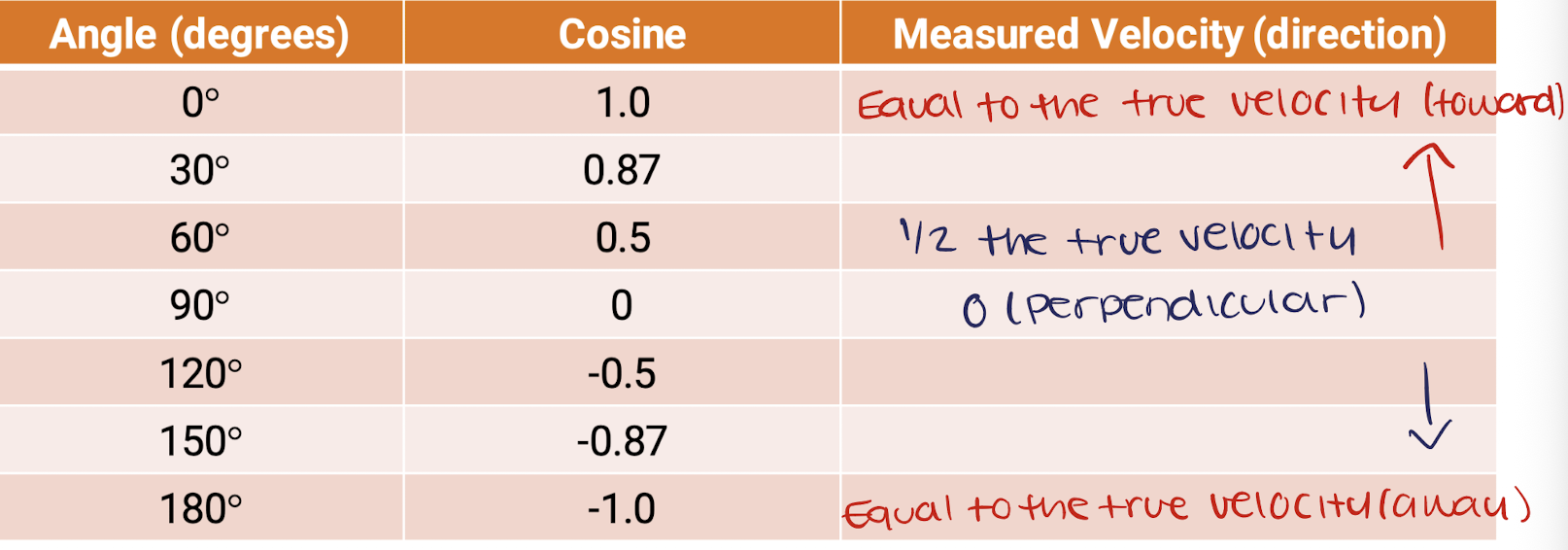
what is the relationship between actual velocity and measured velocity when blood moves at a 60 degree angle to the beam?
cosine for 60 is o.5, the measured velocity at 60 is ½ the actual velocity. when blood travels at 2m/s at a 60 degree angle to the sound beam, the velocity is 1 m/s
what are the types of doppler?
bidirectional
continuous wave
pulsed wave doppler
color doppler
power doppler
which doppler distinguishes the direction of flow? and is most common?
bidirectional
is a signal processing technique for bidirectional doppler
phase quadrature (aka quadrature detection)
distinguishes positive shifts from negative shifts. what kind of doppler?
bidirectional
requires two crystals in the transducer
one crystal constantly transmits ultrasonic energy
second crystal continuously receives reflections from blood cells
what kind of doppler?
continuous wave doppler
what are the advantages of continuous wave doppler?
accurately measures very high velocities
what are the disadvantages of continuous wave doppler?
exact location of moving blood cells can not be determined
range ambiguity limitation
lack of TGC
T/F continuous wave transducer creates anatomic images
False
the sensitivity of continuous wave transducer is?
increased, does not use backing material.
simultaneous atomic imaging and doppler is called?
duplex imaging
continuous wave transducers are able to detect…amplitude reflections and…doppler shifts
low, smaller
only one PZT crystal is necessary
the crystal alternates between sending and receiving sound pulses
what type of doppler is this?
pulse wave doppler
advantage of PW doppler?
able to select exact location where velocities are measured (same volume range gate) called range resolution, range specificity freedom from range ambiguity artifact
disadvantage of PW doppler
inaccurate measurement of high velocity signals posed as traveling in an opposite direction (aliasing)
most common error associated with pulsed wave doppler
aliasing
aliasing is due to?
the sampling rate, aka PRF, being too low in comparison to the measured blood velocities
the very top of the display on spectral tracing is called?
nyquist limit. the top cannot be measured because it goes beyond what can be displayed
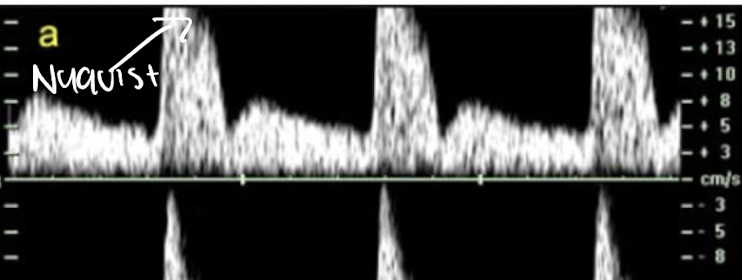
what is the equation for nyquist limit (Hz)?
PRF(Hz)/2
what are 2 ways to reduce aliasing?
rise the nyquist limit
increase PRF
decrease depth
reduce the doppler shift
lower the transducer frequency
what are the 5 ways to avoid aliasing?
using a lower frequency transducer
shallow gate
adjust the PRF scale to its max
shift the baseline up or down
use continuous wave doppler
T/F aliasing only occurs with pulsed doppler, never with continuous wave
TRUE
is the highest doppler frequency or velocity that can be measured without the appearance of aliasing?
nyquist level
higher transducer frequency create more?
aliasing
slower blood velocity
lower frequency transducer
shallow gate (high prf)
how does this affect aliasing?
less aliasing
faster blood velocity
higher frequency transducer
deep gate (low prf)
how does this affect aliasing
more aliasing
spectral dopplers shades of gray are related to?
amplitude of selected signal
number of blood cells creating the reflection at each velocity
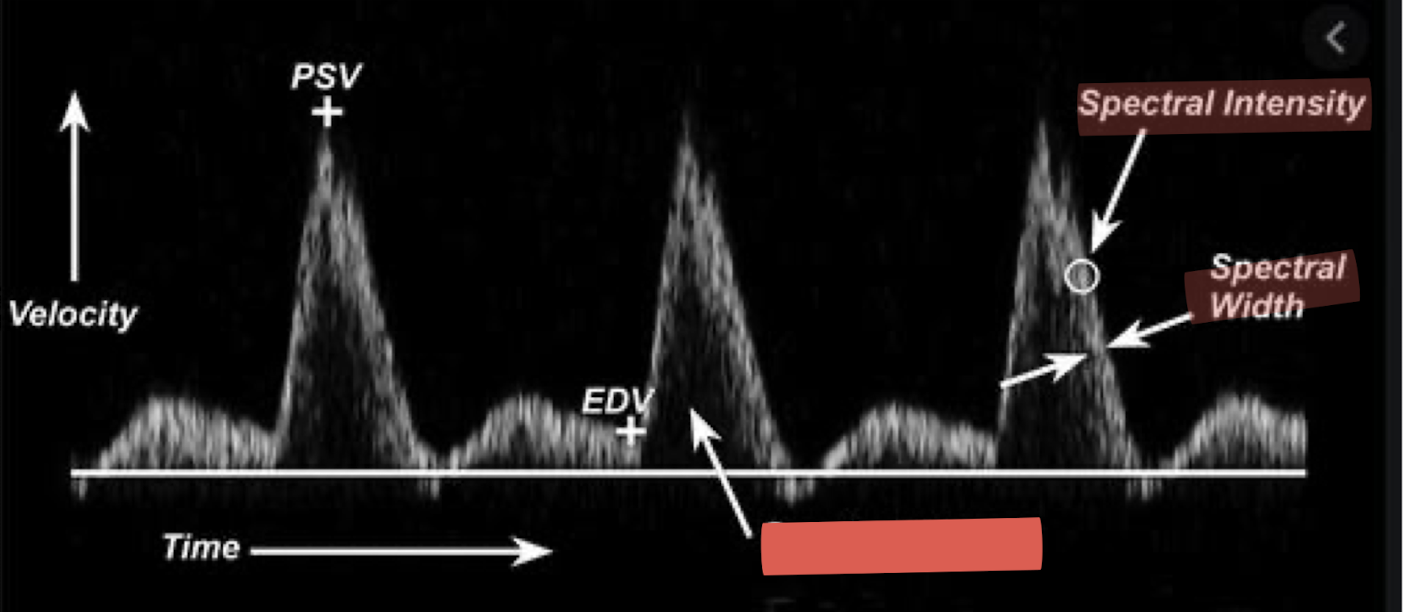
spectral window
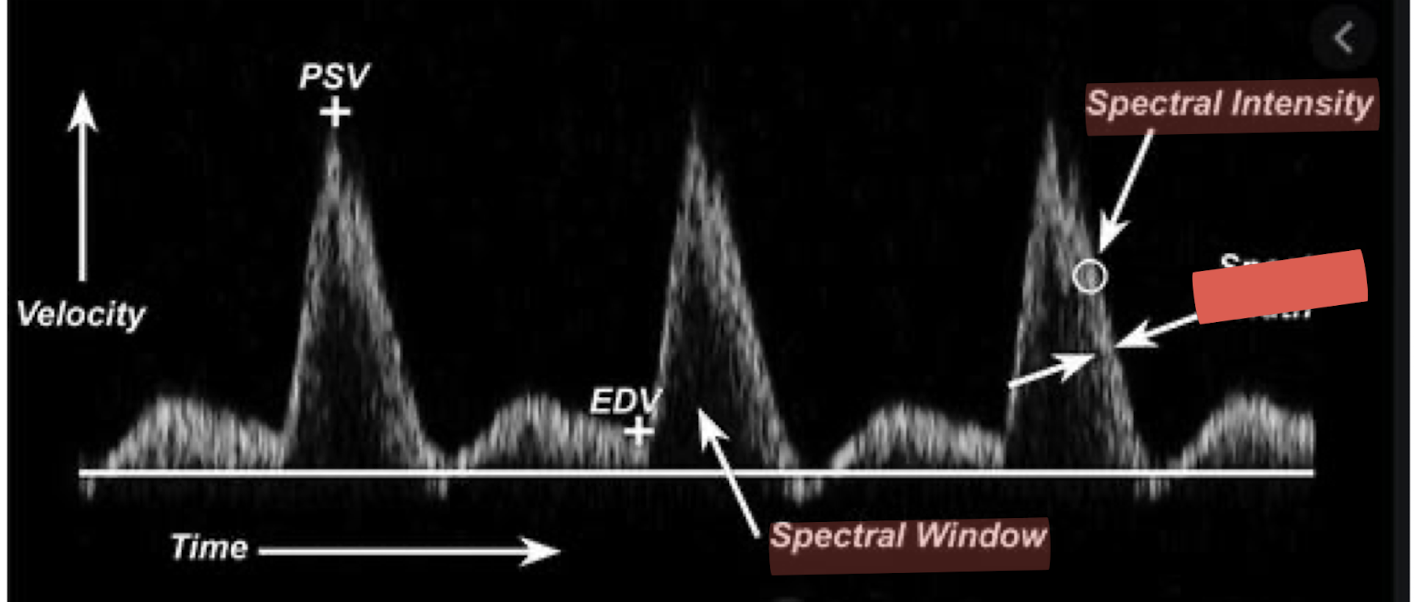
spectral width
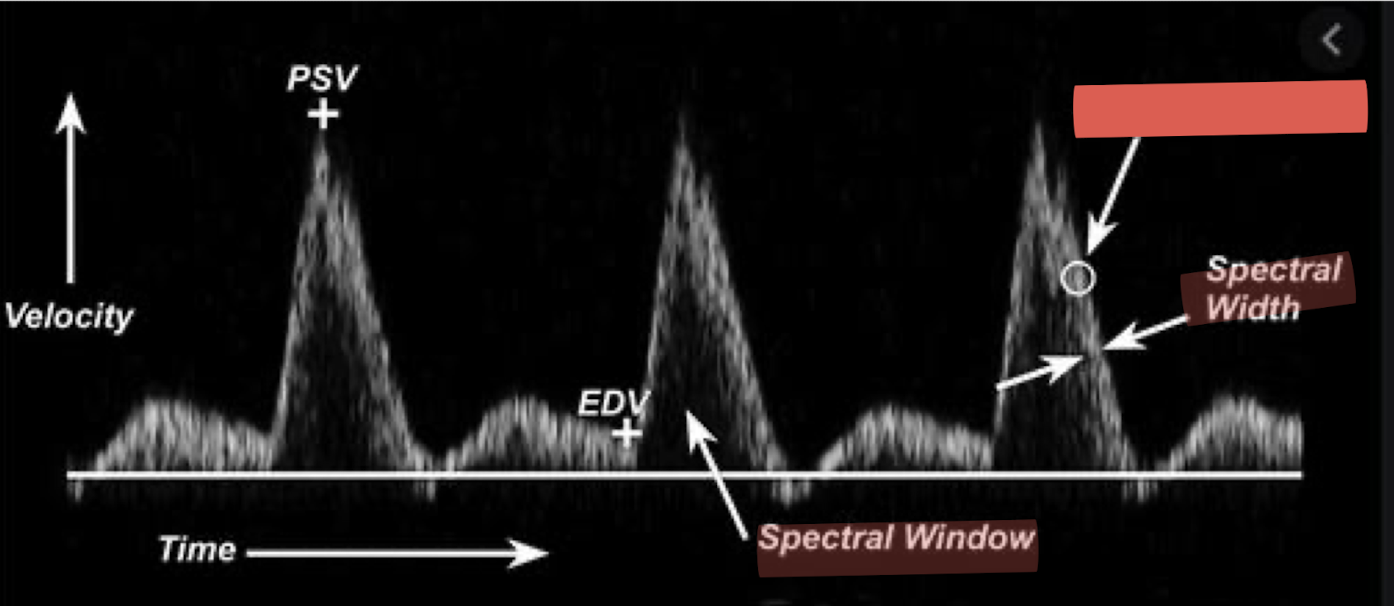
spectral intensity
the filling of the spectral window is known as?
spectral broadening
form of two dimensional doppler. velocity information coded into color and superimposed on a gray scale image. what kind of doppler?
color flow doppler
color doppler reports the…blood flow velocities
average
pulsed ultrasound technique
has range resolution
subject to aliasing
tell direction of flow
what kind of doppler?
color flow doppler
color doppler measures…velocity. spectral doppler (pulsed and cont) measures…velocity
mean, peak
measured velocities converted into color and displayed on a vertical bar?
called color map
what are the two types of color map?
velocity mode map
Variance mode map
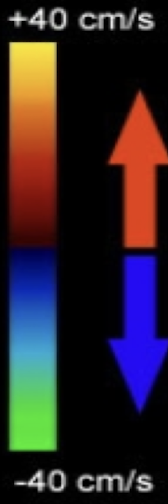
what kind of color map?
velocity
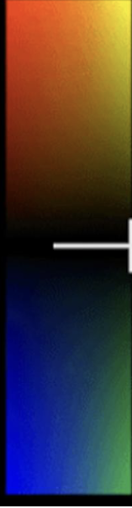
what kind of color map?
variance
shows flow direction and velocity. what kind of map?
velocity
shows laminar and turbulent flow indicated from side to side. what kind of map?
variance
color above the black bar indicates?
toward flow
+ doppler shift
color below the black bar meant?
away flow
doppler shift
color change is always up and down and not side to side
which map?
velocity
in velocity mode map, lower flow velocities are near?
the black line
in velocity map, the higher flow velocities are near the?
top or bottom
laminar and turbulent flow is indicated from side to side
left side = laminar flow
right side = turbulent flow
what kind of map?
variance mode map
with color Doppler multiple ultrasound pulses are used to accurately determine blood velocities. what is this called?
Doppler packets
advantages of larger packets (doppler packets) or longer ensemble length
more accurate velocity measurement
increased sensitivity to low flow
disadvantages of large packets (doppler packets)
decrease frame rate and decreased temporal resolution
more time needed to acquire new data
only identifies the presence of the doppler shift?
power mode
does not eval for speed or direction
non-directional speed
power doppler
advantages in power doppler?
increases sensitivity to low flow or velocity
angle doesnt matter unless 90 degrees
no aliasing
disadvantage of power mode
no measurement of velocity direction
low frame rates (reduced temporal resolution) than conventional color flow doppler
susceptible to motion of the transducer, patient or soft tissue, resulting in a burst of color or flash artifact
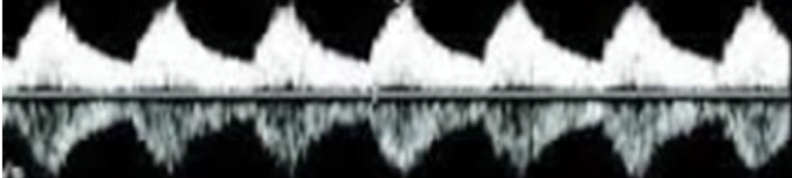
aka spectral mirroring
minor artifact seen in spectral doppler that appears as identical doppler spectrum both above and below the baseline
appears bidirectional but is truly unidirectional
crosstalk
a tool that identifies individual velocities that make up a doppler signal
spectral analysis
what are the 2 methods of spectral analysis?
fast Fourier transformation
autocorrelation
a digital technique, used to process both pulsed and continuous wave doppler waves
distinguishes laminar flow from turbulent flow
clear spectral window (laminar flow) or spectral broadening (turbulent flow)
fast Fourier transform
digital technique used to analyze color flow
less accurate but faster to perform than FFT
autocorrelation or correlation function
power doppler is also called?
energy mode or color angio
on spectral displays, low frequency doppler shift artifacts are called?
clutter