PALEO EXAM 2 QUESTIONS
 Call Kai
 Learn
Learn Practice Test
 Spaced Repetition
 Match
Match Flashcards
 Knowt Play
1/69

There's no tags or description
Looks like no tags are added yet.
Name | Mastery | Learn | Test | Matching | Spaced | Call with Kai |
|---|
No analytics yet
Send a link to your students to track their progress
70 Terms
____ is the normal differences between individuals of a species that are not identical twins
a. individual variation
b. geographic variation
c. sexual dimorphism
d. ecophenotypic effect
a. individual variation
__ is the physical differences between populations, races or subspecies in different parts of the overall species range.
a. sexual dimorphism
b. individual
c. geographic variation
d. ecophenotypic effect
c. geographic variation
____ is different sizes in gender, and different specialized features (horns, antlers, tail, feathers) often related to mate selection
a. sexual dimorphism
b. geographic variation
c. individual
d. ecophenotypic effect
a. sexual dimorphism
___ is when growth increases to scale
a. ativism
b. isometry
c, negative allometry
d. positive allometry
b. isometry
____ is wehn an organ of interest increases in size slower than the rest of the body
a. ativism
b. positive allometry
c. isometry
d. negative allometry
d. negative allometry
____ is when an organ of interest increases in size faster than rest of body
a. ativism
b. negative allometry
c. positive allometry
d. isometry
c. positive allometry
___ is when an organ or feature appears because regulatory genes do not suppress earlier stages of development
a. negative allometry
b. positive allometry
c. isometry
d.ativism
d.ativism
___ is developmental change in the timing of events, which leads to changes in size and shape
a. heterochrony
b. progenesis
c. neotony
d hypermorphosis
a. heterochrony
In comparison of the human head to that of a chimp, the shape of the human skull and face is likely the result of ____
a. neoteny
b. progenesis
c. pedomorphosis
d. peramorphosis
a. neoteny
the results of the plots that show the eyes and head of the baby ichthyosaurs were relatively large is
a. ativism
b. negative allometry
c. positive allometry
d. isometry
b. negative allometry
the results of the plots that show that antlers of the irish elk grew faster than the rest of the body was a result of ____ and not _____
a. ativism, heterochrony
b. negative allometry, sexual dimorphism
c. positive allometry, sexual dimorphism
d. isometry, peramorphosis
c. positive allometry, sexual dimorphism
all of the following is part of circumstantial evidence except:
a. trace fossils
b. cryptic anatomy
c. genetic molecules
d. associated fauna and flora
c. genetic molecules
all of the following is part of interperting function in fossil except:
a. modern analogs
b. phenetics
c. biomechanical modeling
d. circumstantial evidence
b. phenetics
the estimated number of species on earth is between
a. 5-30 million
b. 3-1 million
c. 10-30 million
d. 1-10 million
a. 5-30 million
Sepkowski’s original diversity curve for marine animals from the cambrian to the present day reflects the:
a. linear or additive model
b. exponential model
c. equilibrium model
d. logisitic model
d. logisitic model
all of the following are faunal diversification patterns through time, except:
a. cambrian fauna
b. mesozoic fauna
c. paleozoic fauna
d. modern fauna
b. mesozoic fauna
Mass exinctions on sepkowski’s original diversity curve for marine animals from the Cambrian to the present are reflected as:
a. sharp decreases in abundance
b. sharp increases in diversity
c. sharp decreases in diversity
d. no change in detectable
c. sharp decreases in diversity
all of these other groups of organisms follow the Sepkowski’s diversity curve except:
a. insects
b. baccteria and archea
c. continental tetrapods
d. vascular plants
b. baccteria and archea
re-analysis of Spekowski’s diversity curve by ___ using ___ level data demonstrates that the diversity cruve is more like that modeled by ___, which makes corrections for the supposed poor quality of the fossil record
a. raup, genus; alroy and others
b. alroy and others; family; valentine
c. valentine; genus; alroy and others
d. alroy and others; genus; raup
d. alroy and others; genus; raup
___ simplified naming by designating one Latin name to indicate the genus, and one as the shorthand name for the species. The two names make up the binomial species name
a. clerck
b. darwin
c. hennig
d. linneaus
d. linneaus
advanced characters in cladistics are referred to as:
a. plesiomorphic
b. apomorphic
c. symplesiomorphies
d. synapomorphies
b. apomorphic
primitive characters in cladistics are referred to as:
a. apomorphic
b. symplesiomorphies
c. plesiomorphic
d. synapomorphies
c. plesiomorphic
shared advanced characters in cladistics are referred to as:
a. plesiomorphic
b. synapomorphies
c. apomorphic
d. symplesiomorphies
b. synapomorphies
shared primitive characters in cladistics are referred to as
a. symplesiomorphies
b. plesiomorphic
c. apomorphic
d. synapomorphies
a. symplesiomorphies
____ a natural classification should result in groupings of taxa which share a common ancestor
a. homoplasy
b. monophyly
c. polyphhyly
d. paraphyly
b. monophyly
___ groupings which share a common ancestor but exclude a taxon
a. homoplasy
b. polyphyly
c. paraphyly
d. monophyly
c. paraphyly
___ groupings with taxa which share a common ancestor outside of the group
a. homoplasy
b. paraphyly
c. monophyly
d.polyphyly
d.polyphyly
___ a character state which occurs in many, separate places on a cladogram
a. polyphyly
b. paraphyly
c.homoplasy
d. monophyly
c.homoplasy
the difference between equilibrium and expansion models is that the
a. equilib. model is based on the island biogeography ecological theory where there is a limited carrying capacity, whereas the expansion model as no limit to carrying capacity and has not been reached yet
b. expansion model is based on the island biogeography ecological theory where there is a limited carrying capacity, whereas the equilib. model as no limit to carrying capacity and has not been reached yet
b. expansion model is based on the island biogeography ecological theory where there is a limited carrying capacity, whereas the equilib. model as no limit to carrying capacity and has not been reached yet
what is the difference between background extinction and mass extinction?
a. background extinction happens all the time to lineages where ~ 5-10% of species per millions years have run their evolutionary course and go extinct, whereas mass extinction is caused by some external event in which variety of clades go extinct simultaneously, >30% of organisms at one time
b. mass extinction happens all the time to lineages where ~ 5-10% of species per millions years have run their evolutionary course and go extinct, whereas background extinction is caused by some external event in which variety of clades go extinct simultaneously, >30% of organisms at one time
a.. background extinction happens all the time to lineages where ~ 5-10% of species per millions years have run their evolutionary course and go extinct, whereas mass extinction is caused by some external event in which variety of clades go extinct simultaneously, >30% of organisms at one time
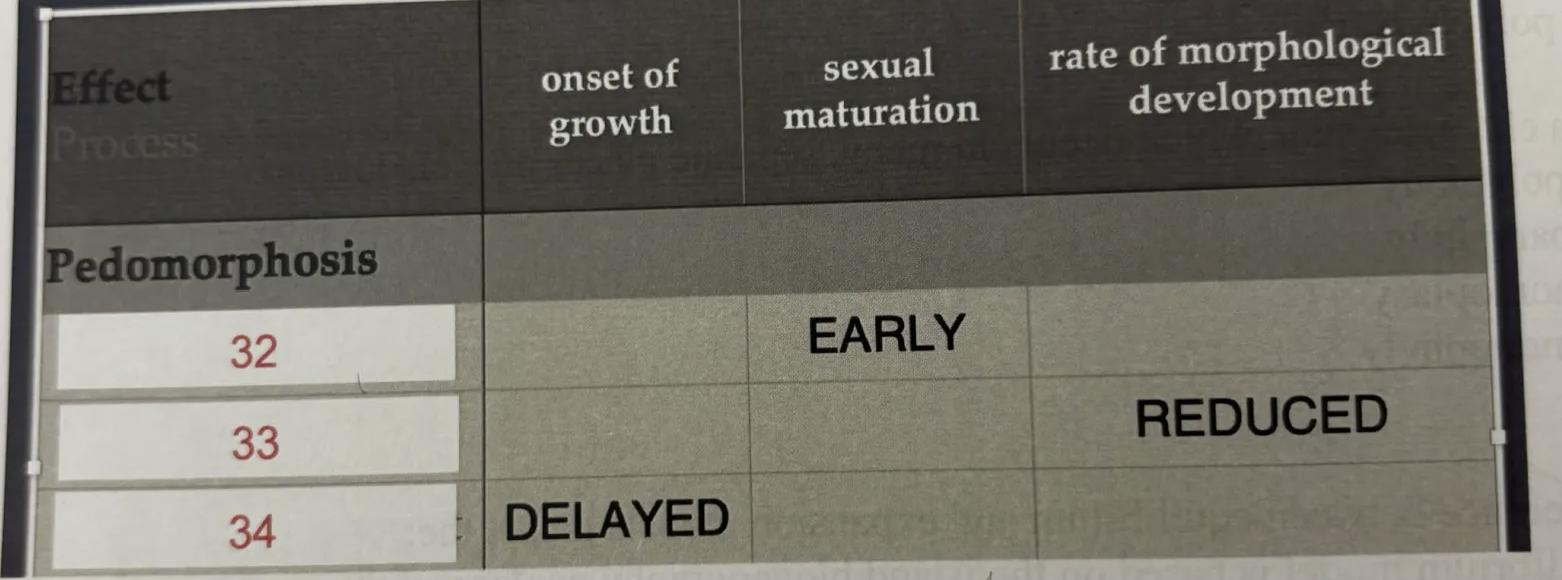
a. acceleration
b. progenesis
c. postdisplacment
d. neotony
b. progenesis
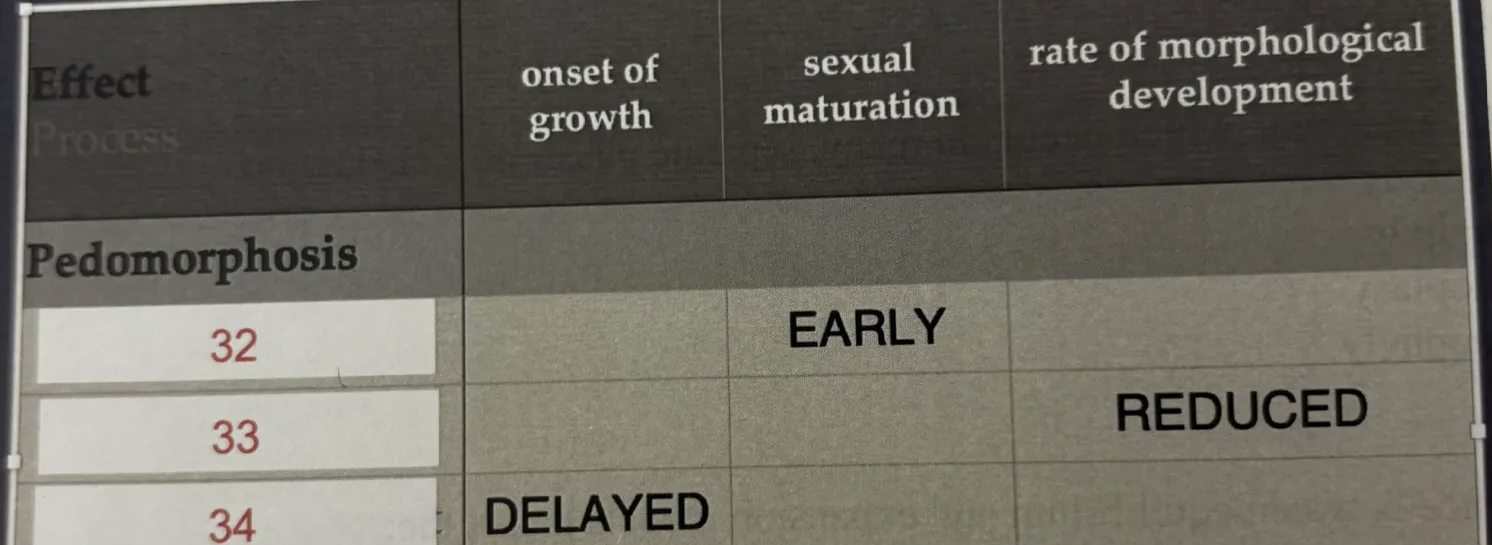
a. neoteny
b. acceleration
c. postdisplacment
d. progenesis
a. neoteny
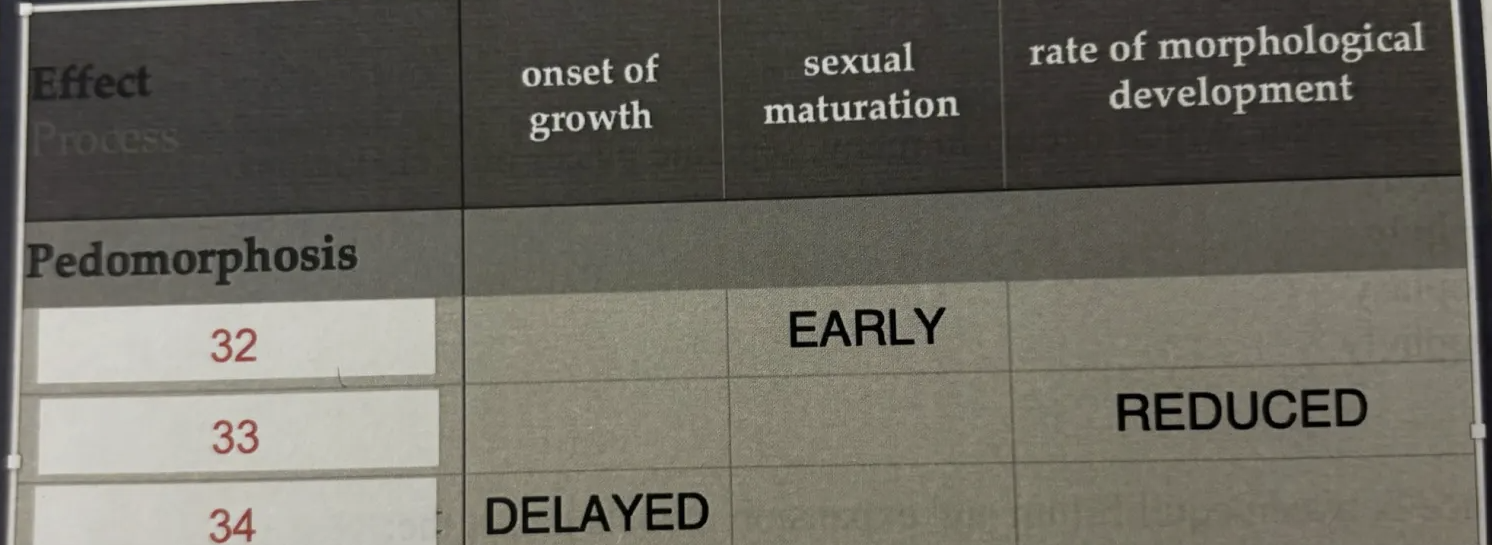
34.
a. acceleration
b. neoteny
c. porgenesis
d. postdisplacement
d. postdisplacement
Raup used the ___ to calculate the 95% of taxa that went extinct at the greatest mass extinction o them all
a. exponential curve
b. additive curve
c. logistic curve
d. negative allometry curve
c. logistic curve
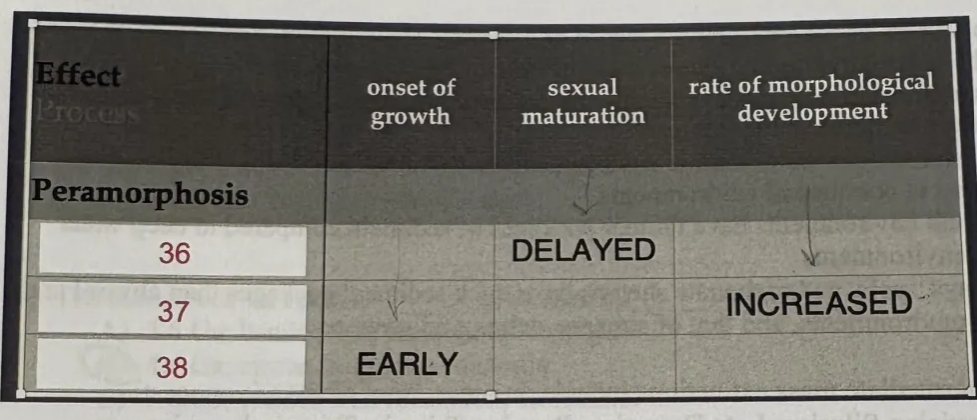
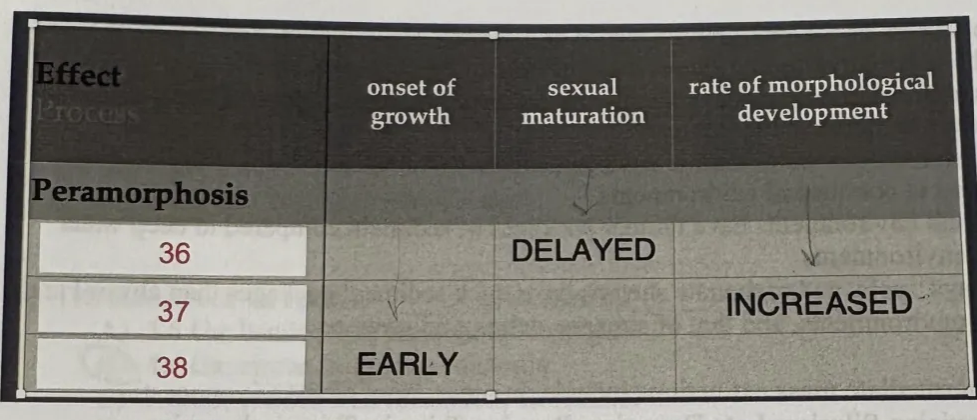
36.
a. acceleration
b. neoteny
c. predisplacement
d. hypermorphosis
d. hypermorphosis
a. hypermorphosis
b. neoteny
c. acceleration
d. predisplacment
c. acceleration
a. acceleration
b. predisplacment
c. hypermorphosis
d.neoteny
b. predisplacment
___ is the local ecological conditions that affect the form of an organism during its lifetime
a. geographic variation
b. ecophenotypic effect
c. sexual dimorphism
d. individual
b. ecophenotypic effect
the largest of all mass extinctions was the ___ in which 95% of species went extinct, but may actually be closer to 80%
a. cretaceous-paleogene
b. late devonian
c. ordovician-silurian
d. permian-triassic
d. permian-triassic
the completeness of the stratigraphic record of sediment accumulation that makes up rocks exhibits the pattern that for the same period of time of interest studied
a. continental environments have the thicker sediment packages compared to more distal, deeper water marine environments
b. more distal, deeper water marine environments have the thicker sediment packages compared to continental environments
c. continental environments have thinner packages of sediments compaed to deep water marine environments
d. lakes, bays, reefs, and carbonate shelves have thick sediment packages than abyssal and bathyal environements and that of streams, deltas, and swamps
a. continental environments have the thicker sediment packages compared to more distal, deeper water marine environments
the four intermediate mass extinctions include, in order, from oldest to youngest
a. ordovician-silurain, late devonian, permian-triassic, triassic-jurassic
b.ordovician-silurain, late devonian, cretaceous paleogene, triassic-jurassic
c.ordovician-silurain, late devonian, triassic-jurassic ,cretaceous paleogene
d.ordovician-silurain, late devonian, cretaceous paleogene , pleistocene-holocene
c.ordovician-silurain, late devonian, triassic-jurassic ,cretaceous paleogene
to study an extinction event in deep water environments would require ___ , whereas to study the same event in deltas and wetlands would require ______
a. 0.1-1 mm; 1cm-1m
b.1-10m; 100-1000m
c. 10-100 m; 1,00-10,000m
d. 0.1-1m;100-1,000m
d. 0.1-1m;100-1,000m
The Signor-Lipps effect states that:
a. epifaunal organisms exhibit shorter generic durations than do infaunal organisms that live in shallow to deep burrows
b. gaps and missing data can make sudden events seem gradual because locating the last fossil occurence is nearly impossible due to taphonomic processes
c. epifaunal organisms exhibit greater generic durations than do infaunal organisms that live in shallow to deep burrows
d. gaps and missing data can make sudden events seem extremely sudden because locating the last fossil occurrence is nearly impossible due to diagenesis
b. gaps and missing data can make sudden events seem gradual because locating the last fossil occurence is nearly impossible due to taphonomic processes
the only two models for the origin of life on earth that is no longer taken seriously are the
a. spontaneous generation and biochemical models
b. biochemical and hydrothermal models
c. spontaneous generation and inorganic models
d. hydrothermal and panspermia models
c. spontaneous generation and inorganic models
All the necessary gasses to create life on earth were present except for
a. NH3
b. H20
c. N2
d. CO2
d. CO2
The first life on Earth represented
a. an RNA world
b. a microbial world
c. a DNA world
d. a complex organic molecule world
a. an RNA world
The oldest rock on Earth is ____, presented by ______ from ____
a. 3.8 Ga ; banded iron formation ; australia
b. 4.4 Ga ; zircon fragment; austrailia
c. 3.8 Ga ; banded iron formation ; greenland
d. 4.4 Ga ; zircon fragment ; greenland
b. 4.4 Ga ; zircon fragment; austrailia
The possible oldest record of life on earth is based on ___ and ___
a. chemicofossils and body fossils
b. trace fossils and body fossils
c. chemicofossils and trace fossils
d. chemico fossils and organic molecules
c. chemicofossils and trace fossils
even though angiosperms evolved in the Cretaceous, clastic analysis suggests the earliest ancestors might be found in the:
a. carboniferous
b. jurassic
c. triassic
d. permian
a. carboniferous
the chlorobionta contain:
a. angiospermae
b. spermatopsida
c. gymnospermae
d. all of the above
d. all of the above
the physiological barriers to terrestrialization of plants, as well as animals, include all of the following except:
a. temperature
b. light
c. gas exchange
d. water
b. light
The first seed plants appeared in the:
a. cambrian
b. ordovician
c. carboniferous
d. devonian
d. devonian
The following plants belong to the gymnosperms except
a. cycads
b. conifers
c. lycopods
d. ginkgos
c. lycopods
The coevolution o insects and plants most likley began in the ___ due to the ____
a. permo-triassic, relationship of insects visiting plants through which angio-spem like gymnosperms evolved into angiosperms
b. jurassic-cretaceous, relationship of insects visiting platns through which angiosperm-like gymnosperms evolved into angiosperms
c. triassic-jurassic, relationship of insects visiting platns through which gymnosperm-like angiosperms evolved into angiosperms
d. carboniferous; relationship of insects visiting platns through which gymnosperm-like angiosperms evolved into angiosperms
a. permo-triassic, relationship of insects visiting plants through which angio-spem like gymnosperms evolved into angiosperms
all of the following are characteristics of foraminifera except
a. single-celled
b. poor for biostratigraphy
c. heterotrophic
d. shelled amoebae
b. poor for biostratigraphy
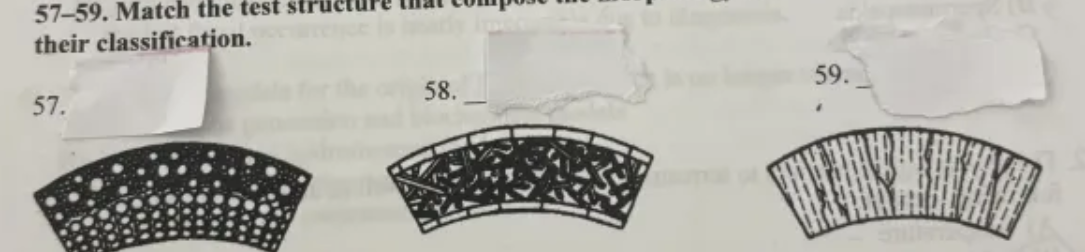
57
a. agglutinated
b. hyaline radial
c. microgranular compound
d. porcellanious
c. microgranular compound
a. agglutinated
b. hyaline radial
c. microgranular compound
d. porcellanious
d. porcellanious
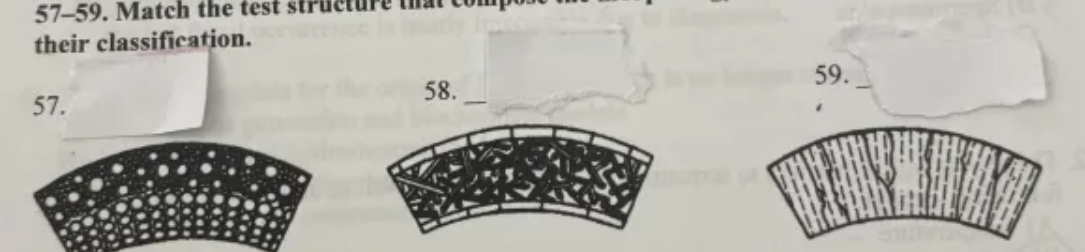
a. agglutinated
b. hyaline radial
c. microgranular compound
d. porcellanious
b. hyaline radial
The formanifer that resembles wheat grains that are found in the building stones around campus belong to the ____ and lived between the _____
a. fusilinids; pennsylvanian-permian
b. endothyrids; devonian-permian
c. globigerinids; jurassic-recent
d. orbitolinids; jurassic-paleogene
a. fusilinids; pennsylvanian-permian
fungi are ____ and have a fossil record that begins in the ____
a. closer to animals evolutionary wise, late neoproterozoic
b. closer to plants evolutionary wise, late neoproterozoic
c. closer to algae; early cambrian
c. closer to protists; early cambrian
a. closer to animals evolutionary wise, late neoproterozoic
the correct sequence in the evolution of plants as expressed by cladistics is
a. chlorobionta, tracheophyta, embryophyta, spermatopsida, gymnospermae, angiospermae
b. chlorobionta, embryophyta, tracheophyta, spermatopsida, gymnospermae, angiospermae
c. embryophyta, chlorobionta, tracheophyta, spermatopsida, gymnospermae, angiospermae
d. chlorobionta, embryophyta, tracheophyta, spermatopsida, angiospermae ,gymnospermae
b. chlorobionta, embryophyta, tracheophyta, spermatopsida, gymnospermae, angiospermae
all of the following were necessary for plants to move onto the continent except,
a. develop a way to use the suns energy to convert co2 and water to sugar
b. develop an internal system to transport nujtrient and water to various parts of the plant
c. develop a way to maintain rigidity and jupright position of the plant
d. develop a way to control gas exchange
a. develop a way to use the suns energy to convert co2 and water to sugar
the oldest known plant is ___ from the ___, but ____ represents the oldest possible plant fossils in the ___
a. from spores; ordovician Rhynia, devonian
b. rhynia, ordovician; spores; devonian
c. rhynia, devonian, spores, ordovician
d. rhynia, carboniferous, spores, devonian
c. rhynia, devonian, spores, ordovician
the two most specious groups of organism on earth today are the ___, followed by the ____
a. plants, insects
b. plants; fungi
c. insects, chordates
d. insects, plants
d. insects, plants
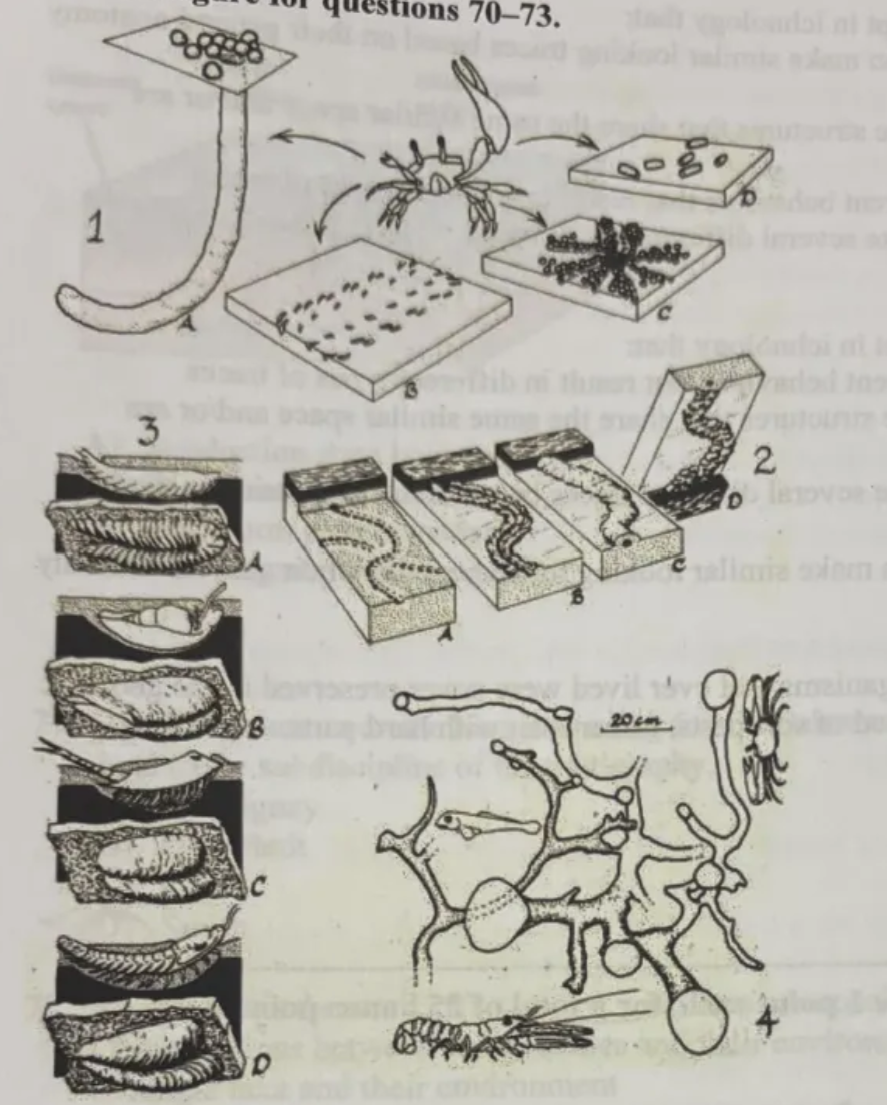
1 illustrates concept in ichnology that
a. multiple animals can produce structures that share the similar space and or are interconnected
b. one type of trace can look like several different traces based on its expression in the sediment or rock outcrop
c. one animal can exhibit different behaviors that result in different types of traces
d. different types of animals can make similar looking traces based on their general anatomy or symmetry and behavior
c. one animal can exhibit different behaviors that result in different types of traces
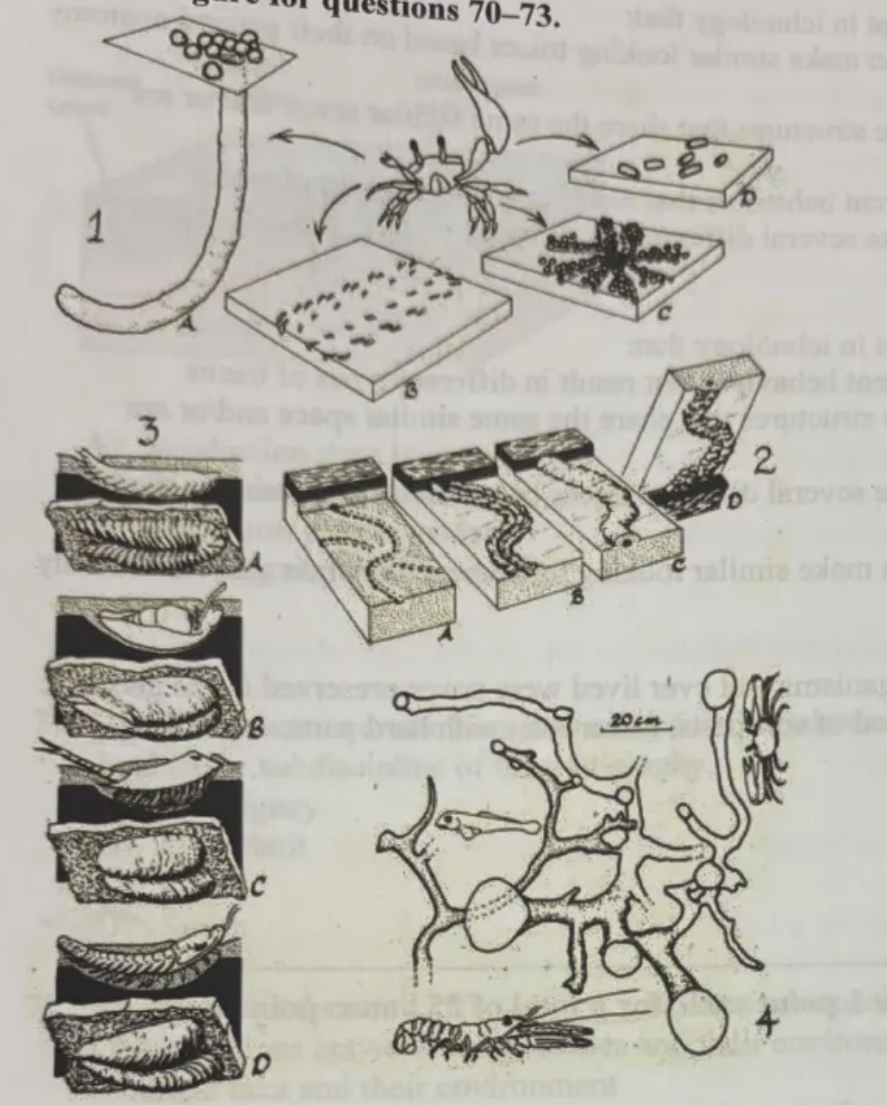
2 illustrates concept in ichnology that
a. multiple animals can produce structures that share the similar space and or are interconnected
b. one type of trace can look like several different traces based on its expression in the sediment or rock outcrop
c. one animal can exhibit different behaviors that result in different types of traces
d. different types of animals can make similar looking traces based on their general anatomy or symmetry and behavior
b. one type of trace can look like several different traces based on its expression in the sediment or rock outcrop
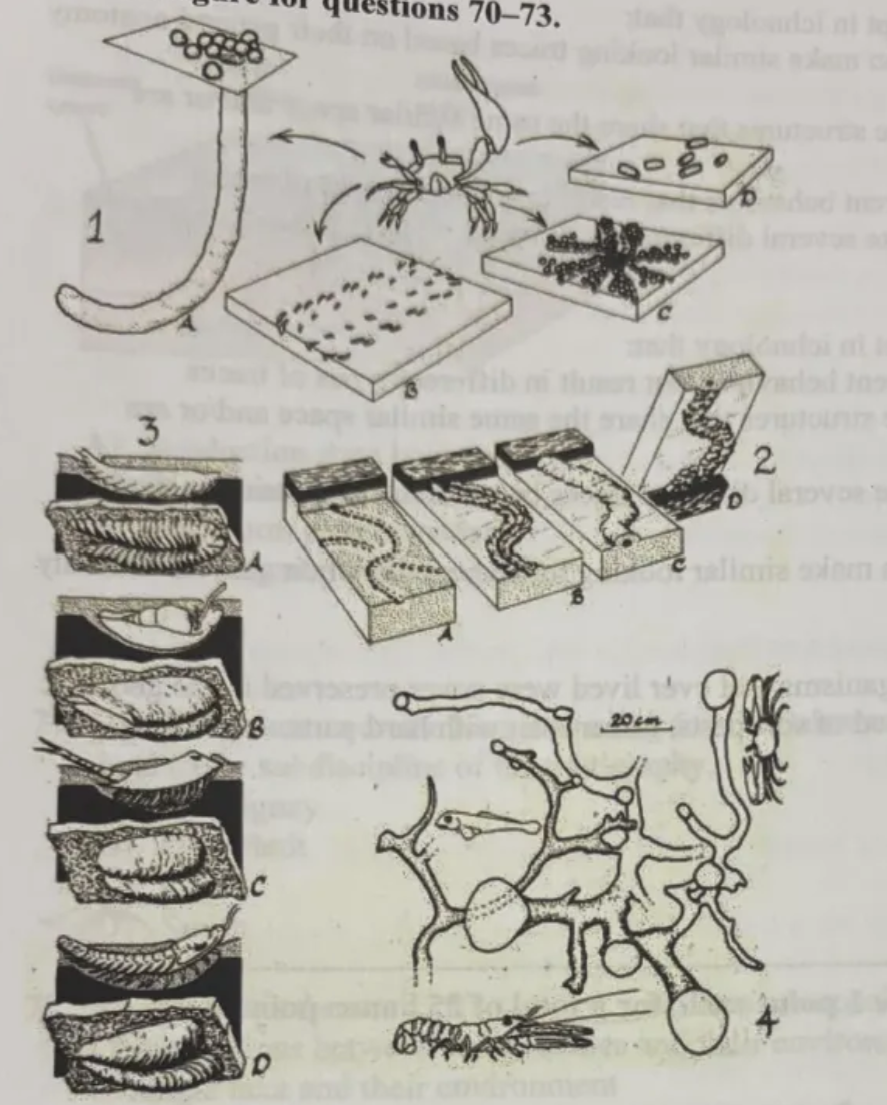
3 illustrates concept in ichnology that
a. multiple animals can produce structures that share the similar space and or are interconnected
b. one type of trace can look like several different traces based on its expression in the sediment or rock outcrop
c. one animal can exhibit different behaviors that result in different types of traces
d. different types of animals can make similar looking traces based on their general anatomy or symmetry and behavior
d. different types of animals can make similar looking traces based on their general anatomy or symmetry and behavior
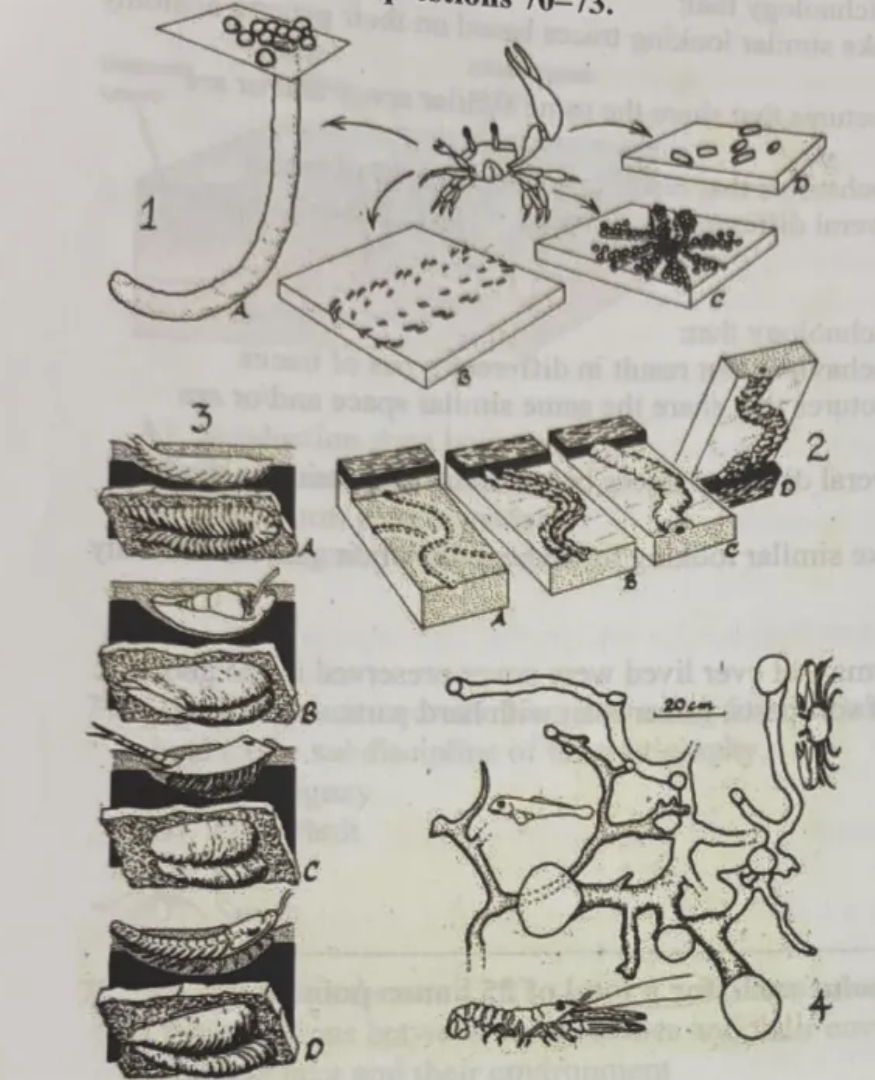
4 illustrates concept in ichnology that
a. multiple animals can produce structures that share the similar space and or are interconnected
b. one type of trace can look like several different traces based on its expression in the sediment or rock outcrop
c. one animal can exhibit different behaviors that result in different types of traces
d. different types of animals can make similar looking traces based on their general anatomy or symmetry and behavior
a. multiple animals can produce structures that share the similar space and or are interconnected
all of the following were used as evidence that showed the continents were moving on plates through geologic time except for
a. geophysical techniques to explore the seafloor and the rocks below the sediemtn
b. magentic reversals recorded in rock on either side of mid-ocean ridge
c. paleo-polar wandering recorded in igneous, sedimentary, and metamorphic rocks
d. milankovitch cyclicity recorded in sedimentary rock layers
d. milankovitch cyclicity recorded in sedimentary rock layers
all of the following would make poor biostratigraphic markers, except for
a. echinoids
b. forams
c. barnacles
d. birds
b. forams