Forensics Final
 Call Kai
 Learn
Learn Practice Test
 Spaced Repetition
 Match
Match Flashcards
 Knowt Play
1/233

There's no tags or description
Looks like no tags are added yet.
Name | Mastery | Learn | Test | Matching | Spaced | Call with Kai |
|---|
No analytics yet
Send a link to your students to track their progress
234 Terms
What are the two kinds of forensic DNA technology?
Nuclear DNA
Mitochondrial DNA
What technology is used for nuclear DNA?
STR Analysis (short tandem repeat)
What technology is used for mitochondrial DNA?
mtDNA sequencing
What does forensic DNA testing begin with?
Serology
Where is DNA found?
Mitochondrion
Nucleus
How many copies of nuclear DNA are there per cell?
2
How many copies of mitochondrial DNA are there per cell?
1000
What is a human’s chromosal makeup?
2 × 23 chromosomes
one copy from each parent
42 total, unique to an individual
How many base pairs of DNA are in an individual?
3 billion base pairs
What is a person’s mitochondrial makeup?
single circular unit
inherited from mother (maternal bloodline)
not unique to individual
Do identical twins share DNA?
Yes — they have identical DNA.
Is DNA the same no matter the body fluid or tissue from which it is obtained?
Yes
What is the first step of STR analysis?
DNA extraction
What is the second step of STR analysis?
After DNA extraction, both nuclear and mitochondrial DNA are amplified using the Polymerase Chain Reaction (PCR). PCR amplification makes many copies of the DNA to allow for detection.
What year was PCR testing first used in forensic science?
1992
Who first used PCR testing in forensic science, and what award did he win?
Kary Mullis, the Nobel Prize in Chemistry in 1993
What is the third step of DNA testing?
Genetic analyzer
Amplified DNA fragments are labeled with a fluorescent tag
DNA fragments are separated by capillary electrophoresis
The size of the fluorescent DNA fragment is detected by a machine which converts the data into a graph
Analysts read the graph to determine the DNA type
How many original loci were there with chromosomal positions?
13
What is a DNA profile?
A listing of all lengths at each loci
How many loci are there in the modern Core Loci?
20
What are relative fluorescence units (RFUs)?
Establush peak-height thresholds for scoring alleles
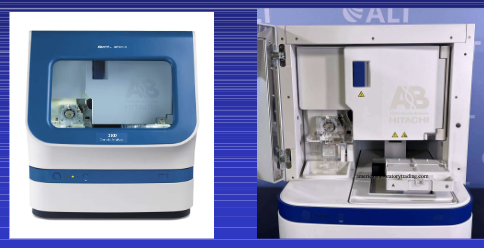
What is this machine?
A Thermo Fisher 3500 Series Genetic Analyzer
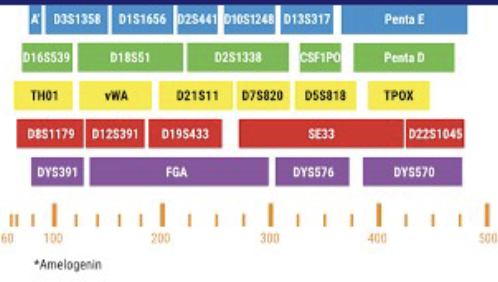
What is this?
Promega PowerPlex Fusion 6C locus map
What is STRmix?
A software program that uses probabilistic genotyping to conduct mixture interpretation and statistical analysis on DNA profiles
What is probabilistic genotyping?
Uses an algorithm based on standard mathematical principles to model possible DNA profiles that could create a mixture observed in casework.
How does STRmix work?
Once the software completes interpretation, statistical analysis is conducted
The analyst chooses two propostions/hypotheses
One in which the person of interest did contribute to the mixture
One in which the person of interest did not contribute to the mixture
The software calculates and compares the probability of the mixture under each scenario and reports the likelihood ratio of the two hypotheses
What DNA type is also known as autosomal DNA?
Nuclear DNA
Describe Y Chromosomal DNA.
Only present in males
Passed on from father to son (paternal bloodline)
Not unique to an individual
When is Y Chromosomal DNA used?
Use primarily for samples where high levels of female DNA are mixed with significantly lower levels of male DNA
What DNA testing is not performed at Wisconsin State Crime Laboratories?
Mitochondrial DNA
Where was mitochondrial DNA first used?
By the Armed Forces DNA Identification Laboratory in the USA in 1993 for the identification of remains from Vietnam Veterans
Where was mitochondrial DNA first used in the UK?
By the Forensic Science Service in 1996 for the identification of the Romanov family
What is the history of mitochondrial DNA with the FBI?
1992: FBI mtDNA research begins
1995: FBI validation study published
June 1996: FBI casework begins
August 1996: 1st US mtDNA testimony in State of Tennessee v. Paul Ware
What are the typical sample sources for mtDNA?
Bones
Teeth
Hair
What DNA testing can be done on telogen hair without follicle or root (i.e. naturally shed hair)?
Nuclear DNA is not possible. mtDNA is possible because it is found in quantities 1000x nuclear DNA.
What are the steps of mtDNA analysis?
Extraction
Amplification (PCR)
Sequencing
Sequence Comparison
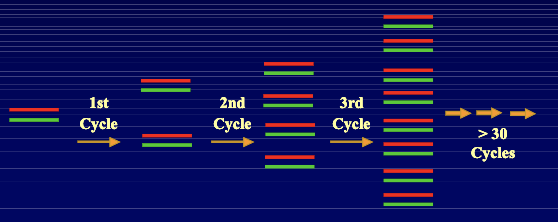
What is this?
Amplification (PCR) — second step in mtDNA analysis
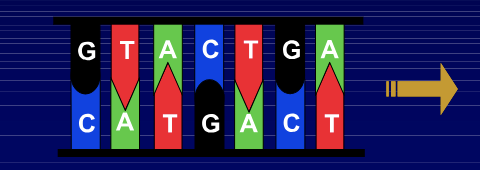
What is this?
Sequencing — third step of mtDNA analysis
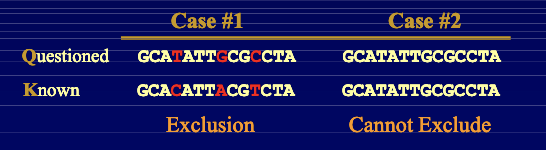
What is this?
Sequence Comparison — fourth step of mtDNA analysis
What does CODIS stand for?
Combined DNA Index System
What is CODIS?
Database of known DNA profiles from convicted offenders and arrestees as well as unknown evidentiary DNA profiles from casework and unknown or missing persons DNA profiles
When was CODIS implemented?
October 1998
What is an investigative lead?
An investigative lead is when at least two profiles are linked by a computer
An investigative lead does not mean the source of the DNA has been confirmed
To determine the statistics and confirm the match, a buccal swab must be submitted from the listed offender
What does “no match” mean in CODIS?
If the perpetrator has never had their DNA collected, the CODIS search will fail to identify any matches and the unknown evidence will continue to be searched indefinitely
What is familial searching?
Familial DNA Search is a tool that deliberately searches for biological relatives of an unknown evidence profile obtained from crime scene evidence.
DNA is inherited and all members of a family will share certain amounts of DNA
Children will share half their DNA with their mother and half with their father
It is possible that one or more members of a family may have their profile in CODIS
When should familial searching be used?
Unsolved violent crime where all traditional investigative leads have been exhausted
How does familial searching work?
A computer program searches each combination of numbers for potential matches and calculates the likelihood that the two individuals are related based on the rarity of each number that matches
Based on the computer comparison, a candidate list is generated
Science is used to narrow the list down to the best potential candidate(s)
How is the candidate list narrowed down in familial searching?
The Y-STR DNA profile is the same in all paternally related male individuals
Unrelated male individuals may also share the same Y-STR DNA profile
What are Y-STRs?
Every male has a Y-chromosome and an X chromosome, whereas a female has no Y chromosome, but instead has two X chromosomes
The Y-STR is inherited unaltered from the father by the son
Thus, if a male on the familial list appears to be a possible parent, child, or sibling of the suspect, his Y-STR must match that of the crime scene stain
If it does not, all his male siblings, together with his biological father and all his sons, are eliminated as possible suspects
What does toolmark examination rely on?
Overall shape of the tool
Manufacturing defects
Use defects
What is a toolmark?
A toolmark is any mark made by one object onto a second object
What is an impressed toolmark?
A toolmark caused by impact or compression
What is a striated toolmark?
A toolmark caused by impact or compression with movement of objects against each other
What is a fracture match?
A toolmark identifying two or more pieces as being part of the same object
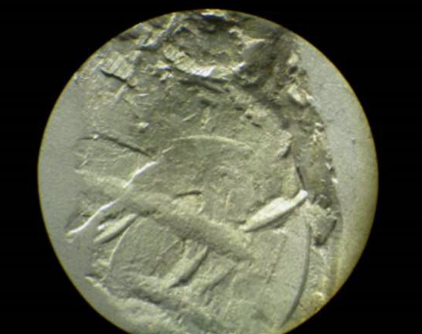
What is this?
Impressed toolmark
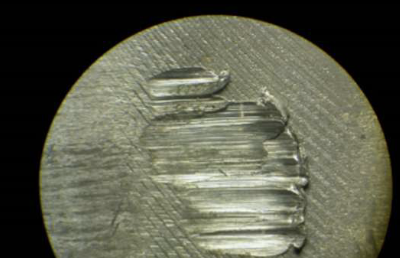
What is this?
Striated toolmark
What was the date of the St. Valentine’s Day Massacre?
February 14, 1929
What were the facts of the St. Valentine’s Day Massacre?
7 gang members of the Moran gang were executed in Chicago
What did the St. Valentine’s Day Massacre lead to?
Established the Scientific Crime Detection Laboratory at Northwestern University
What was the evidentiary process/results from the St. Valentine’s Day Massacre?
Calvin Goddard microscopically examined the fired evidence and later recovered firearms for identification purposes
Evidence recovered at Fred Dane’s/Fred Killer Burke’s residence linked him to an officer-involved shooting, the massacre, and a bank robbery
What is examined/done during firearm function examination?
Make, model, caliber, serial number
Firearm type and action
Critical part inspection and overall condition
Barrel rifling and condition
Safety devices
Trigger pull
Overall and barrel lengths for legal limits
Test fire for proof of function and obtain test bullets and cartridge cases for comparison
What are the types of firearms?
Shotguns
Rifles
Handguns
Pistols
Revolvers
Self-loading pistols
Machine guns
Submachine guns
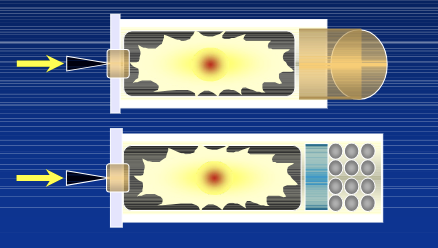
How does a firearm work?
Trigger is pulled
Firing pin strikes primer on cartridge
Primer ignites gunpowder in cartridge
Burning gunpowder causes gas to expand (pressure) that pushes bullet down the barrel
Bullet exits barrel at muzzle and travels toward target
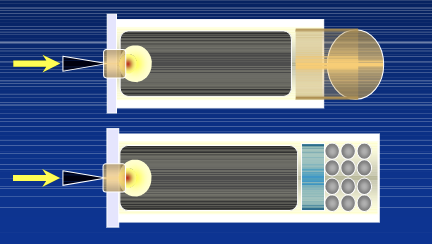
What is this?
Second step in firing a gun — firing pin strikes primer, primer ignites
What is this?
Third step in firing a gun — powder is ignited by primer flame
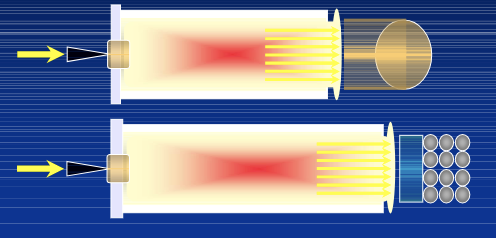
What is this?
Fourth step in firing a gun — burning gunpowder causes gas to expand (pressure) that pushes bullet down the barrel
What are the four major classes of bullets?
Plain lead
Partially jacketed lead
Fully jacketed lead
Non lead (bronze, plastics, wax)
What is a firearm barrel?
A firearm barrel is a tool that leaves striated toolmarks on a fired bullet
What are internal ballistics?
Grooves in the barrel of the firearm called rifling cause the bullet to spin as it moves through the barrel
What are external ballistics?
Barrel spin reduces drag and increases the stability of the projectile through air
Projectiles without barrel spin will tumble end over end
What can you determine from a fired bullet?
General Rifling Characteristics (GRC) — the number, width, and direction of twist of the rifling grooves in a barrel of a given caliber firearm
Class Characteristics
Direction of twist
Number of grooves
Caliber of gauge
Width of lands and grooves of barrel
Possibly gun manufacturer
Individual Characteristics — unique characteristics found to exist in both the known and questioned samples
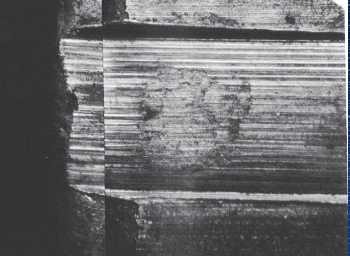
What is this?
Bullets fired from different barrels
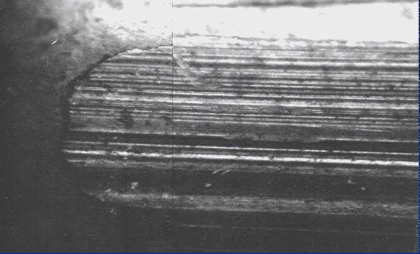
What is this?
Bullets fired from the same barrel
What is the stance on individual characteristics in ballistics?
Guidance from the Association of Firearms and Toolmark Examiners (AFTE) indicates that an examiner may offer an opinion that a specific tool or firearm was the source of a specific set of toolmarks or a particular bullet striation pattern when sufficient agreement exists in the pattern of two sets of marks
What is NIBIN?
National Integrated Ballistic Information Network
What does NIBIN do?
Database search for similar images
Ability to search any other NIBIN site nationwide
Develops investigative leads (NIBIN hits) based on similarity of images
What does NIBIN not do?
It does not make identifications
A NIBIN hot or match is considered a presumptive test, not a confirmation of identification
If an investigative lead — NIBIN hit — is developed, that evidence can be sent to a laboratory for confirmation through microscopic identification
What are the three components of gunshot residue?
Visual inspection
Microscopic inspection
Chemical testing
What can gunshot residue determine?
Determine presence or absence of primer, gunpowder or lead residue on victim’s clothing
Determine approximate distance from firearm muzzle to victim’s clothing
What is gunshot residue?
When a cartridge is discharged in a firearm, unburned or partially burned gunpowder, as well as other residues associated with a gunshot escape from the firearm. These residues can be deposited on garments at reasonably close ranges.
Who is credited with the first fingerprint identification?
Henry Faulds
Who was Henry Faulds?
British surgeon and superintendent of a hospital in Tokyo
Wrote an article that discussed fingerprints as a means of identification
Began to study “skin-furrows”
Developed a classification system for recording impressions
Who discovered that fingerprints are unique?
Sir Francis Galton
When was it first discovered that fingerprints are unique?
1892, through Sir Francis Galton’s book “Finger Prints”
What are minutia sometimes called in honor of Sir Francis Galton?
Galton details
What are the three types of fingerprint classification?
Arch
Loop
Whorl
What are the layers of skin?
Epidermis
Dermis
Subcutaneous tissue
Why do we have fingerprints?
Dermal papillae — an undulating sublayer that causes friction ridges
What are the two types of skin?
Thick skin
Thin skin
How many layers are in thick skin?
5
How many lawyers are in thin skin?
4
Which has more prominent stratum corneum — thick or thin skin?
Thick skin
Which has well developed stratum granulosum — thick or thin skin?
Thick skin
Where is thick skin found?
Palms of the hands and soles of the feet
Where is thin skin found?
Lines most of the body surface
Which has a thicker dermis — thick or thin skin?
Thin skin
Which has hair and sebaceous glands — thick or thin skin?
Thin skin
When does friction ridge skin develop?
Paddle-like hands and friction ridge development starts around 5-6 weeks, or after conception
What happens at 8 weeks gestation?
The fingers separate and violar pads formEh
What are volar pads?
Swellings of tissue under the epidermis in the hands and feet of a fetus