Biogeochemistry - Microorganisms and aq solutions
 Call Kai
 Learn
Learn Practice Test
 Spaced Repetition
 Match
Match Flashcards
 Knowt Play
1/38

There's no tags or description
Looks like no tags are added yet.
Name | Mastery | Learn | Test | Matching | Spaced | Call with Kai |
|---|
No analytics yet
Send a link to your students to track their progress
39 Terms
What governs where microbes live in an environment?
Availability if PEDs, TEAs, light, pH, temperature, nutrients and energy yield
Why does biogeochemical zonation occur?
Microbes use available energy sources in order of thermodynamic favourability
What happens to oxygen with depth in lakes?
Sharp decline in oxygen as temperature decreases and depth increases
Why do lakes show strong phototrophic influence?
They have greater light penetration than ocean sediments therefore phototrophs have strong influence
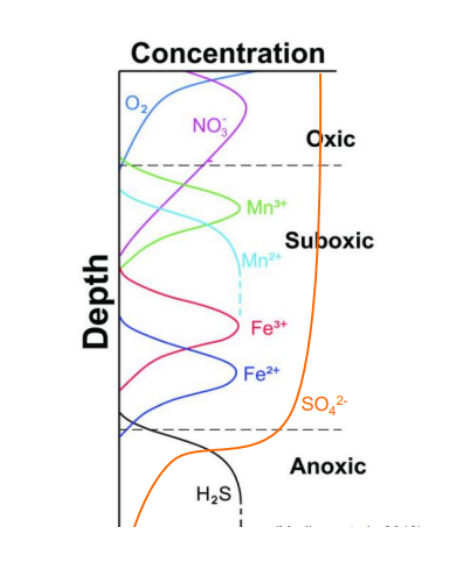
Why doe NO3- peak near the oxic-suboxic boundary?
As it is produced by organims and oxidised by the oxygen and/or chemolithotrophs
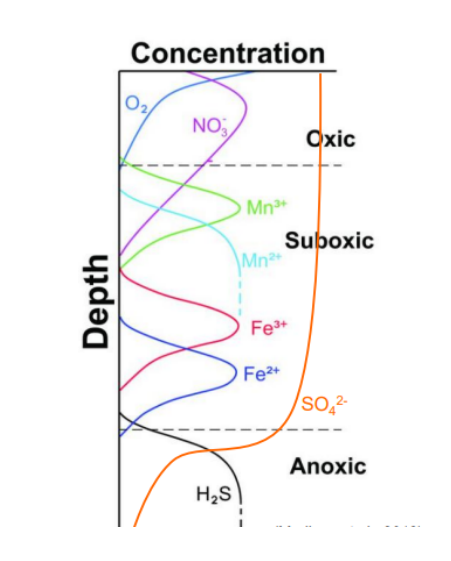
Why are Fe2+ and Mn2+ more abundant in suboxic/anoxic zones?
Their oxidised forms are more insoluble in oxic conditions
What happens when H2S meets Fe2+?
Formation of iron sulfides such as pyrite minerals
What metabollic process dominates at greatest depth?
Methanogenesis
Why do heterotrophs generally yield more net energy than autotrophs?
Autotrophs have to fix inorganic carbon which requires energy
What is the general order of energy yield for chemolithoautotrophy?
Highest → Hydrogen oxidation
Lowest → Nitrogen oxidation
What is the general order of energy yield for chemoheterotrophy?
Highest → Aerobic respiration
Lowest → Chemoheterotrophic methanogenesis
What happens to sulfur species with depth in stratified lakes?
O2 decreases → sulfide oxidised → sulfate reduction in anoxic waters
Which phototrophs dominate the oxic zone?
Cyanobacteria and algae
Which phototrophs dominate the anoxic zone?
PSB and GSB
What colour of microbial matte layers correspond to specific microbes?
Green: Cyanobacteria (top), GNS/GSB (lower)
White: S‑oxidisers
Purple: PSB, PNB
Orange: GNB, Fe‑oxidisers
Black: SRB, methanogens
What causes laminated layers in mats?
Disturbance → community shift upward → new
How do mats shift during the day?
Cyanobacteria produce O2; S-oxidisers move downward to avoid high O2 during the day
What drives stromatolite formation?
Diurnal/tidal disturbance + CaCO₃ precipitation in alkaline waters.
What is chemical equilibrium?
A thermodynamic state where the free energy is minimised and reactants/products no longer change in concentration
How is K related to Gibbs free energy?
ΔG∘=−RTlnK
What is Ka?
The acid dissociation for acid-base reactions:
Ka=[H+][A−] / [HA]
What is Kw?
The ionisation constant of water:
Kw=[H+][OH−]
What is Kd / Kg (dissociation constant)?
Constant describing dissociation of strong or weak acids
What is Kf?
Complex formation (association) constant
What is Ksp?
Solubility product constant for dissolution of solids/minerals:
Example for MgCl2:
Ksp=[Mg2+][Cl−]^2
When is pKa equal to pH?
When the concentrations of acid and conjugate base are equal
Total carbonate concentration expression
Ctotal=[CO2]+[HCO3^−]+[CO3^2−]
How does K relate to solubility?
Higher K → more products → more solubility
Lowe K → more reactants → lower solubility
How does pK relate to solubility
Low pK = higher solubility
How does pH affect solubility?
Higher pH → more reactants → lower solubility
Minerals of weak acids + strong bases raise pH
What is the common ion effect?
The presence of a shared ion reduces solubility of a mineral
What is complexation?
Formation of metal-ligand complexes that increase solubility
What is Eh?
The redox potential of a system relative to the standard hydrogen electrode
What does Q < Ksp?
The solution is undersaturated and dissolution occurs
where Q is the product of the actual measured concentrations
What does Q = Ksp mean?
The system is at equilibrium → saturated
where Q is the product of the actual measured concentrations
What does Q > Ksp mean?
The solution is supersaturated → precipitation occurs
where Q is the product of the actual measured concentrations
What is the saturation index (SI)?
SI = log Q/K
How to interpret SI values:
SI = 0 → equilibrium
SI < 0 → undersaturated
SI > 0 → supersaturated