bio 2.0 chp 6 quiz
 Call Kai
 Learn
Learn Practice Test
 Spaced Repetition
 Match
Match Flashcards
 Knowt Play
1/45

There's no tags or description
Looks like no tags are added yet.
Name | Mastery | Learn | Test | Matching | Spaced | Call with Kai |
|---|
No analytics yet
Send a link to your students to track their progress
46 Terms
Is this kinetic energy or potential energy?:
a. light emitted from a lamp
b. the carbon-carbon covalent bonds in molecules such as carbohydrates and lipids
c. a person who is running
kinetic, potential, kinetic
is the Gibbs free energy of a reaction ever influenced by the enzyme?
NO
What are allosteric inhibitors?
they bind to an enzyme at a site that is not the active site
_____ and some types of _____ bind to the active site of an enzyme
substrates and some types of inhibitors
true or false:
most enzymes are CARBOHYDRATES.
FALSE- they’re proteins
How might an enzyme inhibitor slow down the action of an enzyme without binding to the active site?
by binding to another site on the enzyme and changing its shape
ATP is a type of (amino acid/nucleotide) and is composed of adenine, _____, and three phosphate groups
ribose
energy is…
the a system’s capacity to do work
The potential energy in a molecule of ATP that is harnessed to do the work of the cell is held in part in the…
repulsion of the phosphate groups from each other
the reaction pathways of glycolysis and the citric acid cycle break down glucose into smaller molecules. therefore, these pathways are ____
catabolic
Imagine that a researcher tries to reduce the size of an enzyme by removing all the amino acids from the protein except those flanking, and constituting, the active site. Why wouldn’t this work?
a. The removal of the amino acids will likely affect the shape of the active site.
b. The removal of the amino acids may affect the ability of the enzyme to bind to substrates.
c. All of these choices are correct.
d. Without the additional amino acids, the protein may not fold properly.
c. all are correct
A carbohydrate such as glucose has a lot of ____ energy
potential
synthesis of a protein is an example of a chemical reaction that is (endergonic/exergonic) and (catabolic/anabolic)
endergonic, anabolic
The energy of activation of a reaction is:
the energy input needed to reach the transition state
Some enzymatic inhibitors are called “competitive inhibitors” because they compete with the substrate for binding to the active site. Why would an allosteric inhibitor not be considered a competitive inhibitor?
because allosteric inhibitors bind to a different part of the enzyme
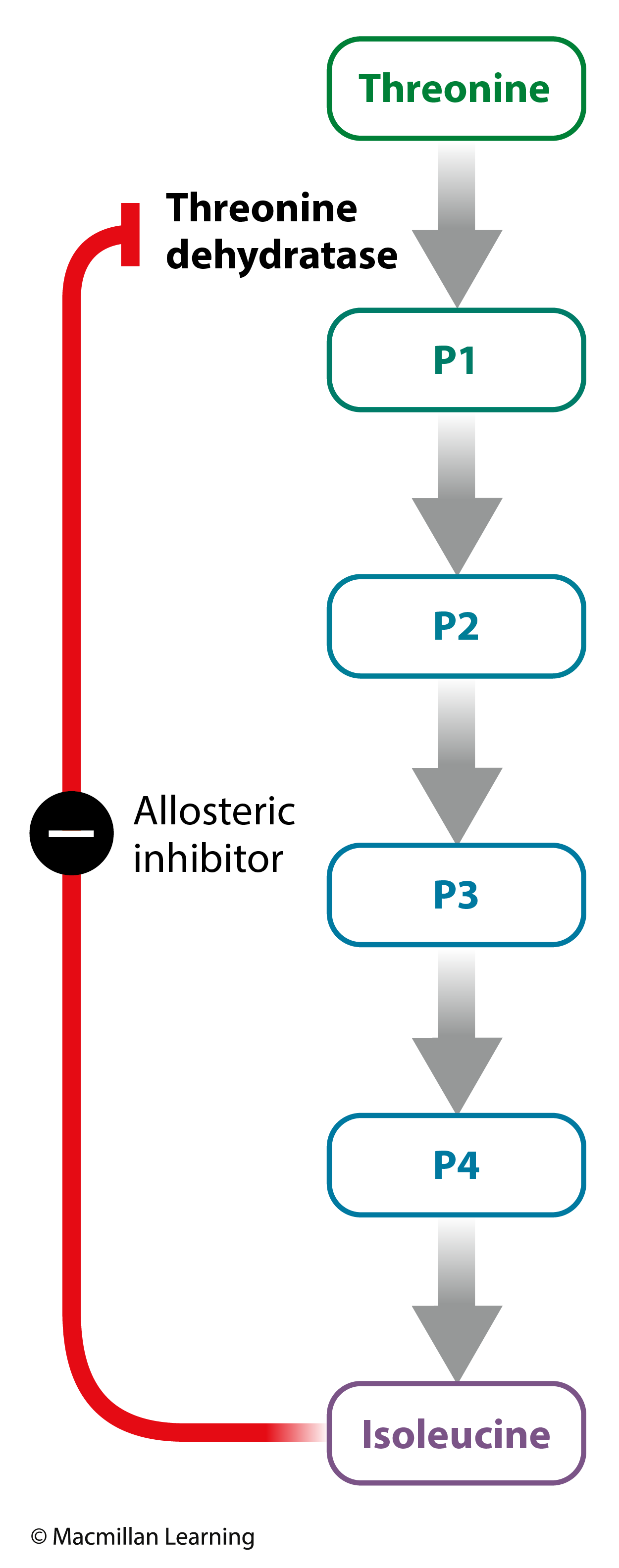
In the pathway leading from threonine to isoleucine, one of the first enzymes in the pathway, threonine dehydratase, is _____ by an accumulation of isoleucine.
inhibited
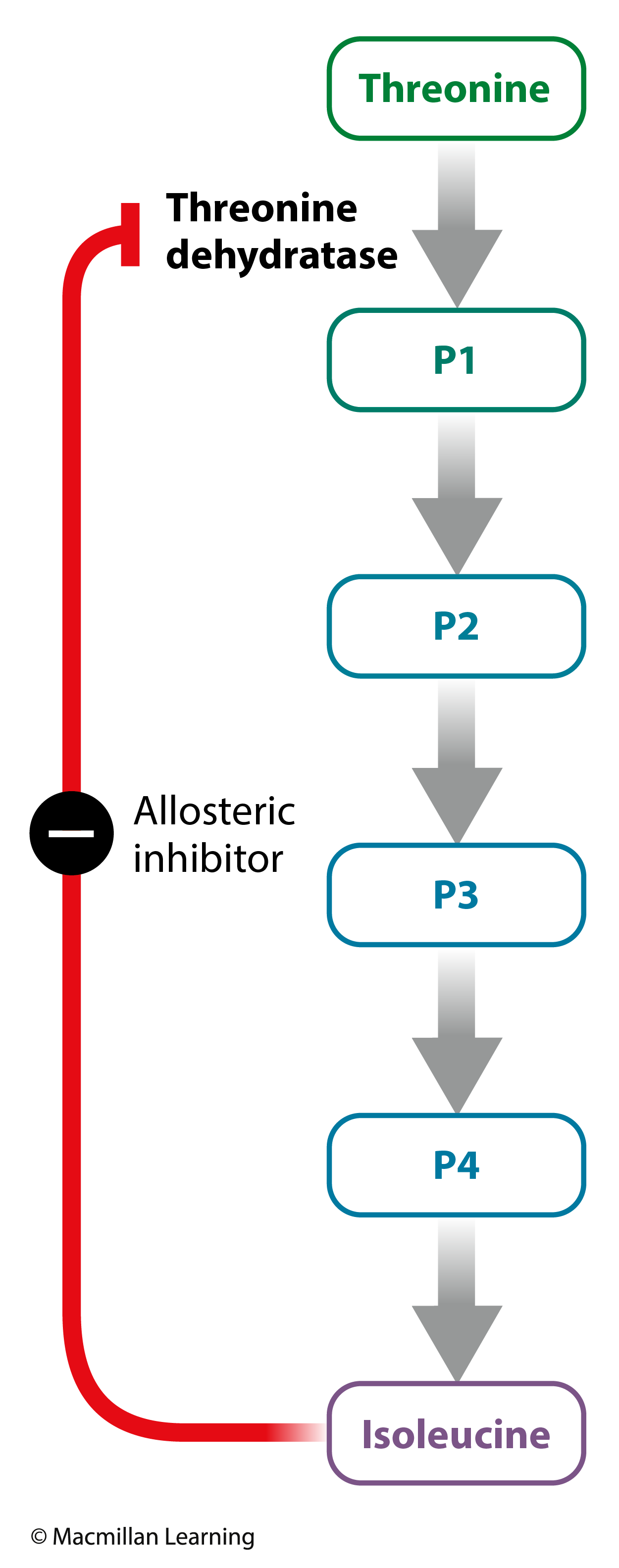
In the pathway leading from threonine to isoleucine, when isoleucine is abundant, which of the intermediates in the pathway is produced? Refer to the figure shown.
None of the intermediates is produced.
Which has the most entropy, individual nucleotides or a nucleic acid?
(THINK: which has more organization vs. which has more chaos?)
individual nucleotides
Organic molecules store (kinetic/potential) energy in their (covalent/hydrogen/ionic) bonds.
potential, covalent
Which of the answer choices is a correct description of the role of enzymes in catalyzing biochemical reactions?
a. Enzymes decrease the ΔG of reactions, making them proceed rapidly.
b. Enzymes provide the necessary activation energy to reach the transition state.
c. Enzymes stabilize the transition state and decrease its free energy.
d. Enzymes increase the ΔG of reactions, making them proceed rapidly.
c. enzymes stabilize the transition state and decrease its free energy
What does the FIRST LAW of thermodynamics state?
energy can be neither created not destroyed, but can be transferred
(energy is conserved)
true or false:
the transformation of energy from one form to another is 100% efficient
FALSE
true or false:
regardless of the type of chemical reaction, the total energy of the system remains constant and the total entropy (S) of the universe increases.
true
ATP synthesis from the substrates ADP and Pi is an example of ___
anabolism
Chemotrophs and heterotrophs receive their energy and carbon source from:
chemical compounds and organic compounds respectively
Is fat BREAKDOWN an exergonic reaction?
What sign would delta G be?
yes, negative
true or false:
“ATP” nucleotide is synthesized during a anabolic reaction.
false- catabolic
ATP releases its stored potential energy when its ______ _____ _____ is broken
terminal phosphate bond
When energy transformation occurs, entropy ____
increases
Given the free energy equation, what would the sign of delta G be for a glucose BREAKDOWN reaction?
would S increase or decrease?
negative, increases
Given the free energy equation, during a glucose breakdown when delta G becomes NEGATIVE and S INCREASES, if the temperature were increased, what would happen to delta G then?
the negative delta G would decrease
Through “energy coupled” reactions, ATP hydrolysis (ΔG= -7.3
kcal/mol) can fuel other ongoing reactions in the cell. Based on the
given ΔG, which reaction can be coupled to ATP hydrolysis?
ΔG= +1.3 kcal/mol
Choose the right delta G, delta S, and delta H combination for an EXERGONIC REACTION.
negative delta G, positive delta S, negative delta H
The activation energy (EA) in a chemical reaction is
the energy needed to reach the transition state
How does using an enzyme affect activation energy?
lowers/decreases it
Which factors contribute to enzyme activity? List all 7.
substrate concentration, pH, temperature, cofactors, coenzymes, activators, inhibitors
When does COMPETITIVE inhibition occur?
when an inhibitor binds to active site instead of substrate
The final product in a biochemical pathway allosterically binds to
the first enzyme of the pathway and reduces its activity. This kind of
inhibition is called:
feedback inhibition
Say, an inhibitor molecule binds to a site away from the “active
site” of the enzyme and reduces the enzyme activity. In which way
does this inhibitor impact enzyme activity?
Enzyme conformation (3D structure) changes
Interaction of enzyme with the substrate at active site
changes
What is cellular respiration?
the breakdown of glucose to ATP via rex reactions
_____ cellular respiration consumes organic molecules in the presence of oxygen and yields ATP, O2, and H2O
aerobic
the partial degradation of sugars ANAEROBICALLY in yeast and bacteria
fermentation
Where does glycolysis occur?
in the cytoplasm
What are the FOUR steps of pyruvate oxidation?
pyruvate is transported to mitochondrial matrix
pyruvate is oxidized to form carbon dioxide
electrons are donated to NAD+, resulting in the formation of NADH
acetyl group is transferred to coenzyme A
due to the pumping action of the electron transport chain, protons have a high concentration in the _____ and a low concentration in the _____
intermembrane space, mitochondrial matrix