Data Analytics Exam 3
 Call Kai
 Learn
Learn Practice Test
 Spaced Repetition
 Match
Match Flashcards
 Knowt Play
1/68

There's no tags or description
Looks like no tags are added yet.
Name | Mastery | Learn | Test | Matching | Spaced | Call with Kai |
|---|
No analytics yet
Send a link to your students to track their progress
69 Terms
T/F Optimization models have been used extensively in operations and supply chains, finance, marketing, and other disciplines.
True
Optimization is the process of selecting values of decision variables to:
a. minimize or maximize some quantity of interest
b. evaluate descriptive summaries of historical datasets
c. estimate correlations between unrelated variables
d. organize raw data into categorical groups
A
The main elements of an optimization model are
a. parameters, datasets, and forecasting rules
b. decision variables, objective function, constraints
c. inputs, outputs, and reporting metrics
d. coefficients, predictions, and simulations
B
What is the most important tool in prescriptive anaytics?
a. Regression analysis
b. Data visualization
c. Optimization
d. Clustering algorithms
C
Which of the following best describes the definition of a decision variable?
a. fixed inputs provided by historical data
b. constants used to scale objective values
c. decision rules derived from regression models
d. unknown values that the model seeks to determine
D
The objective function is
a. the quantity that the model seeks to maximize or minimize
b. a set of restrictions that define feasible solutions
c. a measure of statistical error in predictions
d. a transformation of raw input data into outputs
A
A limitation or requirement imposed on a solution is called a
a. objective function
b. constraint
c. parameter estimate
d. decision rule
B
Types of constraints
Constrains the value of a single variable
a. Simple bounds
b. Limitations
c. Requirements
d. Proportional relationships
e. Balance constraints
A
Types of constraints
Usually involves the allocation of scarce resources
a. Simple bounds
b. Limitations
c. Requirements
d. Proportional relationships
e. Balance constraints
B
Types of constraints
Involve the specification of minimum levels or performance
a. Simple bounds
b. Limitations
c. Requirements
d. Proportional relationships
e. Balance constraints
C
Types of constraints
are often found in problems involving mixtures or blends of materials or strategies
a. Simple bounds
b. Limitations
c. Requirements
d. Proportional relationships
e. Balance constraints
D
Types of constraints
State that input must equal output and ensures everything is accounted for
a. Simple bounds
b. Limitations
c. Requirements
d. Proportional relationships
e. Balance constraints
E
A company must allocated 2x its marketing budget into R&D. What kind of constraint is this?
a. Simple bound
b. Limitation
c. Requirement
d. Proportional relationship
e. Balance constraint
D
All constraints in optimization models must be one of these three forms:
a. ≤, ≥, =
b. +, −, ×
c. max, min, avg
d. true, false, undefined
A
Which of the following is NOT a constraint?
a. Number of pairs of Deercrest skis must be at least twice the number of pairs of Jordanelle skis.
b. SSC anticipates selling at least twice as many Deercrest models as Jordanelle models
c. The fabrication department has 12 skilled workers who each work 7 hours a day
d. All of the above are constraints
D
T/F A decision variable can be negative
False
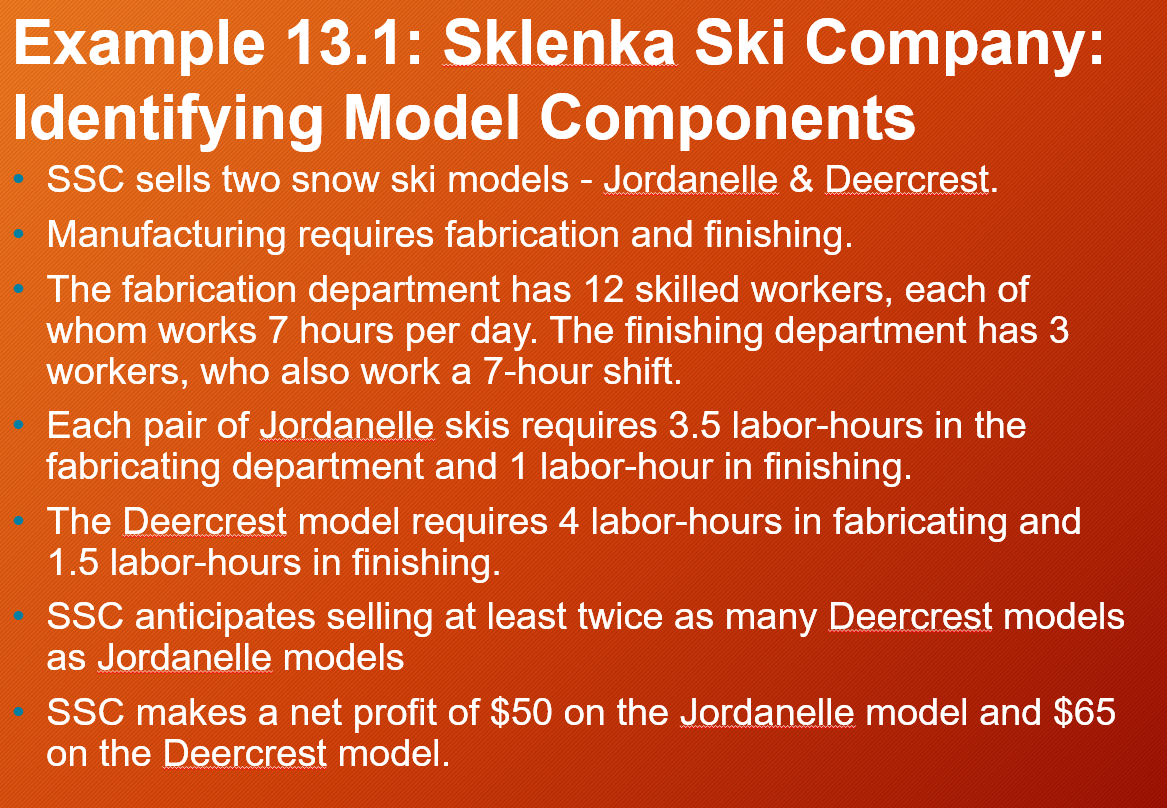
Based on the example image, what are the decision variables for Jordanelle and Deercrest?
Jordanelle:
Deercrest:
Jordanelle: Number of Jordanelle skis produced per day
Deercrest: Number of Deercrest skis produced per day
Explanation — Decision variables are the outputs
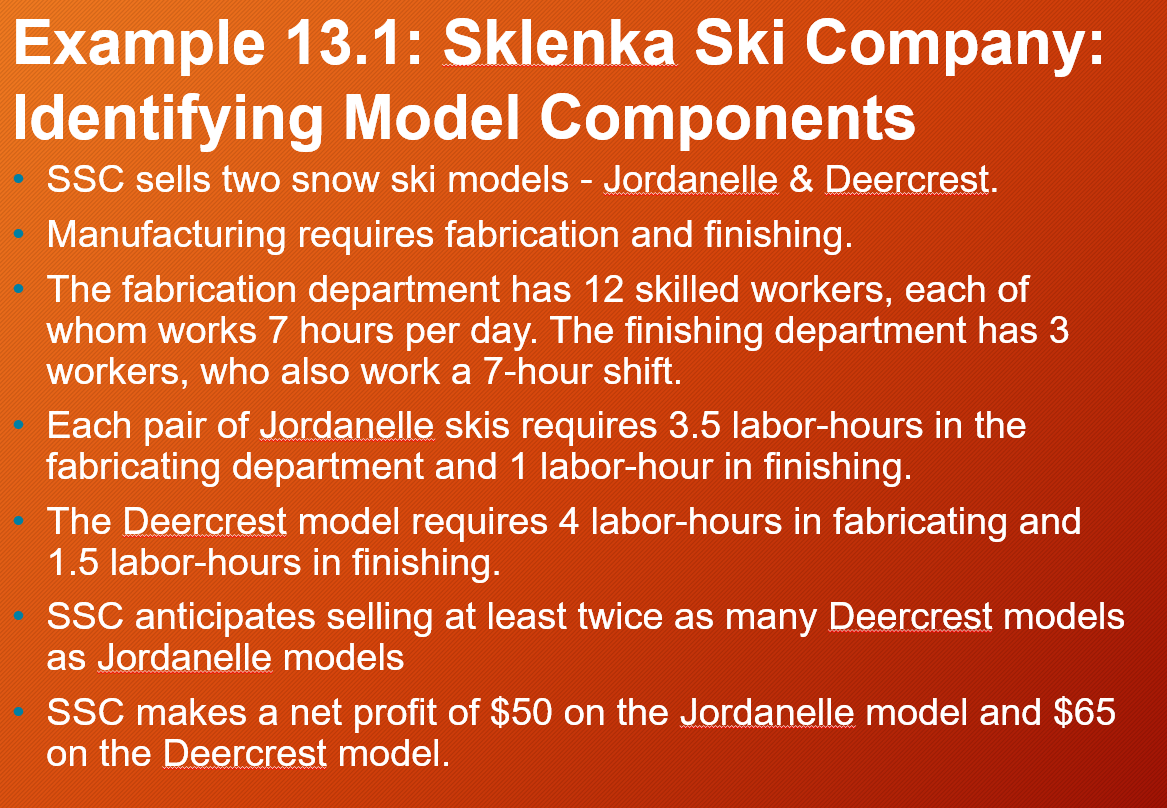
Based on the image, what is the objective function?
Maximize net profit
Which of the following is true regarding mathematical models
a. they rarely use subscripted letters for multiple variables because it is often confusing.
b. they represent decision variables by descriptive names, abbreviations, or subscripted letters.
c. you shouldn’t use descriptive names in spreadsheet models
d. All of the above are true
B
For mathematical formulas involving many variables, you should use ____ to make it more understandable.
a. descriptive words
b. color coding of variables
c. subscripted letters
d. all of the above
C
Constraints are typically expressed as
a. probability distributions or random processes
b. graphical decision trees or flow diagrams
c. tabular summaries of data relationships
d. algebraic inequalities or equations
D
Which of the following is the correct structure of a mathematical constraint?
a. 5x + 3 ≤ 2y + 10
b. 20 ≥ 4a + 6b
c. y > 50
d. 3x + 2y ≤ 100
D
A is wrong because there are variables on both sides
B is wrong because variables must be on the left
C is wrong because > is not a valid constraint
D is correct
A constraint function is the right-hand side of a constraint
False; left-hand side
“Total labor-hours used in fabrication cannot exceed the amount of labor hours available.” is an example of a
a. constraint function
b. decision variable
c. proportional relationship
d. balance constraint
A
Which of the following is an example of a non-negativity constraint?
a. x ≥ 10
b. x ≥ 0
c. 0 ≤ 30 + x
d. 4x+9y * 0
B
Take a look at this example.
3.5 Jordanelle + 4 Deercrest ≤ 84
Which part is the constraint function?
a. 84
b. ≤
c. 3.5 Jordanelle + 4 Deercrest
d. The whole thing
C; the left side is the constraint function
“The number of pairs of Deercrest skis must be at least twice the number of Jordanelle skis.” is an example of a
a. constraint function
b. decision variable
c. proportional relationship
d. balance constraint
C
can also be called a market mixture constraint
Which of the following is the correct mathematical expression of “The number of x must be at least twice the number of y”
a. x ≥ 2y
b. 2x ≥ y
c. x > 2y
d. x ≤ 2y
A
“We must produce at least 350 units of product Y to meet customer commitments this month.” is an example of a
a. constraint function
b. decision variable
c. simple bound
d. balance constraint
Make the inequality for it as well.
C
Constrains a single variable.
Y ≥ 350
“The amount of money spent on research and development projects cannot exceed the assigned budget of $300,000.” is an example of a
a. constraint function
b. decision variable
c. simple bound
d. limitation
Make the inequality for it as well
D
R&DExpenses ≤ $300,000
“Contractual requirements specify that a total of at least 500 units of product must be shipped from factories in Austin and Atlanta.” is an example of a
a. requirement
b. decision variable
c. simple bound
d. limitation
Make the inequality for it as well.
A
Atlanta + Austin ≥ 500
or
X1 + X2 ≥ 500
“Available inventory and production in June must satisfy the demand of 150 units or be held over to July.” is an example of a
a. requirement
b. decision variable
c. balance constraint
d. limitation
C
Which of the following are steps in implementing linear optimization models onto spreadsheets?
a. Put the objective function coefficients, constraint coefficients, and right-hand values in a logical format
b. Define a set of cells (either rows or columns) for the values of the decision variables
c. Define separate cells for the objective function and each constraint function
d. Use descriptive labels directly above each objective/constraint function cell
e. all of the above
D
Please review image
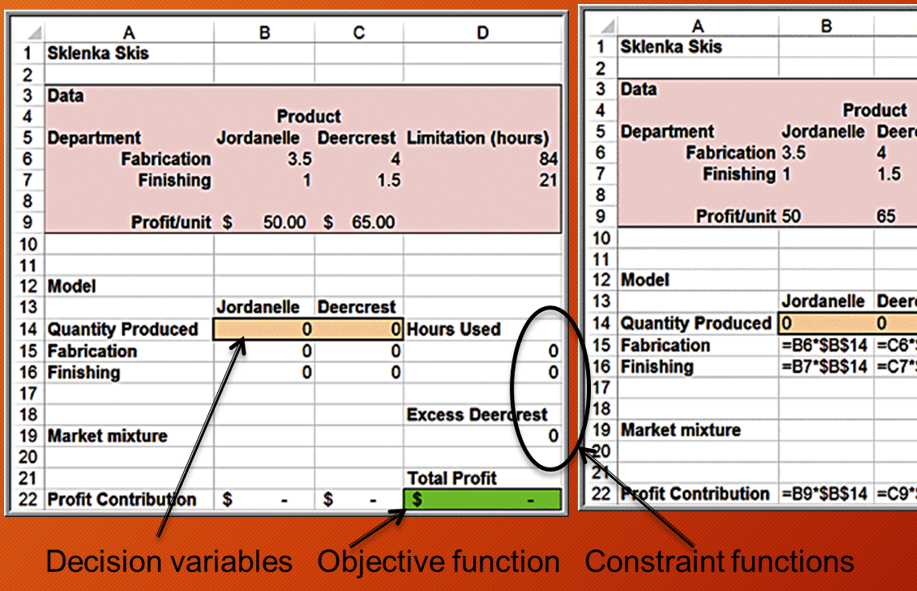
The _____ function often simplifies the model-building process, particularly when many variables are involved.
a. SUMPRODUCT
b. ABS
c. ROUND
d. MIN and MAX
A
T/F Good linear optimization models use functions like ABS, IF, MIN/MAX, INT, ROUND, and COUNT
False; Avoid these functions
A feasible solution to an optimization problem is
a. the best of all the feasible solutions
b. any solution that satisfies all of the constraints.
c. the value of the objective at the optimal solution
d. all of the above
B
The optimal objective value is
a. the best of all the feasible solutions
b. any solution that satisfies all of the constraints.
c. the value of the objective at the optimal solution
d. all of the above
C
An optimal solution is
a. the best of all the feasible solutions
b. any solution that satisfies all of the constraints.
c. the value of the objective at the optimal solution
d. all of the above
A
provides basic information about the solution, including the values of the original and optimal objective function and decision variables.
a. Solver answer report
b. Cell value
c. Binding constraint
d. Slack
e. all of the above
A
refers to the value of the constraint function (left-hand side) using the optimal values of the decision variables.
a. Solver answer report
b. Cell value
c. Binding constraint
d. Slack
e. all of the above
B
is one for which the Cell Value is equal to the right-hand side value of the constraint.
a. Solver answer report
b. Cell value
c. Binding constraint
d. Slack
e. all of the above
C
refers to the difference between the left- and right-hand sides of the constraints for the optimal solution.
a. Solver answer report
b. Cell value
c. Binding constraint
d. Slack
e. all of the above
D
For binding constraints, the slack is
a. greater than 1
b. less than 1
c. equal to 1
d. zero
D
Slack refers to the difference between the left- and right-hand sides of the constraints for the optimal solution.
Binding constraints are when the left side is equal to the right-hand side of the constraint (example: 2(2) + 5 = 9)
9 = 9 so slack is 0.
This optimization outcome occurs when there is exactly one solution that will result in the maximum or minimum objective.
a. Unique optimal solution
b. Alternative (multiple) optimal solutions
c. Unbounded solution
d. Infeasibility
A
This optimization outcome occurs when the objective is maximized or minimized by more than one combination of decision variables, all of which have the same objective function value.
a. Unique optimal solution
b. Alternative (multiple) optimal solutions
c. Unbounded solution
d. Infeasibility
B
T/F Solver does not tell you when alternative solutions exist and reports only one of the many possible optimal solutions.
True
This optimization outcome occurs when the objective can be increased or decreased without bound to infinity
a. Unique optimal solution
b. Alternative (multiple) optimal solutions
c. Unbounded solution
d. Infeasibility
C
A solver message that says, “The objective (Set Cell) values do not converge.” means the optimization solution is
a. unique
b. alternative
c. unbounded
d. infeasible
C
This optimization outcome occurs when there is no solution that satisfies all the constraints.
a. Unique optimal solution
b. Alternative (multiple) optimal solutions
c. Unbounded solution
d. Infeasibility
D
Involves determining how much to ship from a set of sources of supply to a set of demand locations at minimum cost.
a. Transportation model
b. Project selection problem
c. Solver sensitivity report
d. integer optimization model
A
The transportation problem involves determining how much to ship from a set of sources of supply to a set of demand locations at minimum cost. What would be the decision variable and typical objective function?
Decision variable:
Objective function (goal):
Decision variable: The amount of products shipped to each demand location
Objective function: Minimizing total shipping cost
A linear model in which some or all variables are restricted to being whole numbers.
a. Transportation model
b. Project selection problem
c. Solver sensitivity report
d. integer optimization model
D
Many integer optimization models require binary variables
True
In integer optimization models, binary variables are
a. variables that can take any real value within a range
b. variables used only in nonlinear models
c. variables restricted to being either 0 or 1
d. variables that represent continuous scaling factors
C
T/F Binary variables are used to model logical yes/no decisions
True
Involves finding the best subset of potential projects that must be selected with limited resource constraints to maximize total expected return.
a. Transportation model
b. Project selection problem
c. Solver sensitivity report
d. integer optimization model
B
What is the typical objective function of project selection problems?
a. minimizing total production variance
b. balancing supply and demand across networks
c. maximizing expected return
d. minimizing forecast error
Maximizing total expected return
A model in which the objective function and/or at least one constraint is nonlinear.
a. Transportation model
b. Project selection problem
c. Solver sensitivity report
d. nonlinear optimization model
D
T/F Nonlinear models are generally more difficult to develop.
True
In Solver, use the ____ solving method to solve nonlinear optimization models.
a. Simplex LP
b. GRG Nonlinear
c. Evolutionary
B
The Sensitivity Report allows us to understand how the optimal objective value and optimal decision variables are affected by:
a. how much the objective function coefficient needs to be reduced for a zero variable to become positive
b. how much the objective function will change as the right-hand side of a constraint is increased
c. changes in the objective function coefficients and resource limitations or requirements
d. differences between multiple optimal solutions under identical inputs
C
In the solver sensitivity report, “Reduced Cost” refers to
a. how much the objective function coefficient needs to be reduced for a zero variable to become positive
b. how much the objective function will change as the right-hand side of a constraint is increased
c. changes in the objective function coefficients and resource limitations or requirements
d. how the objective function reacts to changes in resource limits
A
T/F If a variable is positive in the optimal solution of a solver sensitivity report, its reduced cost is zero.
True
In a Sensitivity Report “Shadow Price” refers to
a. how much the objective function coefficient needs to be reduced for a zero variable to become positive
b. how much the objective function will change as the right-hand side of a constraint is increased
c. changes in the objective function coefficients and resource limitations or requirements
d. the difference in objective values between alternative optimal solutions
B
In the Sensitivity Report, whenever a constraint has positive slack, the shadow price is
a. negative
b. zero
c. positive
B
Sensitivity Report
If a change in an objective function coefficient stays within the Allowable Increase and Allowable Decrease, the optimal values of the decision variables
a. Will change
b. Will not change
c. No prediction can be made; must be re-solved
B
Sensitivity Report
If a change in an objective function coefficient exceeds the Allowable Increase or Allowable Decrease limits, the optimal values of the decision variables
a. Will change
b. Will not change
c. No prediction can be made; must be re-solved
C
If a change in the right-hand side of a constraint remains within the Allowable Increase and Allowable Decrease, the shadow price
a. allows you to predict how the objective function value will change; must be re-solved
b. does not allow you to predict how the objective function value will change; must be re-solved
A
If a change in the right-hand side of a constraint exceeds the Allowable Increase and Allowable Decrease, the shadow price
a. allows you to predict how the objective function value will change; must be re-solved
b. does not allow you to predict how the objective function value will change; must be re-solved
B