Memory
 Call Kai
 Learn
Learn Practice Test
 Spaced Repetition
 Match
Match Flashcards
 Knowt Play
1/42

There's no tags or description
Looks like no tags are added yet.
Name | Mastery | Learn | Test | Matching | Spaced | Call with Kai |
|---|
No analytics yet
Send a link to your students to track their progress
43 Terms
The atkinson-shiffren model of memory
what is memory
•Memory consists of a collection of complex interconnected and interacting systems
▫Each system serves a different purpose and operates in a different way
•It is an active processing system
▫You have control over it
▫We do not have a memory, we have different memory systems
▫Each system processes and stores different types of information in a different way
•Memories are not exact replicas of the world!!
▫
Defining Memory
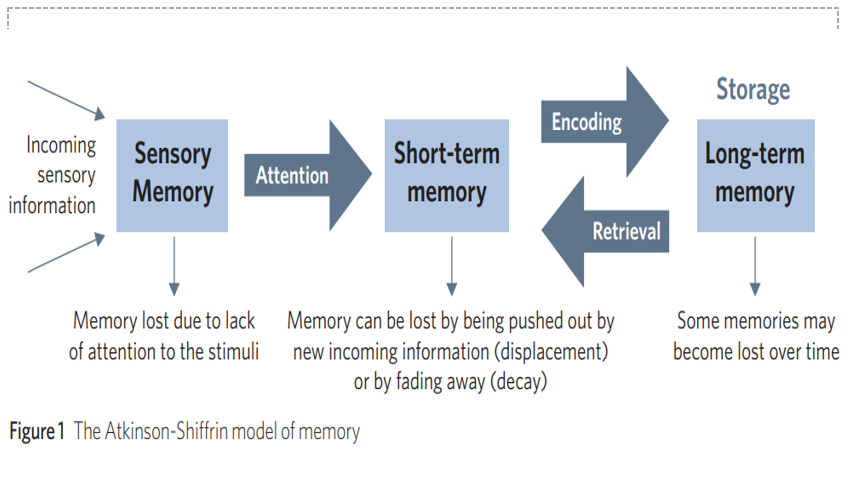
•An information processing system that enables encoding, storage and retrieval of information
▫An internal representation of some prior event or experience
memory •Involves three processes that interact:
▫Encoding – converting information to a useable form
▫Storage – retaining information in memory over time
▫Retrieval – locating and recovering stored information when needed
Interaction – how information is encoded determines exactly what is stored and how it is stored and its storage determines what can be retrieved
The Atkinson-Shiffrin Multi-store
Model of Memory
•Suggested memory was made up of more than a single system
▫So called the multi-store model of memory
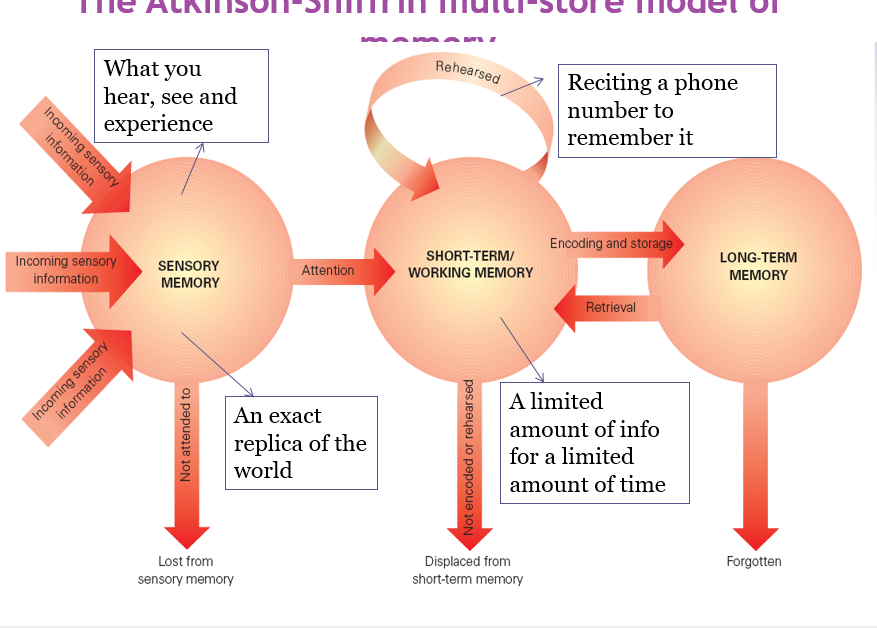
•Represents memory as three components:
▫Sensory Memory
▫Short Term Store
▫Long Term Store
•States that info passes through 3 levels of memory as it is encoded, stored and retrieved
•
1) Sensory Memory
•Function: Entry point of memory where all new incoming sensory information is stored for a very brief period of time
•Holds information in a raw or unprocessed form
•Stores information long enough for:
▫ each impression to slightly overlap the next
Allows us to perceive the world as continuous, rather than disjointed images.
▫us to attend to it and select information to be transferred to STM for processing
This information that is transferred to STM has a chance of being stored permanently
Information not attended to whilst in SM is lost
•Capacity: Unlimited: Can store all information coming in from our sensory receptors but information fades rapidly
•Acts as a filter to prevent us having to process irrelevant and unimportant information
•Is considered to have a sensory register for each of the 5 senses.
••Vision and hearing are the 2 senses that tend to be more closely studied
•
Iconic Memory
•Sensory register for incoming visual information
•
•Duration: Holds information for between 0.2 and 0.4 of a second
▫Just long enough for us to recognise and process the information
example of ionic memory
•Iconic memory can be viewed by watching a sparkler in a dark room. The afterimage (the tail of the sparkler) you see which quickly fades, is brought about by IM.
•Imagine this:
You look at a page of text for a split second.
The page disappears.
For a brief moment, you can still “see” the image of the page in your mind.
That brief visual trace is iconic memory.
⚡ Another everyday example:
A lightning flash lights up the sky at night.
Even after it’s gone, you still momentarily “see” the scene.
•If iconic memory held visual information any longer than 0.3 of a second, we would see the world in a blur. If it was shorter we would see the world as a series of film stills
Echoic Memory
•Sensory register for incoming auditory information
•
•Duration: Holds information for between 3 and 4 seconds
▫Just long enough for us to recognise and process the information
•It is important that echoic memory holds information for a longer period of time so that word comprehension can take place.
▫Visual image is presented in one hit.
▫Auditory information can take a longer period of time to be presented (eg. A word may have several syllables and therefore take a couple of seconds to complete verbalising). Eg - Electroencephalogram
▫It is important that we can hold the initial parts of the word in our sensory memory for long enough for the word to be completed so that we can place meaning to the word and for it to be transferred into STM,
Com....puter, Com....unism, Com....pete
•Eg. When your mum shouts that dinner is ready and you say “what”? but then “Oh yeah” . You have retrieved this information from echoic memory
2) Short Term Memory
•Information that we pay attention to in sensory memory will be transferred to STM.
•
•Information retrieved from LTM will move to STM.
▫Function: To pay conscious attention to information. STM holds all the information you are consciously aware of at any point in time
Information is no longer
•Information is no longer an exact copy of the sensory stimulus, but an encoding of one (a representation)
•
•Referred to as “working memory” as STM combines information from SM with retrieval of information from LTM.
•
•Used for interpreting, analysing, problem solving, comprehending spoken language.
Duration of STM
•Duration: We can hold information for 18-30 seconds
•
•We can increase the duration of STM through rehearsal e.g. repeating a phone number to yourself (maintenance rehearsal – we will get to this later!)
•
Capacity of STM
•Capacity: Can hold 7+ 2 items of information (5-9 items)
•
•When STM is full, new items can only be added by pushing old items out
•
•Space in STM is used when we think and when information is retrieved from LTM to be used or updated
•
•Can increase STM capacity by chunking.
•Information is lost by:
▫Decay = occurs when information is not maintained by rehearsal and it simply fades away over time
▫Displacement = information is pushed out by new information coming in
•
3) Long Term Memory and function
•The relatively permanent memory system that holds vast amounts of information for a long period of time, possibly indefinitely.
•
•Function: to store information which can be retrieved for future use.
duration and capacity of LTM
•Duration: Potentially permanent
•Capacity: Unlimited
As the capacity of LTM is so vast, it requires information storage to be highly organized in order to aid retrieval.
Types of LTM
Implicit (Procedural
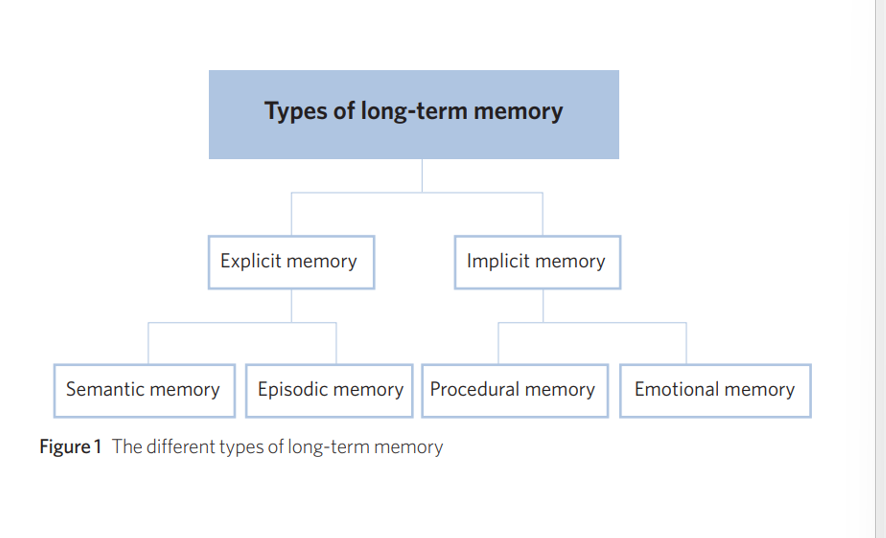
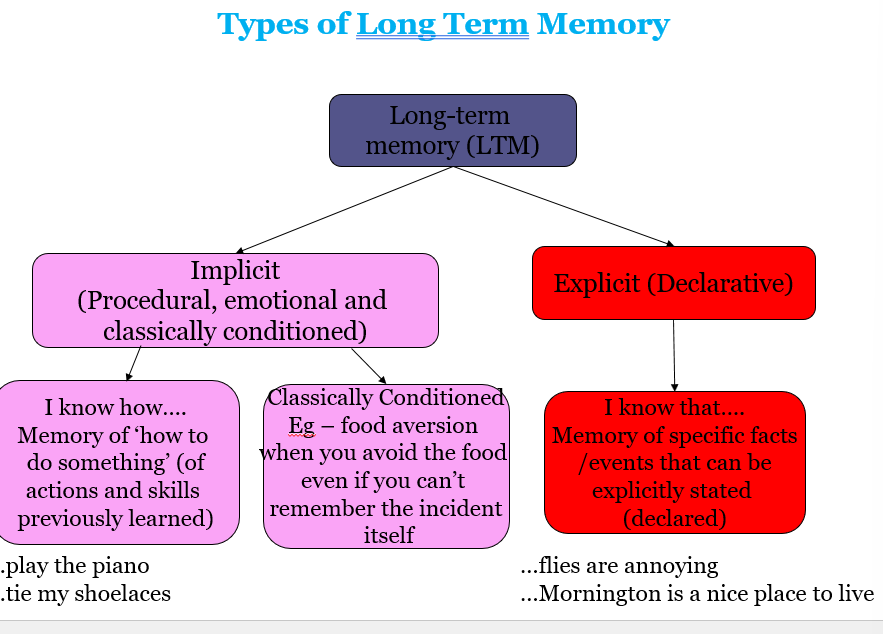
•1) Implicit (Procedural) = the memory of actions and skills that have been learned previously (knowing how to do something)
You use it without awareness
Learned through practice and experience
Examples:
Riding a bike
Typing on a keyboard
Habits and skills
▫Can be recalled by performance rather than intentional conscious recall
▫May be difficult to recall when or how we learned the actions involved in the memory
▫Often difficult to put into words
▫Formed in the Amygdala (medial temporal lobe)
•Procedural memory –
Memory for skills and actions (e.g., riding a bike)
✔ Emotional memory –
Memory for emotional responses, usually learned through conditioning
Example: feeling fear when hearing a loud noise linked to a past event
Implicit classical conditioning is a type of learning where an automatic (unconscious) response becomes associated with a stimulus without the person being aware of the learning process.
For example, someone might start feeling anxious when hearing a certain sound (like a tone used in a stressful situation), even if they don’t consciously remember why.
•
C2) Explicit (Declarative)
▫C2) Explicit (Declarative) = the memory of specific facts or events (knowing that)
▫an be intentionally recalled
▫Easy to explicitly state or declare the memory
▫Formed in the hippocampus
▫
•Two types of Explicit Memory:
▫They may often work together to form new memories
▫Memories may contain both episodic and semantic information
•Episodic
•Episodic = the declarative memory of specific events or personal experiences
▫Includes details of the time, place and state of the person when event occurred
▫Like a mental diary that records autobiographical episodes
▫If there is an emotional context – will be formed in the amydala
•Semantic
•Semantic = the declarative memory of information we have about the world
▫Includes our specialised knowledge of areas of expertise, academic knowledge, rules, general knowledge and the meanings of words
▫Involves facts that do not depend on a particular place or time
Implicit Vs explicit
episodic vs semantic
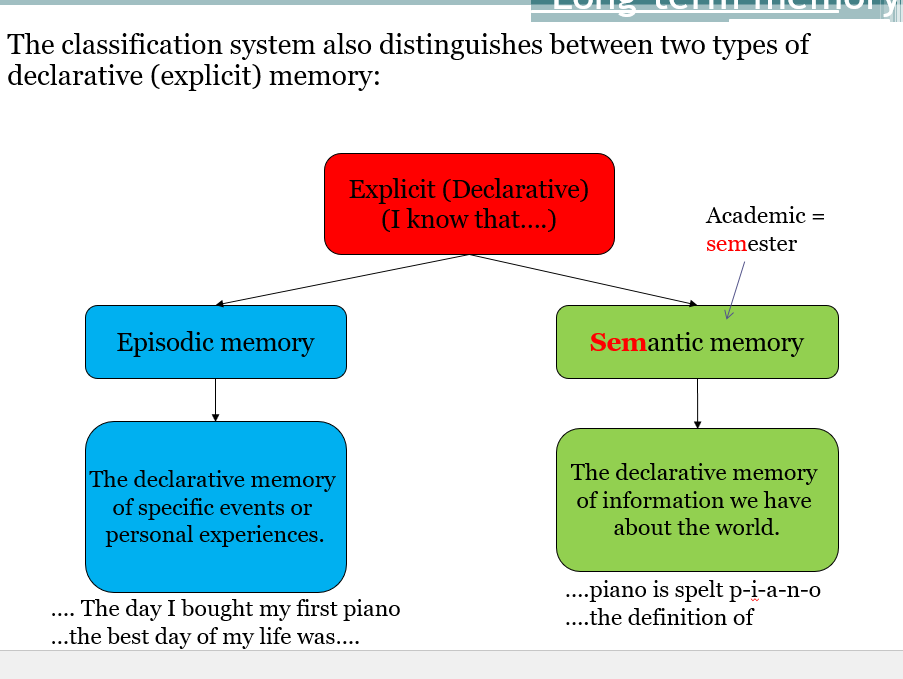
Types of LTM – Summary
•Explicit (also known as declarative memory) – a type of LTM that can be consciously retrieved (stated)
▫Semantic (‘knowing that’ – facts, e.g. I have two sisters)
▫Episodic (memory of personal experiences/events, e.g. I remember dancing at my 18th Birthday Party)
▫
•Implicit - a type of LTM that is retrieved unconsciously
▫Procedural (‘knowing how’ to do things, often memory of motor tasks e.g. how to drive)
▫Emotional memories (including CC emotional responses e.g. feeling sad when you hear a particular song)
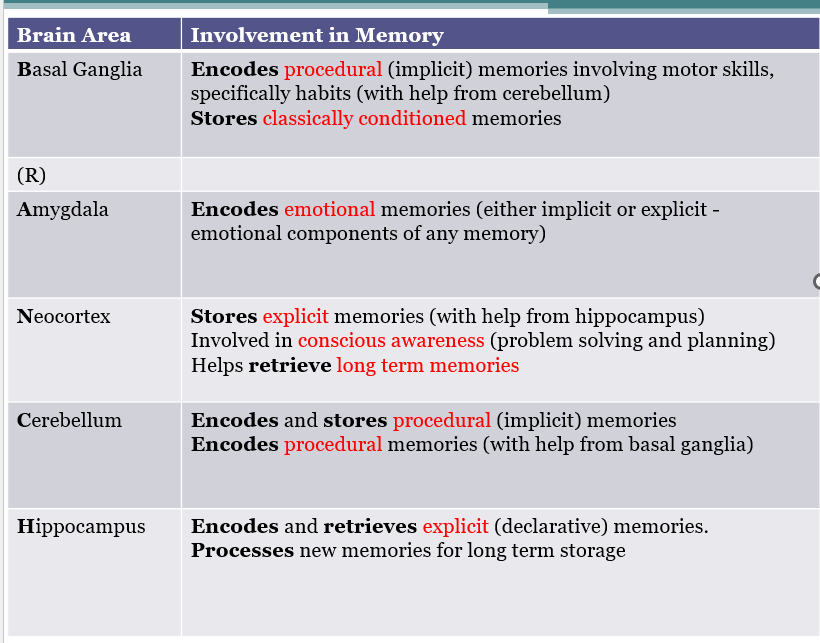
•Hippocampus
•Amygdala
•Neocortex
•Basal Ganglia
•Cerebellum
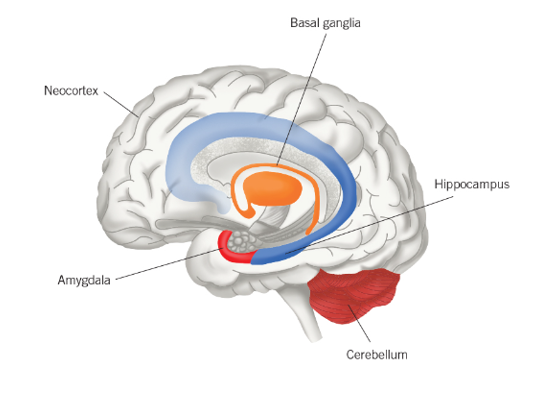
HIPPOCAMPUS
Integrates information from a number of brain areas to form a single declarative memory that it transfers to LTM.
•The hippocampus is responsible for the encoding, consolidation and retrieval of explicit memories.
•
•Processes new memories for long term storage
•
•Temporarily stores explicit memories during consolidation
•The hippocampus does not permanently store memories.
Declarative memory = memory you can consciously recall and describe in words
Consolidation = turning short-term memories into long-term memories.
The hippocampus helps do this.
Example:
You learn someone’s name → the hippocampus processes it → later (e.g. after sleep) you remember it.
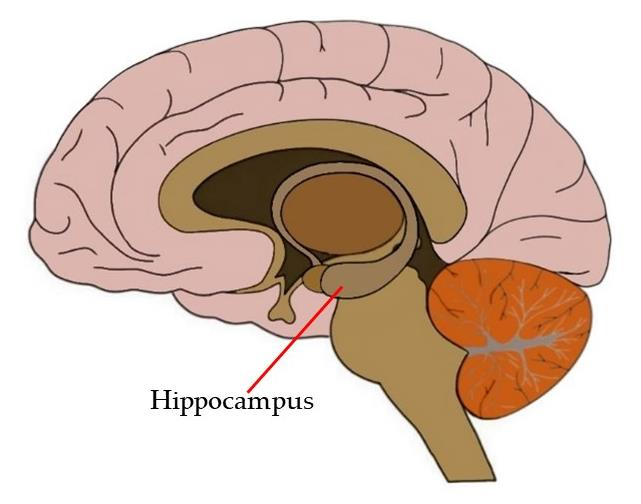
HIPPOCAMPUS extra info
•Consolidation is the process of making a memory stable and permanent in the brain.
•
•Critical role in memory formation
•
•Believed to be the centre for STM because it is heavily involved in forming, consolidating (encoding) new explicit (declarative) memories.
•
•Memories are believed to be formed when the hippocampus receives and integrates information from the areas of the cerebral cortex that initially receive and process the various features that comprise the memory.
AMYGDALA
•The amygdala is responsible for the encoding and consolidation of emotional memories. These can be both emplicit and implicit
•The amygdala does not permanently store memories
You touch a hot stove → feel fear/pain → the amygdala links that emotion to the memory → you avoid doing it again.
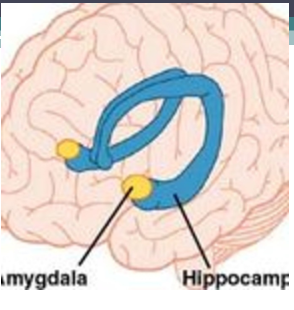
amygdala extra
•By adding an emotional element to a memory, the amygdala activates the hippocampus to increase the strength of consolidation of an explicit memory so it becomes more memorable.
▫(think back to the role of adrenaline – we are more likely to remember emotionally arousing events)
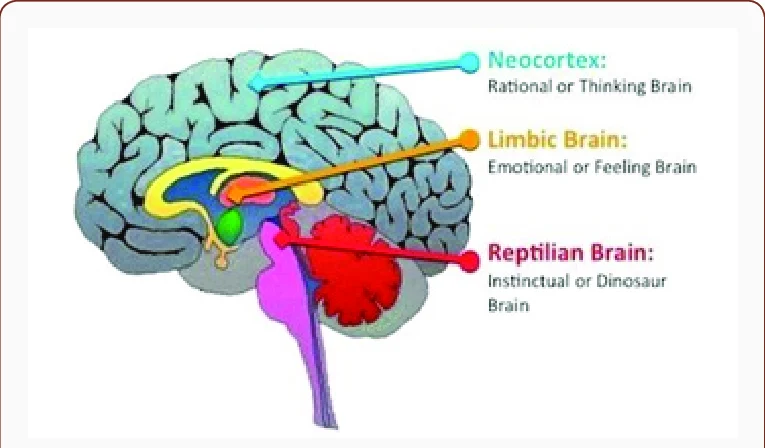
NEOCORTEX
•The Neocortex: is the top layer of the cerebral cortex, that is involved in high order mental processes such as language, attention and memory.
•Is divided into two hemispheres, each with four lobes that have different roles in memory
•The neocortex is responsible for storing explicit memories
•Involved in conscious awareness (problem solving and planning)
•Helps retrieve long term memories
After learning something in class, the information is stored in the neocortex so you can remember it later (e.g. in a test).
hippocampus → helps form and consolidate new memories (short-term → long-term)
neocortex → stores those long-term memories
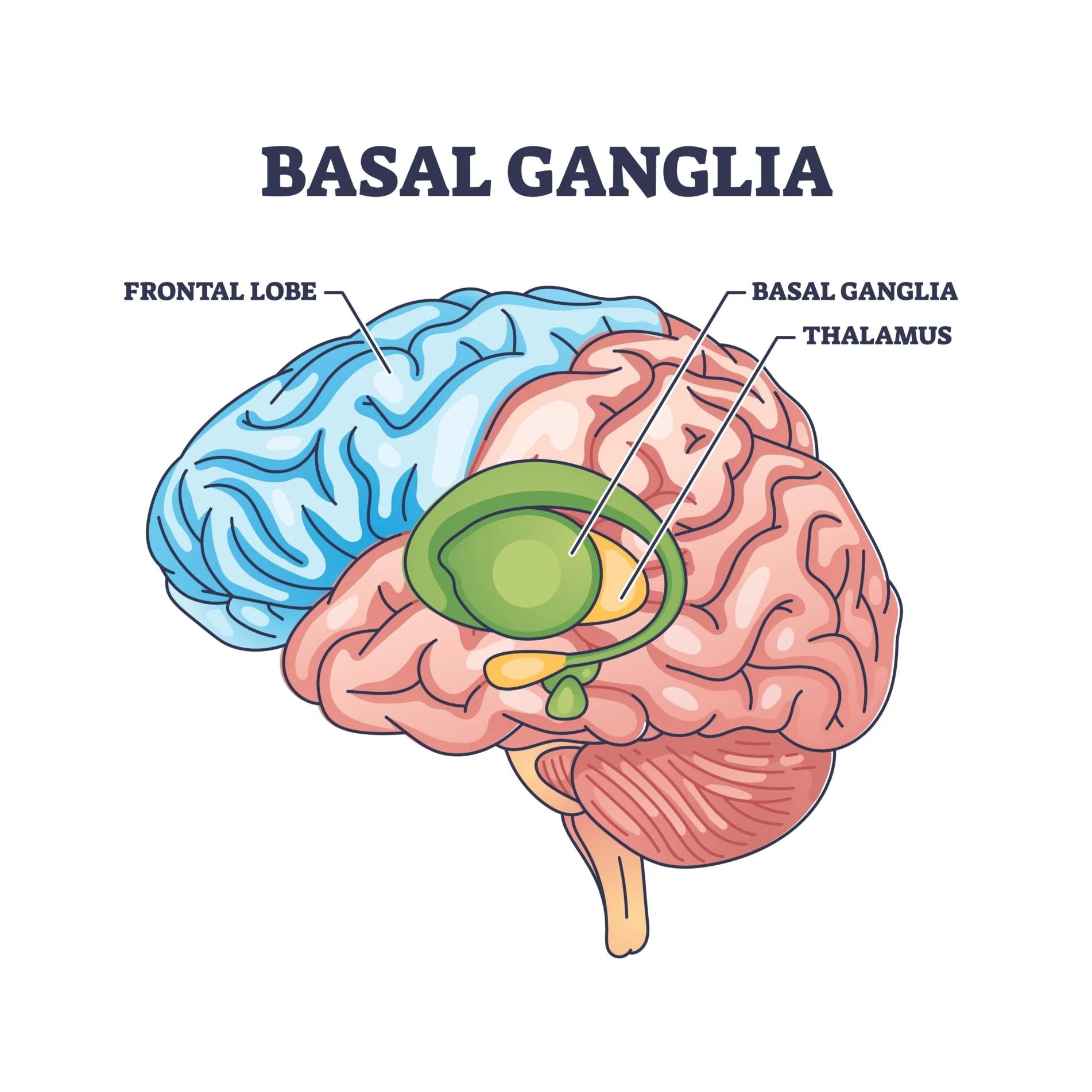
BASAL GANGLIA
•Basal ganglia has roles in learning, procedural memories, routine behaviours and emotions.
•Basal ganglia’s roles are in encoding long term implicit procedural memories, particularly classically conditioned ones and habits
•Also stores classically conditioned memories
▫Planning and control of fine motor movements relating to a sequence of goal-directed behaviour so that they can be performed in a smooth manner.
▫the encoding of implicit procedural memories, specifically habits.
Basal ganglia works to form habits by associating movement with reward and reinforcement
▫
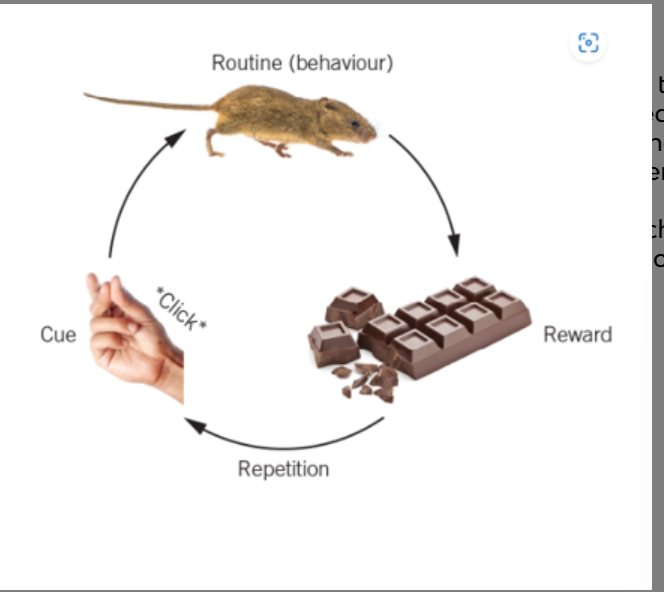
Habit Loop
•A cycle of cue and reward
•When the loop is repeated, the behaviour related to the sequence of movement is strengthened and becomes more precise and efficient.
•This makes repetitive behaviours automatic, which frees up our brain to focus on other more complex decisions.
CEREBELLUM
•Encodes and stores implicit procedural memories, particularly those created by classical conditioning.
•Encodes procedural memories (with help from basal ganglia)
•Eg conditioned reflexes such as blinking in response to a puff of air.
•This is due to the cerebellum being involved in motor control, balance and coordination.
Learning to ride a bike → the cerebellum helps you remember how to balance and pedal without thinking.
Basal Ganglia and Cerebellum working together
•
•Cerebellum encodes and stores the procedural memory
•Basal ganglia ensures the procedural memory is carried out in a smooth sequence
▫Eg dancing.
Cerebellum encodes and stores steps
Basal ganglia allows the dance routine to occur in a fluid coordinated way
Summary – B(r)ANCH
Retrieving Autobiographical events
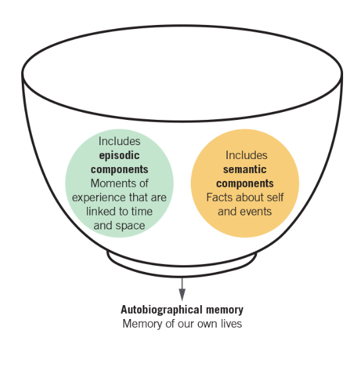
•Autobiographical memories are:
▫episodes recalled from a person’s life
▫based on a combination of episodic (tacts, details, sensory input, times, places) and semantic (general event knowledge, facts without context) memories.
▫A more constructive and
integrated information
processing system than episodic
alone
•Episodic Memory is memory for specific events (with time and place), like what you did yesterday.
Autobiographical Memory iAutobiographical memory is the system of long-term memory that stores an individual’s personal experiences, knowledge, and life history
Example:
Episodic → “I ate pasta at dinner last night”
Autobiographical → “I usually eat pasta after training” or memories from your life overall
“I remember my 10th birthday when my friends surprised me with a cake.”
“I remember my first day at high school when I felt nervous but excited meeting new people.
🆚 Episodic vs Autobiographical:
Episodic memory: specific events (e.g., “my 10th birthday party”)
Autobiographical memory: broader life memories (includes episodic + personal facts)
✍ Example sentence:
“I remember playing soccer in the rain last weekend and feeling really excited.”
An important function of autobiographical memory
memory is to support our sense of self and identity.
•Our self-identity includes abstract representations of our personal characteristics such as
•Our self-identity includes abstract representations of our personal characteristics such as
▫our traits (e.g. ‘I am timid’)
▫general knowledge about periods and events in our life (e.g. ‘When I was in primary school, we used to visit my grandma on Sundays’)
▫memories of specific happenings in our past (e.g. ‘The time I broke my leg in grandma’s garden’).
•In comparison to episodic memories which are a series of single past events.
•Autobiographical memory links past events together into a personal history that relates self through past, present and future, essentially forming a life narrative.
••Through reconstruction we combine stored information with…
•Through reconstruction we combine stored information with other available information to form what is believed to be a more coherent, complete or accurate memory.
▫For example, if you were asked to recall your favourite holiday, you might remember certain features, such as where you went, who was there, what you were wearing and what happened. As all these features and events are recalled from different locations in your long-term memory, they are put together to reconstruct the memory of your holiday, as you would piece together a jigsaw puzzle.
When we retrieve autobiographical
experiences, episodic memory helps us richly recall an experience as it occurred during a specific time and place.
Constructing possible imagined futures
•We have the ability to extract our consciousness from the current moment and to mentally transport ourselves to another time, place or perspective.
•In recent years, episodic and semantic memory has been reconsidered as encompassing our ability to imagine and envision possible future scenarios as well the ability to retrieve memories from our personal past.
•
•This form of imagining is called episodic future thinking = projecting yourself forwards in time to pre-experience an event that might happen in your personal future and is also known as mental time travel.
•
•We frequently use future-oriented thoughts every day; these thoughts may be abstract or specific, and personal or non-personal.
Constructing possible imagined futures part 2
•Researchers believe that we rearrange our memories of the past to put together a vision of what the future might look like. They have discovered that autobiographical memories and episodic future thinking occur in the same regions of the brain and appear to use the same underlying processes.
•Like reconstructing autobiographical memories, episodic future thinking involves a process of active construction of events that have not yet occurred but that is based on past events and knowledge.
how do hippocampus and cerebellum work togeher
The Hippocampus and Cerebellum work together during learning:
Hippocampus → remembers information and instructions (what to do)
Cerebellum → controls coordination and makes movements smooth (how to do it)
Together: the hippocampus helps you learn a new skill, and the cerebellum helps you practice it until it becomes automatic.