AP Macroeconomics Final
 Call Kai
 Learn
Learn Practice Test
 Spaced Repetition
 Match
Match Flashcards
 Knowt Play
1/347

There's no tags or description
Looks like no tags are added yet.
Name | Mastery | Learn | Test | Matching | Spaced | Call with Kai |
|---|
No analytics yet
Send a link to your students to track their progress
348 Terms
currency
the paper bills and coins used to buy g/s
Money
is any generally accepted means of payment
medium of exchange
is what people trade for g/s
barter
involves the trade of g/s in the absence of a commodity accepted medium of exchange
double coincidence of wants
occurs when each party in an exchange transaction happens to leave what the other party desires (uncommon so thats why we create a medium of exchange)
Commodity money
involves the use of an actual good for money (gold/silver)
commodity-backed money
money you can exchange for a commodity at a fixed rate (quarters made of real silver in 1964) (ties the value of the holders money to something real, limits amount of money, limits inflation)
fiat money
money with no value except as a medium of exchange, there is no inherent or intrisinc value of the currency (can create inflation rapidly. does not rely on precious resources and if they are avaliable or not)
Balance sheet
on accounting statement that summarizes a firms key finacial information
assets
items a firm owns
liabilities
fincial obligations a firm owes to others
owners equity
the difference between a firm assets and its liabilites
reserves
portion of bank deposity that are set asside and not loaned out (currency in the banks vaul that the bank holds in deposits at the federal reserve)
fractional reserve banking
occurs when banks hold only a fraction of deposits on reserve
bank run
occurs when money depositers attempt to withdraw their funds from a bank at the same time
required reserve ratio (RR)
portion of deposits that banks are required to keep on reserve
excess reserves
only bank reserves hold in excess of those required (total reserves-required reserves)
FDIC
federal deposit insurance corporation
moral hazard
is the lack of incentive to guard against risk where one is protected from its ocnsequences
how do banks create money?
simple money multiplier
simple money multiplier
the rate at which banks multiply money when all money is deposited into banks and they hold no excess reserves (1/rr)(represents the MAXIMUM size of the money multipolier)
Monetary policy
countroling the US money supply and regulating it to offset macroeconomic fluctuations
centeral banking
bank for banks
bank regulation
ensuring the finacial stability of banks & determination of reserve requirements
federal funds
deposits that private banks hold on reserves at the federal reserve
Federal funds rate
interest rate on loans BETWEEN PRIVATE BANKS
discount loans
loans from the federal reserve to private banks
discount rate
interest rate on discount loans made by the federal reserve to private banks
open market operations
involve the purchase or sale of bonds by a centeral bank
quantitative easing
targeted use of open market operations in which the centeral bank buys securities specifically targeting certain markets
Maturity on bonds
how long it will take to give you your principle + interest
liquidiity
assets that can quickly be converted into cash
m1
liquid money (easy medium of exchange)
physical currency (coins and paper money) in circulation, demand deposits (checking accounts), other checkable deposits ``
m2
currency you have evenaully (m1+saving+money market)
Why do banks hold reserves
prevent bank runs & satisfiy reserve requirements
do banks perfer to borrow from other banks?
yes because its more efficient and cheaper
expansionary monetary policy
occurs when a centeral bank wants to increase the money supply in an effort to stimulate the economy (buying bonds, decrease required reserves, decrease interest rates)
How does monetary policy impact real vs nominal effects
monetary policy can have immediate real short run effects but as prices adjust in the LR, effects wear off
contractionary monetary policy
occurs when a central bank acts to decrease the money supply (occurs when the economy is expanding rapidly) (sells bonds in the loanable funds market, which takes funds out of the market) (interest rates rise increase, investment decrease, AD decrease, GDP decrease, unemployment increase)
monetary neutrality
idea that the money supply does not affect real economic variables
how does unexpected inflation impact fixed wage workers
harms them
phillips curve
indicates a short-run negative relationship between inflation and unemployment (monetary expansion stimulates the economy and brings some inflation which reduces unemployment)
adaptive expectatoins theory
holds that peoples expectations of future inflation are based on their most recent experience
stagflation
combonation of high unemployment and high inflation (goes against phillips curve)
rational expectation theory
holds that people form expectations are the basis of all avaliable information
How does unemployment get impacted by suprise inflation
unemployment is only impacted if the inflation is a suprise
active monetary policy
strategic use of monetary policy to contract macroeconomic expansion and contractions
positive monetary policy
typically refers to actions taken by a central bank, such as lowering interest rates or increasing the money supply, to stimulate economic growth, reduce unemployment, and manage inflation
what do nominal interest rates equal?
interest on NEWLY issue government bonds
what is on the axis of the money market graph
nominal interest rates on y axis and quantity of money on x axis
what is the money market graph
tradeoff between liquid assets and new bonds (illiquid assets)
what type of graph is it if you see nominal interest rates in the question
money market (monetary policy)
what shifts the money demand
changes in price level (if pl increase we will demand more money which will cause demand for m1 to increase because it costs more to buy stuff), change in income (if you have less money you have less of a demand for money), change in taxation that affects personal investment (changes capital gains tax would charge them demand for money), techonology impact how people demand money
what are on the axis of the bond market
x axis- quantity of bonds
y axis - price of bonds
what is the concept behind the bond market?
bond prices are inversely related to nominal interest rates, because nominal interest rates reflect the yeild of new bonds printed by the fed
where are recessions on the phillips curve?
right on SRPC of the LRPC
where are peaks on the phillips curve?
left of SRPC of the LRPC
what do supply shocks do the the phillips curve?
shift the srpc
Federal reserve market graph
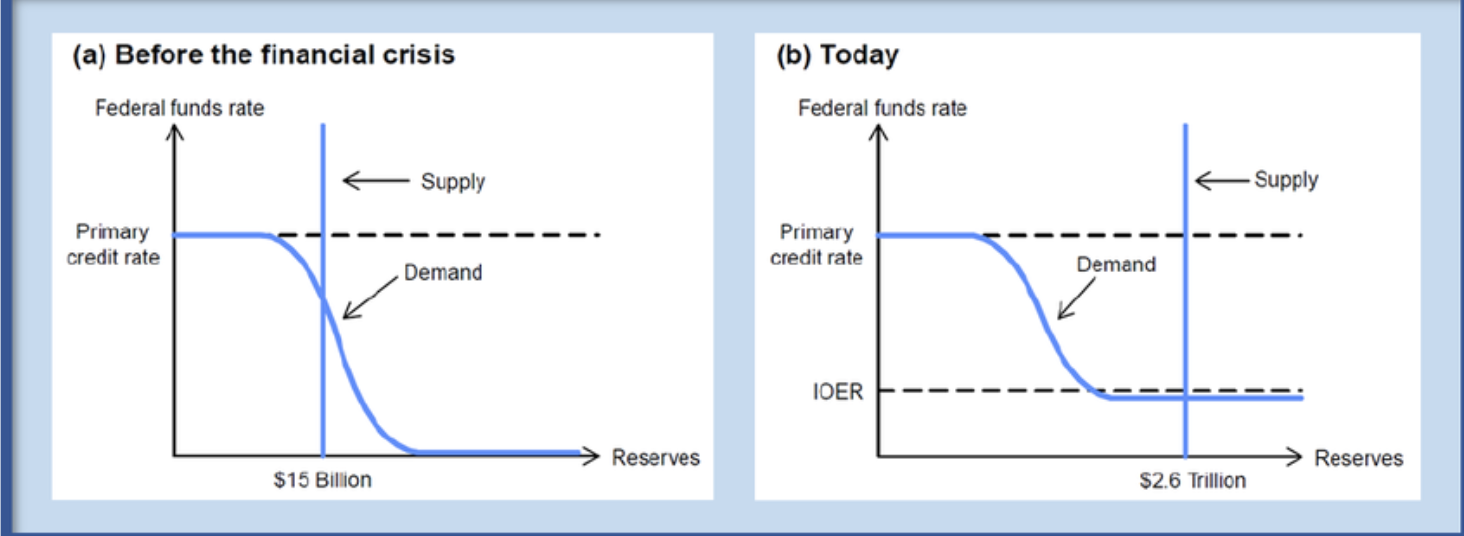
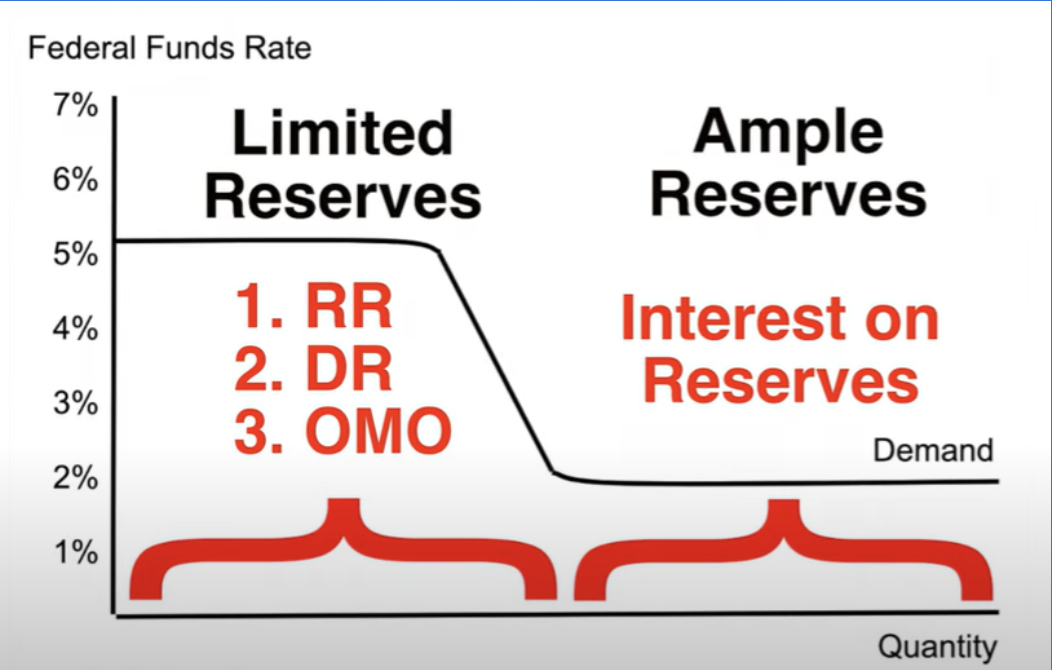
Transaction
People demand money to make everyday purchases. This is NOT affected by the interest rate.
Asset Demand for Money
People demand money as a liquid asset because they prefer it to other non-liquid assets like real estate.
why is the supply of money vertical in the money market graph
because the total quantity of money is fixed, or set exogenously, by a central bank (like the Federal Reserve). Because this amount is determined by policy rather than the interest rate, the quantity of money supplied remains constant regardless of whether interest rates rise or fall, making it perfectly inelastic.
when the fed buy/sells bonds what does that represent with the demand of bonds?
an increase in demand/decrease in demand
when does supply shift in bond market
changes in government fiscal policy (deficits/surpluses), expected economic conditions, and inflation expectations. Increased borrowing needs to fund budget deficits are the main drivers of a rightward shift (increased supply), while improved economic conditions can increase corporate bond issuance.
what does monetary policy do the the phillips curve
results in a slide along the SRPC
Aggregate deamand
total demand for final g/s in an economy
aggregate supply
total supply of final g/s in an economy
What makes up AD?
Consumer+Investment+government spending+net exports (exports-imports)
price level
not of any specific g/s but rather a general level for the whole economy (GDP deflator)
What happens to QD when PL decreases?
increases
wealth
net value of ones accumulated assets
Wealth affect
change in the quantity of aggregate demand that results from wealth changes due to the price level changes
What happnes to wealth if PL falls?
it increases, QD to increase
What causes slides on the AD?
Wealth effect, interest rate effect, international trade effect
interest rate effect
As price level goes up, savings decreases, interest rates increase and credit is more expensive. Thus, these purchases decrease.
International trade effect
occurs when a change in the PL leads to a change in the quantity of net exports demanded
What happens when U.S. PL increases
g/s become more expensive than foreign goods so demand for U.S. g/s fall
What causes shifts in consumption? (shift to AD)
peoples current welath (if your current wealth increases you will spend more), expected future income (consumer confidence)(when people expect higher income in the future they spend more today), taxes (when consumers pay lower taxes they can spend more)
What causes shifts in investment? (shift to AD)
Changes in business firm confidence (when the future of the industry is positive they will spend more on tools to increase production and future profits), interest rates (increase in interest rates makes investment more expensive causing AD to decrease), increasing quantity of money (more money creates lower interest rates allowing firms to borrow more)
What causes shifts in government spending? (shift to AD)
Changes in government budget (when government budget increases, AD increases)
What causes shifts in net exports? (shift to AD)
Foreign income (when income of people in foreign nations grows, their demand fo U.S. g/s increases which increases NX and increases the quantity of AD), Exchange rates (when the value of the dollar increases, americans find that imports are less expsnvei but exports are more expensive which reduces NX and decreases the quantity of AD)
What is LRAS?
period of time sufficient for all prices to adjust (input costs unstick)
price level does not affect
vertical (full employment output)
What is SRAS
period of time in which some prices have not adjusted (input prices stay sticky)
What shifts LRAS?
Changes in resources, technology, and institutions (new research)
What are input & output prices in SRAS?
sticky input prices (no sticky output prices)
if inflation increase prices, you will increase ouput prices, but your input prices will continue to stick
Costs dont rise but revenues do, so you should increase output
Menu costs
if PL is increasing, but firms dont adjust price of menu costs, consumers will have more of its ouput, causing the quantity of AS to increase
Money illusion
occurs when people interpret nominal values as real values (if ouput decreases but workers do not accept nominal pay decreases, they reinforce sticky input prices and firms reduce output)
Why is SRAS positively sloped?
because of sticky input prices
what causes SRAS to shift?
change in input prices, supply shock
Change in input prices
when input costs decrease, firms increase output
supply shock
suprise events that change a firm’s production costs (negative lead to higher production costs)
What happens in an AD-AS model?
in the long run, prices naturally adjust towards equilibrium
What happens to SR and LR when AD increases
SR: real gdp increases, unemployment decreases, PL increases
LR:real gdp returns to equilibirum, unemployment returns to equilibrium, and PL increases more
What happens to SR and LR when AD decreases
SR: real gdp decreases, unemployment increases, PL decreases
LR:real gdp returns to equilibirum, unemployment returns to equilibrium, and PL decreasrs more
Real gdp
economys output of g/s corrected for the growth in the economy
What is the LRAS made up of?
4-6% unemployment, 2% inflatoin, 2-3% gdp growth
Who is the first to benefit in a booming economY?
investors and firms. The last people to benefit are minimum wage employees and those on a contract for wages
Real
adjusted for inflation
Nominal
the analysis of economic data—such as GDP, wages, or interest rates—measured in current, raw market prices without adjusting for inflation or deflation
What happens according to the wealth affect if there is an increase in PL?
People feel poorer and spend less